


Investment casting

Investment casting
ZOLLERN GmbH & Co. KG is a global leader in casting technology, with a history dating back to 1708. The company specializes in transmission technology, engineering elements, foundry technology, and steel profiles, employing over 2400 people worldwide.
Investment Casting Process
Investment casting involves creating ceramic shell molds for precision casting without mold parting lines. The process includes wax pattern production, ceramic slurry immersion, pattern melting, mold firing, casting, machining, and inspection. It is ideal for complex shapes and hard-to-machine materials.
Tolerances and Surface Quality
The VDG Specification P 690 outlines dimensional tolerances and surface qualities for investment casting, ensuring high surface quality and dimensional accuracy. Tolerances cover linearity, evenness, and parallelism.
VDG Specification P 695
This specification provides guidelines for investment castings using the lost wax method, focusing on quality grades, dimensional tolerances, and surface roughness to enhance supplier-buyer cooperation.
Applications of Investment Casting
Investment casting is used for small to large workpieces, including those made from super alloys. It offers economic benefits and technical problem-solving capabilities.
Investment Casting Specifications and Guidelines
1. Dimensions and Shape: Accuracy depends on the greatest dimension and shape, with deviations requiring agreement between supplier and buyer.
2. Validity of Accuracy Levels: Three levels exist for material groups D and A, with Level 3 requiring supplier agreement.
3. Tolerance Zone Location: Ideally centered around the nominal size, considering machining allowances.
4. Dimensional Tolerances: Influenced by mold size, surface area, and design features.
5. Shape and Position Tolerances: Require reference planes and points as per DIN ISO 1101.
6. Angular Tolerances: Must be agreed with the supplier.
7. Surface Properties: Default to class N9 and sandblasted finish unless specified otherwise.
8. Machining Allowances: Consider material properties and tolerance field positions.
9. Supplementary Remarks: Inside radii, outside radii, and chamfers should follow specified dimensions.
10. Identification and Contours: Marks and contours should be agreed upon, using core technology for shaping.
11. Design Considerations: Economical for complex shapes, using core slides and ceramic cores.
12. Special Features: Cooling fins, threads, and toothing should consider casting tolerances.
13. Shrinkage Cavities: Should occur in gates, with non-critical cavities tolerated.
Investment Casting Overview
Mould and Draught Angles: Generally not required unless for long inside contours.
Gates: Placed on thickest sections for economical separation.
Junctions: Avoid sharp edges and material accumulation.
Holes and Channels: Designed for unsplit core slides, with rounded bottoms for blind holes.
Flat Surfaces: Should be avoided or broken up.
Knife Edges: Require machining allowance.
Division Plane and Ejector Marks: Generally ignorable.
Material Types: Allows for a wide range of materials, including higher-grade options.
Applications: Includes nozzle tips, steering column end pieces, and missile components.
Vacuum Investment Casting: Used for high-purity, heat-resistant materials.
Economy: Emphasizes corrosion-resistant materials to reduce costs.
Contact Information: Details for Zollern plants and project inquiries.
Catalog excerpts
INVESTMENT CASTING FOUNDRY TECHNOLOGY
Open the catalog to page 1
The Zollern factories The ZOLLERN GmbH & Co. KG is a company with worldwide operations, employing over 2400 employees in the business fields of transmission technology (automation, gears and winches, friction bearing technology), engineering elements, foundry technology and steel profiles. INVESTMENT CASTING • ZOLLERN Castings Technology – performance, experience and innovation • The Process • Tolerances and Surfaces • VDG Specification P 695 • VDG Specification P 690 • Shaping • Applications INVESTMENT CASTING 3 4 6 8 9 14 22
Open the catalog to page 2
ZOLLERN CASTINGS TECHNOLOGY – PERFORMANCE, EXPERIENCE AND INNOVATION 2 3 In the field of castings technology, the ZOLLERN Company is not only one of the foremost names in Europe but also a highly respected exporter to some of the most important industrial notions in the world. After all, we have been making castings for around one hundred years. ZOLLERN helped to shape every stage in the development of the technology, from the production of simple cast iron at the end of the 19th century to the most modern technologies in use today. Our origins, however, go a lot further back. Prince Meinrad...
Open the catalog to page 3
THE PROCESS Investment casting is taken to mean casting into singlepiece ceramic shell moulds, eliminating the mould (pattern) parting line and the imprecision and flash associated with it. The characteristic feature of Investment casting is that the pattern is melted away and thus lost. The process is described by the following detail production steps. Surface quality The casting are produced without any trace of flash, and with an excellent surface finish. In many cases-expect for producing the required seat dimensions – there is no need for a follow-on machining process. Piece weights Investment...
Open the catalog to page 4
1 Patternmaking 2 Assembly of the casting unit 3 Immersion 4 Packing in sand 4 5 5 Shell mould 6 Melting out of pattern 7 Firing 8 Casting 9 Casting ejection 10 Release 11 Machining 12 Inspection 1 For every casting, a wax pattern has to be produced. Pattern are manufactured using an injection moulding machine in metal moulds made of soft metal alloy, aluminium or using wax. 2 The Patter are glued either individually (in the case of large workpieces) or in groups forming ‘clusters’ to a gating system (sprue, gates, feeder) which is also manufactured using wax. 3 up to 5 By repeated immersion...
Open the catalog to page 5
TOLERANCES AND SURFACES Using the investment casting method, economical dimensioning means ensuring that no tolerance is selected closer than necessary for the intended purpose. Dimensional tolerances, surface and machining allowances are generally laid down by the Technical Memorandum of the VDG (German Association of Foundry Specialists), P 690. The accuracy level D 1 is generally taken to be the free size tolerance for casting which demonstrate an average degree of complexity. Accuracy level D2 applies to casting dimensions within toleranced limits. Accuracy level D3 corresponds to the range...
Open the catalog to page 6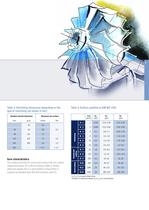
6 7 CLA [µinch] Ra1) [µm] Rz1) [µm] Rt1) [µm] N 1 1 0.025 0.22–0.30 0.24–0.40 N 2 2 0.050 0.15–0.60 0.49–0.90 N 3 4 0.1 0.8–1.1 0.85–1.45 N 4 8 0.2 1.0–1.8 1.10–2.40 N 5 16 0.4 1.6–2.8 1.75–3.60 N 6 Greatest nominal dimension 32 0.8 3.0–4.8 3.2–6.0 Investment casting Table 3: Surface qualities to DIN ISO 1302 N 7 63 1.6 5.9–8.0 6.3–10.0 N 8 125 3.2 12–16 13.0–19.5 N 9 250 6.3 23–32 25–38 Sand casting Table 2: Machining allowances depending on the type of machining (all values in mm) N 10 500 12.5 46–57 48–68 N 11 1000 25 90–110 95–130 N 12 2000 50 180–220 190–250 Allowance per surface over up...
Open the catalog to page 7
VDG SPECIFICATION P 695 INVESTMENT CASTINGS: TERMS OF DELIVERY Part 1: General conditions Part 2: Quality grades 1. Applications 1. General VDG Specification P 695 lays down the general technical terms of delivery for investment castings made by the lost wax method from standard and non-standard casting materials or metals. Additional, specific requirements relating to certain materials are laid down in separate standards. The present specification lays down various grades of external and internal quality for the condition of materials on delivery. The grades are subdivided in accordance with...
Open the catalog to page 8
VDG SPECIFICATION P 690 8 9 DIMENSIONAL TOLERANCES, SURFACES, MACHINING ALLOWANCES P690, 4th edition, February 1992 Directive compiled by the Special Committee on ‘Investment Casting’ GERMAN ASSOCIATION OF FOUNDRY SPECIALISTS Available from VDG-Center of Information Sohnstr. 70, 40237 Düsseldorf Tel. +49 (0) 211/68 71-254 Fax. +49 (0) 211/68 71-364 Email [email protected] www.vdg.de Slightly abridged version with the permission of the German Association of Foundry Specialists. 1. Definition and scope 1.1 Investment casting is a process by which a high surface quality can be manufactured through the...
Open the catalog to page 9
3. Dimensional accuracy 3.1 Contraction and shrinkage During the solidification and cooling of cast metals, a contraction of the volume naturally occurs as a result of shrinkage. Other factors influencing the production of instrument castings can result from the shrinkage of the lost pattern and the expansion of moulds during heating. The sum of these influencing factors is taken into consideration in the shrinkage allowance during the manufacture of injection moulds. The shrinkage allowance is based on experience values, depending on the contour of the casting, the ceramic shell and the casting...
Open the catalog to page 10
4. Dimensional tolerances 4.1.2. Dimensions and shape of the casting The achievable accuracy level of the rated dimensions of an investment casting depends on the greatest dimension and the shape of the casting. If the rated dimension (GTA) exceeds the rated dimension range indicated for a certain accuracy level, the overall tolerance of the casting must be toleranced at the accuracy level (greatest tolerance field). Deviation outside the accuracy level must be agreed between the supplier and the buyer. 4.1 Linear dimensional tolerances Achievable dimensional tolerances on investment casting...
Open the catalog to page 11All ZOLLERN catalogs and technical brochures
 Industrial gear units
16 Pages
 Winch gearboxes
20 Pages
 Sugar mill gearbox
12 Pages
 Slewing gearbox
20 Pages
 Travel drives
8 Pages
 Palier lisse industriel
20 Pages
 Copper casting alloys
16 Pages
 Housing plain bearings
20 Pages
 Vertical Bearings
11 Pages
 Plain bearing shells
20 Pages
 linear drive units
12 Pages
 Rescue boat winches
8 Pages
 compact winches
2 Pages
 free fall winches
16 Pages
 Wind turbine gearboxes
28 Pages
 drive gearboxes
12 Pages
 SLEWING GEARS
20 Pages
 ZOLLERN TORQUE MOTOR
2 Pages
 GEARS AND WINCHES
20 Pages
 PLAIN BEARING TECHNOLOGY
20 Pages
 PLANETARY GEAR UNITS
16 Pages
Archived catalogs
 Steel Profiles
16 Pages
 Materials
12 Pages
 Brochure
18 Pages