


Zivid 2+ M60
1 /19Pages
Zivid 2+ M60
1 /19Pages
Catalog excerpts

Technical Specification
Open the catalog to page 1
Zivid 2+ is a product family of structured-light 3D cameras designed for machine vision applications. These cameras produce 2D color images and colored 3D point clouds with high resolution, fidelity and quality at high speeds ranging from 10's of milliseconds to seconds, depending on the application and required point cloud quality. Zivid 2+cameras are designed to be ruggedized and small, making them ideal for robot-mounted applications where the camera is fixed to the end-effector of a fast-moving robot. They are available in different variants with different field-of-view tailored to the volumes-of-interest...
Open the catalog to page 2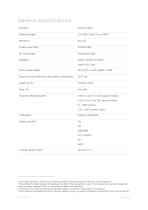
Structured light Point cloud output 3D (XYZ) + Color (RGB) + SNR Exposure time (minimum per pattern projection) 1.677 ms Aperture (A) f/2.38 to f/32 Projector Brightness (B) 0.25x to 2.5x 3 (in 3D capture mode) Calibration Factory calibrated Typical capture time 4 1 The model number is found on the physical label on the product and the box it was shipped in. 2 The product’s major revision of hardware for which this datasheet is valid. The revision can be found together with the model number (M/N) on the physical label of the product. 3 Limited to 2.2x when projecting white light unless "unlimited”...
Open the catalog to page 3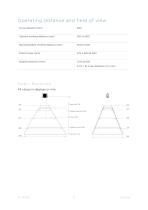
Optimal working distance (mm) Recommended working distance (mm) Figure 1 - Field of View
Open the catalog to page 4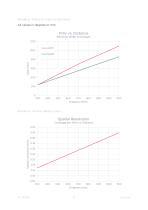
Figure 2 - Field of View vs. Distance FOV vs. DistanceEffective Width and Height 1200 Distance (mm) Figure 3 - Spatial Resolution Spatial ResolutionCoverage per Pixel vs. Distance o
Open the catalog to page 5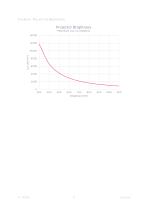
Figure 4 - Projector Brightness
Open the catalog to page 6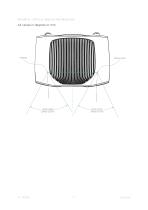
Figure 5 - Optical Angles and Baseline
Open the catalog to page 7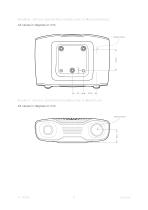
Figure 6 - Optical Center Position Relative to Mounting Holes All values in degrees or mm. Optical center
Open the catalog to page 8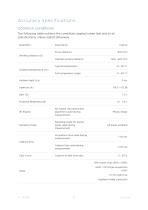
Common conditionsThe following table outlines the conditions applied under test and to all specifications unless stated otherwise. Parameter Description Typical Focus distance Optimal working distance Full temperature range 0 - 40 °C 3D Engine algorithm) used during Phase, Stripe Sampling mode for sensor Sampling mode pixels used during All pixels sampled Acquisition time used during measurement Capture time Capture time used during measurement Duty Cycle Capture-to-ldle time ratio 5 - 30 % 81% center crop (90% x 90%) HDR = off (single acquisition Other on|y) Applied in-field correction
Open the catalog to page 9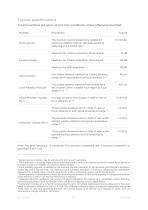
The minimum recommended time needed for 10 minutes Warm-up time camera to stabilize from an idle state assuming capturing at a constant rate.5 Maximum for 1-frame acquisition, Phase engine Dynamic Range Maximum for 1-frame acquisition, Omni engine Point precision la Euclidian distance variation for a point between consecutive measurements at focus distance, D. 6 Local Planarity Precision la Euclidian distance variation from a plane for a set of points within a smaller local region at focus distance, D.7 9 Global Planarity Trueness Average deviation from a plane in field of view at Error focus...
Open the catalog to page 10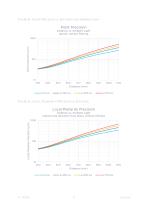
Figure 8 - Point Precision vs. Distance and Ambient Light Point PrecisionDistance vs. Ambient Light typical, without filtering 1000 Local Planarity Precision (pm) to Point Precision (pm) 10 - Local Planarity Precision vs. Distance Local Planarity PrecisionDistance vs. Ambient Light typical local deviation from plane, without filtering 1000
Open the catalog to page 11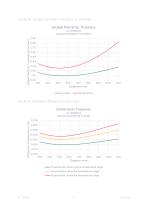
Figure 10 - Global Planarity Trueness vs. Distance typical deviation from plane Dimension Trueness Error (%) ^ Global Planarity Trueness Error (mm) - Dimension Trueness vs. Distance typical uncertainty in scale -70-percentile, within typical temperature range -70-percentile, within full temperature range -95-percentile, within full temperature range
Open the catalog to page 12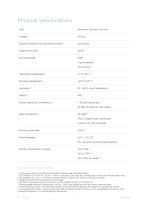
Flatness tolerance of mounting surface 11 ±0.05 mm Cable strain limit Operating temperature Noise, typical at 1 m distance Data connection 10 GigE 16 M12 X-coded, 8-pin connector CAT6A, SF-UTP or better Power connection Power adapter Power consumption, typical 24 V - 5A, DC EU, US, and UK power plug options 11 The surface which the camera is mounted to should meet this specification. 12 IEC 60068-2-6, 10-150 Hz, 5 g, in X, Y and Z direction, 2 hour per axis. Sweep rate 1 octave per minute sweep rate. 13 IEC 60068-2-27,15 g /11 ms half sine shock pulses. 3 shocks per direction, 18 shocks in total....
Open the catalog to page 13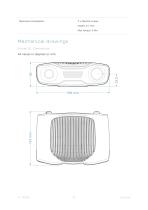
Mechanical Installation 3 x M5x0.8 screws. Depth: 5-7 mm Max torque: 3 Nm Mechanical drawingsAll values in degrees or mm 1.1 - 10/24
Open the catalog to page 14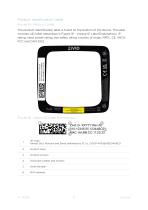
The product identification label is found on the bottom of the device. The label includes UID label (described in Figure 16 - Unique ID Label Explanation), IP rating, input power rating, eye safety rating, country of origin, NRTL, CE, UKCA, FCC and CAN-ICES. (livid 2+ XXYYY Rev @10-12345-55 1234ABCI@ ^IAC: AA:BB:CC:11:22:33 2D code format: SKU, Revision and Serial, delimited by i.e. ZVD2P-M130$A1$1234ABCD 4 Zivid part number and revision
Open the catalog to page 17
0.1 5/23 Initial preliminary version. Typical specifications (trueness, precision) in tables and plots are based on simulated values. 0.2 6/23 Updated preliminary version with new simulated performance values. Updated drawings. 0.3 6/23 Updated optical drawings. 1.0 11/23 Official version. Typical specifications updated with qualification data. Updated plots and mechanical drawings. 1.1 10/24 Added NRTL certification, mechanical installation specifications, and product identification label information.
Open the catalog to page 18
Zivid AS Gjerdrums vei 10A N0484 Oslo Norway © 2023 Zivid AS. All rights reserved. Subject to change without notice.
Open the catalog to page 19All Zivid catalogs and technical brochures
 Zivid 2+M130
19 Pages
 Zivid 2+ MR130
19 Pages
 Zivid One+ datasheet
21 Pages
 Zivid Two datasheet
15 Pages
 Zivid One+ user guide
18 Pages
 Zivid Studio user guide
22 Pages
 Zivid Two user guide
22 Pages
- Digital imager
- Visible imager
- Industrial camera module
- Full-color camera system
- Image processing camera module
- Inspection imager
- HD camera module
- Rugged camera
- High-performance imager
- Machine vision video camera
- Lightweight imager
- 5 Mpx camera
- HDR camera module
- Robotic camera module
- Vision sensor
- Software library
- Object detection vision sensor
- Color vision sensor
- Smart vision sensor