
- Catalogs
- ZEISS Métrologie et Microscopie Industrielle
- ZEISS Medical Industry Solutions

ZEISS Medical Industry Solutions
ZEISS Medical Industry Solutions
ZEISS Medical Industry Solutions provides a comprehensive quality intelligence portfolio to address the challenges in the heavily regulated medical technology sector. Their solutions ensure compliance with industry standards, enhancing productivity and quality of life.
Proof of Quality
ZEISS ensures accurate quality assurance across diverse components and materials in medical technology, addressing the complexity of quality assurance processes.
Guideline Compliance
ZEISS assists global companies in adhering to regulations such as the MDR in Europe and FDA guidelines in the USA, including data handling and quality management standards like 21 CFR Part 11 and ISO 13485:2016.
ZEISS Software Solutions
ZEISS software supports compliance with DIN EN ISO 13485 and FDA 21 CFR Part 11, featuring secure user management, audit trails, automated certificate creation, and disaster recovery.
Connected ZEISS Portfolio
ZEISS offers a range of hardware solutions, including CMMs, 3D scanners, and CT/X-ray systems, integrated with software for regulatory compliance and process adherence.
Quality Solutions for Implants
ZEISS provides solutions for implant quality control, ensuring biocompatibility and mechanical functionality, meeting stringent regulatory standards.
Metal Working Process
ZEISS addresses challenges in metal working for orthopedic implants, focusing on raw material properties, geometric dimensioning, and technical cleanliness through efficient inspection and analysis.
Quality Gates and Solutions
ZEISS offers solutions for quality gates in manufacturing, including inspection of supplied parts, void inspection, and surface quality checks to prevent failures and ensure compliance.
Technical Cleanliness and Quality Solutions
- Automated Particle Analysis: Detects and classifies particulate contamination using microscopes, ensuring compliance with industry standards.
- Process Monitoring: Uses optical 3D metrology to prevent processing of scrap parts.
- Added Value: Reduces machining time by quantifying contamination and combining detection and classification.
Plastic Manufacturing Process
Facilitates efficient production of plastic implants using materials like UHMWPE, adaptable to patient needs.
Software and Automation
- ZEISS PiWeb: Provides scalable reporting and statistical analysis.
- ZEISS FACS: Enhances productivity with automation software.
- Volume Inspect: Analyzes internal structures and geometries using CT data.
Microscopy and Metrology Solutions
- ZEISS ZEN core: Offers a comprehensive suite for imaging and analysis, compliant with regulatory demands.
- ZEISS CALYPSO: Provides easy and reliable metrology measurements.
Coordinate Measuring Machines and CT Systems
- ZEISS DuraMax: Ideal for shop floor inspection with high accuracy.
- ZEISS METROTOM: Delivers complete 3D imaging for GD&T analyses.
Global Presence
ZEISS maintains a global network of application engineers and service technicians to ensure high-quality assurance and traceability.
Catalog excerpts

Seeing beyond Quality Assurance for the Highest Medical Standards. ZEISS Medical Industry Solutions
Open the catalog to page 1
ZEISS Medical Industry Solutions: Overcome the hurdles of a regulation-driven industry
Open the catalog to page 2
Quality and Compliance The hurdles of the medical industry ZEISS understands your challenges With its high regulatory requirements and a large number of products that have a direct impact on the quality of people’s lives, the medical technology industry depends on reliable quality assurance systems. ZEISS understands the regulations, requirements, and the challenges faced by manufacturers and their quality departments. Our connected quality intelligence portfolio offers tailored hardware and software solutions that fulfill industry standards and work as a coherent system, granting manufacturers...
Open the catalog to page 3
To fulfill the regulatory demands of medical technology authorities, manufacturers must go beyond the usual requirements in quality assurance. Not only must industry-specific workflows be correctly set up, manufacturers must be able to document and validate that these workflows are consistently followed. To this end, quality assurance hardware and software must work hand in hand to provide appropriate functionality. ZEISS software solutions include: ■ Compliance with the requirements of DIN EN ISO 13485 and FDA 21 CFR Part 11 ■ Secure user management ■ Integration of audit trail and release management...
Open the catalog to page 4
Dental Implant Shoulder Implants Spinal Implants Quality Solutions For all types of implants Implants remain in the human body for years or decades and must function flawlessly in terms of mechanics and biology. This leads to exceptionally high quality requirements and an enormous responsibility on the part of manufacturers to fulfill them. For example, ensuring biocompatibility is essential – the implant must not trigger an immune response. It is also important that the implant functions mechanically, withstands stress, and is durable. The most stringent regulatory requirements, such as FDA...
Open the catalog to page 5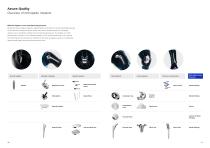
Assure Quality Overview of orthopedic implants Different implants, same manufacturing processes Despite the diverse range of implants, fixation options, and solutions, the manufacturing processes of the individual components remain similar. Due to their material properties, orthopedic implants can be classified according to the manufacturing processes. This enables us to offer tailored quality solutions in the individual segments, which boosts productivity in your process. The following sections introduce our solutions for the metal and plastic processes, including the relevant quality gates...
Open the catalog to page 6
Metal Working Process Orthopedic implants must function flawlessly even under the demanding physiological conditions in the human body. This makes it a central requirement for manufacturers to gain a deep understanding of orthopedic materials – metallic compounds, ceramic, and polymers – and the resulting organic reaction. One of the most important steps in the metal working process is assessing the raw material properties to ensure the performance of the product. Other important challenges are the geometric dimensioning, technical cleanliness during the manufacturing process, and efficiency...
Open the catalog to page 7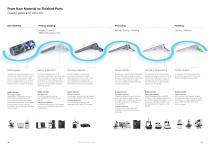
From Raw Material to Finished Parts Quality gates and solutions Primary Shaping Forging / Casting / Additive Manufacturing* Milling / Turning / Grinding Coating / Polishing Incoming Inspection Process Control Geometric Dimensioning Surface Analysis Analyze the structure and evolution of your steel and other metals from micro to nano scale. Accurate characterization enables maximum understanding for the quality of your raw material in terms of purity, nonmetallic inclusions, and grain size analysis. The primary shaping process can be controlled and optimized in all process steps from tool to product....
Open the catalog to page 8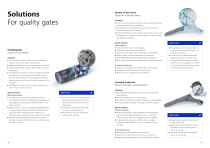
Quality of Raw PartsInspection of primary shapeChallenge: ■ Verifying that the components feature a good shape and specified dimensional quality prior to acceptance ■ Checking parts for critical defects such as voids, cracks, and inclusions before further processing ■ Gathering information on the number, type (inclusion, crack, void), size (dimensions, volume), position (e.g. distance to outer surface), and distribution of defects MetallographyAnalysis of raw materialChallenge: ■ Assure constant quality of material, e.g. with respect to porosity, voids, cracks, fissures, and grain size ■ Rapidly...
Open the catalog to page 9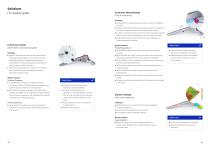
Geometric DimensioningFinal dimensioningChallenge: • Critical factors for quality assurance are cycle time and the reliability of results • Expensive material and difficult machining drive require manufacturers to make the forged part small with minimal material removal • An optical inspection may be required if the parts have highly polished sections and cannot be touched due to the risk of micro scratches • Tight profile tolerances on polished surfaces are a challenge for traditional inspection methods In-Process ControlObservation of processing qualityChallenge: ■ Suppliers, manufacturers,...
Open the catalog to page 10
Plastic Manufacturing Process The manufacturing process enables highly efficient production of plastic implants, either in large batches or individually. In some cases, these are individual parts that have been specifically manufactured for the patient. This is because the great advantage of plastics in medicine is that they can be shaped in a variety of ways and can therefore be ideally adapted to the respective needs of the patient. Ultra-high-molecular-weight polyethylene (UHMWPE) has enjoyed particular success in medical implant applications due to its high abrasion resistance, toughness,...
Open the catalog to page 11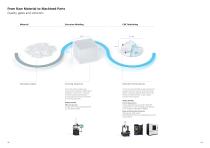
From Raw Material to Machined Parts Quality gates and solutions Extrusion Molding Granulate Analysis Incoming Inspection Geometric Dimensioning Verify if the product arrived at your warehouse in the required condition before accepting it into your stock – and avoid unnecessary processing of bad parts. Securing high level of technical cleanliness for incoming components The final check for permitted variations between the produced component and the nominal CAD model presents a particular challenge. Most implants have finished or polished surfaces, so optical quality assurance may be required....
Open the catalog to page 12All ZEISS Métrologie et Microscopie Industrielle catalogs and technical brochures
 ZEISS CALENO Hambot
12 Pages
 ZEISS ABIS Planner
7 Pages
 Quality Assurance for eMobility
45 Pages
 ZEISS Metrology Shop
8 Pages
 IQS
52 Pages
 ZEISS TS
2 Pages
 GearPro
6 Pages

Archived catalogs
 ZEISS DuraMax
6 Pages
 ZEISS CenterMax
4 Pages
 ZEISS METROTOM
4 Pages
 ZEISS Xradia Versa Family
2 Pages
 ZEISS Xradia Ultra Family
33 Pages


- Analysis software solution
- ZEISS measuring system
- Process software
- Computer-aided design software
- Cloud-based software
- Control software
- ZEISS optical microscope
- Industrial software
- Measurement software
- Visualization software solution
- ZEISS laboratory microscope
- Quality software
- Simulation software solution
- Programming software solution
- Reporting software
- EDM software
- Engineering software
- Automatic measurement system