
- Catalogs
- ZEISS Métrologie et Microscopie Industrielle
- Quality Assurance for eMobility

Quality Assurance for eMobility

Quality Assurance for eMobility
Manufacturers in the NEV market face evolving requirements and growing demand, with core components like batteries and electric motors being crucial for safety and performance. Establishing sophisticated quality assurance processes is essential for maintaining high standards and leading the transition to electric mobility.
Batteries are vital for NEV range and longevity. High-quality materials and precise production techniques are necessary. ZEISS offers solutions like industrial microscopy and computed tomography to ensure battery safety and performance.
- Materials: ZEISS uses electron and X-ray microscopy for material property analysis and correlative microscopy for efficient analysis.
- Electrodes: ZEISS provides solutions for burr inspection and technical cleanliness to prevent contamination.
- Cells and Modules: ZEISS offers automated defect detection and high-resolution inspection solutions.
- Trays: ZEISS provides solutions for milling and drilling process control, structure analysis, and full-field inspection.
ZEISS's Blue Line concept identifies quality challenges and solutions at each production step, from raw material processing to final inspection.
- XRM: 3D X-ray microscopy offers nondestructive inspection of NEV components with submicron precision.
- CT: Supports nondestructive analyses crucial for quality and safety checks, providing detailed imaging of battery cells and modules.
- Hairpins: Non-contact digitization and geometrical inspection are crucial. ZEISS offers CMMs with optical sensors for accurate measurement.
- Sheet Stacks: ZEISS provides automated inspection with multisensor CMMs and X-ray solutions.
- Rotors and Shafts: Dimensional measurement and porosity analysis are essential. ZEISS CMMs with active scanning technology ensure accurate results.
- Stators: ZEISS solutions ensure safety and performance through comprehensive inspection processes.
ZEISS offers a range of technologies for quality assurance in electric motor production, including CT systems, CMMs, optical sensors, and software solutions for data analysis and process optimization.
ZEISS provides a holistic portfolio covering all aspects of electric motor applications, ensuring efficient processes and seamless hardware-software integration.
- Bipolar Plates: ZEISS solutions include 3D scanning and high-resolution data capture for welding and microstructure formation.
- Membrane Electrode Assemblies (MEA): ZEISS solutions include particle detection and 3D volume acquisition for membrane and electrode inspection.
ZEISS ensures efficiency of peripheral components like hydrogen piping systems and stack assembly, using CT and measuring technology for defect detection.
ZEISS provides high-resolution imaging and failure mode identification for semiconductors, and analytical electron microscopy for automotive electronics design optimization.
ZEISS supports nondestructive inspection and failure analysis with X-ray and optical technology for printed circuit boards, and ensures safety and reliability of battery pack housing with CMMs.
ZEISS provides gear metrology with CMMs for precision measurements, reducing noise in e-motors and optimizing gears for noise and efficiency.
ZEISS X-ray solutions detect variances in cast aluminum housings, and CMMs with tactile roughness sensors check surface parameters and perform high-precision contour measurements.
ZEISS tactile active scanning with flexible probe systems meets inspection requirements for complex geometries with tight tolerances.
ZEISS PiWeb software manages metrology results for efficient production quality tracking, and ZEISS CONNECTED QUALITY enables remote monitoring and collaboration. ZEISS offers comprehensive solutions, including measuring services, training, and application support.
Catalog excerpts

Quality Assurance for eMobility ZEISS eMobility Solutions
Open the catalog to page 1
Table of Contents Driving Quality Forward Battery Quality Assurance for Battery Materials Quality Assurance for Battery Electrodes Quality Assurance for Battery Cells and Modules Fuel Cell System Quality Assurance for Bipolar Plates Quality Assurance for Membrane Electrode Assemblies Quality Assurance for Peripheral Components Blue Line for fuel cell systems Quality Assurance for Battery Trays Automotive Electronics Blue Line for batteries Quality Assurance for Semiconductor XRM: The X-Factor for Submicron Imaging Quality Assurance for Printed Circuit Board CT: Boosting Quality and Safety at...
Open the catalog to page 2
New energy vehicle safety 9 Manufacturers on the global market for new energy vehicles (NEVs) must handle constantly evolving requirements and rapidly growing demand. Core components such as batteries and electric motors are of critical importance in ensuring the safety of NEVs and enhancing their output, range, and structure. In order to move with the times while maintaining the highest standards in safety and performance, manufacturers must establish sophisticated holistic quality assurance processes for NEV production. Consistent high quality will enable them to master new challenges, avoid...
Open the catalog to page 3
Battery Electrodes Technical cleanliness Battery Tray Inspection of structure and integrity Battery Cells and Modules Fast, high-resolution inspection Battery Quality Management Ensuring superior long-term performance Batteries are key to the range, performance, and longevity of NEVs. Reliable and long-lasting batteries require topclass materials and precise production techniques. They are also at the heart of a wide range of quality management applications from initial development onward. Battery cells, modules, and trays must comply with very tight tolerances during final assembly. From industrial...
Open the catalog to page 4
Quality Assurance for Battery MaterialsMaterial structure development and raw material processing Among all of the elements in an NEV, the battery system has the largest impact on the driving experience. Battery performance is highly influenced by raw materials, with material and structure development playing a key role in this regard. Particular challenges include developing new activematerials, ensuring a uniform and consistent supply, maintaining proper calendering pressure, and observing microscopic changes caused by aging.
Open the catalog to page 5
Recipe developmentQuality challenges ■ Capacity, charging behavior, and battery lifetime all defined by materials used for cathode, anode, and separator • Cell performance is highly influenced by microscopic material structure, particle chemical composition, and impurities • Determine relevant material properties with ZEISS electron and X-ray microscopy (XRM) for enhanced battery performance • Efficient correlative analysis via a patented correlative microscopy solution incorporating light microscopes and SEMs • Ensure uniformity and consistency via incoming goods check: avoid impaired performance...
Open the catalog to page 6
Quality Assurance for Battery Electrodes Burr inspection and technical cleanliness The geometry and composition of electrodes inside battery cells play a major role in safety and efficiency. To prevent safety issues and meet strict quality standards, the cutter blade used in the electrode cutting process must be inspected and replaced in a timely manner. Since there is a high risk of particle contamination that can affect battery lifetime and quality, it is essential to detect this and identify the root cause via technical cleanliness.
Open the catalog to page 7
Burr inspectionQuality challenges ■ Metal burrs generated during electrode cutting process can impair battery performance ■ Cutter blade changes must therefore be perfectly timed to balance battery quality and production cost • High-resolution quality lab inspection of cut electrodes with ZEISS optical multisensor CMMs ■ Real-time monitoring of high-speed electrode cutting and stacking via ZEISS optical inline metrology • Automated burr detection in factory environments with the ZEISS burr inspection system • High contamination risk during transportation and production: need to detect foreign...
Open the catalog to page 8
Final inspection of the complete battery module is a particularly challenging process, as the individual cells in such modules pose a number of safety risks and quality challenges. Fast test cycles with high resolution are required for all three cell types -cylindrical, prismatic, and pouch. All three types also face different challenges in terms of manufacturability, performance, durability, safety, quality testing, and failure analysis.
Open the catalog to page 9
Cell typesQuality challenges ■ Three different battery cell types present numerous distinct challenges during production and assembly ■ Malfunctions may be caused by issues relating to overhang, weld tabs, and electrode defects ■ Identify metal particles, delamination, winding, electrode burn marks, and more using ZEISS X-ray solutions ■ Defect inspection on module assembly, dimensional metrology on battery housing for all cell types using ZEISS X-ray solutions ■ Metal contamination generated during cell manufacturing must be detected as it can cause a short circuit ■ Avoid safety hazards and...
Open the catalog to page 10
Quality Assurance for Battery Trays Ensuring proper formation and integration As a battery receptacle fully integrated into the body of an electric vehicle, the battery tray must be mechanically stable and fit seamlessly into its surroundings. Featuring a complex aluminum weld design, it houses all battery cells, connectors, control units, and the battery packs that contain numerous battery modules. The integrity and structure of the battery tray must be inspected at multiple intervals during production, with methods such as full-field inspection ensuring quality and safety.
Open the catalog to page 11
Milling and drilling process controlQuality challenges ■ Torsion and bending of the battery tray due to thermal expansion of the battery pack when charging and driving • Measurement of numerous dimensional characteristics via random sampling or complete automated end-of-line inspection • Horizontal arm machine: multisensor measurement of large number of features with quick inspection cycles • Quickly extract feature data using ZEISS non-contact optical laser scanners • Access challenging optical features such as undercuts with ZEISS tactile probe systems • Evaluation of the complete tray surface...
Open the catalog to page 12All ZEISS Métrologie et Microscopie Industrielle catalogs and technical brochures
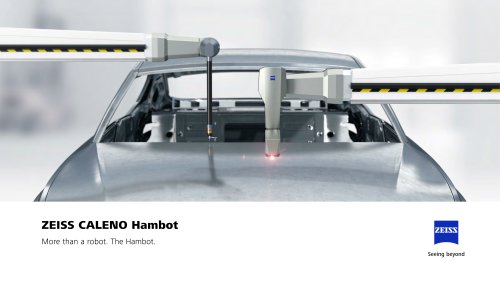 ZEISS CALENO Hambot
12 Pages
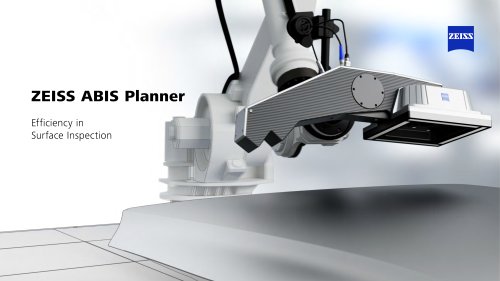 ZEISS ABIS Planner
7 Pages
 ZEISS Medical Industry Solutions
17 Pages
 ZEISS Metrology Shop
8 Pages
 IQS
52 Pages
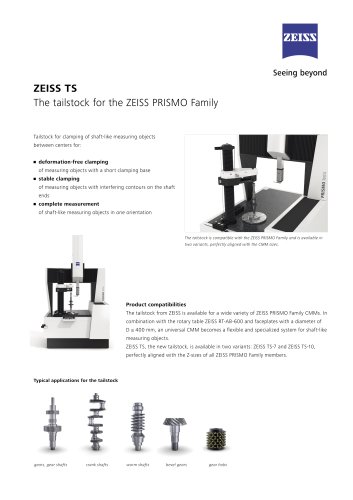 ZEISS TS
2 Pages
 GearPro
6 Pages

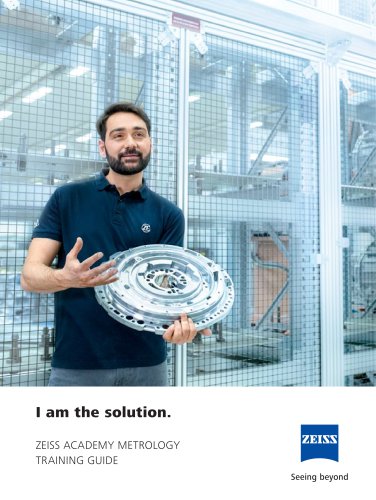
Archived catalogs
 ZEISS DuraMax
6 Pages
 ZEISS CenterMax
4 Pages
 ZEISS METROTOM
4 Pages
 ZEISS Xradia Versa Family
2 Pages
 ZEISS Xradia Ultra Family
33 Pages
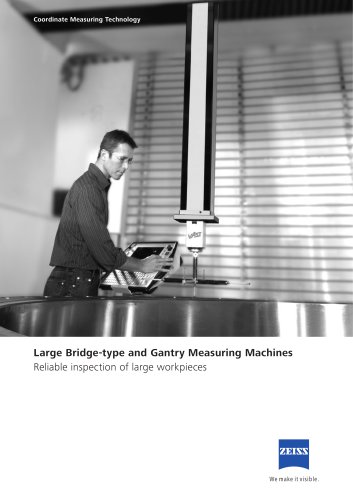

- Automation software solution
- Analysis software solution
- ZEISS measuring system
- Process software
- Computer-aided design software
- Cloud-based software
- Control software
- ZEISS optical microscope
- Industrial software
- Measurement software
- Visualization software solution
- ZEISS laboratory microscope
- Quality software
- Simulation software solution
- Programming software solution
- Reporting software
- EDM software
- Engineering software
- Automatic measurement system