
- Catalogs
- YZ Systems
- NJEX® Odorant Injection System

NJEX® Odorant Injection System

NJEX® Odorant Injection System
The NJEX 6300 and 6302 odorant injection systems are designed to inject precise amounts of liquid odorant into gas pipelines, ensuring detectability. These systems are ideal for lower flow applications and offer proportional-to-flow odorant injection, onboard metering, system monitoring, and alarm notifications. They can document and verify system performance, parameter changes, alarms, and injection rates. Available in single or dual-unit configurations, they can inject up to 6.7 liters/day (1.76 gallons/day).
- Patented, pneumatically-actuated, positive-displacement plunger pump.
- Maximum odorant output of 6.7 liters/day (1.76 gallons/day).
- Versatile electronic controller for proportional-to-flow or time-based injection.
- Real-time system monitoring and alarm notifications.
- Remote communication via ModBus or Sentry4 Software.
- Intrinsically safe electronics.
- Single or dual configuration options.
- Weatherproof enclosure for environmental protection.
- Maximum odorant output: 6.7 liters/day (1.76 gallons/day).
- Maximum operating pressure: 99.28 bar (1440 psig).
- Operating temperature range: 17°C to 60°C (0°F to 140°F).
- Power supply options: Standard SPS-12 solar panel or optional LPS 120/240 volt, 50/60 Hz AC charger.
- Battery reserve: Approximately 30 days.
- Gas flow rate input signal: 1-5 VDC, 4-20 mA, or pulse.
Table 1 outlines the pipeline and actuation pressure requirements:
- 100-200 psi (6.89-13.8 Bar): 30 psi (2.07 Bar) actuation pressure.
- 200-500 psi (13.89-34.5 Bar): 40 psi (2.76 Bar) actuation pressure.
- 500-900 psi (34.5-62.1 Bar): 50 psi (3.45 Bar) actuation pressure.
- 900-1400 psi (62.1-96.5 Bar): 60 psi (4.14 Bar) actuation pressure.
Catalog excerpts

NJEX® Odorant Injection System Models 6300 and 6302 NJEX 6300 and 6302 odorant injection systems inject precise amounts of liquid odorant into cubic feet or meters, of gas that flows down a pipeline to ensure detectability. Ideal for lower flow applications, these proven systems provide proportional-to-flow odorant injection, onboard metering of the odorant injected, system monitoring and alarm notification. Additionally the system will document and verify the performance of each system component, parameter changes, alarms and injection rates. Available in a single or dual-unit configuration, the systems are capable of accurately injecting up to 6.7 liters/day (1.76 gallons/day). Patented, pneumatically-actuated, positive-displacement plunger pump 6.7 liters/day (1.76 gallons/day) maximum odorant output Versatile, electronic controller for proportional-to-flow or time-based injection Real-time system monitoring and alarm notifications Remote communication via ModBus or Sentry4 Software Intrinsically safe electronics Single or Dual Configuration to meet application requirements Weatherproof enclosure for protection from the elements. Specifications Maximum odorant output Maximum operating pressure Operating temperature range Power supply Standard SPS-12 solar panel Optional LPS 120/240 volt, 50/60 Hz AC charger Battery reserve Gas flow rate input signal At temperatures below 0°C (32°F) conditioning of the actuation gas supply may be required. © 2015 Accudyne Industries. All rights
Open the catalog to page 1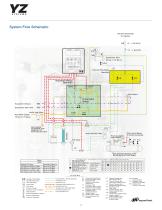
an Accudyne Industries brand System Flow Schematic Table 1 6300 Pipeline Pressure 100-200 psi (6.89-13.8 Bar) 200-500 psi (13.89-34.5 Bar) 500-900 psi (34.5-62.1 Bar) 900-1400 psi (62.1-96.5 Bar) © 2015 Accudyne Industries. All rights Reserved.
Open the catalog to page 2All YZ Systems catalogs and technical brochures
 NJEX 7300G
129 Pages
 Cyclone 4400
36 Pages
 njex-6300-datasheet
129 Pages
 YZ Connect
1 Page
 Crude Oil Sampling Systems
2 Pages
 Odorization Systems
8 Pages


- Real-time software
- Windows software
- Monitoring software solution
- Gas detector
- Communication gateway
- Fieldbus gateway
- Ethernet gateway
- Wireless gateway
- Portable detector
- IoT gateway
- Greasing system
- Oil greasing system
- Modbus RTU gateway
- Modbus gateway
- Liquid sampler
- Cellular gateway
- Android software
- Modbus TCP gateway
- Gas sampler
- IOS software