

- Company
- Products
- Catalogs
- News & Trends
- Exhibitions
jOINING methods FOR BELTS
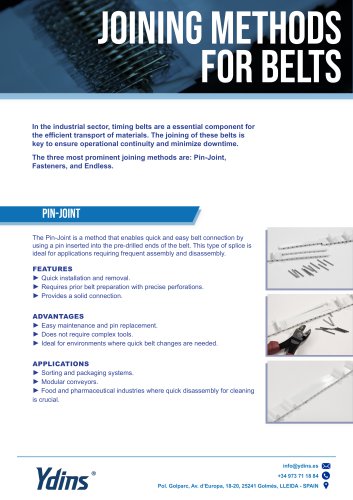
jOINING methods FOR BELTS
In the industrial sector, timing belts are crucial for efficient material transport. Ensuring operational continuity and minimizing downtime relies heavily on effective belt joining methods. The primary methods include Pin-Joint, Fasteners, and Endless.
This method involves inserting a pin into pre-drilled ends of the belt, allowing for quick and easy connection. It is particularly suitable for applications requiring frequent assembly and disassembly.
- Features: Quick installation and removal, requires precise perforations, provides a solid connection.
- Advantages: Easy maintenance and pin replacement, no complex tools needed, ideal for quick belt changes.
- Applications: Sorting and packaging systems, modular conveyors, food and pharmaceutical industries.
This mechanical method uses metal hooks to join belt ends, known for its simplicity and effectiveness under various conditions.
- Features: Quick and easy installation, robust connection with metal hooks, applicable to various belt materials.
- Advantages: Strength and durability, easy installation without specialized equipment, suitable for emergency repairs.
- Applications: Mining and construction, agriculture, food processing.
This method provides a continuous and permanent connection without mechanical splices, ideal for strong and durable connections.
- Features: Continuous connection without interruptions, no need for perforations or additional components, increases strength by eliminating stress points.
- Advantages: Greater durability, ideal for continuous transmission applications.
- Applications: High-load conveyors in heavy industries, equipment requiring constant transmission, automotive and textile sectors.
Catalog excerpts
jOINING methods FOR BELTS In the industrial sector, timing belts are a essential component for the efficient transport of materials. The joining of these belts is key to ensure operational continuity and minimize downtime. The three most prominent joining methods are: Pin-Joint, Fasteners, and Endless. pin-joint pin-joint The Pin-Joint is a method that enables quick and easy belt connection by using a pin inserted into the pre-drilled ends of the belt. This type of splice is ideal for applications requiring frequent assembly and disassembly. FEATURES ► Quick installation and removal. ► Requires prior belt preparation with precise perforations. ► Provides a solid connection. ADVANTAGES ► Easy maintenance and pin replacement. ► Does not require complex tools. ► Ideal for environments where quick belt changes are needed. APPLICATIONS ► Sorting and packaging systems. ► Modular conveyors. ► Food and pharmaceutical industries where quick disassembly for cleaning is crucial.
Open the catalog to page 1
joining methods FOR BELTS This joining system is a mechanical method that uses metal hooks to join the ends of a belt. It is one of the most common methods due to its simplicity and effectiveness under various conditions. FEATURES ► Quick and easy installation. ► Use of metal hooks that provide a robust connection. ► Applicable to belts made of various materials. ADVANTAGES ► Strength and durability under demanding working conditions. ► Easy to install without the need for specialized equipment. ► Suitable for emergency repairs. APPLICATIONS ► Mining and construction. ► Agriculture. ► Food processing....
Open the catalog to page 2All Ydins catalogs and technical brochures
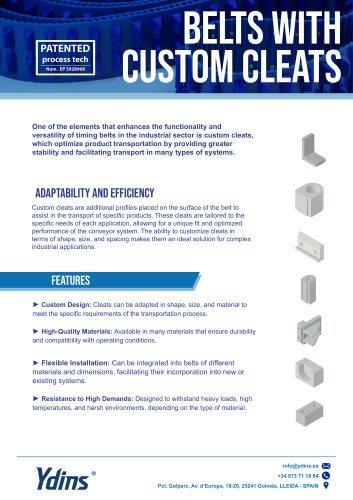 belts with custom cleats
2 Pages
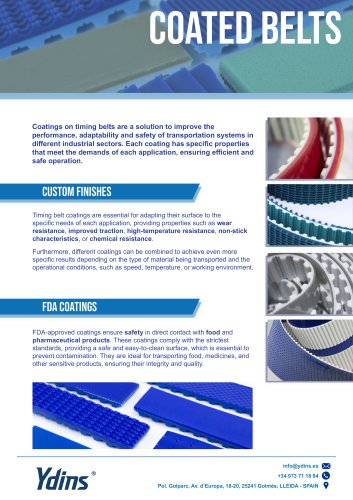 coated belts
2 Pages
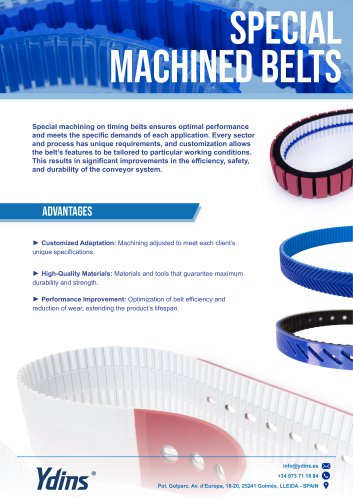 special machined belts
1 Page
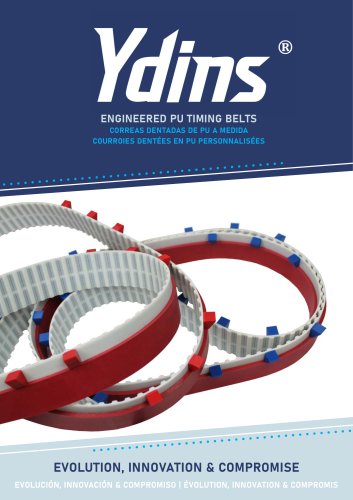 ENGINEERED PU TIMING BELTS
8 Pages
- Power transmission belt
- Industrial strip
- Industrial belt
- Polymer belt
- Timing belt
- Sturdy belt
- Polyurethane power transmission belt
- Synchronous power transmission belt
- Machines belt
- High-performance belt
- High-resistance belt
- Abrasion-resistant belt
- Endless belt
- Strip belt
- Belt for the textile industry
- Belt for the food industry
- Conveyor belt belt
- Belt for the packaging industry
- Custom-made strip
- Shore A belt