


- Products
- Catalogs
- News & Trends
- Exhibitions
YASKAWA Report 2013

YASKAWA Report 2013
Yaskawa Electric Corporation, established in 1915, is a leader in mechatronics, focusing on integrating machinery with electronics to improve quality and functionality. As it nears its 100th anniversary in 2015, the company emphasizes efficient natural energy use and the coexistence of humans and robots.
The report covers financial data from 2004 to 2013, detailing net sales, operating income, and net income across segments like Motion Control, Robotics, and System Engineering. The Robotics segment notably increased sales and profits due to investments in the automotive industry.
President Junji Tsuda discusses the "Realize 100" mid-term plan, aiming for record-high performance by expanding core businesses globally and developing new ones, despite challenges like the global financial crisis and a strong yen.
- Motion Control: Decline due to reduced demand in semiconductor and electronics markets.
- Robotics: Growth from automotive sector investments.
- System Engineering: Steady performance.
- Information Technologies: Faced declining sales.
Yaskawa's commitment to corporate social responsibility includes governance, customer relations, and environmental management, emphasizing sustainable practices and community engagement.
Includes detailed financial statements, offering insights into Yaskawa's financial health and strategic investments.
Yaskawa remains a leader in mechatronics, focusing on innovation and global expansion, poised to tackle future challenges with technological advancements and sustainability commitments.
The Yaskawa Report 2013 outlines strategic initiatives and financial goals for the "Realize 100" plan, aiming for growth by 2015, focusing on expanding production outside Japan, increasing profitability, and developing new markets in robotics and renewable energy.
- High Profitability Structure: Increase production efficiency and automation in Japan, targeting a 10% operating profit ratio by FY2015.
- Glocal Management Structure: Increase net sales outside Japan from 54% in FY2012 to 65% by FY2015, focusing on China and Europe.
- Creation of New Markets: Develop businesses in environmental and energy sectors, like PV power conditioners and motor drive systems for electric vehicles.
- Net sales projected to grow from 310.3 billion JPY in FY2012 to 400 billion JPY by FY2015.
- Operating income expected to increase from 13 billion JPY in FY2012 to 40 billion JPY by FY2015.
Expanding robotics applications beyond automotive into biomedical and social services, establishing "Robotics Centers" globally.
Entered the solar power market with products like PV1000 and Enewell-SOL, emphasizing reliability and efficiency.
By 2015, Yaskawa aims to lead in core businesses, leveraging manufacturing capabilities for environmental solutions and community development.
The Mahoro robot is a dual-arm, general-purpose robot designed for complex tasks with human-like precision, addressing labor shortages in Japan, particularly useful in the biomedical field.
Performs high-precision tasks using the same tools as humans, operating in various environments, including anoxic conditions and areas handling dangerous substances.
Overcame challenges in replicating human tasks, expanding application in the biomedical field, increasing brand awareness and usability.
Yaskawa aims to differentiate with dual-arm robots, expanding presence in the biomedical industry through promotional initiatives and global outreach.
Faced challenges in FY2012 but expects recovery and growth in FY2013, focusing on innovative solutions and expanding into new markets like photovoltaic power conditioners.
Strong demand in automotive industry, expanding applications beyond manufacturing into biomedical and service sectors.
Includes financial data indicating fluctuations in net sales and operating income, with projections for recovery and growth in FY2013.
Enhancing global structure to meet demands in growing markets outside Japan, particularly in Asia, establishing new sales and service centers.
Expanding robotics applications into new fields, engaging with research facilities to identify market needs and drive product development.
Provides solutions for large-scale plant facilities, recognized for reliability and advanced systems leveraging drive technology.
Achieved increased sales but faced profit loss, focusing on renewable energy and expanding Social Systems business.
Increased investment in telecommunications and environment & energy fields, aiming to strengthen business base under "Renaissance 21" plan.
Anticipates steady demand in automotive market and recovery in LCD market, enhancing global sales and service structures.
YE Data Group aimed to restructure businesses for surplus, focusing on core businesses, quality improvement, and building a quality assurance system.
Yaskawa Information Systems focuses on information processing services, while YE Data deals with information-related products and services.
Enhancing global market responsiveness, developing new products in Environmental & Energy domain, promoting coexistence technologies in Robotics Human Assist domain.
Shifting focus from quantity to quality, implementing proactive patent cycle, reinforcing patent activities in emerging markets.
Emphasizes customer-first principles, corporate diversity, and community engagement, contributing to society through business performance and environmental efforts.
Mission to contribute to societal progress and welfare, emphasizing product quality, operational efficiency, and market-oriented attitudes.
Management system includes internal and external directors for rational and efficient decision-making, focusing on managerial decision-making, execution, and oversight.
Board consists of seven members, including six internal and one external director, with a one-year term, holding regular and extraordinary meetings.
Includes two internal and two external auditors, overseeing management decisions and operations, strengthening auditing systems.
System in place to expedite business operations, with regular meetings to discuss and resolve important business matters.
Ensures proper business administration, establishing and revising internal control policies, including risk management and information disclosure.
Compliance Committee and whistle-blowing system promote adherence to corporate standards, with policies for risk management and emergency preparedness.
Compensation determined by shareholder meetings, with caps on director and auditor compensation.
Prioritizes customer satisfaction through quality products and services, engaging in initiatives to improve quality and customer satisfaction.
Enhanced analytical capabilities with 3D X-ray CT system, promoting continuous improvement through CS-KAIZEN activities.
Emphasizes product safety from development stage, performing risk assessments and ensuring compliance with international standards.
Practices fair trade and CSR-based procurement, focusing on quality, cost, and environmental impact.
Merit-based personnel system, supporting a diverse workforce and promoting work-life balance.
Committed to creating a safe workplace, conducting risk assessments, and providing training to prevent accidents.
Reduced risks and occupational accidents, focusing on preventing work-related illnesses and promoting health education.
Career Plan System aligns with individual aspirations, offering development plans and enhancing employee skills.
Emphasizes transparent communication with shareholders and stakeholders, engaging in proactive public relations and investor relations activities.
Participates in local community events and supports youth development through sports sponsorships and educational contests.
Committed to environmental sustainability, focusing on reducing CO2 emissions, waste management, and green procurement.
Maintained ISO 14001 certification, achieving continuous improvements in environmental performance.
Achieved 100% implementation rate of environmental evaluations using Life Cycle Assessment (LCA).
Promotes environmental management for a low-carbon and resource-recycling society.
Prioritizes environmental protection, engaging in activities to reduce environmental impact across product lifecycles.
Developed world's first GaN-based power conditioner, achieving high conversion efficiency.
Production and sales activities resulted in 22,138 t-CO2 emissions, managing environmental data globally.
Reduced CO2 emissions by 26% compared to FY1990, with significant reductions in energy consumption.
Implemented energy management system, reducing maximum energy usage significantly.
Implemented energy management system across facilities, visualizing power usage and implementing smart power-saving measures.
Reduced water and paper usage, introduced printing authorization system, and switched packaging materials.
Emphasizes eco-conscious design throughout product lifecycle, implementing life cycle assessment practices.
For fiscal year ending March 2013, reported net sales of 310,383 million yen, with a gross profit of 82,108 million yen.
Total assets amounted to 302,518 million yen, with total liabilities of 185,052 million yen, and shareholders' equity increased to 108,896 million yen.
Operating activities generated net cash of 6,391 million yen in 2012 and 24,640 million yen in 2013, with investing and financing activities detailed.
Scope of consolidation includes 67 subsidiaries, with changes in consolidated companies and equity method companies.
Founded on July 16, 1915, employs 10,383 people, operates globally with subsidiaries in Japan, Europe, Asia, and the Americas.
As of March 20, 2013, had 252,331 thousand shares outstanding, listed on the Tokyo Stock Exchange under code 6506.
Catalog excerpts
YASKAWA Report YASKAWA ELECTRIC CORPORATION
Open the catalog to page 1
Introduction Since its founding in 1915, and based on its management principle of contributing to the evolution of society and the welfare of humankind through the performance of its business, Yaskawa Electric has provided continuing support for the key industries of the times from motors and factory automation to the mechatronics* of today. At present we are working toward the first centenary of Yaskawa Electric's founding in 2015 by taking on the challenges of high - efficiency utilization of natural energy and the realization of a society in which people and robots coexist. Our mechatronic...
Open the catalog to page 2
3 Consolidated Financial Highlights 21 Message from the Director in Charge of CSR 5 Interview with the President 22 Management Principles and Corporate Activity Standards 23 Corporate Governance 25 Board of Directors and Corporate Auditors 26 Relations with Customers 28 Relations with Suppliers 29 Relations with Employees 31 Relations with Shareholders and Investors 32 Relations with Local Communities and Society 9 Special Feature: Launching New Business! - Aiming Towards Realization of 2015 Vision - 34 Environmental Management 36 Contribution to the Environment through Products and Services...
Open the catalog to page 3
Consolidated Financial Highlights Yaskawa Electric Corporation and Consolidated Subsidiaries Years ended March 20 or as of March 20 (Millions of yen) Operating Income Ratio Ordinary Income Ordinary Income Ratio Sales and Profit by Business Segment*1 Operating Income Operating Income Ratio Net Sales Motion Control Operating Income Operating Income Ratio Operating Income Operating Income Ratio Operating Income Operating Income Ratio Net Sales System Engineering Net Sales Information Technologies Sales by Destination Japan The Americas* Earning - basic Earning - diluted Shareholders' Equity Shareholders'...
Open the catalog to page 4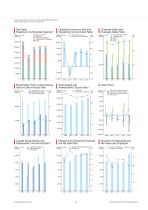
Yaskawa Electric Corporation and Consolidated Subsidiaries Years ended March 20 or as of March 20 Net Sales: Breakdown by Business Segment Motion Control Robotics System Engineering Information Technologies Other Operating Income (Loss) and Operating Income (Loss) Ratio Operating Income (Loss) Operating Income (Loss) Ratio Overseas Sales Ratio The Americas Europe Asia Other Overseas Sales and Overseas Sales Ratio Shareholders' Equity, Interest-bearing Debt and Debt-to-equity Ratio Shareholders Equity Interest-bearing Debt Debt-to-equity Ratio Total Assets and Shareholders' Equity Ratio Total...
Open the catalog to page 5
Interview with the President The new mid-term plan "Realize 100" began this year. 2015 will mark our 100th anniversary. Our goal for this momentous occasion is to achieve record-high performance by further expanding our core businesses around the world and growing our new businesses. Junji Tsuda Representative Director Chairman of the Board President Yaskawa Electric's new mid-term business plan "Realize 100" started in FY2013 (year ending March 2014). The plan aims to realize a high profitability structure by harvesting and continuously evolving the results produced in our previous mid-term...
Open the catalog to page 6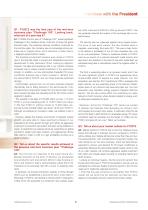
Q1 FY2012 was the final year of the mid-term business plan "Challenge 100 ". Looking back, what sort of a year was it? from 20% in the end of FY2010 to 30% by the end FY2012. This has gradually reduced the impact of the exchange rate on our performance. A1 FY2009, the first year of "Challenge 100", posed significant challenges to the Yaskawa Group foremost of those the global financial crises. The extremely adverse conditions continued for the next few years. Our company saw an increasingly strong yen, steep rise in magnet prices, and a reduction in orders due to a stagnant semiconductor market....
Open the catalog to page 7
we plan to increase our ratio of production outside Japan from 30% at the end of FY2012 to 50% by FY2015. Within Japan we plan to maintain production output by expanding sales into new businesses and markets. Furthermore, we aim to increase the operating profit ratio to at least 10% by FY2015 through improving efficiency of production via expanding automation in Japanese plants, launching new core products, and rolling out cost-cutting initiatives on a company-wide level. The second is "realization of a glocal management structure." This refers to building a management structure that can optimally...
Open the catalog to page 8
Q6 What do you prioritize in the development of new robotics markets? A6 Up to now, the use of industrial robotics has been limited mostly to automobile production. The automobile industry began implementing robotics on their production lines early on. Thus they already possess a high level of know-how regarding the use of robotics. There are not nearly enough system integrators with the knowhow for using industrial robotics in other industries, so few companies outside the automotive industry have implemented robotics into their operations. Aiming to cultivate system integrators with a high...
Open the catalog to page 9
Special Feature : Launching New Business! Aiming Towards Realization of 2015 Vision Yaskawa Electric has established the vision of using the group s core technologies to solve emerging global problems for the years leading up to its 100th anniversary in 2015. In the Environment & Energy business domain, we contribute to resolving environmental and energy issues through both energy creation and energy conservation. In the Robotics Human Assist business domain, we strive to provide solutions to combat problems associated with declining birthrate and aging population in advanced countries. This...
Open the catalog to page 10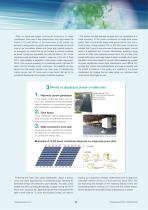
When we eventually began commercial production of power conditioners, there were a few manufacturers that had entered the market 5-10 years before us. As newcomers to the market, we focused on raising name recognition and brand awareness. At the time none of our competitors offered both home and industrial products, so leveraging our product line-up as a vehicle to promote ourselves as power conditioner specialists, we took top share in the 10 kW industrial power conditioner market in Japan as of the end of fiscal 2012. High reliability is essential in solar power system equipment, which must...
Open the catalog to page 11Archived catalogs
 YASKAWA Report 2012
51 Pages
 YASKAWA ELECTRIC CORPORATION
10 Pages
 YASKAWA Report 2014
55 Pages
 P1000 Catalog
52 Pages
 MPiec Machine Controllers
8 Pages
 YASKAWA HERMETICALLY SEALED CONTACT
110 Pages
 AC SERVO DRIVES JUNMA SERIES
43 Pages
 MACHINE CONTROLLER MP2000 SERIES
96 Pages
 AC SERVO DRIVES
479 Pages
 YASKAWA AC DRIVES
25 Pages
 Machine Controller MP920
50 Pages
 MACHINE CONTROLLER MP2000 SERIES
64 Pages


- Yaskawa industrial robot
- Yaskawa articulated robot
- Servo-motor
- Yaskawa 6-axis robot
- Yaskawa handling robot
- Yaskawa floor-mounted robot
- Servo-amplifier
- AC servo-motor
- Compact robot
- High-speed robot
- DC servo-amplifier
- Assembly robot
- 4-axis robot
- Ceiling-mounted robot
- Applications robot
- Welding robot
- Yaskawa AC drive
- Ultra-compact servomotor
- High-precision robot
- IP54 robot