
- Catalogs
- Yamamoto Rock Splitter International
- Hydraulic Rock Splitter


Hydraulic Rock Splitter
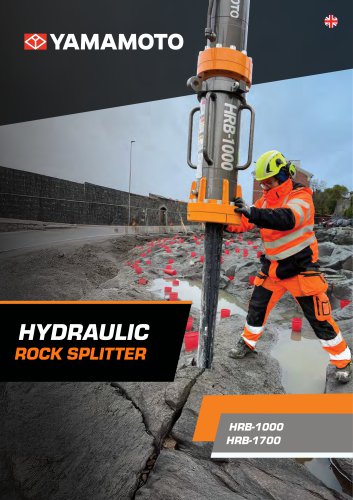
Hydraulic Rock Splitter
The Yamamoto Hydraulic Rock Splitter, models HRB-1000 and HRB-1700, is designed for efficient excavation of hard rock without causing vibration, noise, or debris. It serves as an alternative to blasting, particularly in sensitive or densely populated areas, ensuring safety and precision.
Productivity
The splitter is noted for its high productivity, which varies based on rock hardness and project type. It features a minimal number of parts and uses excavator pressure, eliminating the need for boosters. The design includes extra-long counter wedges to protect the center wedge, reducing machine failure risks.
Robustness and Durability
Components are designed with large safety margins and precise finishing for long-term, trouble-free operation. The wedge set is made from forged steel, offering wear resistance and flexibility. Many users report years of use with minimal maintenance.
Technical Specifications
- HRB-1000: Hole size Ø 102 mm, bench height 1.2 m, productivity up to 25 m³/hr.
- HRB-1700: Hole size Ø 127 mm, bench height 2.0 m, productivity up to 45 m³/hr.
Applications
The splitter is suitable for trenching, confined spaces, land development, and tunneling. It has been used globally in various construction and civil engineering projects since 1981.
Work Process
The process involves drilling specific diameter and depth holes, inserting wedges, and using hydraulic pressure to split the rock. The rock is then removed with a breaker or ripper.
About Yamamoto
Yamamoto Rock Splitter International, with a history dating back to 1915, specializes in rock drills and splitters. The first hydraulic rock splitter was developed in 1981, and the company has since supplied nearly 400 units worldwide. Manufacturing and development are based in Tojo, Japan, ensuring quality control.
Contact Information
For international sales and distribution, contact Yamamoto Rock Splitter International via phone, fax, or email. The factory is located in Hiroshima-Pref., Japan.
Catalog excerpts
ROCK SPLITTER
Open the catalog to page 1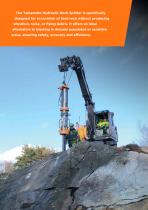
The Yamamoto Hydraulic Rock Splitter is specifically designed for excavation of hard rock without producing vibration, noise, or flying debris. It offers an ideal alternative to blasting in densely populated or sensitive areas, ensuring safety, accuracy and efficiency.
Open the catalog to page 2
THE MOST EFFICIENT, SAFE AND QUIET WAY FOR ROCK EXCAVATION PRODUCTIVITY As the largest splitter in the market, Yamamoto Rock Splitter also offers the highest productivity. With larger wedge you can increase the spacing between holes and go deeper with each split. Productivity is dependent on the hardness of the rock and types of projects. Hole size Bench height Typical hole spacing Volume per split Productivity ROBUSTNESS The Yamamoto Rock Splitter is designed with minimal number of parts, utilising the pressure of the excavator to avoid boosters. Extra long counter wedges help protects the tip...
Open the catalog to page 3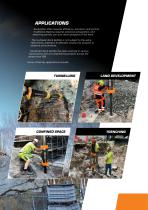
APPLICATIONS Excavation often requires efficiency, precision, and control. Traditional blasting requires extensive preparation, and obtaining permits can slow down progress of the work. The Hydraulic Rock Splitter is not subject to the same restrictions, making it an efficient solution for projects in sensitive environments. Yamamoto Rock Splitter has been working in various construction and civil engineering projects across the globe since 1981. Some of the key applications include: CONFINED SPACE LAND DEVELOPMENT
Open the catalog to page 4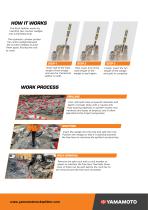
HOW IT WORKS The Rock Splitter works by inserting two counter wedges into a predrilled hole. The hydraulic cylinder pushes the centre wedge between the counter wedges to push them apart, forcing the rock to crack. Insert half of the total length of the wedge and use the Yamamoto splitter to split. Then insert 3/4 of the total length of the wedge to split again. STEP 3 Finally, insert the full length of the wedge and split to complete. WORK PROCESS DRILLING First, drill split holes of specific diameter and depth, normally done with a crawler drill. Hole spacing depends on splitter model, rock...
Open the catalog to page 5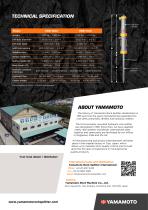
TECHNICAL SPECIFICATION Hydraulic Cylinder Drill hole diameter* Hydraulic flow Carrier weight Drill hole depth Split hole spacing Splitting force Body length (C) Hydraulic pressure (min/max) Counter Wedge *Also available for 76 mm / 3 in drill hole diameter ABOUT YAMAMOTO The history of Yamamoto Rock Splitter started back in 1915 and over the years manufacturing expanded into rock drills, pneumatic drifters and hydraulic drifters. The first excavator mounted hydraulic rock splitter was developed in 1981. Since then, we have supplied nearly 400 splitters worldwide. International sales, logistics...
Open the catalog to page 6