
- Catalogs
- XQ Instruments
- Brochure MCD-13

Brochure MCD-13

Brochure MCD-13
Catalog excerpts

Microcapper MCD-13 01 The Microcapper MCD-13 helps in attaching screw caps. It improves occupational health & safety and process integrity. Consistent tightening of the caps is ensured to prevent leakage during transportation. The MCD-13 reduces operator's hand fatigue. It is known that hazards such as carpal tunnel syndrome can result from the repetitive strain of manually tightening screw caps, making even semi-automated mechanical capping important. Designed for capping of screw caps on containers typically used in laboratories, the MCD-13 works for various cap, vial and tube sizes. The bench top device is compact, a footprint of less than half an A4 paper, and portable. The product is user friendly and can be operated with minimum training. Caps are manually placed on each tube, before loading onto holder and pushing in for capping. A de-capping function is also provided. Workflow Capping and de-capping of 12 mm - 24mm diameter screw caps onto standard micro-tubes typically used in laboratories (user adjustable). Different container holders and spacers available to adapt for a wide range of containers Tubes are inserted into holder with cap engaged; holder is pushed into capping position. Tube will be instantly capped or de-capped. Capping torque adjustable based on customer requirements between 12 to 25 Ncm. Operated simply by an ON/OFF power switch and reverse switch for de-capping
Open the catalog to page 1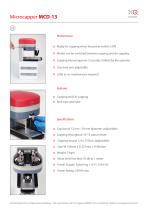
Microcapper MCD-13 02 Performance Ready for capping when the power switch is ON Modes can be switched between capping and de-capping Capping interval approx. 5 seconds, limited by the operator Cap sizes user adjustable Little to no maintenance required Features Capping and De-capping Bulk caps and tube Specifications Cap size of 12 mm - 24 mm diameter (adjustable) Capping throughput 10-15 caps/minute Capping torque 12 to 25 Ncm (adjustable) Size: W 154mm x D 227mm x H 405mm Weight: 5 kge) Noise level less than 70 db at 1 meter Power Supply: Switching 115 V / 230 V AC Power Rating: 250 W max....
Open the catalog to page 2All XQ Instruments catalogs and technical brochures
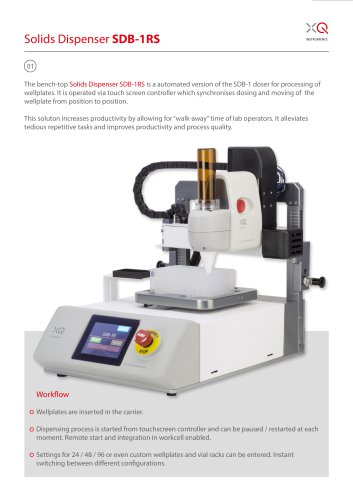 SDB-1-RS
2 Pages
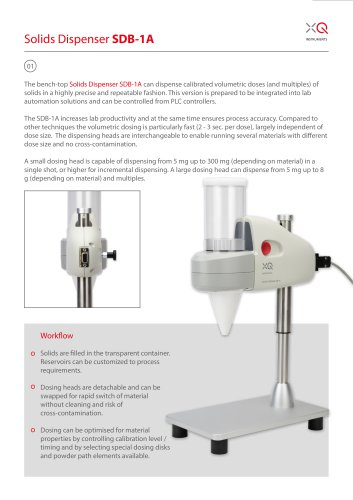 Brochure SDB-1A
2 Pages
 Brochure SDB-1C
2 Pages
 Brochure MCF-13
2 Pages
 Brochure SDH-1
2 Pages
 Brochure MCF-13A
2 Pages
 Brochure SDB-1R
2 Pages
 Brochure SDB-2
2 Pages
 Brochure SDM-1
2 Pages
 Brochure SDB-1
2 Pages
 Brochure PCD-1
2 Pages
- Volumetric dosing unit
- Liquids dispensing system
- Automatic dispensing system
- Solid dosing unit
- Dispensing system for the food industry
- High-precision dosing unit
- Continuous dosing unit
- Powder dispensing system
- Programmable dosing unit
- Weight dispensing system
- Gravimetric dispensing system
- Dosing dispenser for the chemical industry
- Screw capping machine
- Manual dosing unit
- Dosing dispenser for the pharmaceutical industry
- Granules metering system
- Laboratory dosing unit
- Dosing dispenser for the cosmetics industry
- Automatic screw capping machine
- Digital dispensing system