
- Catalogs
- Xiamen Dexing Magnet Tech. Co., Ltd.
- Operating Manual of DXTC-290 Temperature Controller


Operating Manual of DXTC-290 Temperature Controller
Operating Manual of DXTC-290 Temperature Controller
The document is an operating manual for the DXTC-290 Temperature Controller by Xiamen Dexing Magnet Tech. Co., Ltd. It provides detailed guidance on the product's specifications, installation, and operation.
The product includes a one-year warranty covering faults, instrument replacement, or service, with exclusions for improper maintenance or unauthorized modifications. The warranty period begins from the delivery or installation date.
The manual describes sensor input, temperature control, interface, display settings, and expansion cards, detailing specifications for input, sensor configuration, temperature measurement, control, and interface.
This section discusses temperature sensor selection and calibration, installation guidelines, and effective temperature control considerations, including sensor types, calibration methods, and installation materials.
Guidelines for inspection, unpacking, and installation are provided, including rear panel definition, power input, and sensor input connections, with tips on reducing measurement noise and sensor polarity.
The document covers PID control, manual tuning, autotuning, and zone tuning, with insights into setting heater ranges, adjustment ratios, and tuning derivatives.
Information on thermoelectric devices and capacitive sensor inputs with expansion cards is included, highlighting wiring, protection, and shielding techniques.
The TC290 temperature controller is a high-resolution, accurate, and stable device for advanced laboratory applications, supporting multiple sensor types and connecting up to ten sensors for multi-point temperature measurement.
The controller stores up to 64 temperature curves, supports thermoelectric compensation for resistance sensors, and provides ±10 V analog voltage output, alarm, and relay control, with temperature measurement accuracy as low as 10 mK.
The TC290 has two control loops capable of PID mode temperature control, with Loop 1 outputting 100W or extending to 200W, and Loop 2 outputting 1W or extending to 100W. The self-tuning function automatically adjusts PID parameters.
The controller supports Ethernet, RS-485, and USB communication methods, featuring a 5" color capacitive touch screen with a dual-language menu for user-friendly operation.
The TC290 supports two standard sensor inputs, expandable to ten with an 8-channel expansion card, compatible with diode, RTD, and thermocouple sensors, with 24-bit high-resolution converters and optical isolation to reduce noise.
The controller provides 200 W of heater power, with precise control outputs based on temperature set points and feedback, supporting auto-tuning and setpoint ramp functions for smooth transitions.
The TC290 includes Ethernet, RS-485, and USB interfaces for data acquisition and control, featuring a bright color LCD touch screen displaying up to 10 readings simultaneously, with customizable display modes.
The controller can be expanded with an 8-way card for additional sensor types, enhancing versatility for specific measurement goals.
The document provides a detailed table of compatible sensors, including silicon diodes, GaAIAs diodes, platinum RTDs, and Cernox™ sensors, with effective temperature ranges and suitability for various conditions.
The TC290 temperature controller is a comprehensive solution for precise temperature measurement and control in advanced laboratory settings, offering flexibility, accuracy, and ease of use.
The document outlines specifications of a temperature control system, including a 5-inch color capacitive touch display with a resolution of 800x480 pixels, supporting readings from 1 to 8 sources, and featuring alarms and relays for safety and operational alerts.
The document details procedures for selecting temperature sensors, emphasizing experimental temperature range, sensor sensitivity, environmental conditions, and measurement accuracy, along with sensor calibration services.
Safety precautions include proper grounding, avoiding operation in explosive atmospheres, and ensuring ventilation, stressing the importance of not modifying the instrument and following safety standards.
Recommendations include choosing sensors with good sensitivity, regularly calibrating sensors and instruments, and using appropriate sensor packages for specific conditions, advising against substitute parts and emphasizing manufacturer guidelines.
The document includes a table summarizing sensor calibration options, highlighting the importance of calibration for accurate readings and providing guidance on selecting appropriate methods based on application needs.
The document discusses sensor calibration to improve accuracy, emphasizing known temperature reference points, with DEXINMAG offering sensors with two or three-point software calibration.
Some sensors have predictable behavior allowing for a standard temperature response curve, useful for interchangeability but may not match calibrated sensor accuracy.
DEXINMAG provides "Curve Handler" software for loading temperature curves into the TC290, simplifying the process and compatible with all DEXINMAG instruments.
Important considerations for sensor installation include material choice in low-temperature environments, matching linear expansion coefficients, and using flexible mounting schemes.
Good thermal conductivity is crucial for reducing temperature gradients, recommending materials like copper and aluminum, and discussing thermal contact area and pressure.
Proper handling of sensor leads is essential to avoid errors, advising on soldering techniques and thermal anchoring methods.
Thermal radiation can affect measurement accuracy, suggesting radiation shields or super insulation to minimize transfer.
Guidelines for selecting and installing heaters include resistance and power considerations, positioning to minimize gradients, and the TC290's current limit feature to prevent overheating.
Resistive wires like nichrome are flexible heaters with predictable resistance, while cartridge and foil heaters provide even heating.
Inside vacuum enclosures, 30 AWG copper wire is recommended, with thermal anchors to prevent heat transfer when off.
Good thermal conductivity is crucial for consistent temperatures, with dual-sensor methods balancing accuracy and stability.
The TC290 uses PID control, involving Proportional (P), Integral (I), and Derivative (D) terms, with manual tuning for optimal settings.
Manual tuning involves setting heater range and adjusting scale setting, requiring knowledge of heater range.
Effective temperature control involves understanding heater types, wiring considerations, and control techniques like PID.
Procedures for setting initial parameters, stabilizing load temperature, and adjusting settings for optimal performance.
Use oscillation period to calculate integral setting, adjusting as needed, with derivative set to 0 if stable.
Utilize autotuning for automatic PID adjustments, with zone tuning for different temperature ranges.
Require bipolar output for effective control, using an external power amplifier to boost output.
Inspect and unpack the TC290, familiarizing with rear panel connections for proper setup.
Includes TC290 controller, user manual, sensor input connectors, heater output connectors, and optional accessories.
Proper connection to line power, operating at AC220V with a range of AC90-264V, ensuring safety through a grounded connection.
Details connection of diode and resistive sensors to standard input and expansion card, with pin configurations provided.
Guidelines emphasize minimizing error and noise pickup, recommending specific cables and shielding techniques.
Inputs should be isolated from ground to reduce noise, with shielded cables connected to input connector's shield pin.
Correct polarity is essential for diode sensors, with specific connection rules for four-lead resistors.
Technique eliminates lead resistance effects, with separate current and voltage leads.
Used when space is limited, with potential errors calculated based on lead resistance and current.
Recommendations include using four-wire measurements, avoiding ground connections, and using shielded cables.
Covers configuration of capacitive sensor inputs, with proper wiring and shielding crucial for accuracy.
Details configuration for thermocouple inputs, with special considerations for low-temperature applications.
Emphasizes careful installation to avoid errors, with grounding minimized to reduce noise.
Describes variable DC current sources with configurable resistance settings, providing guidance on wiring and noise reduction.
Output 3 controls an external power supply, with requirements for voltage and power settings.
Details operation, including touch screen interface for setting parameters and multiple display modes.
Describes various display modes, including input data from sensors and temperature control display mode.
Supports a variety of temperature sensors, with specific input settings and range selections.
Provides detailed specifications for different sensor types, ensuring accurate measurements.
Features automatic range selection for resistance temperature devices, with manual selection available.
Uses a thermal compensation algorithm to minimize errors from thermoelectromotive voltage.
Outlines settings for various expansion cards, providing additional functionality and input options.
Users can select from standard or user-defined curves for temperature sensors, allowing flexibility.
Includes a reading filter to smooth sensor input readings, affecting response to temperature changes.
Outlines functionality improvements and safety features, including filter restart and sensor input naming.
Includes a temperature limit feature to protect equipment, with preferred units for display consistency.
Records highest and lowest readings since last reset, with values captured in preferred units.
After configuring sensor inputs, users can set up output controls for temperature loops, with various modes available.
Optimized for 25Ω or 50Ω heaters, with parameters to limit maximum power and prevent damage.
Allows users to decide if heaters should be off when the device powers up, with display modes aiding setup.
Supports four output modes: Off, Closed Loop PID, Zone, and Open Loop, with feedback for maintaining setpoint temperatures.
Includes Proportion (P), Integral (I), and Derivative (D) settings for fine-tuning the control algorithm.
Part of the PID control equation, with a range from 0 to 1000 and a default value of 20.
The derivative parameter, or rate, is part of the PID control equation, with initial settings of 0%, 50%, or 100%.
Allows direct control of the output, either in open or closed loop control modes.
Sets the desired load temperature, with a ramp function for smooth transitions.
Generates a smooth temperature control point ramp, minimizing overshoot and undershoot.
Controls the output power range, with automatic shutdown if limits are exceeded.
A variable DC voltage source, configurable in open loop, preheat power, or monitor output modes.
Includes RS-485, USB, and Ethernet interfaces, with separate usage and driver requirements.
Includes PID auto-tuning for automatic adjustment in cryogenic systems.
Outlines configuration and operation, focusing on closed-loop control and auto-tuning processes.
Includes Auto-tune P, PI, and PID modes, each suited for different system characteristics.
Supports up to ten custom continuous temperature zones, each with specific PID values and settings.
Supports bipolar control for devices like thermoelectrics, with a control output range of -10 V to +10 V.
Controls an external power supply to rapidly increase system temperature.
Tracks the assigned control input based on scaling parameters, useful for data acquisition systems.
Includes high and low alarm functions for each input, with options for visible and audible alerts.
Discusses use of relays for signaling remote monitors and ensuring safety, with state latching and deadband parameters.
Supports 20 standard curve positions and 44 user curve positions, each holding 250 data pairs.
Includes editing, viewing, deleting, and copying curves, with steps for each operation.
Features a touch screen for local operations and supports remote operations via interfaces, with LabVIEW software for curve data import.
Device can switch between remote and local modes, with remote mode disabling touch screen operations.
Uses differential signal logic for communication, supporting a two-wire half-duplex mode.
Acts as a virtual serial COM port, facilitating easy connection to modern computers.
Allows connection to Ethernet networks, supporting TCP socket connections and providing an embedded web interface.
Lists various commands for interface communication, including querying device identification and setting alarm parameters.
Provides instructions for configuring temperature control parameters, including PID settings and output modes.
Instructions for setting output parameters, emphasizing correct configuration for optimal performance.
Provides technical specifications, procedures, and guidelines for the TC290 temperature controller, including querying and configuring functions, model options, accessories, and service information.
- RAMPING Status: Query and configure output ramping status for channels 1 and 2.
- Temperature Measurement: Query temperature measurement status and set upper limits for channels A-D.
- Relay Output: Configure and query relay output parameters and status for channels 1 and 2.
- Calibration: Sensor temperature curve software supports three-point calibration.
- Control Parameters: Set and query segmented temperature control parameters for output channels.
- TC290: Standard temperature controller with 2 diode/RTD inputs and 2 control outputs.
- Expansion Cards: Options include diode/RTD expansion, dual thermocouple input, capacitive input, and 100W heating card.
- Heater output plugs, sensor input connectors, terminal block connectors, power cord, and user manual.
- USB Troubleshooting: Steps for new installations, existing installations, and intermittent failures.
- Factory Reset: Procedure to reset instrument parameters and clear curve memory.
- Calibration: Calibration services available through DEXINMAG after-sales service.
- Electrostatic Discharge (ESD): Precautions to prevent damage to electronic components during handling and installation.
Catalog excerpts
Xiamen Dexing Magnet Tech. Co., Ltd DXTC-290 Temperature Controller Operating Manual V 1.1 厦门盈德兴磁电科技有限公司 Xiamen Dexing Magnet Tech. Co.,Ltd Add:Unit 409, 4/F, No.992, Anling Road, Huli
Open the catalog to page 1
Xiamen Dexing Magnet Tech. Co., Ltd Guarantee Of Quality:One (1) year warranty 1. DEXINMAG guarantees that during the warranty period,all faults (except the situations listed in Article 4 of this statement),instrument replacement or service caused by this product are free of charge.If DEXINMAG receives a customer's fault report about the product during the product warranty period,DEXINMAG will repair or replace the product for the customer free of charge according to its own choice.we guarantee that the repaired or replaced parts will have 90 days or the original warranty period,whichever is...
Open the catalog to page 2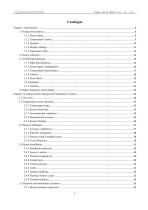
Xiamen Dexing Magnet Tech. Co., Ltd
Open the catalog to page 3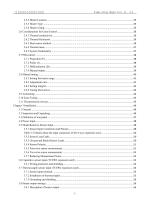
Xiamen Dexing Magnet Tech. Co., Ltd
Open the catalog to page 4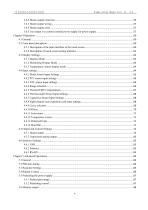
Xiamen Dexing Magnet Tech. Co., Ltd
Open the catalog to page 5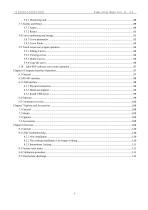
Xiamen Dexing Magnet Tech. Co., Ltd
Open the catalog to page 6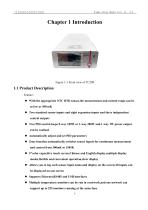
Xiamen Dexing Magnet Tech. Co., Ltd Figure 1-1 Front view of TC290 1.1 Product Description Feature: With the appropriate NTC RTD sensor,the measurement and control range can be as low as 300 mK Two standard sensor inputs and eight expansion inputs and three independent control outputs Two PID control loops:2-way 100W or 1-way 200W and 1-way 1W power output can be realized Automatically adjust and set PID parameters Zone function automatically switches sensor inputs for continuous measurement and control from 300mK to 1505K 5"color capacitive touch screen,Chinese and English display,multiple...
Open the catalog to page 7
Xiamen Dexing Magnet Tech. Co., Ltd In addition to the DEXIN custom protocol,it also supports the standard MODBUS protocol Supports Diode,RTD and Thermocouple temperature sensors Allows storage of up to 64 temperature curves,including 20 standard temperature curves for internal curing Supports thermoelectric compensation for resistance sensors Supports ±10 V analog voltage output,alarm and relay control The TC290 temperature controller is designed by our company using the most advanced electronic technology.It has extremely high resolution,accuracy and stability characteristics.The...
Open the catalog to page 8
Xiamen Dexing Magnet Tech. Co., Ltd range is out of the available range of a given sensor.You no longer have to worry about temperature sensor errors and measurement continuity issues.Alarms,relays and ±10v analog voltage output functions can help you automate secondary control functions. In many applications,the unmatched capabilities of the TC290 allow you to replace multiple instruments with one,saving time,money and valuable lab space.It can provide more feedback,tighter control,and faster cycle time,and it keeps pace with increasingly complex temperature measurement and control applications.It...
Open the catalog to page 9
Xiamen Dexing Magnet Tech. Co., Ltd detector.The non-volatile memory can store up to 64 temperature sensor curves with 250 points each,the first 20 are standard curves cured inside the system,and the last 44 are user-defined curves.Using the TC290 temperature controller curve processing software,the temperature sensor curve data can be easily uploaded and manipulated. 1.1.2 Temperature Control TC290 temperature controller is the most powerful temperature controller,providing a total of 200 W of heater power.Providing a very clean heater power supply,it precisely controls temperature over the...
Open the catalog to page 10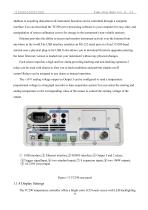
Xiamen Dexing Magnet Tech. Co., Ltd addition to acquiring data,almost all instrument functions can be controlled through a computer interface.You can download the TC290 curve processing software to your computer for easy entry and manipulation of sensor calibration curves for storage in the instrument's non-volatile memory. Ethernet provides the ability to access and monitor instrument activity over the Internet from anywhere in the world.The USB interface emulates an RS-232 serial port at a fixed 115200 baud rate,but uses a physical plug-in for USB.It also allows you to download firmware upgrades,ensuring...
Open the catalog to page 11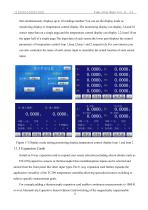
Xiamen Dexing Magnet Tech. Co., Ltd that simultaneously displays up to 10 readings number.You can set the display mode as monitoring display or temperature control display.The monitoring display can display 2,4,and 10 sensor input data on a single page,and the temperature control display can display 1,2,4,and 10 on the upper half of a single page.The input data of each sensor,the lower part displays the control parameters of temperature control loop 1,loop 2,loop 1 and 2 respectively.For convenience,you can also customize the name of each sensor input to remember the actual location of each sensor...
Open the catalog to page 12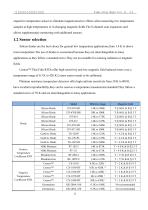
Xiamen Dexing Magnet Tech. Co., Ltd capacitive temperature sensor to eliminate magnetoresistive effects when measuring low temperature samples at high temperatures or in changing magnetic fields.The 8-channel scan expansion card allows supplementary monitoring with additional sensors. Silicon diodes are the best choice for general low temperature applications,from 1.4 K to above room temperature.The use of diodes is economical because they are interchangeable in many applications as they follow a standard curve.They are not suitable for ionizing radiation or magnetic fields. Cernox™ Thin Film...
Open the catalog to page 13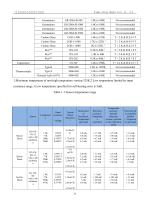
Xiamen Dexing Magnet Tech. Co., Ltd
Open the catalog to page 14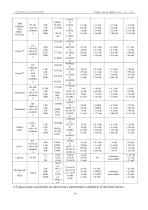
Xiamen Dexing Magnet Tech. Co., Ltd
Open the catalog to page 15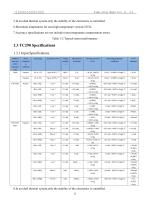
Xiamen Dexing Magnet Tech. Co., Ltd 5.In an ideal thermal system,only the stability of the electronics is controlled. 6.Maximum temperature for non-high temperature version:325 K. 7.Accuracy specifications are not include room temperature compensation errors. Table 1-2 Typical sensor performance 1.3 TC290 Specifications 1.3.1 Input Specifications Standard input and tc2901 Expansion card Sensor Temperatu re coefficient Input range Negative Positive Excitation current Measurement Resolution Measuring temperature coefficient
Open the catalog to page 16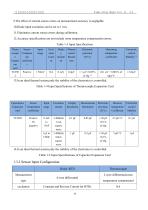
Xiamen Dexing Magnet Tech. Co., Ltd 9. The effect of current source errors on measurement accuracy is negligible. 10. Diode input excitation can be set to 1 mA. 11. Eliminates current source errors during calibration. 12. Accuracy specifications are not include room temperature compensation errors. Table 1-3 Input Specifications
Open the catalog to page 17All Xiamen Dexing Magnet Tech. Co., Ltd. catalogs and technical brochures
 Common door gasket profile
6 Pages
 DXME-15C10 Operation manual
18 Pages
 Rubber Magnet MSDS
18 Pages
 Impulse Magnetizer ROHS
18 Pages
 Dexinmag Product Categories
32 Pages
 DX-1205F Gaussmeter
16 Pages
 Three Dimensional Hall Probe
6 Pages
 Two-dimensional Hall Probe
7 Pages
 Axial Probe
8 Pages
 Transverse Probe
12 Pages



- Cutting system
- Industrial press
- Kiln
- DC power supply
- AC/DC power supply
- Welding system
- Chamber kiln
- Forming press
- Hydraulic press
- Measuring device
- Automatic cut-off machine
- Heat treatment kiln
- Monitoring analyzer
- Knife cutting system
- Automatic welding machine
- Measuring machine
- Automatic analyser
- Microscope
- Making machine