
- Catalogs
- Xi'an Aigtek Electronic Technology Co., Ltd.
- ATA-7030 High Voltage Amplifier


- Company
- Products
- Catalogs
- News & Trends
- Exhibitions
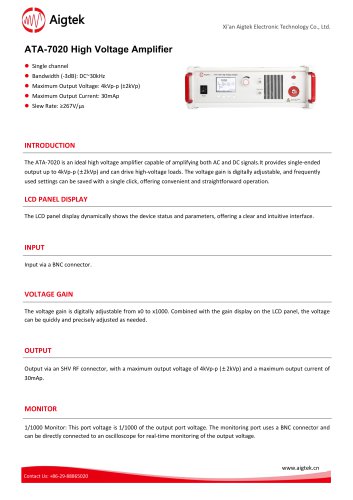
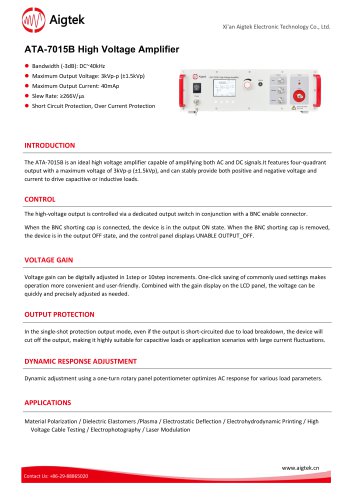
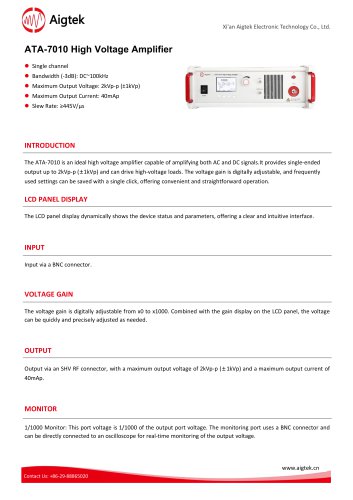
ATA-7030 High Voltage Amplifier
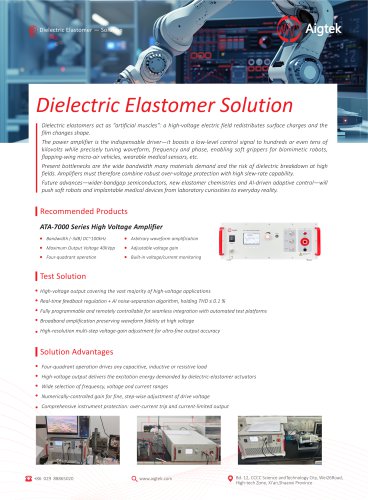
ATA-7030 High Voltage Amplifier
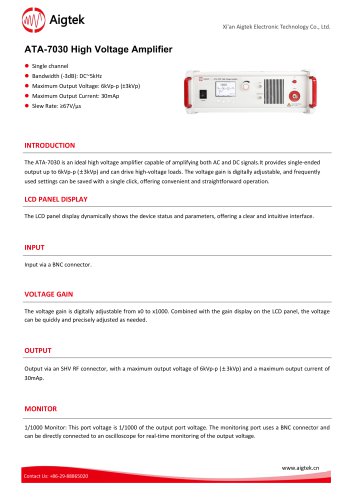
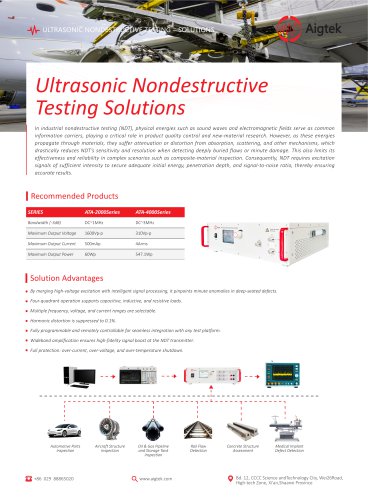
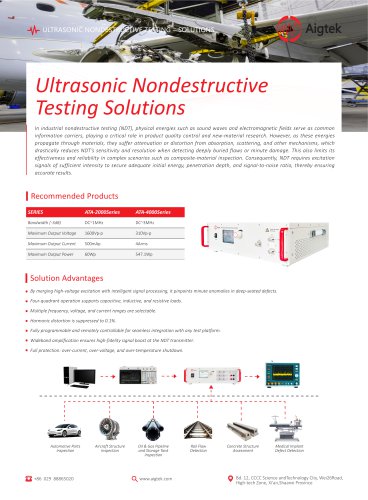
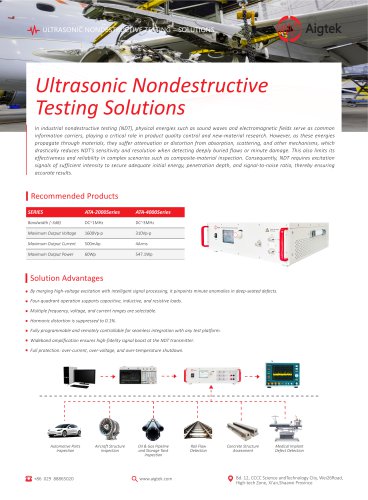
The document discusses solutions for ultrasonic non-destructive testing, focusing on the ATA-7000 Series High Voltage Amplifier and its applications in dielectric elastomer technology. It highlights the need for advanced materials in specialized applications where conventional materials fall short.
Specifications
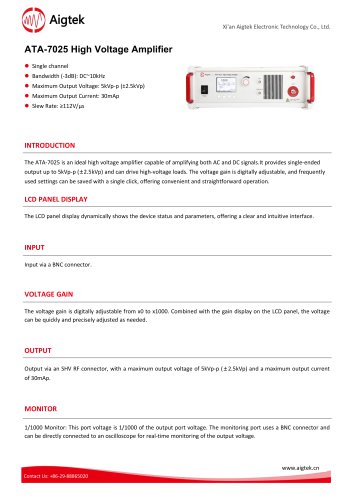
The ATA-7000 Series High Voltage Amplifier offers high-voltage output suitable for most applications, with real-time feedback regulation and AI noise-separation algorithms ensuring THD ≤ 0.1%. It is fully programmable and remotely controllable, allowing integration with automated test platforms. The amplifier supports broadband amplification, high-resolution voltage-gain adjustment, and four-quadrant operation for various load types. Key specifications include a bandwidth of DC~100kHz and a maximum output voltage of 40kVpp.
Dielectric Elastomer Solution
Dielectric elastomers function as "artificial muscles," changing shape under a high-voltage electric field. The power amplifier is crucial in boosting control signals to high voltages, enabling applications in biomimetic robots, micro-air vehicles, and medical sensors. Challenges include the need for wide bandwidth and protection against dielectric breakdown. Future advancements may involve wider-bandgap semiconductors and AI-driven control.
Applications and Case Studies
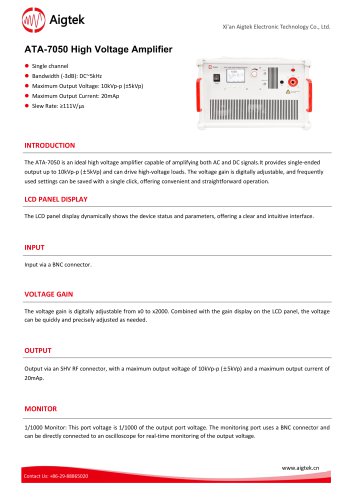
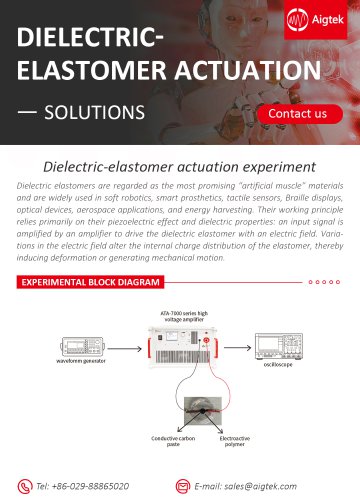
Dielectric elastomers are gaining attention for their ability to convert electrical energy into mechanical work, with applications in aerospace, precision machinery, and biomedical engineering. The Aigtek ATA-7050 amplifier is commonly used, delivering up to 20 kV for dielectric-elastomer tests. Case studies include the electromechanical performance of silicone-rubber composites and actuation experiments, where the amplifier's role is critical in driving elastomer deformation.
Conclusion
The document emphasizes the importance of dielectric elastomers and high-voltage amplifiers in advancing technology for specialized applications. The ATA-7000 Series provides the necessary capabilities to support these innovations, with ongoing research promising further developments in the field.
Catalog excerpts

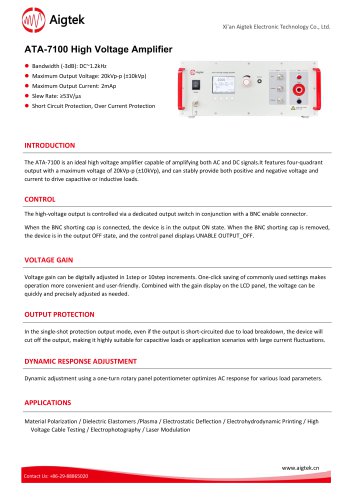
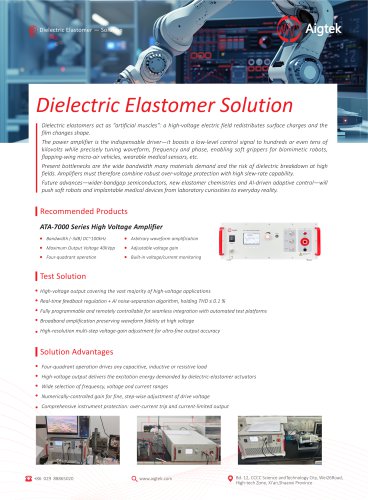
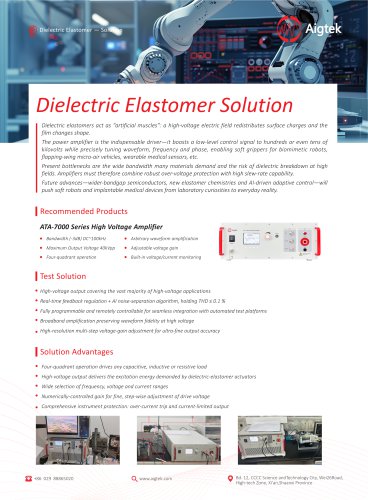
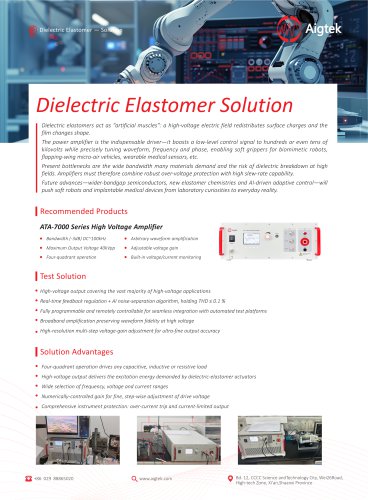
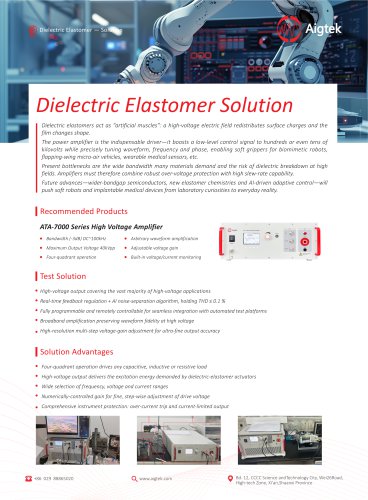
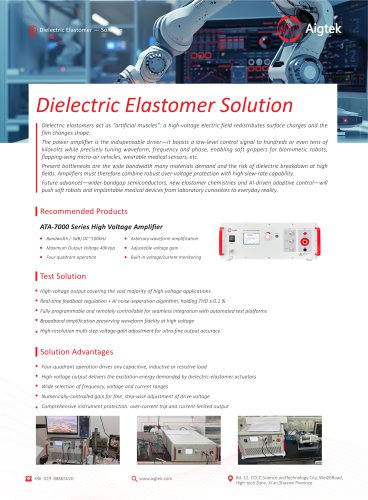
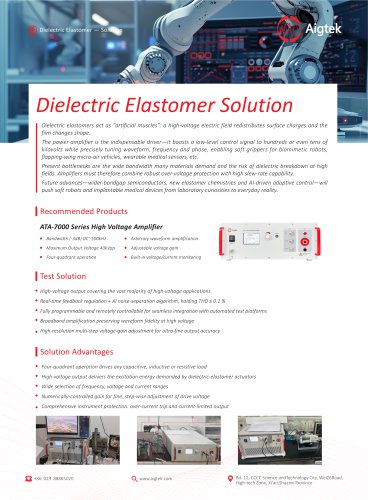
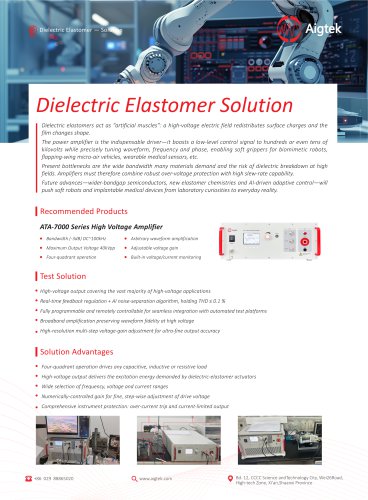
Dielectric elastomers act as "artificial muscles": a high-voltage electric field redistributes surface charges and the film changes shape. The power amplifier is the indispensable driver—it boosts a low-level control signal to hundreds or even tens of kilovolts while precisely tuning waveform, frequency and phase, enabling soft grippers for biomimetic robots, flapping-wing micro-air vehicles, wearable medical sensors, etc. Present bottlenecks are the wide bandwidth many materials demand and the risk of dielectric breakdown at high fields. Amplifiers must therefore combine robust over-voltage protection with high slew-rate capability. Future advances—wider-bandgap semiconductors, new elastomer chemistries and AI-driven adaptive control—will push soft robots and implantable medical devices from laboratory curiosities to everyday reality. | Recommended Products ATA-7000 Series High Voltage Amplifier • Maximum Output Voltage 40kVpp • Four-quadrant operation • Arbitrary waveform amplification • Adjustable voltage gain • Built-in voltage/current monitoring | Test Solution • High-voltage output covering the vast majority of high-voltage applications • Real-time feedback regulation + AI noise-separation algorithm, holding THD < 0.1 % • Fully programmable and remotely controllable for seamless integration with automated test platforms • Broadband amplification preserving waveform fidelity at high voltage • High-resolution multi-step voltage-gain adjustment for ultra-fine output accuracy • Four-quadrant operation drives any capacitive, inductive or resistive load • High-voltage output delivers the excitation energy demanded by dielectric-elastomer actuators • Wide selection of frequency, voltage and current ranges • Numerically-controlled gain for fine, step-wise adjustment of drive voltage • Comprehensive instrument protection: over-current trip and current-limited output O Bd. 12, CCCC Science andTechnology City, Wei26Road, High-tech Zone, Xi'an,Shaan
Open the catalog to page 1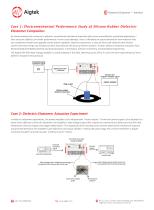
Dielectric Elastomer — Solution Case 1: Electromechanical Performance Study of Silicone-Rubber DielectricElastomer Composites As human productivity continues to advance, conventional mechanical materials often prove unsuitable for specialized applications— their excessive stiffness can hinder performance or even cause damage. There is therefore an urgent demand for new materials that can complement metals and upgrade overall system capability. Dielectric elastomers, a class of smart soft materials that directly convert electrical energy into mechanical work, have become the focus of intense research....
Open the catalog to page 2All Xi'an Aigtek Electronic Technology Co., Ltd. catalogs and technical brochures
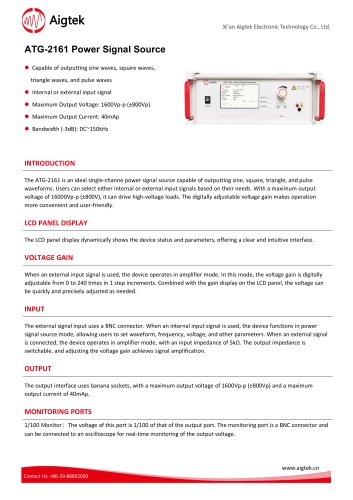 ATG-2161 Power Signal Source
2 Pages
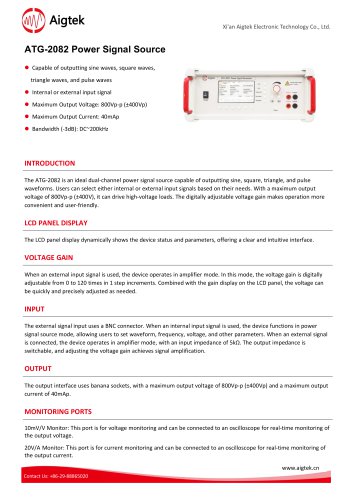 ATG-2082 Power Signal Source
2 Pages
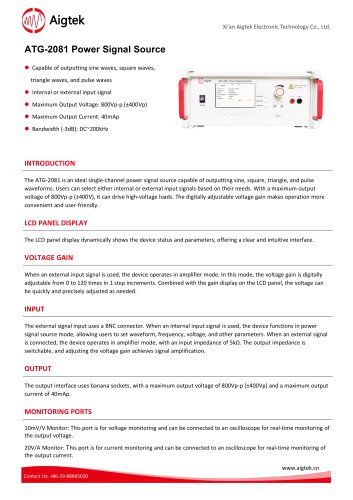 ATG-2081 Power Signal Source
2 Pages
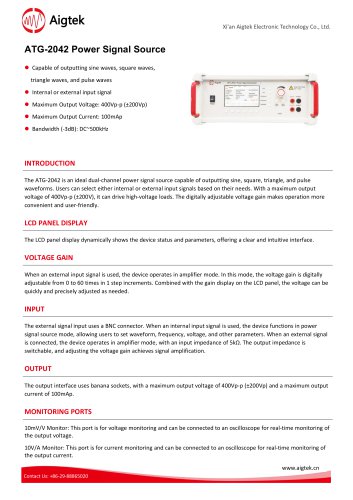 ATG-2042 Power Signal Source
2 Pages
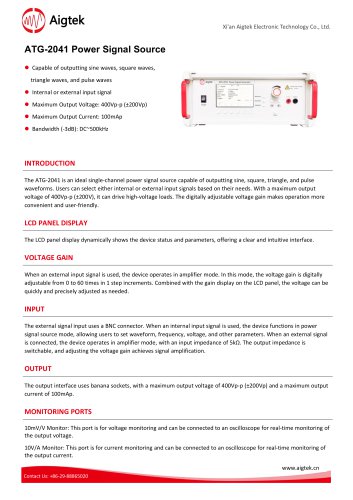 ATG-2041 Power Signal Source
2 Pages
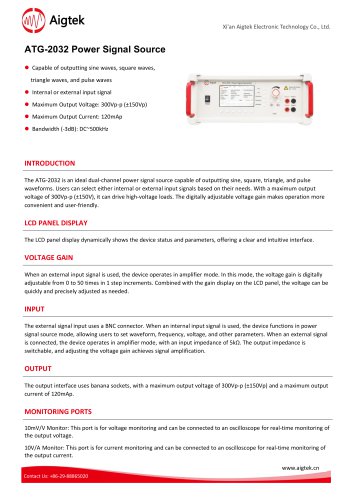 ATG-2032 Power Signal Source
2 Pages
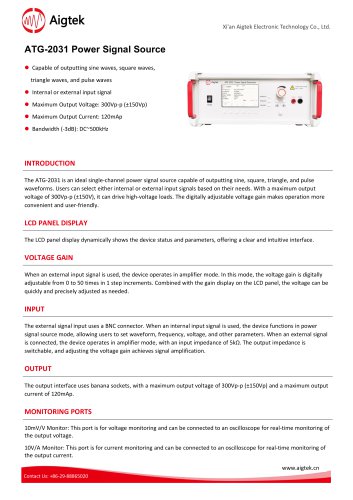 ATG-2031 Power Signal Source
2 Pages
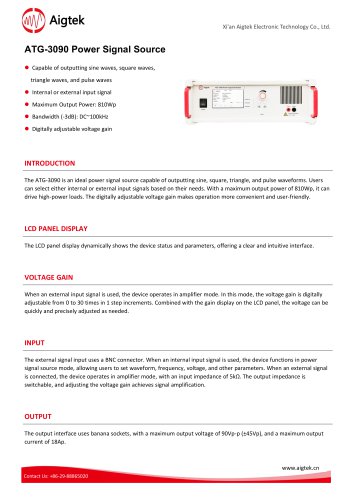 ATG-3090 Power Signal Source
2 Pages
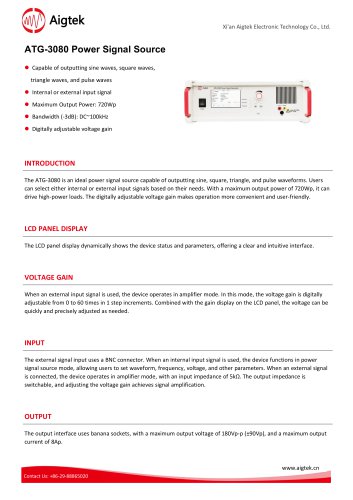 ATG-3080 Power Signal Source
2 Pages
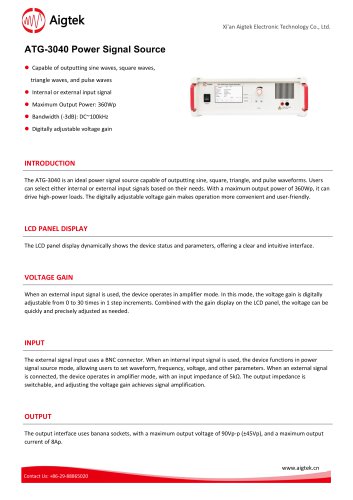 ATG-3040 Power Signal Source
2 Pages
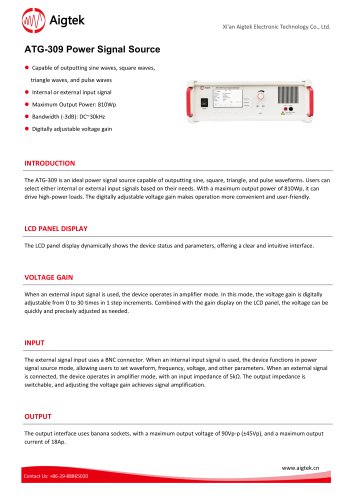 ATG-309 Power Signal Source
2 Pages
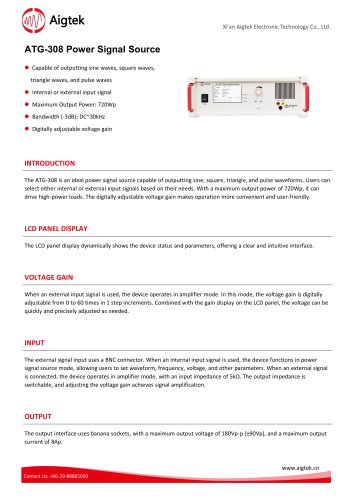 ATG-308 Power Signal Source
2 Pages
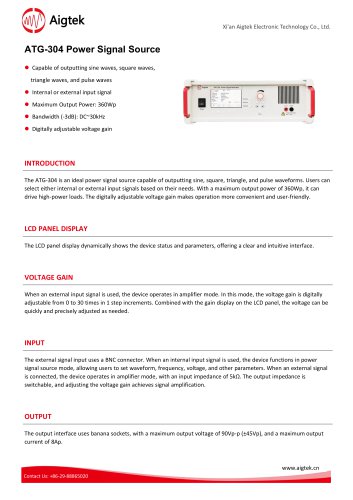 ATG-304 Power Signal Source
2 Pages
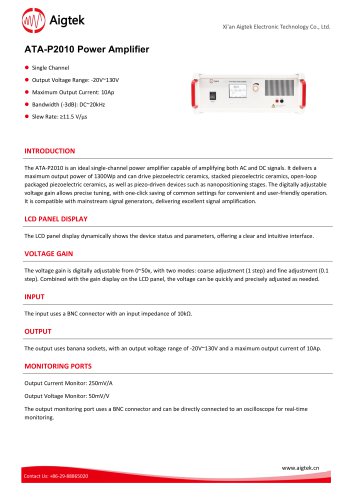 ATA-P2010 Power Amplifier
2 Pages
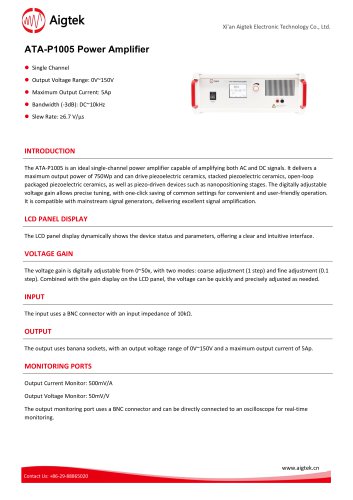 ATA-P1005 Power Amplifier
2 Pages
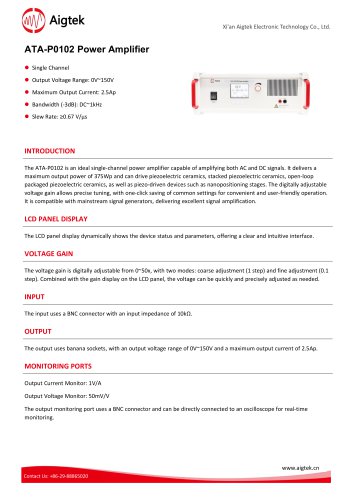 ATA-P0102 Power Amplifier
2 Pages
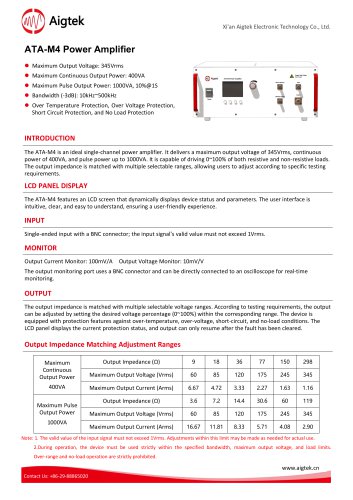 ATA-M4 Power Amplifier
2 Pages
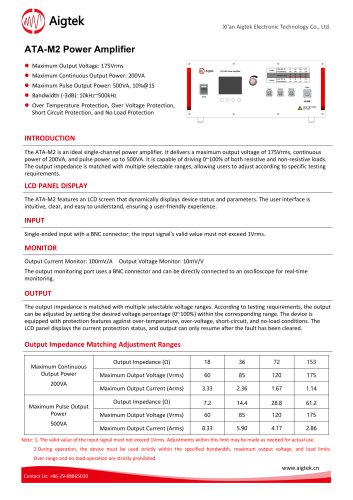 ATA-M2 Power Amplifier
2 Pages
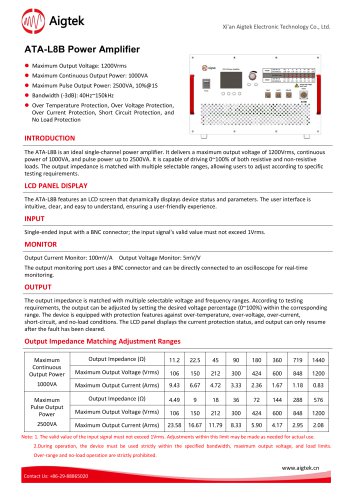 ATA-L8B Power Amplifier
2 Pages
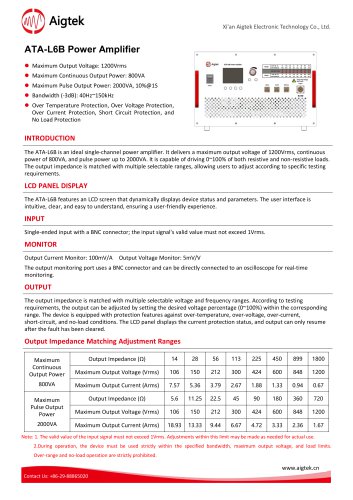 ATA-L6B Power Amplifier
2 Pages
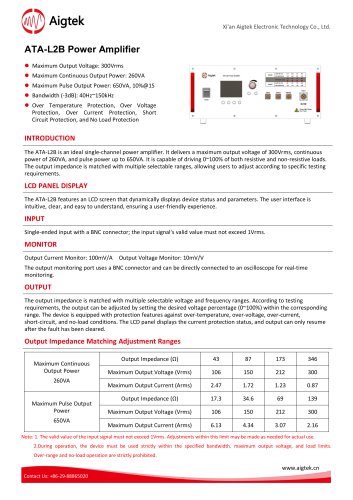 ATA-L2B Power Amplifier
2 Pages
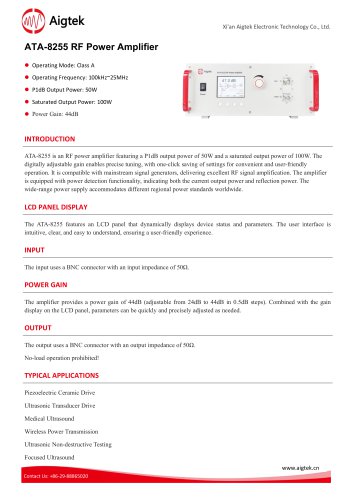 ATA-8255 RF Power Amplifier
2 Pages
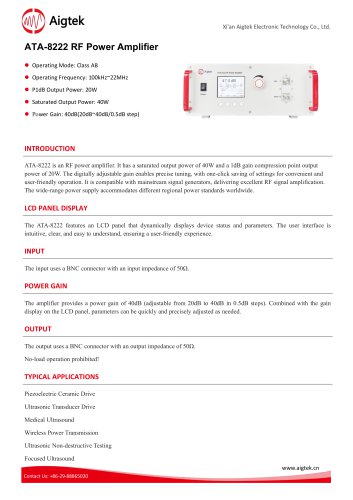 ATA-8222 RF Power Amplifier
2 Pages
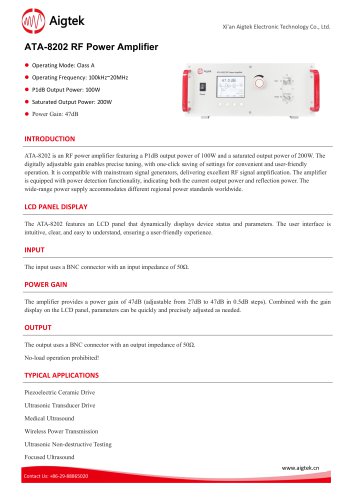 ATA-8202 RF Power Amplifier
2 Pages
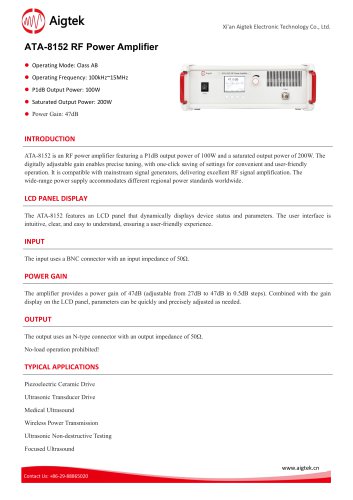 ATA-8152 RF Power Amplifier
2 Pages
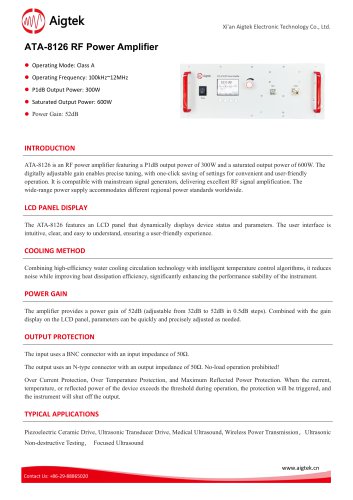 ATA-8126 RF Power Amplifier
2 Pages
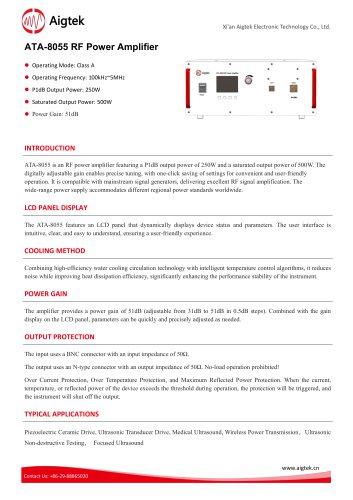 ATA-8055 RF Power Amplifier
2 Pages
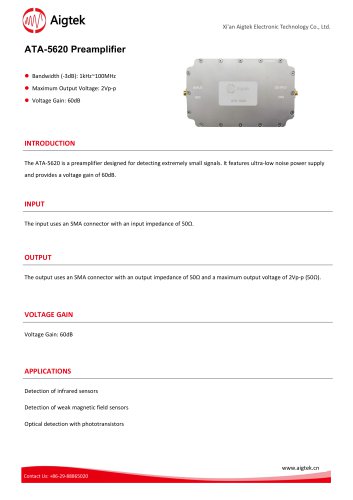 ATA-5620 Preamplifier
2 Pages
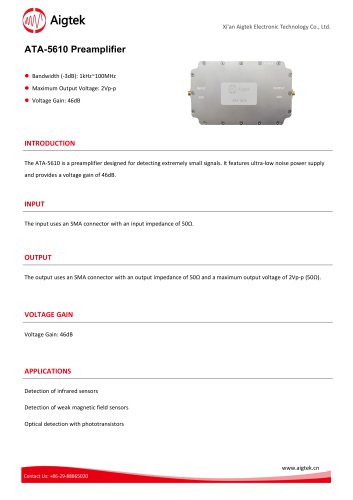 ATA-5610 Preamplifier
2 Pages
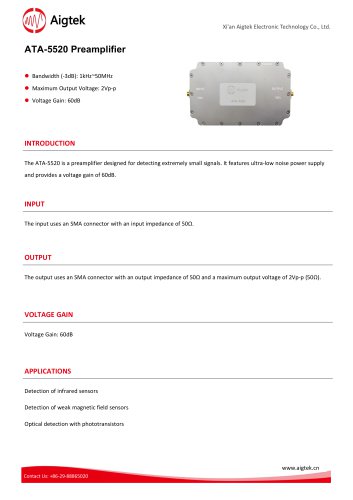 ATA-5520 Preamplifier
2 Pages
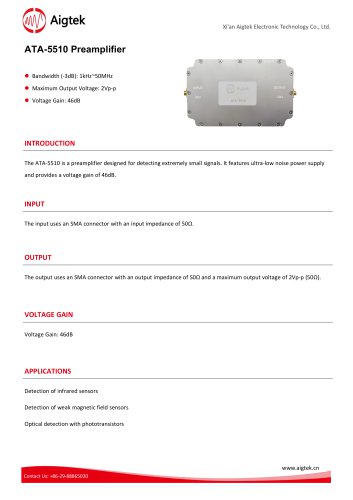 ATA-5510 Preamplifier
2 Pages
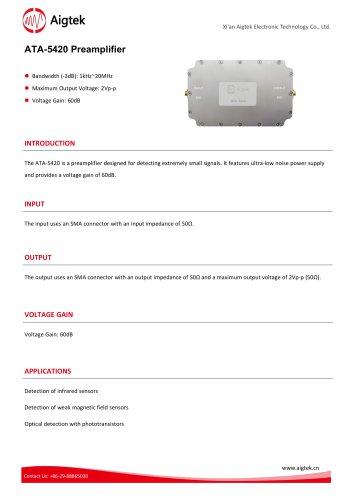 ATA-5420 Preamplifier
2 Pages
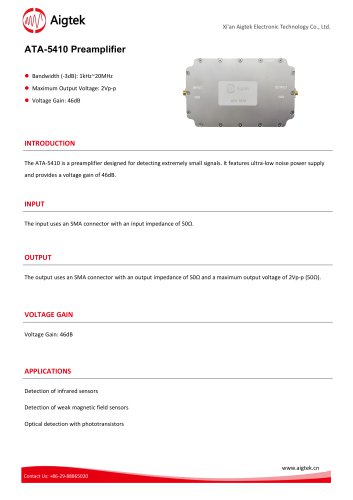 ATA-5410 Preamplifier
2 Pages
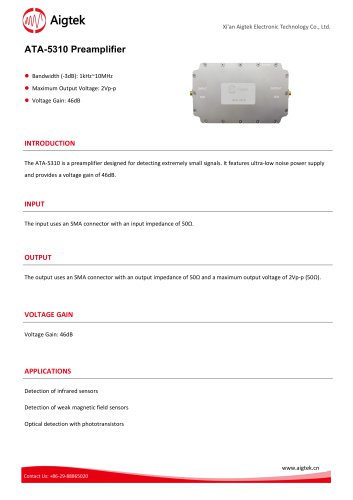 ATA-5310 Preamplifier
2 Pages
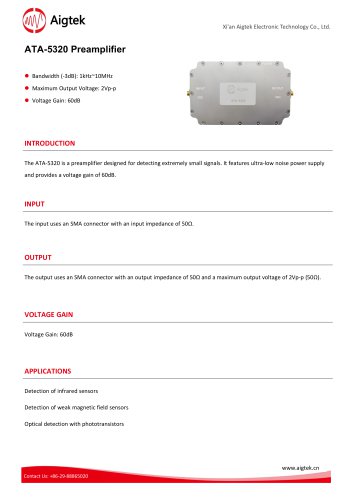 ATA-5320 Preamplifier
2 Pages
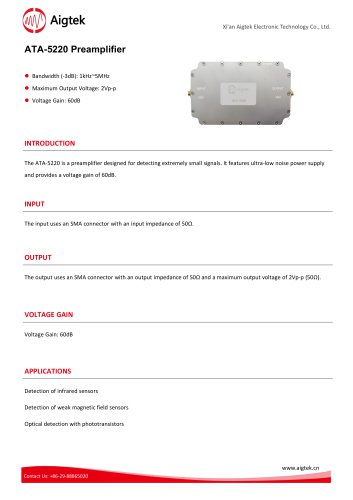 ATA-5220 Preamplifier
2 Pages
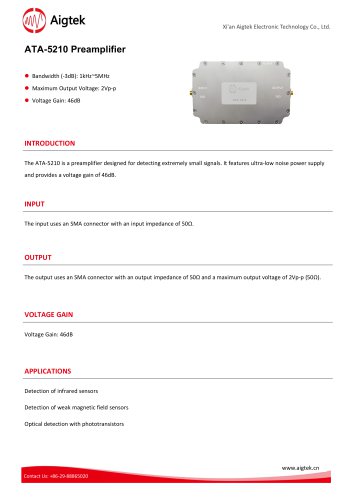 ATA-5210 Preamplifier
2 Pages
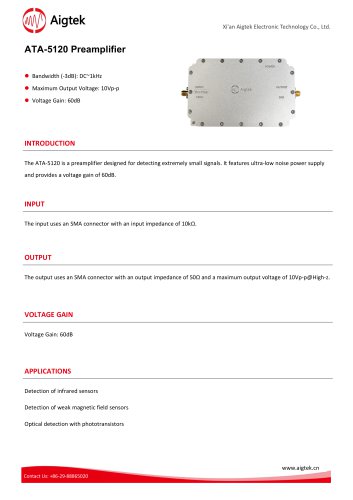 ATA-5120 Preamplifier
2 Pages
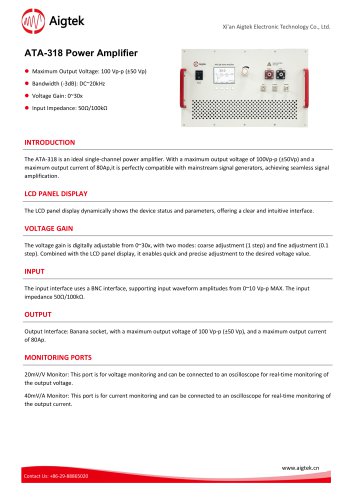 ATA-318 Power Amplifier
2 Pages
 ATA-318 Power Amplifier
2 Pages
 ATA-315 Power Amplifier
2 Pages
 ATA-314 Power Amplifier
2 Pages
 ATA-8152 RF Power Amplifier
2 Pages
 ATA-8126 RF Power Amplifier
2 Pages
 ATA-8061 RF Power Amplifier
2 Pages
 ATA-8055 RF Power Amplifier
2 Pages
 ATA-8222 RF Power Amplifier
2 Pages
 ATA-8202 RF amplifier
2 Pages
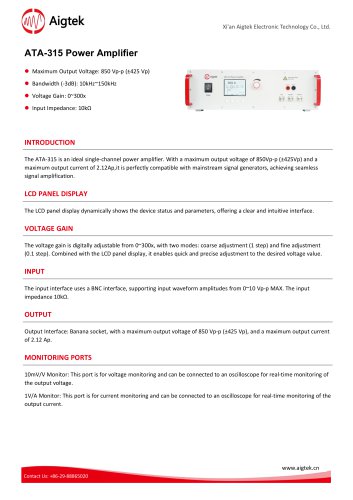 ATA-315 Power Amplifier
2 Pages
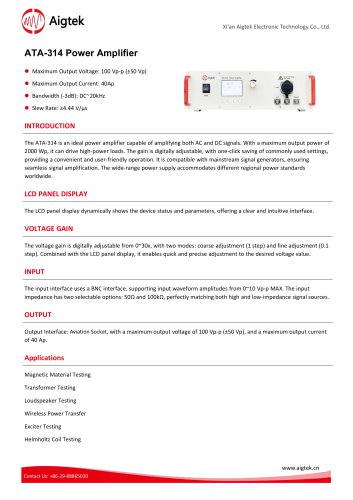 ATA-314 Power Amplifier
2 Pages
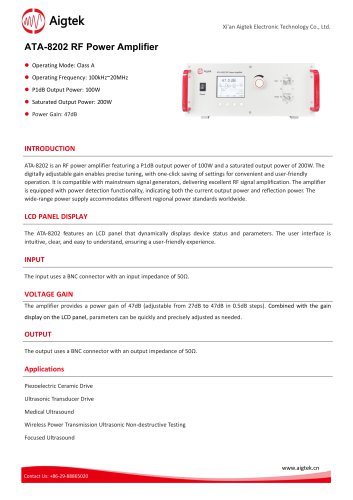 ATA-8202 RF Power Amplifier
2 Pages
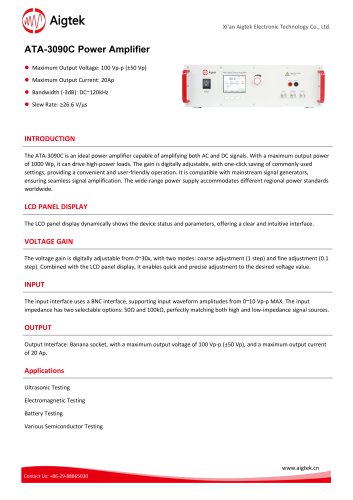
 ATA-3090C Power Amplifier
2 Pages
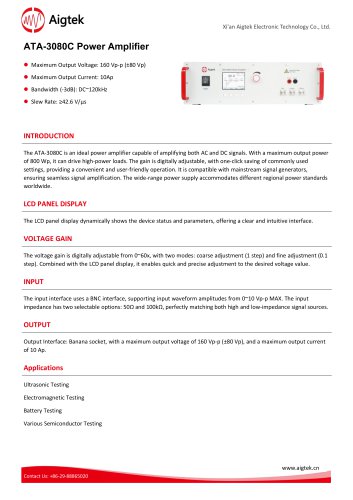
 ATA-3080C Power Amplifier
2 Pages
 ATA-3040C Power Amplifier
2 Pages
 L8B Power Amplifier
2 Pages
 L2B Power Amplifier
2 Pages
 L20 Power Amplifier
2 Pages










- Power supply unit
- DC power supply
- AC/DC power supply
- Signal amplifying integrated circuit
- Tabletop power supply
- Generator
- Variable-output power supply
- Rack-mount power supply
- Electronic equipment power supply
- High-voltage power supply
- Digital power supply
- Measuring amplifier
- Stabilized power supply
- DC amplifier
- Electronic amplifier
- Pulse generator
- Low-noise amplifier