
- Catalogs
- Xi'an Aigtek Electronic Technology Co., Ltd.
- ATA-4052C High Voltage Amplifier


- Company
- Products
- Catalogs
- News & Trends
- Exhibitions
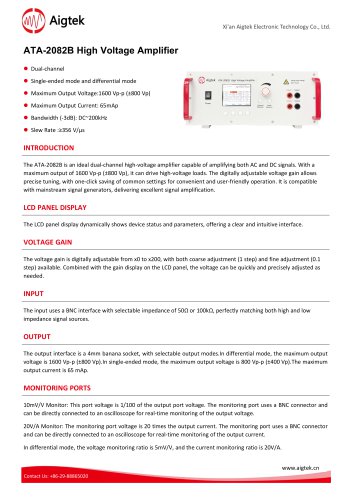
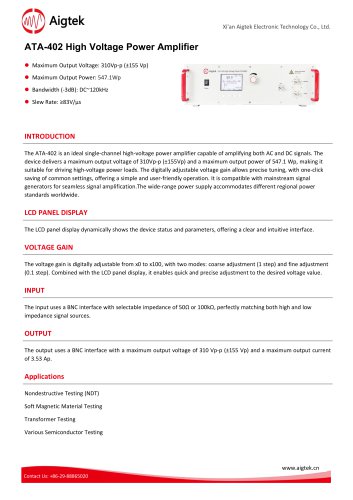
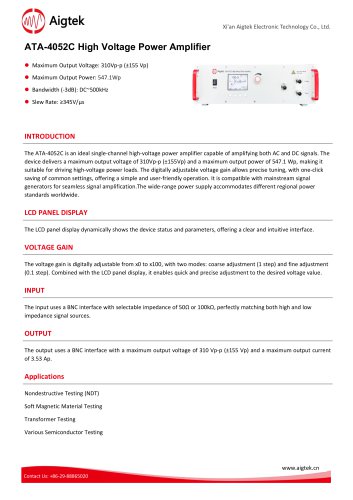
ATA-4052C High Voltage Amplifier
ATA-4052C High Voltage Amplifier
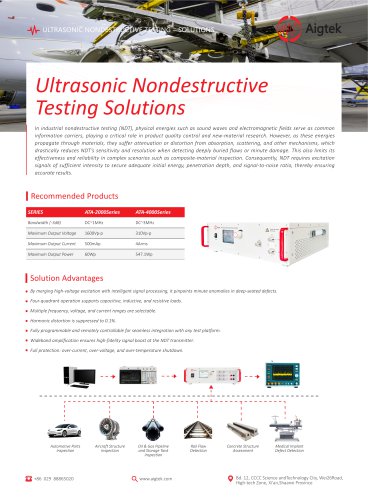
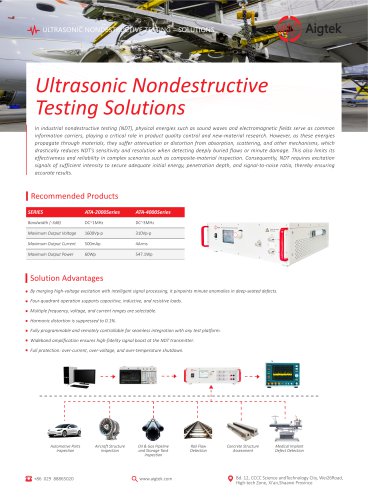
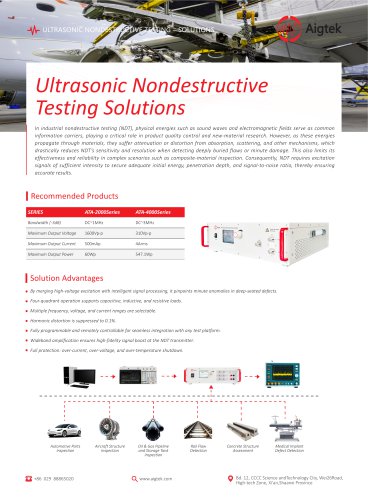
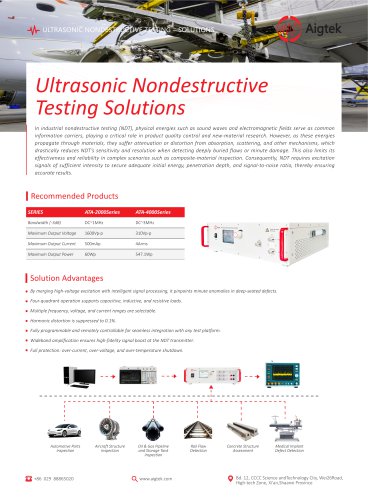
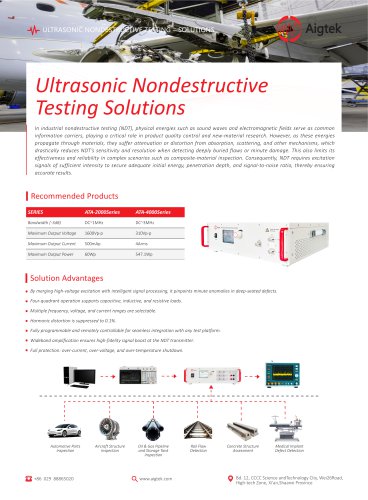
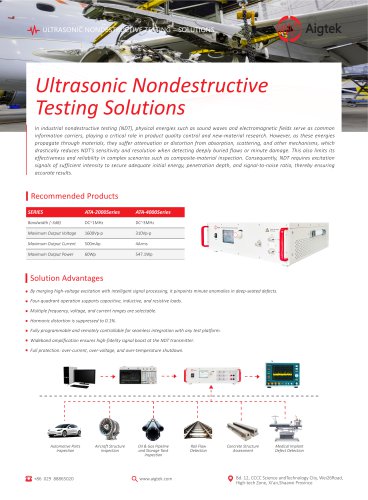
Ultrasonic nondestructive testing (NDT) is crucial in industrial applications for quality control and material research. It uses sound waves and electromagnetic fields to detect flaws in materials. However, challenges such as attenuation and distortion can affect sensitivity and resolution, especially in complex scenarios like composite-material inspection. High-intensity excitation signals are necessary for accurate results.
The document outlines two series of ultrasonic testing solutions: ATA-2000 and ATA-4000. The ATA-2000 series offers a bandwidth of DC~1MHz, a maximum output voltage of 1600Vp-p, and a maximum output power of 60Wp. The ATA-4000 series provides a bandwidth of DC~3MHz, a maximum output voltage of 310Vp-p, and a maximum output power of 547.1Wp.
The solutions combine high-voltage excitation with intelligent signal processing to detect minute anomalies. They support capacitive, inductive, and resistive loads, offer multiple frequency, voltage, and current ranges, and suppress harmonic distortion to 0.1%. The systems are fully programmable, remotely controllable, and provide full protection against over-current, over-voltage, and over-temperature.
These solutions are applicable in various fields, including rail flaw detection, concrete structure assessment, medical implant defect detection, aircraft structure inspection, oil & gas pipeline inspection, and automotive parts inspection.
Case 1: Ultrasonic Guided-Wave Experiment for Electrode-Depth Measurement in Submerged-Arc Furnaces. Aigtek’s ATA-2000 series power amplifiers are used to detect Electrode Insertion Depth (EID) using ultrasonic guided waves.
Case 2: Monitoring Test of Support-Frame Node Connection Status Using Piezoelectric Sensing Technology. The ATA-2000 series is also used for online monitoring of construction support frames to prevent collapse under complex forces.
Catalog excerpts

ULTRASONIC NONDESTRUCTIVE TESTING – SOLUTIONS 超声无损检测—解决方案 Ultrasonic Nondestructive Testing Solutions In industrial nondestructive testing (NDT), physical energies such as sound waves and electromagnetic fields serve as common information carriers, playing a critical role in product quality control and new-material research. However, as these energies propagate through materials, they suffer attenuation or distortion from absorption, scattering, and other mechanisms, which drastically reduces NDT’s sensitivity and resolution when detecting deeply buried flaws or minute damage. This also limits its effectiveness and reliability in complex scenarios such as composite-material inspection. Consequently, NDT requires excitation signals of sufficient intensity to secure adequate initial energy, penetration depth, and signal-to-noise ratio, thereby ensuring accurate results. Recommended Products SERIES Maximum Output Voltage Maximum Output Current Maximum Output Power Solution Advantages By merging high-voltage excitation with intelligent signal processing, it pinpoints minute anomalies in deep-seated defects. Four-quadrant operation supports capacitive, inductive, and resistive loads. Multiple frequency, voltage, and current ranges are selectable. Harmonic distortion is suppressed to 0.1%. Fully programmable and remotely controllable for seamless integration with any test platform. Wideband amplification ensures high-fidelity signal boost at the NDT transmitter. Full protection: over-current, over-voltage, and over-temperature shutdown. Automotive Parts Inspection Aircraft Structure Inspection Oil & Gas Pipeline and Storage Tank Inspection Rail Flaw Detection Concrete Structure Assessment Medical Implant Defect Detection Bd. 12, CCCC Science andTechnology City, Wei26Road, High-tech Zone,
Open the catalog to page 1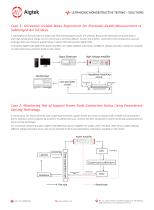
ULTRASONIC NONDESTRUCTIVE TESTING – SOLUTIONS Case 1: Ultrasonic Guided-Wave Experiment for Electrode-Depth Measurement in Submerged-Arc Furnaces A submerged-arc furnace (SAF) is a large-scale electrometallurgical unit for ore smelting. Because the electrodes are buried deep in ultra-high-temperature charge, on-line monitoring is extremely difficult. To solve this problem, researchers have introduced an acoustic technique that uses ultrasonic guided waves to detect Electrode Insertion Depth (EID). In this field, Aigtek’s ATA-2000 series power amplifiers are widely adopted; instruments of different...
Open the catalog to page 2All Xi'an Aigtek Electronic Technology Co., Ltd. catalogs and technical brochures
 ATG-2161 Power Signal Source
2 Pages
 ATG-2082 Power Signal Source
2 Pages
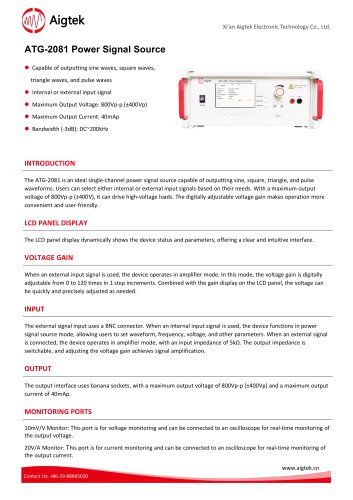 ATG-2081 Power Signal Source
2 Pages
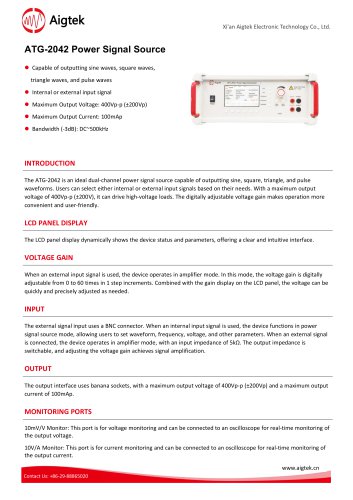 ATG-2042 Power Signal Source
2 Pages
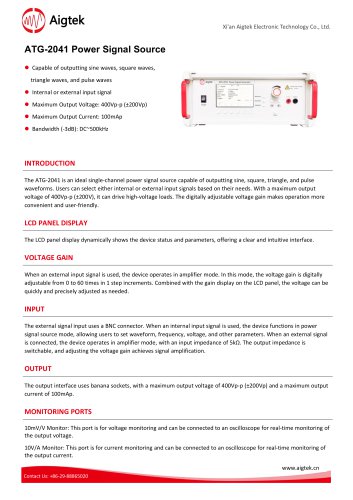 ATG-2041 Power Signal Source
2 Pages
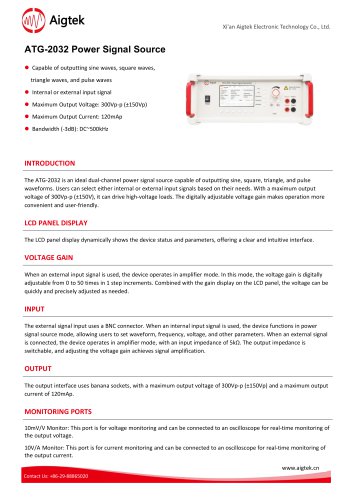 ATG-2032 Power Signal Source
2 Pages
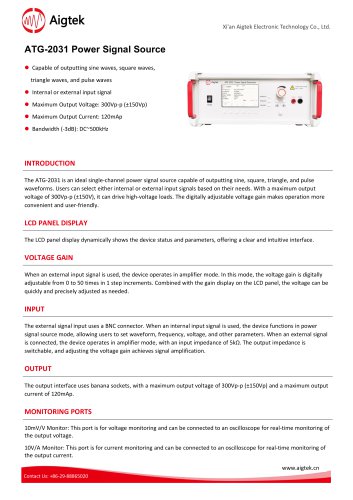 ATG-2031 Power Signal Source
2 Pages
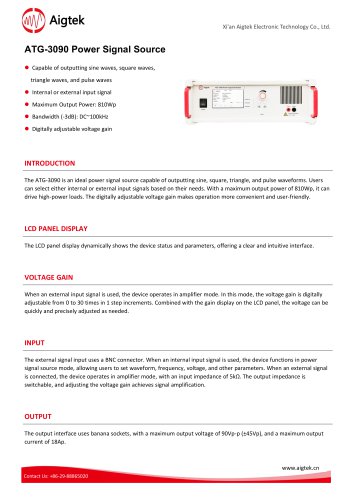 ATG-3090 Power Signal Source
2 Pages
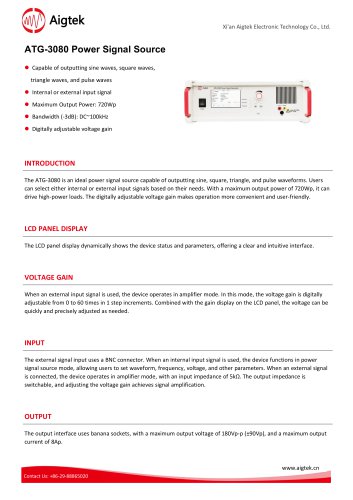 ATG-3080 Power Signal Source
2 Pages
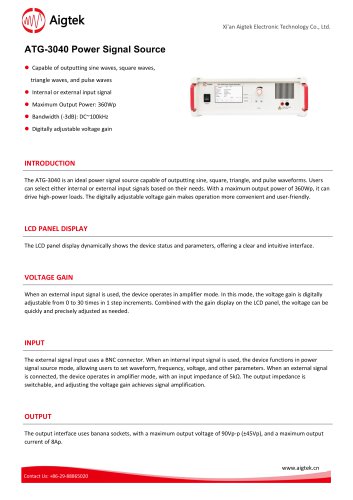 ATG-3040 Power Signal Source
2 Pages
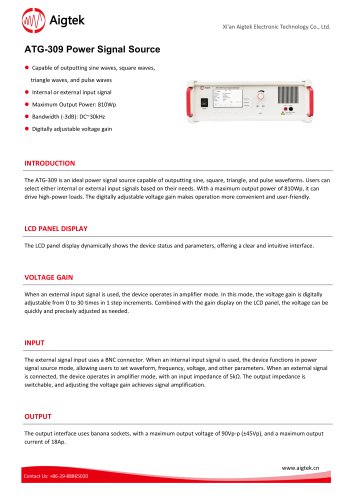 ATG-309 Power Signal Source
2 Pages
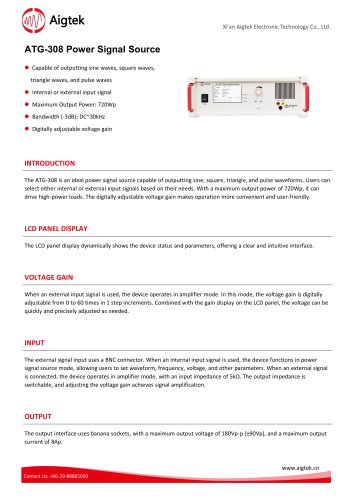 ATG-308 Power Signal Source
2 Pages
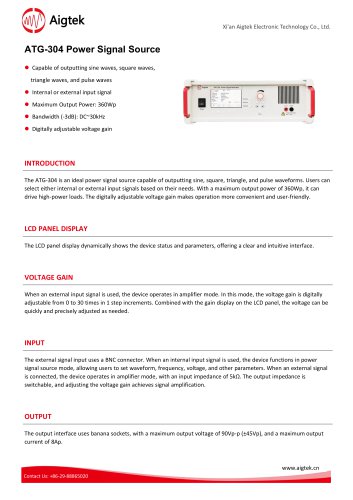 ATG-304 Power Signal Source
2 Pages
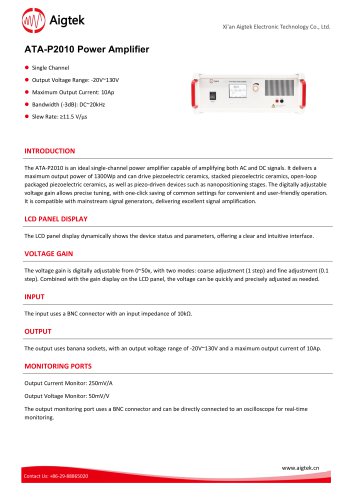 ATA-P2010 Power Amplifier
2 Pages
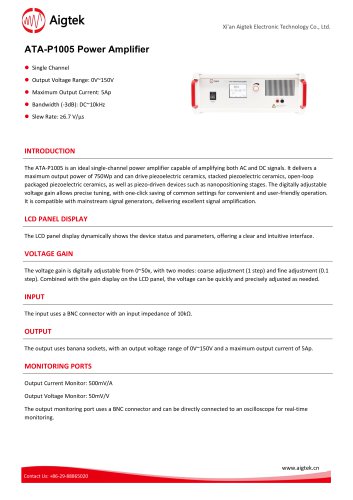 ATA-P1005 Power Amplifier
2 Pages
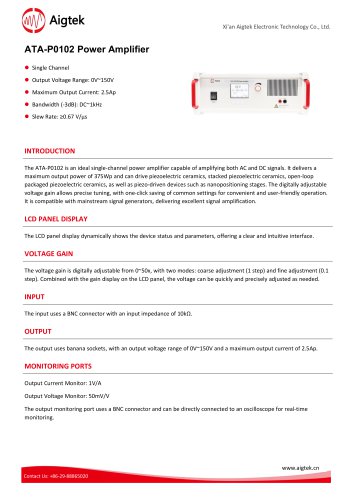 ATA-P0102 Power Amplifier
2 Pages
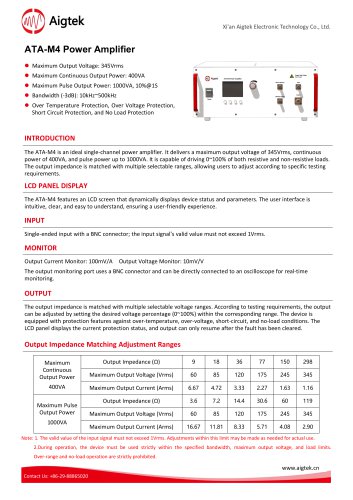 ATA-M4 Power Amplifier
2 Pages
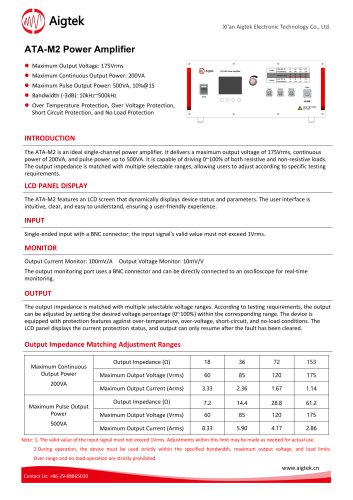 ATA-M2 Power Amplifier
2 Pages
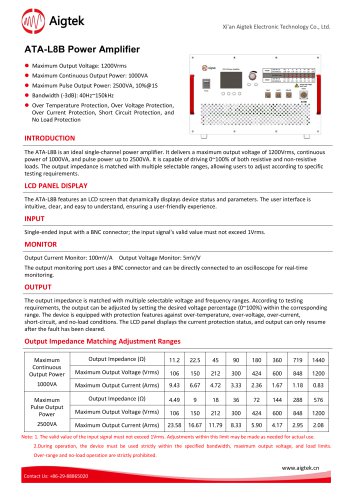 ATA-L8B Power Amplifier
2 Pages
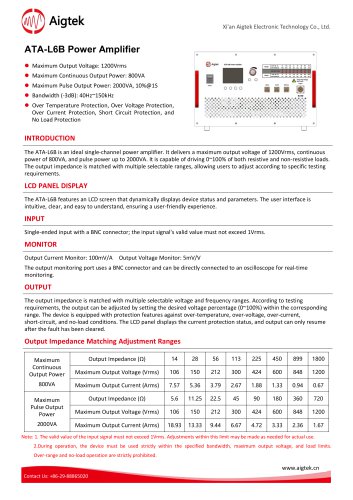 ATA-L6B Power Amplifier
2 Pages
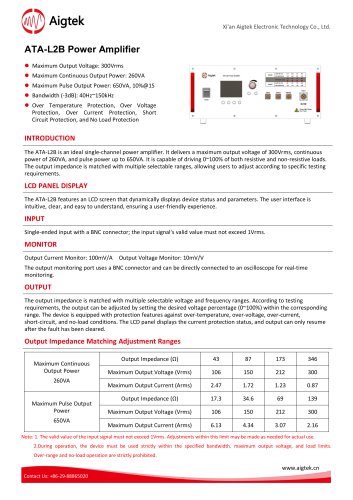 ATA-L2B Power Amplifier
2 Pages
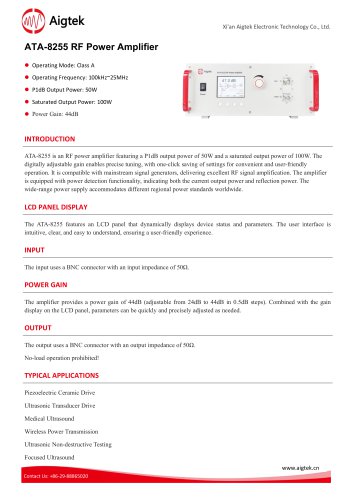 ATA-8255 RF Power Amplifier
2 Pages
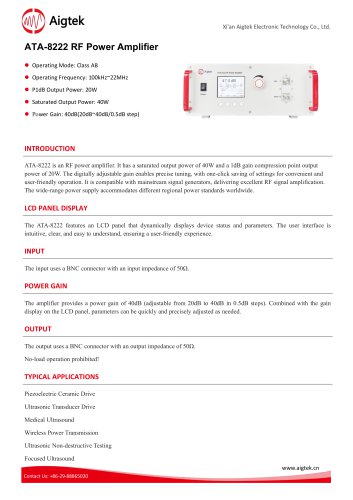 ATA-8222 RF Power Amplifier
2 Pages
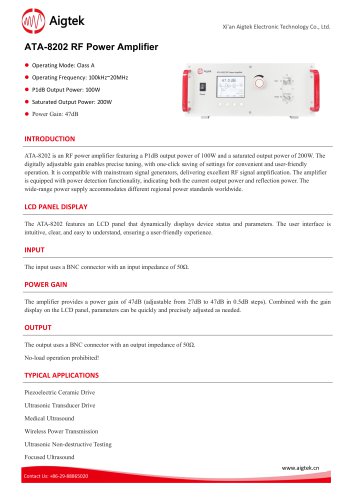 ATA-8202 RF Power Amplifier
2 Pages
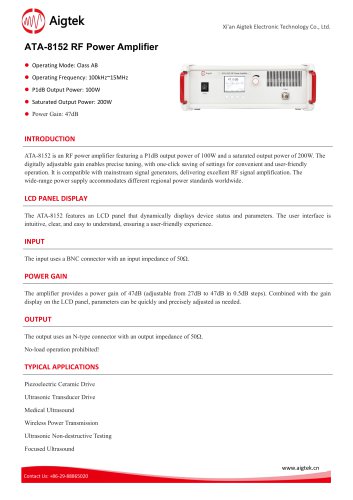 ATA-8152 RF Power Amplifier
2 Pages
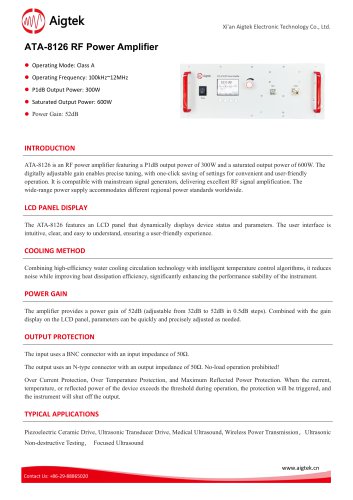 ATA-8126 RF Power Amplifier
2 Pages
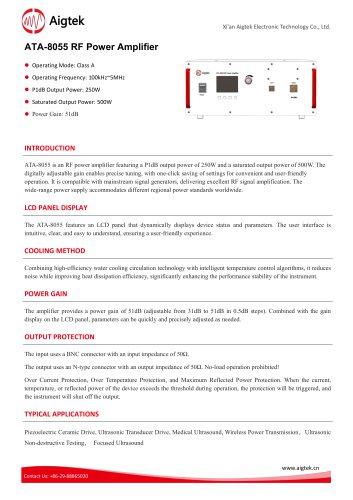 ATA-8055 RF Power Amplifier
2 Pages
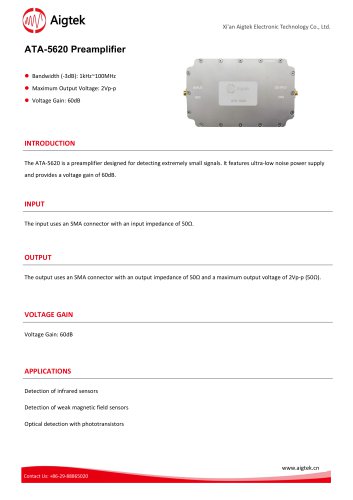 ATA-5620 Preamplifier
2 Pages
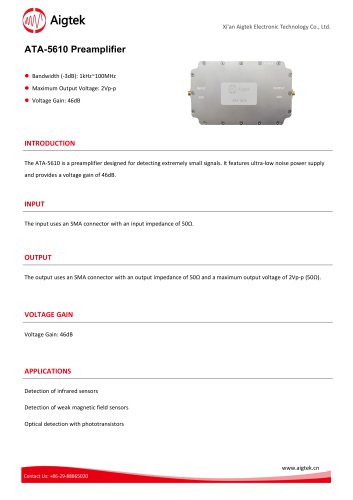 ATA-5610 Preamplifier
2 Pages
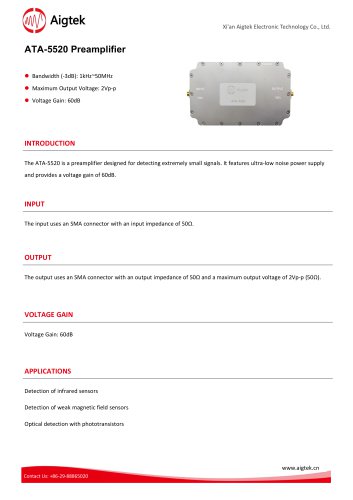 ATA-5520 Preamplifier
2 Pages
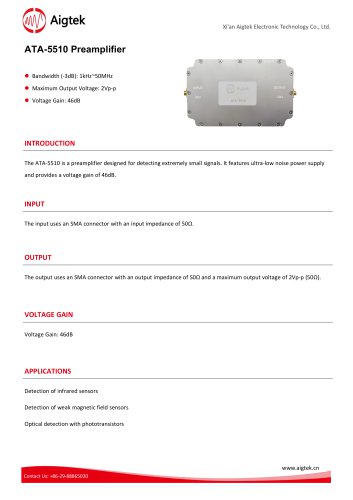 ATA-5510 Preamplifier
2 Pages
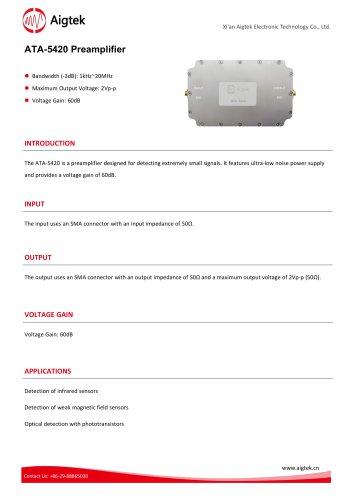 ATA-5420 Preamplifier
2 Pages
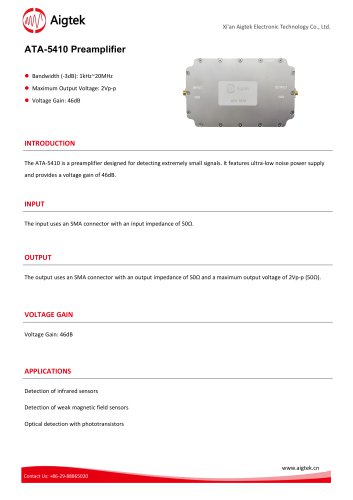 ATA-5410 Preamplifier
2 Pages
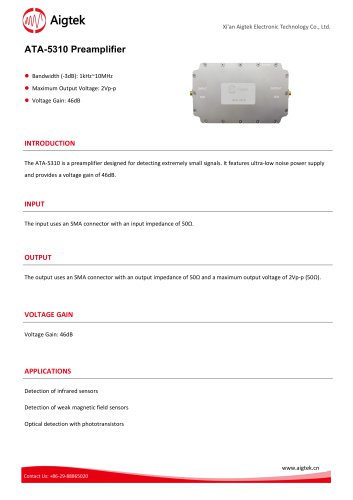 ATA-5310 Preamplifier
2 Pages
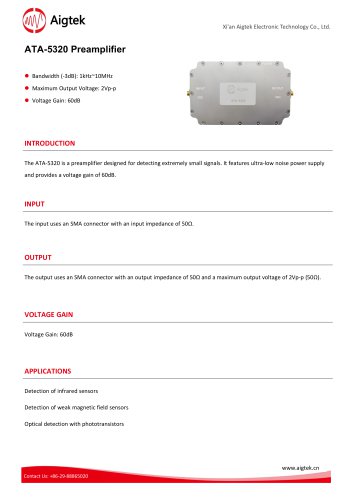 ATA-5320 Preamplifier
2 Pages
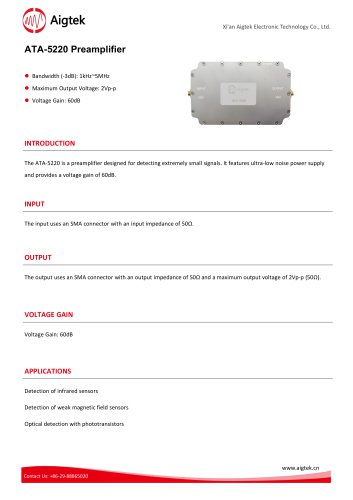 ATA-5220 Preamplifier
2 Pages
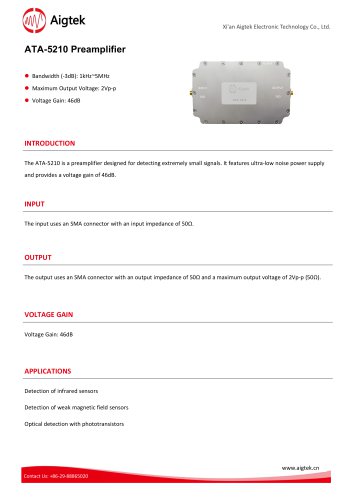 ATA-5210 Preamplifier
2 Pages
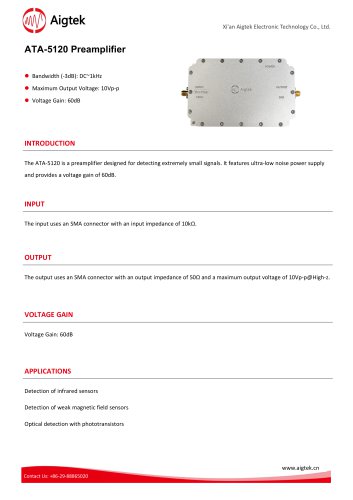 ATA-5120 Preamplifier
2 Pages
 ATA-318 Power Amplifier
2 Pages
 ATA-318 Power Amplifier
2 Pages
 ATA-315 Power Amplifier
2 Pages
 ATA-314 Power Amplifier
2 Pages
 ATA-8152 RF Power Amplifier
2 Pages
 ATA-8126 RF Power Amplifier
2 Pages
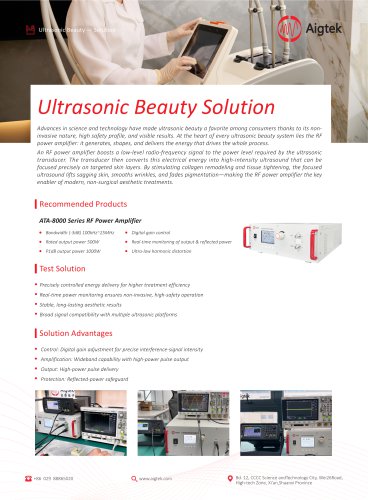 ATA-8061 RF Power Amplifier
2 Pages
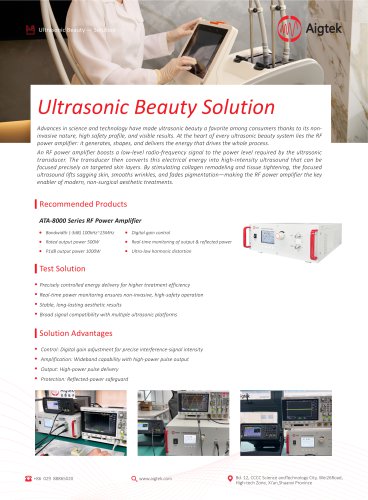 ATA-8055 RF Power Amplifier
2 Pages
 ATA-8222 RF Power Amplifier
2 Pages
 ATA-8202 RF amplifier
2 Pages
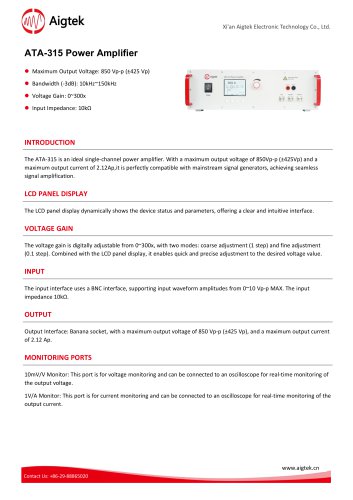 ATA-315 Power Amplifier
2 Pages
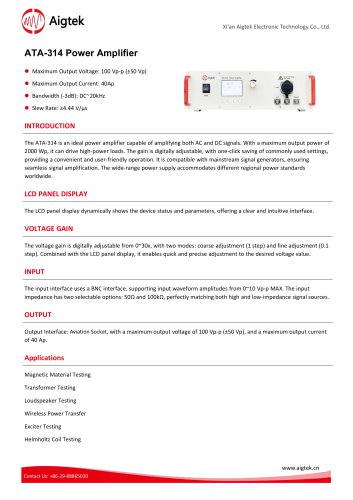 ATA-314 Power Amplifier
2 Pages
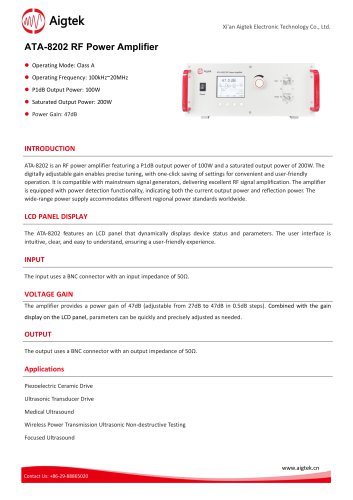 ATA-8202 RF Power Amplifier
2 Pages
 ATA-3090C Power Amplifier
2 Pages
 ATA-3080C Power Amplifier
2 Pages
 ATA-3040C Power Amplifier
2 Pages
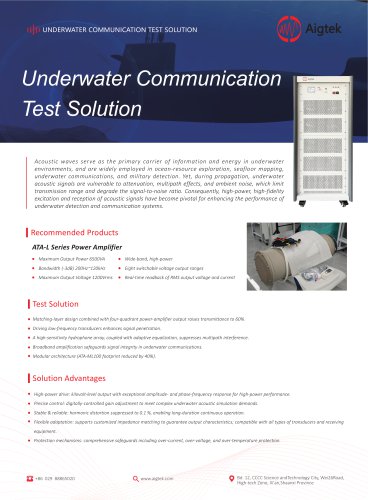 L8B Power Amplifier
2 Pages
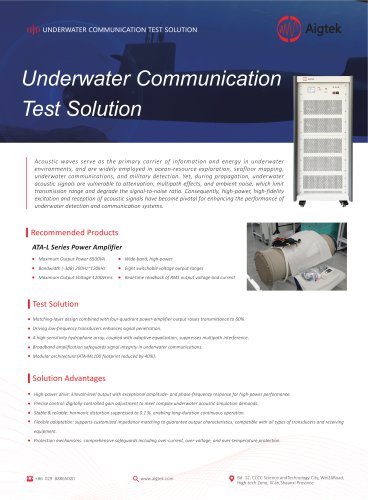 L2B Power Amplifier
2 Pages
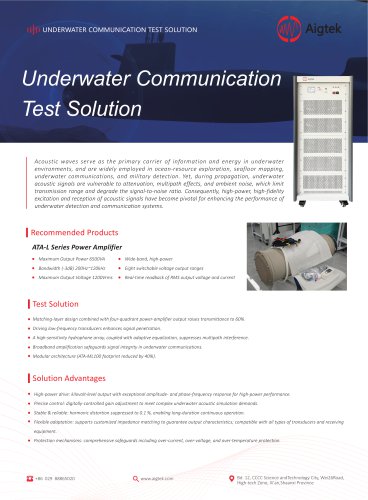 L20 Power Amplifier
2 Pages


















- Power supply unit
- DC power supply
- AC/DC power supply
- Signal amplifying integrated circuit
- Tabletop power supply
- Generator
- Variable-output power supply
- Rack-mount power supply
- Electronic equipment power supply
- High-voltage power supply
- Digital power supply
- Measuring amplifier
- Voltage amplifier
- Stabilized power supply
- DC amplifier
- Electronic amplifier
- Pulse generator
- High-voltage amplifier
- Low-noise amplifier