
- Catalogs
- Xi'an Aigtek Electronic Technology Co., Ltd.
- ATA-3090C Power Amplifier


- Company
- Products
- Catalogs
- News & Trends
- Exhibitions
ATA-3090C Power Amplifier

ATA-3090C Power Amplifier
The document discusses solutions for ultrasonic non-destructive testing, focusing on the ATA-3000 Series Power Amplifier and its applications in soft magnetic material testing.
The ATA-3000 Series Power Amplifier is highlighted for its four-quadrant output performance, reliability under extreme conditions, and intelligent regulation. Key features include high voltage output, wide bandwidth, and robust protection mechanisms. It is compatible with multiple standards and offers a user-friendly interface.
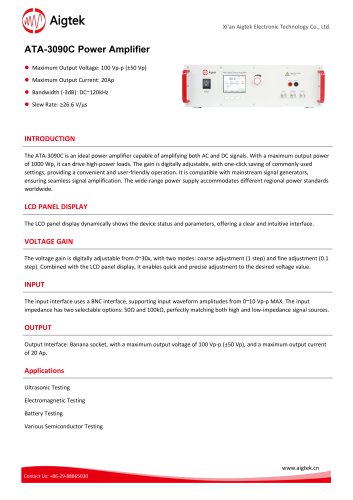
- Maximum Output Power: 1000Wp
- Bandwidth (-3dB): DC~120kHz
- Maximum Output Voltage: 160Vpp
- Maximum Output Current: 20Ap
This testing is crucial for evaluating magnetic performance in motors, transformers, and sensors. Key metrics include permeability, saturation flux density, coercivity, and core loss. Accurate testing requires controlled environmental conditions and precise measurement techniques.
- Case 1: Silicon Steel Material Testing
Involves characterizing silicon-steel performance using a controlled electromagnetic environment. A signal generator and power amplifier create an alternating magnetic field, with real-time data visualization and logging. - Case 2: Magnetic Classification and Detection of Microparticles
The ATA-3000 series enhances detection sensitivity in experiments involving magnetic particles, aiding in classification and analysis. This has applications in materials science and biomedicine.
Catalog excerpts

SOFT MAGNETIC MATERIAL TESTING – SOLUTIONS 超声无损检测—解决方案 Soft Magnetic Material Testing Solutions Soft-magnetic testing is essential for evaluating magnetic performance and is widely applied in the R&D and production of motors, transformers, sensors and other electronic devices. The key metrics are permeability, saturation flux density, coercivity and core loss.Standard techniques include DC and AC magnetic characterization. Environmental temperature, sample dimensions and other variables must be tightly controlled to guarantee accuracy. For example, high-frequency loss measurements must account for skin-effect influences. The resulting data guide materialformulation optimization and device design, forming a vital bridge that moves soft-magnetic materials from the laboratory to full-scale production. Recommended Products ATA-3000 Series Power Amplifier Maximum Output Power 1000Wp Maximum Output Current 20Ap Arbitrary waveform amplification Maximum Output Voltage 160Vpp Adjustable voltage gain Test Solution Solution Advantages Four-Quadrant Output Performance Evaluation. Output: High voltage and wide bandwidth to cover every soft-magnetic test scenario. Extreme-Condition Reliability, Overload & Protection Mechanisms. Protection: Over-voltage, short-circuit, and over-temperature safeguards. Digitally Controlled Voltage Gain with Intelligent Regulation. Compatibility: Multi-standard adaptation and open connectivity. Key Parameters for System Integration. Human–Machine Interface: Intelligent, user-friendly operation. Bd. 12, CCCC Science andTechnology City, Wei26Road, High-tech Zone,
Open the catalog to page 1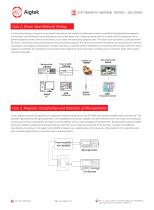
SOFT MAGNETIC MATERIAL TESTING – SOLUTIONS Case 1: Silicon Steel Material Testing In silicon-steel testing, the goal is to accurately characterize the material’s performance under a controlled alternating electromagnetic environment, with dedicated control software as the orchestration hub. A signal generator delivers a stable 100 kHz waveform that is power-amplified and then drives an excitation coil to create the alternating magnetic field. The silicon-steel specimen is positioned within this field; a Hall probe continuously measures the surrounding magnetic flux density and streams the data...
Open the catalog to page 2All Xi'an Aigtek Electronic Technology Co., Ltd. catalogs and technical brochures
 ATG-2161 Power Signal Source
2 Pages
 ATG-2082 Power Signal Source
2 Pages
 ATG-2081 Power Signal Source
2 Pages
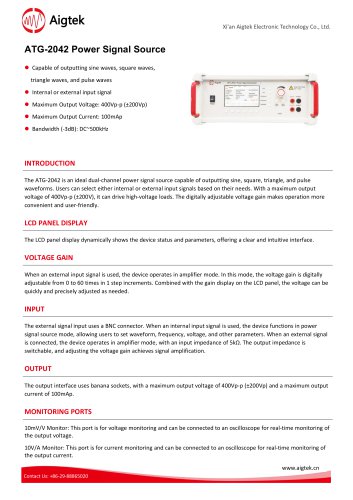 ATG-2042 Power Signal Source
2 Pages
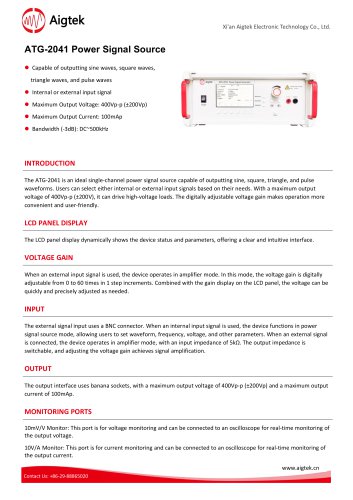 ATG-2041 Power Signal Source
2 Pages
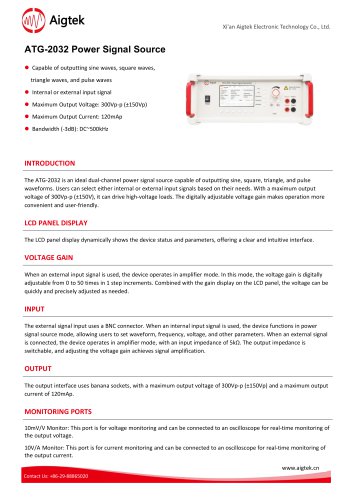 ATG-2032 Power Signal Source
2 Pages
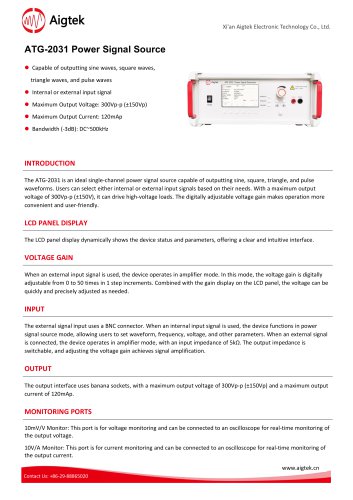 ATG-2031 Power Signal Source
2 Pages
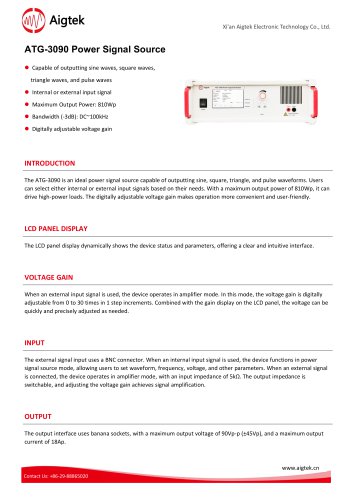 ATG-3090 Power Signal Source
2 Pages
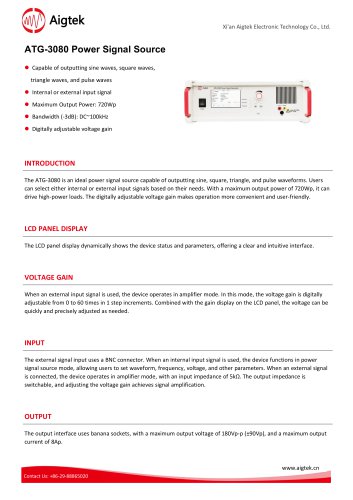 ATG-3080 Power Signal Source
2 Pages
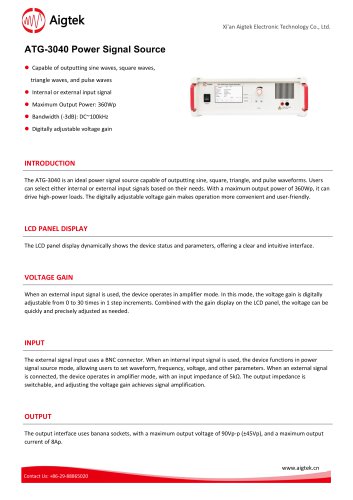 ATG-3040 Power Signal Source
2 Pages
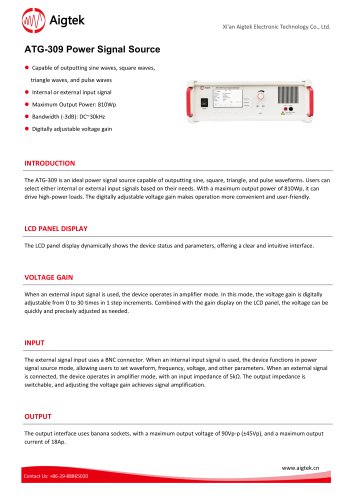 ATG-309 Power Signal Source
2 Pages
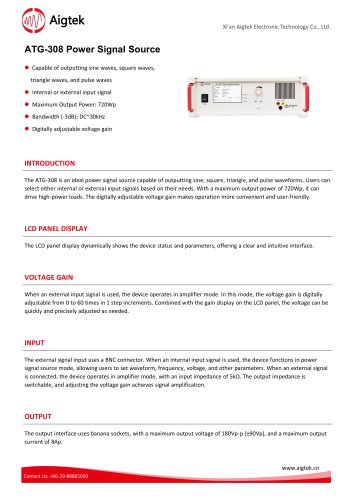 ATG-308 Power Signal Source
2 Pages
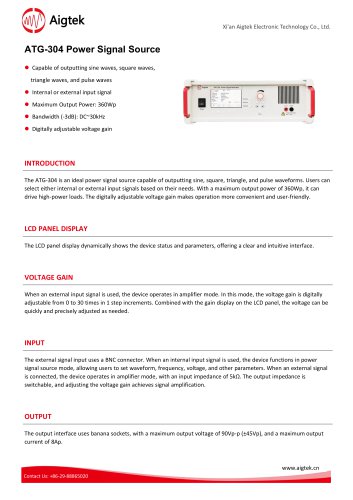 ATG-304 Power Signal Source
2 Pages
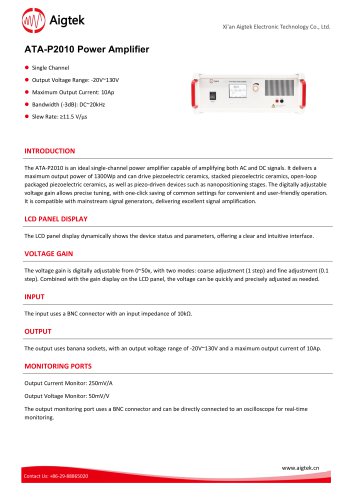 ATA-P2010 Power Amplifier
2 Pages
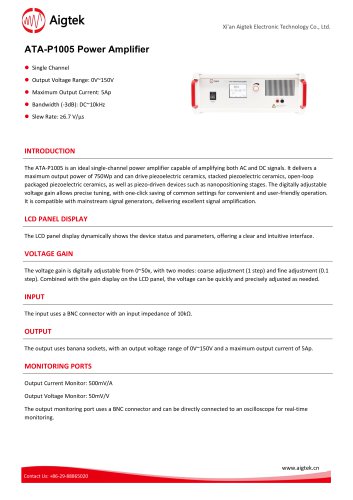 ATA-P1005 Power Amplifier
2 Pages
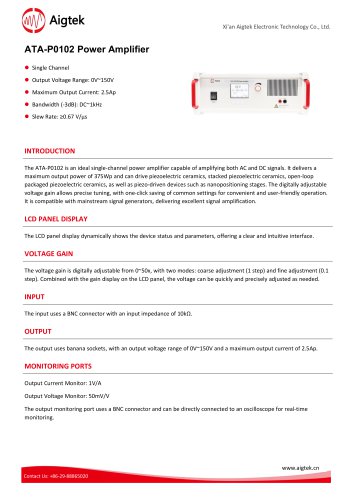 ATA-P0102 Power Amplifier
2 Pages
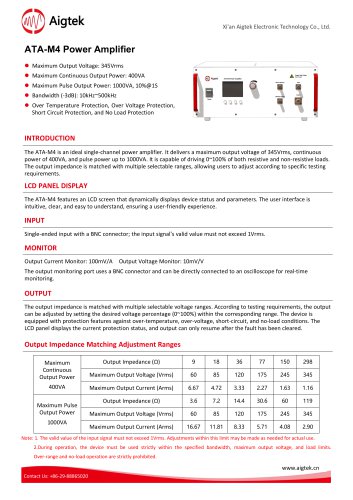 ATA-M4 Power Amplifier
2 Pages
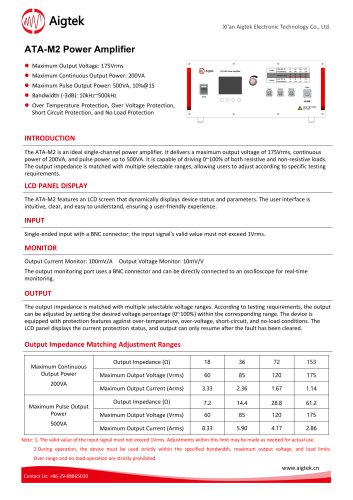 ATA-M2 Power Amplifier
2 Pages
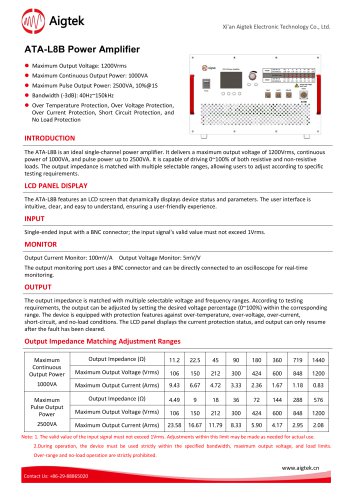 ATA-L8B Power Amplifier
2 Pages
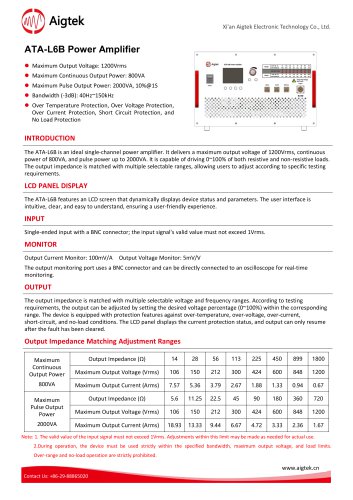 ATA-L6B Power Amplifier
2 Pages
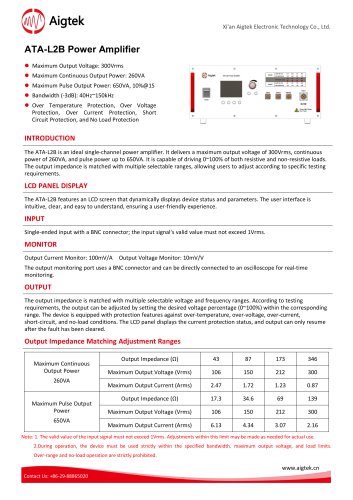 ATA-L2B Power Amplifier
2 Pages
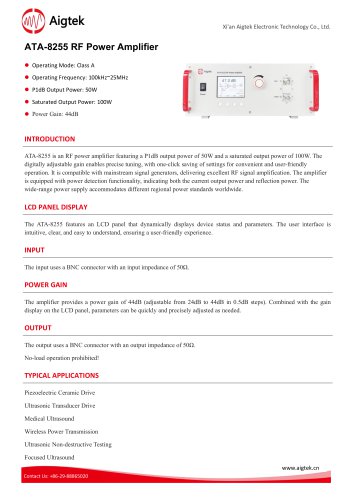 ATA-8255 RF Power Amplifier
2 Pages
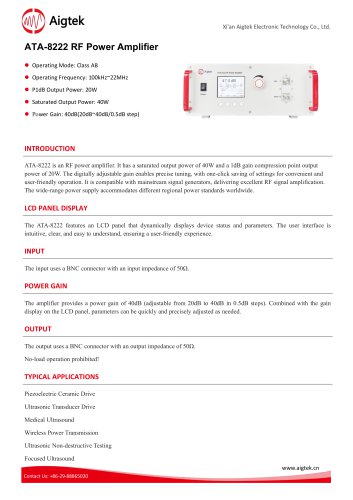 ATA-8222 RF Power Amplifier
2 Pages
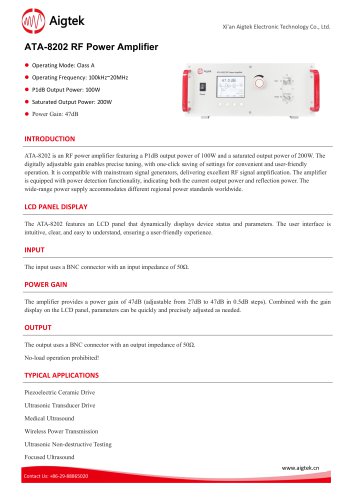 ATA-8202 RF Power Amplifier
2 Pages
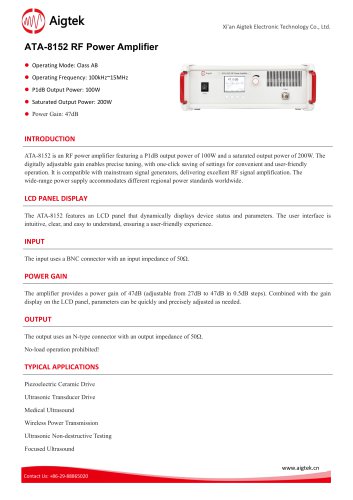 ATA-8152 RF Power Amplifier
2 Pages
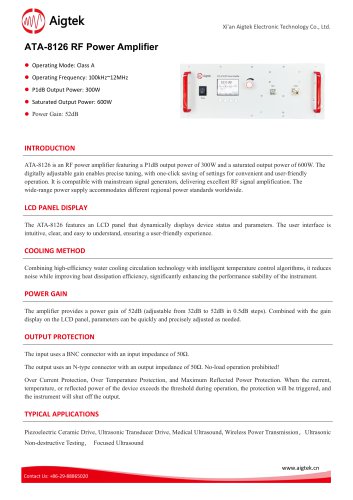 ATA-8126 RF Power Amplifier
2 Pages
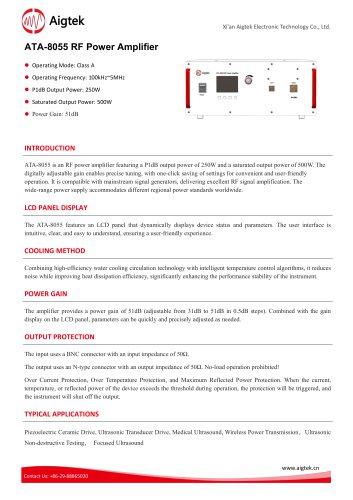 ATA-8055 RF Power Amplifier
2 Pages
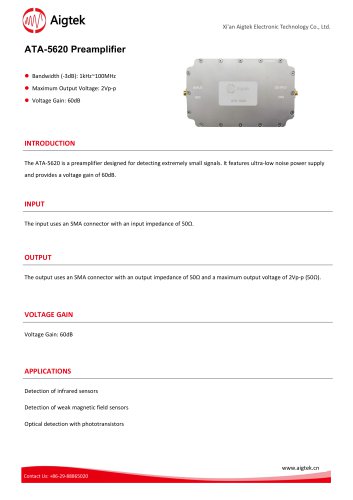 ATA-5620 Preamplifier
2 Pages
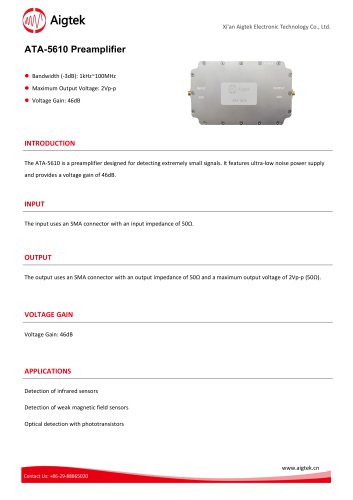 ATA-5610 Preamplifier
2 Pages
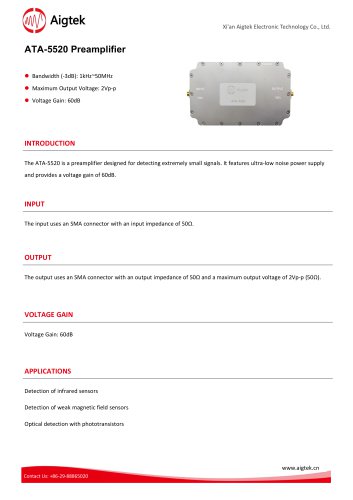 ATA-5520 Preamplifier
2 Pages
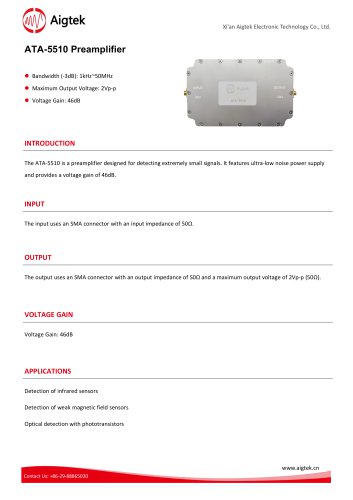 ATA-5510 Preamplifier
2 Pages
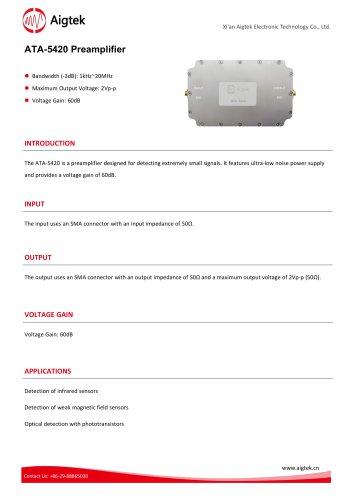 ATA-5420 Preamplifier
2 Pages
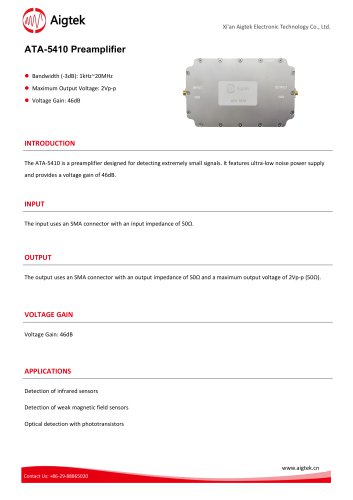 ATA-5410 Preamplifier
2 Pages
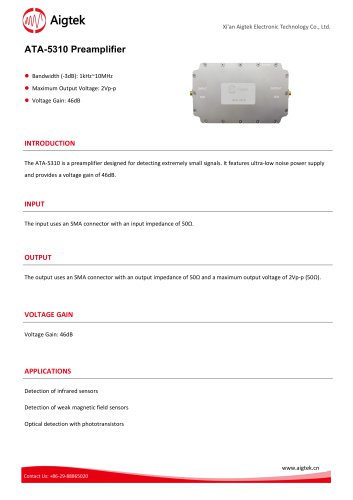 ATA-5310 Preamplifier
2 Pages
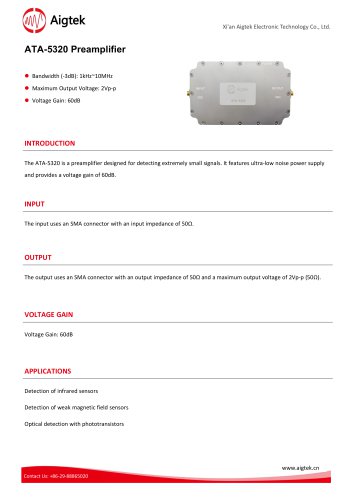 ATA-5320 Preamplifier
2 Pages
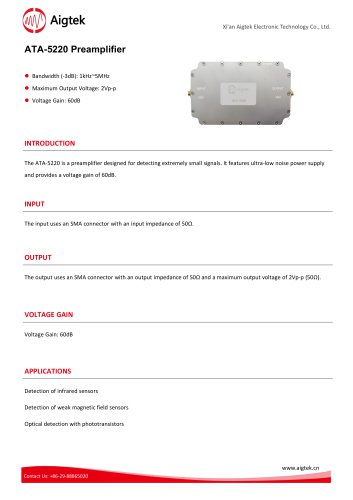 ATA-5220 Preamplifier
2 Pages
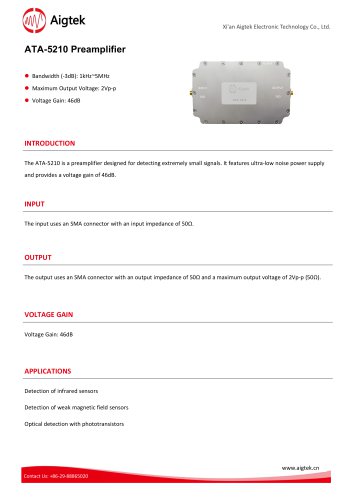 ATA-5210 Preamplifier
2 Pages
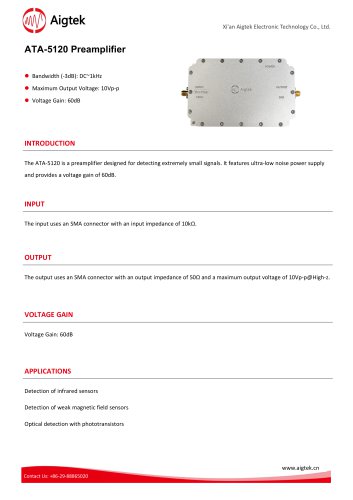 ATA-5120 Preamplifier
2 Pages
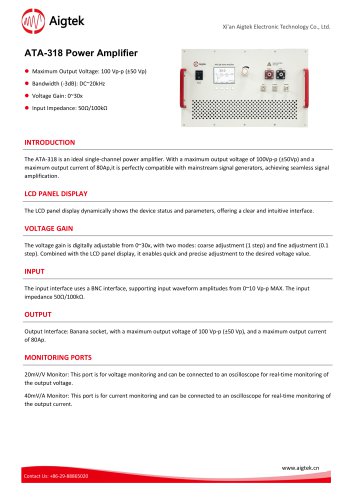 ATA-318 Power Amplifier
2 Pages
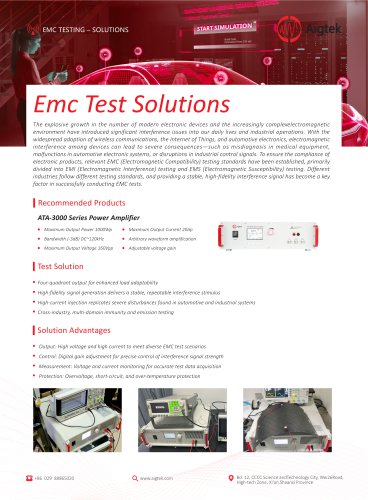 ATA-318 Power Amplifier
2 Pages
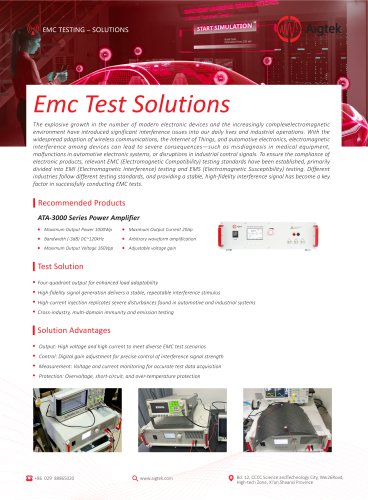 ATA-315 Power Amplifier
2 Pages
 ATA-314 Power Amplifier
2 Pages
 ATA-8152 RF Power Amplifier
2 Pages
 ATA-8126 RF Power Amplifier
2 Pages
 ATA-8061 RF Power Amplifier
2 Pages
 ATA-8055 RF Power Amplifier
2 Pages
 ATA-8222 RF Power Amplifier
2 Pages
 ATA-8202 RF amplifier
2 Pages
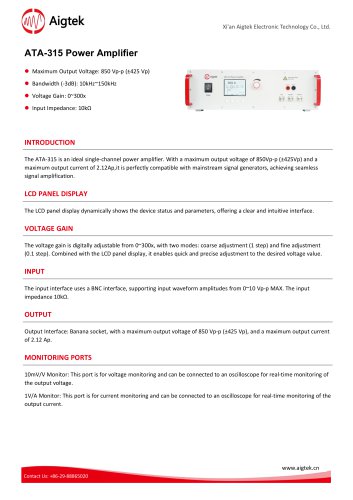 ATA-315 Power Amplifier
2 Pages
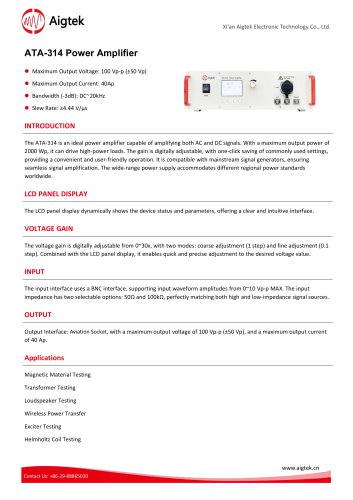 ATA-314 Power Amplifier
2 Pages
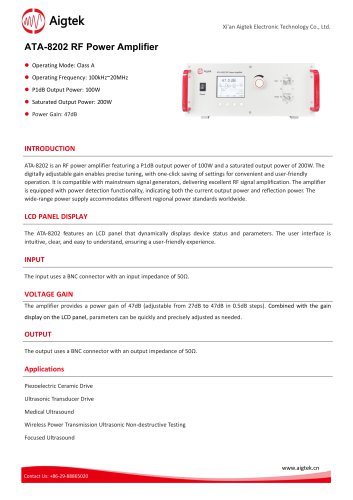 ATA-8202 RF Power Amplifier
2 Pages
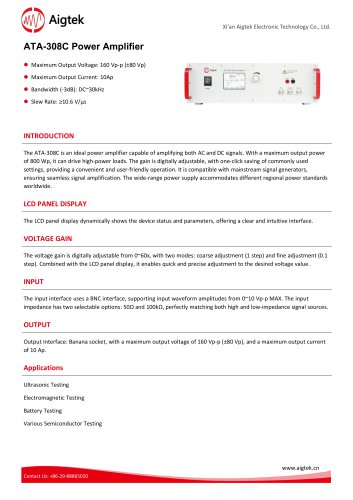
 ATA-3080C Power Amplifier
2 Pages
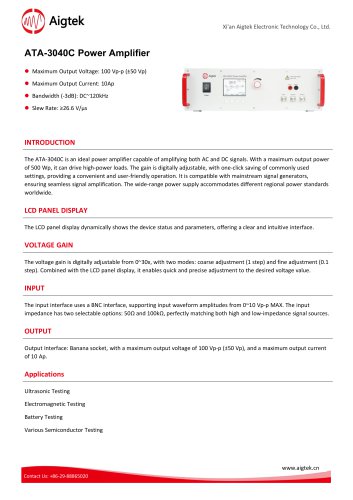
 ATA-3040C Power Amplifier
2 Pages
 L8B Power Amplifier
2 Pages
 L2B Power Amplifier
2 Pages
 L20 Power Amplifier
2 Pages
























- Power supply unit
- DC power supply
- AC/DC power supply
- Signal amplifying integrated circuit
- Tabletop power supply
- Variable-output power supply
- Rack-mount power supply
- Electronic equipment power supply
- High-voltage power supply
- Digital power supply
- Measuring amplifier
- Voltage amplifier
- Stabilized power supply
- DC amplifier
- Electronic amplifier
- Pulse generator
- High-voltage amplifier
- Low-noise amplifier