


The secrets of inclination measurement

The secrets of inclination measurement
This document, "The Secrets of Inclination Measurement," explores the field of inclination measurement in metrology, highlighting its applications in machine tool alignment and dam monitoring. WYLER AG, a leader since 1928, aims to enhance understanding and usage of these tools.
- History: Inclination measurement has evolved from ancient construction and navigation tools to modern electronic sensors.
- Definition: Inclination is the angle between two lines, with absolute and relative distinctions.
- Units: Units include degrees, radians, and micrometers per meter (µm/m).
- Measurement Techniques: Techniques involve absolute zero determination and gravitational force effects.
WYLER AG offers systems and software for inclination measurement, including precision spirit levels and digital sensors.
Products include precision spirit levels, electronic instruments, and digital sensors for specific applications.
Used in machine tool alignment, surface flatness measurement, and structural monitoring.
Includes zero adjustment techniques and use of clinometers for precise measurements.
Systems like nivelsWiss and BlueSystem offer high precision for industrial applications.
Analog and digital sensors like Zerotronic are used in dynamic environments.
Devices like BlueLevel-2D provide digital measurement evaluation.
Used for precise monitoring of structures like dams and bridges.
WYLER AG provides digital displays and interfaces for data transmission and measurement display.
Catalog excerpts

WYLER AG, Inclination measuring systems Im Holderli 13, CH - 8405 WINTERTHUR (Switzerland) E-Mail: [email protected] Web: www.wylerag.com
Open the catalog to page 1
Compendium inclination measurement WYLER AG, Winterthur / Switzerland Page General introduction to inclination measurement History of inclination measurement Units in inclination measurement Relationship between degrees/arcmin and µm/m Correlation between the most common units (SI) Correlation between the most common units in inclination measurement What are positive and negative inclinations? The absolute zero by means of a reversal measurement Effect of gravitational force and compensation with inclination measuring instruments Measuring uncertainty Length of measuring bases Absolute measurement...
Open the catalog to page 3
Compendium inclination measurement WYLER AG, Winterthur / Switzerland 6.3
Open the catalog to page 4
Compendium inclination measurement WYLER AG, Winterthur / Switzerland Preface There are already a great number of reference books on the topic of measuring techniques – so why the need for a book on inclination measuring technology? The title of this book “The Secrets of Inclination Measurement“ addresses the essential point: Inclination measurement holds a niche position within the field of metrology. The potential of this measuring technology remains largely unmet since it – and the implementation and interpretation of measurements for quality improvement – continue to be areas about which...
Open the catalog to page 5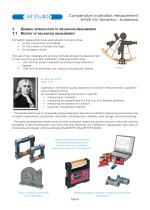
Compendium inclination measurement WYLER AG, Winterthur / Switzerland 1. General introduction to inclination measurement 1.1 History of inclination measurement Inclination measurement was used already in ancient times • for the construction of buildings • for the creation of simple city maps • for navigation at sea The use of new materials and working methods allowed the development of new and more accurate inclination measuring instruments • 1727 the first sextant was built according to Isaac Newton‘s designs • 1760 the first theodolite was made by the physicist Dollond Especially in the field...
Open the catalog to page 6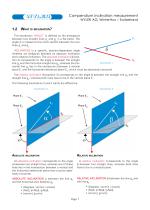
Compendium inclination measurement WYLER AG, Winterthur / Switzerland 1.2 What is inclination? The expression “ANGLE“ is defined as the divergence between two straight lines g and g in a flat plane. The 1 2 angle d is created at the cross section between the two lines g and g . 1 INCLINATION is a specific, position-dependent angle whereas we distiguish between an absolute inclination and a relative inclination. The absolute inclination (illustration 2) corresponds to the angle a between the straight Illustration 1 line g3 and the horizontal straight line g4, whereas the horizontal line g lies...
Open the catalog to page 7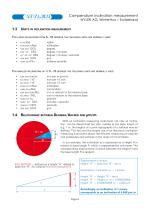
Compendium inclination measurement WYLER AG, Winterthur / Switzerland 1.3 Units in inclination measurement For large inclinations from 5...10 degrees the following units are normally used: • • • • • • • x.xx Rad xxxx.xx mRad xxx.xxx° DEG xxx° xx‘ DEG xx° xx‘ xx“ DEG xxx.xxx GON xxxx.xx A%o radian milliradian degree degree / minutes degree / minutes / seconds gon artillerie-permille For smaller inclinations up to 5...10 degrees the following units are normally used: • • • • • • • • • • • xxx.xxx mm/m xx.xxxx “/10“ xx.xxxx “/12“ xxxx.xx mRad xxxx.xx µRad xxx.xxx mm/REL xx.xxxx “/REL xxxx.xx %o...
Open the catalog to page 8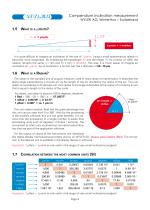
Compendium inclination measurement WYLER AG, Winterthur / Switzerland 1.5 What is a ^m/m? It is quite difficult to imagine an inclination of the size of 1 jm/m. Using a small mathematical relation it becomes more imaginable. By multiplying the baselength "L” and the height "h” by a factor of 1000, the relation remains the same, L = 1km and h = 1 mm (1 mm/km). This way, it is much easier to imagine an inclination of 1 jm/m. As an illustration, a human hair has a diameter of 50...70 pm. 1.6 What is a Radian? The radian is the standard unit of angular measure, used in many areas of mathematics....
Open the catalog to page 9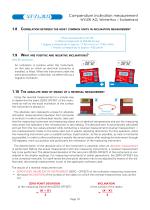
Compendium inclination measurement WYLER AG, Winterthur / Switzerland 1.8 Correlation between the most common units in inclination measurement 1 Rad corresponds to 57.30° 1 mRad corresponds to 206.26 Arcsec 1 degree corresponds to approx. 17.45 mm/m or 17.45 mRad 1 Arcsec corresponds to approx. 4.85 µm/m 1.9 What are positive and negative inclinations? WYLER definition: An inclination is positive when the instrument, on that side on which an electrical connector is installed, is lifted. When the instrument under the same precondition is declined, we define this as a negative inclination. 1.10...
Open the catalog to page 10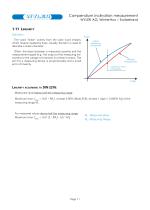
Compendium inclination measurement WYLER AG, Winterthur / Switzerland The word “linear“ comes from the Latin word linearis, which means created by lines. Usually, the term is used to describe a linear character. output measuring instrument Often, the basis between a measured quantity and the measurement signal (e.g. the output of the measuring instrument or the voltage of a sensor) is a linear function. The aim for a measuring device is proportionality and a small error of linearity. nominal characteristic maximum error of linearity Linearity according to DIN 2276: Measured value below half the...
Open the catalog to page 11
Compendium inclination measurement WYLER AG, Winterthur / Switzerland 1.12 Effect of gravitational force and compensation with inclination measuring instruments The inclination displayed by inclination measuring instruments and sensors is based on the gravitation. However, gravitational force is not consistent around the globe, varying with latitude and height above sea level. Furthermore, variations of the density in the lithosphere cause additional local deviations. As an example, the gravity at sea level is • 9.78033 m/s2 at the equator • 9.80620 m/s2 at 45 degree of latitude • 9.83219 m/s2...
Open the catalog to page 12
Compendium inclination measurement WYLER AG, Winterthur / Switzerland 1.13 Measuring uncertainty In order to perform a valid measurement, a number of conditions must be fulfilled. A precision measurement is usually dependent on the influence of a number of different factors, such as: • Temperature of the object and ambient temperature • Temperature of the measuring instrument • Linearity of the measuring instrument • Vibrations • Dirt, dust, and humidity These influencing factors are generally termed measuring uncertainty. What are the major causes of measuring uncertainty? Measurements can never...
Open the catalog to page 13All WYLER AG catalogs and technical brochures
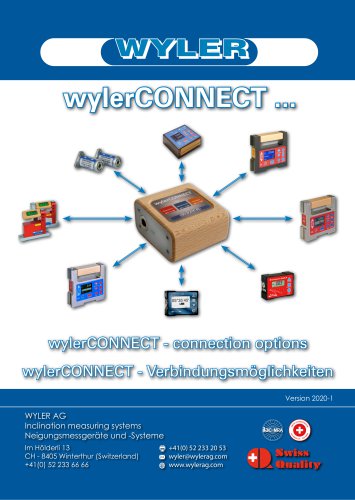 wylerConnect Connection option
12 Pages
 LED CROSS / LED-KREU
3 Pages
 wylerCONNECT The interface
4 Pages
 Clinotronic S
8 Pages
 Monitoring Wind Turbines
2 Pages
 WYLER CATALOGUE 2018
216 Pages
 WYLER miniCATALOGUE 2017
16 Pages
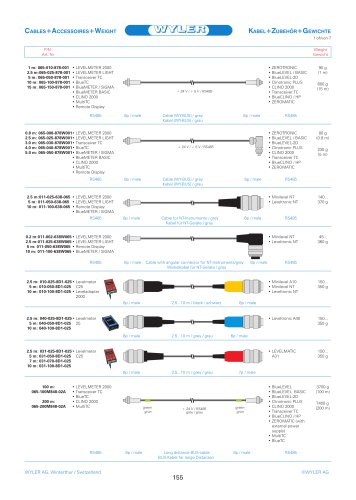 CABLES + ACCESSOIRES
4 Pages
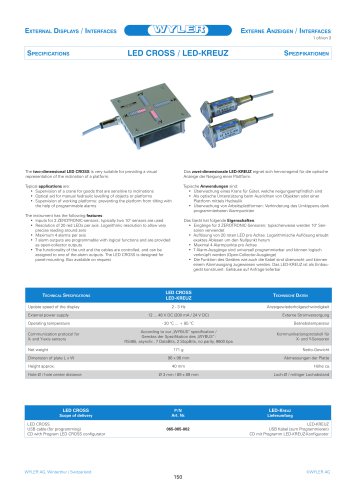 CROSS
CROSS3 Pages
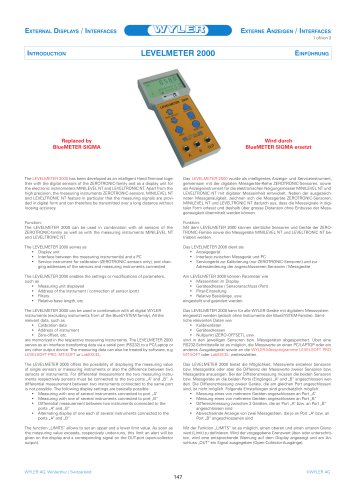 LEVELMETER 2000
3 Pages
 BlueMETER BASIC
3 Pages
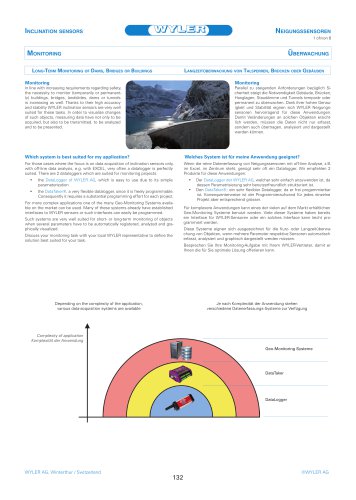 Monitoring
6 Pages
 BlueSYSTEM SIGMA
14 Pages
 wylerDYNAM
4 Pages
 ZEROTRONIC
46 Pages
 LEVELMATIC
4 Pages
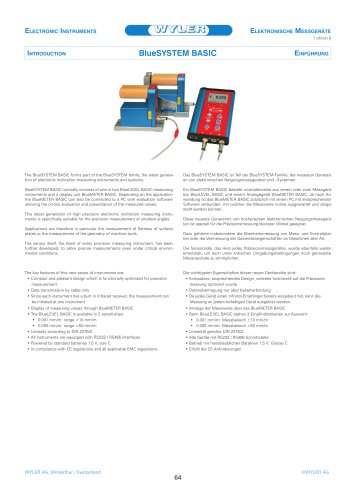 BlueSYSTEM BASIC
8 Pages
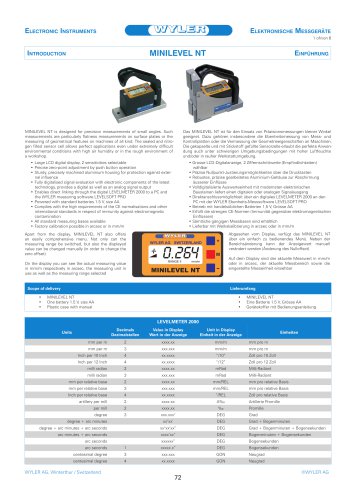 MINILEVEL NT
6 Pages
 nivelSWISS-D
3 Pages
 nivelSWISS
3 Pages
 BlueCLINO High Precision
8 Pages
 CLINO 2000
4 Pages
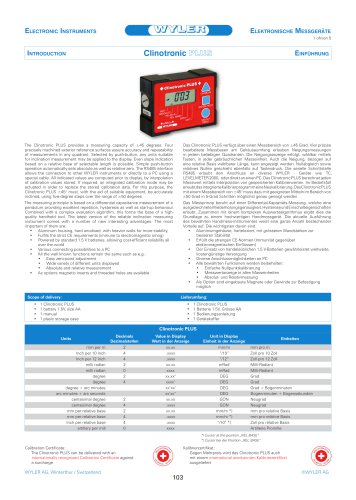 Clinotronic PLUS
5 Pages
 BluemETER SIgma
7 Pages
 WYLER AG
104 Pages
 WYLER PRODUCTS
215 Pages
 WW76
WW761 Page
 WW59
WW591 Page
 WW53
WW531 Page
 WW56
WW561 Page
 WW55
WW551 Page
 BlueCLINO
4 Pages
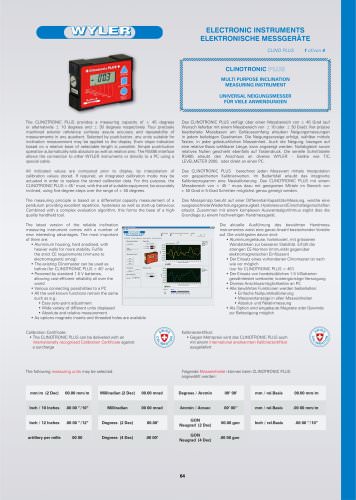 CLINO_PLUS
4 Pages
 clino2000
2 Pages
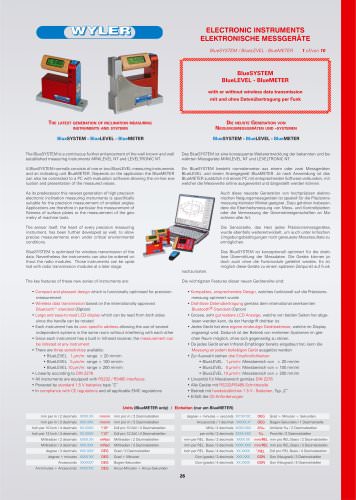 katalog_2012/BlueSYSTEM
11 Pages
 Wasserwaagen_Clinometer_alle
26 Pages
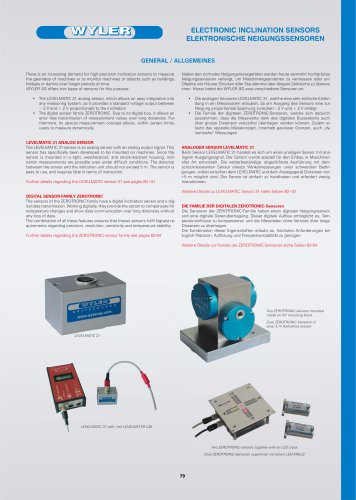 katalog_2012/Sensoren
22 Pages
 WYLER CATALOGUE 2009
166 Pages


Archived catalogs
 Wyler Catalogue 2006
164 Pages
- Management software solution
- Monitoring software solution
- LED display panel
- Measurement software
- Interface software
- Electronic display panel
- Programmable display system
- Digital inclination sensor
- Machine software
- 2-axis tilt sensor
- Compact display panel
- 2D software
- Compact converter
- Multi-axis tilt sensor
- Serial converter
- High-precision tiltmeter
- Analog inclination sensor
- 1-axis tilt sensor