
- Catalogs
- WUNTRONIC GmbH
- Radiometer For Research, Laboratory and Industrie

Radiometer For Research, Laboratory and Industrie

Radiometer For Research, Laboratory and Industrie
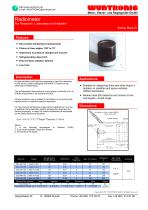
- Non-contact temperature measurement with selectable view angles of 150° or 75°.
- Resistant to pressure changes and vacuum conditions.
- Self-generating output in millivolts (mV), proportional to incident heat flux.
- Flare and flame radiation detection capabilities.
- Cost-effective solution for various applications.
- Measurement of solar and other radiation in satellites and space vehicles, suitable for aerospace applications (e.g., NASA).
- Detection and control of radiant heat (IR) across a broad range of targets.
| Model | Sensitivity (mV/(BTU/ft²sec)) | Max. mV Output | Impedance (Ω) | Max. Body Temperature | Accuracy |
|---|---|---|---|---|---|
| Mark IV-301 | 30 | 20 | 60 | 121°C (250°F) | ±3% |
| Mark IV-602 | 60 | 40 | 75 | 121°C (250°F) | ±3% |
| Mark IV-1004 | 100 | 70 | 100 | 121°C (250°F) | ±3% |
| Mark IV-601 | 60 | 40 | 120 | 121°C (250°F) | ±3% |
| Mark IV-1202 | 120 | 80 | 150 | 121°C (250°F) | ±3% |
| Mark IV-2004 | 200 | 140 | 200 | 121°C (250°F) | ±3% |
Catalog excerpts
Mess-, Steuer- und Regenerate GmbH For Research, Laboratory and Industrie Features: • Non-contact temperature measurement • Choice of view angles: 150° or 75° • Impervious to pressure changes and vacuum • Self-generating utput (mV) • Flare & Flame radiation detector • Low Cost lts high sensitivity and rapid time response to heat Rux absorbed by the sensor surface distinguish the MARK IV models as top performance Radiometers. The self-generated thermoelectric output signal in millivolts (mV) is directly proportional to the incident heat flux. Various windows may be added for elimination of convective heat transfer and/or or selective spectral responses. For Non-Contact temperature measurement applications, one has to establish the temperature relation between the target and the Sensor empirically, or apply the classic relationship as expressed by the Stefan-Boltzmann equation: Q/A=.1714*10-8 *F*E* (T4target-T4sensor) BTU/ft2Hr Where: T: is the absolute temperature in Rankine (t"460) F: Form factor between Target and Sensor E: Emissivity of the target • Suitable for measuring Solar and other object's radiation in satellites and space vehicles (NASA) Aerospace • Radiant heat (IR) detection and control of various targets—broad range Window/Filter Material Quartz Sapphire BaF2 Germanium Mylar Others Transmission Range, pm 0.18 to 3.5 0.15 to 5.5 0.15 to 11.5 2 to 110.31 to 50 request Copyright© 2017 WUNTRONIC GmbH. All Rights Reserved
Open the catalog to page 1All WUNTRONIC GmbH catalogs and technical brochures
 Universal Heat Flow Sensors
2 Pages
 Reference Magnet series MT
2 Pages
 USB Gauss / Tesla Meter
8 Pages
 CobraMax CompuScope Family
4 Pages


Archived catalogs
 Accelerometer
2 Pages
 Transmitter
4 Pages
 Data Logger
7 Pages
 Pulse Generator
2 Pages
 Frequency Counter
5 Pages


- Acceleration sensor
- Triaxial acceleration sensor
- Compact accelerometer
- Neodymium magnet
- Cylindrical magnet
- Magnetic sensor
- Miniature accelerometer
- Hall effect magnetic sensor
- Gaussmeter
- Magnetometer
- Heat flux sensor
- Portable gaussmeter
- Teslameter gaussmeter
- USB gaussmeter
- Hand-held gaussmeter
- High-temperature heat flux sensor
- Thin-film heat flux sensor
- Magnetic pole finder
- Angular accelerometer
- Electronic magnetic pole finder