
- Catalogs
- WUNTRONIC GmbH
- Pulse / Pattern Generators w. 50- 125MHz

Pulse / Pattern Generators w. 50- 125MHz

Pulse / Pattern Generators w. 50- 125MHz
Catalog excerpts

http://www.wuntronic.de e-mail: [email protected] Mess-, Steuer- und Regelgeräte GmbH Pulse Generator TTL and Word Generator with 16 or 24 individually controlled digital output lines (TTL levels) Model PulseBlaster Features: Standard clock frequency of 100 MHz High-speed models available, currently up to 400 MHz clock frequency up to 24 independently controlled output channels 25 mA output current per channel DB-25 bracket mounted connector IDC headers for on-board access to signals. Programmable pulse lengths from five clock periods (50 ns at 100 MHz), to 7 days per instruction. Pulses as short as 2.5 ns are available (BlasterESR-PRO model at 400 MHz). 10 ns pulse resolution (at 100 MHz) 512 or 32k pulse program instruction words Advanced pulse-program flow control: nested loops (16 levels), branches, and subroutines 20-bit loop counter (over 1 million events/repetitions) Software and hardware triggering, up to 5 MHz retriggering frequency PCI or Compact-PCI form factor. Description: PulseBlaster® is a general-purpose intelligent multichannel programmable TTL pulse / pattern generator system and an advanced timing. Its versatility and performance are of particular value in NMR, MRI, NQR, ICR, Solids, Mass Spectrometry, Ultrasound, and related resonance and test applications. The entire logic design is contained in a single silicon chip, qualifying it as a system-on-a-chip (SOC) design – the industry’s first and only design of this kind. Implemented in state-of-the-art programmable silicon, its innovative design has many unique and attractive features, such as small size, high speed, increased functionality, and low cost. Applications: Complex, high-speed, multi-channel pulse, pattern, and word generation. Customers’ applications have included Order Informations: PulseBlaster systems can be delivered with selected clock frequencies, number of output bits/channels, and program memory space. Clock frequencies: 50, 80, 100, or 125 MHz Number of output bits/channels: 12, 16, or 24 Program memory space: 512 or 32k 80-bit words Order Number Key: Experiment and process control in Electron, Nuclear and Quadrupolar Resonances (ESR, NMR, NQR) Mass Spectrometry and related test technologies Ultrasound, radar, medical imaging Laser control in advanced communication Solid state physics experiments Nanomagnetism and spintronics applications Robotics and process synchronization Data bus emulation General laboratory use PulseBlaser: Numbers of Channels (16): Frequency (100 MHz): Memory (32k): Copyright© 2009 WUNTRONIC GmbH. All Rights Reserved
Open the catalog to page 1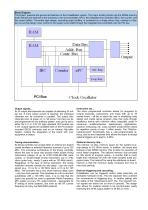
Block Diagram The Figure presents the general architecture of the PulseBlaster system. The major building blocks are the SRAM memory (both internal and external to the processor), the microcontroller (uPC), the integrated bus controller (IBC), the counter, and the output buffers. The entire logic design, excluding output buffers, is contained on a single silicon chip, making it a System-on-a-Chip design. User control to the system is provided through the integrated bus controlled over the PCI bus. Output signals... Its 24 output bits/channels are capable of delivering 25 mA per pin. If more output...
Open the catalog to page 2All WUNTRONIC GmbH catalogs and technical brochures
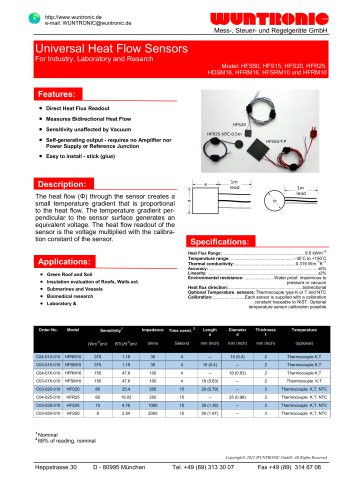 Universal Heat Flow Sensors
2 Pages
 Reference Magnet series MT
2 Pages
 USB Gauss / Tesla Meter
8 Pages
 CobraMax CompuScope Family
4 Pages


Archived catalogs
 Accelerometer
2 Pages
 Transmitter
4 Pages
 Data Logger
7 Pages
 Pulse Generator
2 Pages
 Frequency Counter
5 Pages


- Acceleration sensor
- Triaxial acceleration sensor
- Compact accelerometer
- Neodymium magnet
- Cylindrical magnet
- Magnetic sensor
- Miniature accelerometer
- Hall effect magnetic sensor
- Gaussmeter
- Magnetometer
- Heat flux sensor
- Portable gaussmeter
- Teslameter gaussmeter
- USB gaussmeter
- Hand-held gaussmeter
- High-temperature heat flux sensor
- Thin-film heat flux sensor
- Magnetic pole finder
- Angular accelerometer
- Electronic magnetic pole finder