
- Catalogs
- Würschum GmbH Dosieranlagen-Abfüllmaschinen
- Capping Machines


Capping Machines

Capping Machines
Overview of Capping Machines
The document provides detailed information on various types of capping machines designed for securely and precisely sealing containers such as jars, bottles, cans, and canisters. These machines are suitable for both screw caps and press caps, with capping tools adapted to the specific cap types. The machines operate either pneumatically or electrically, and some models support multiple cap sizes with a single capping tool.
Main Sections and Summaries
1. Manual Screwers (SPH-2 and SEH-2 Series)
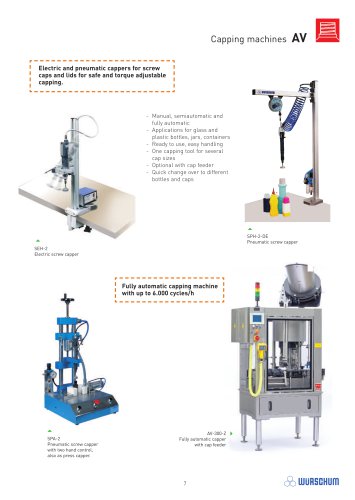
- Models: SPH-2-DE (pneumatic), SEH-2-DE (electric), SPH-2 (pneumatic), SEH-2 (electric)
- Working Method: The operator places the cap manually on the container and either presses the container upwards against the screwer (SPH-2/SEH-2) or pulls the screwer down onto the cap (SPH-2-DE/SEH-2-DE). The screwer motor is height and angle adjustable to optimize ergonomics.
- Functionality: The screwing process starts upon contact and stops automatically when the preset torque is reached, ensuring consistent sealing quality.
2. Pneumatic and Semi-Automatic Cappers (SPA-2, SPA-20, DE-1, AV-100, SEH-2)
- Models and Operation Modes: SPA-2 (pneumatic, semi-automatic), SPA-20 (semi-automatic), DE-1 (pneumatic press capper), AV-100 (automatic), SEH-2 (manual)
- Safety Features: SPA-2 and DE-1 include two-hand safety controls to ensure operator safety during operation.
- Working Method: Caps are placed manually on containers, which are then positioned and clamped between jaws. The screwer or press capper moves down to apply the cap. The screwing or pressing stops automatically upon reaching the preset torque or after a set time. The jaws release, and the sealed container is removed manually or via conveyor.
- Capacity: Capacities vary by model, ranging from 600 to 2000 containers per hour, depending on product and filling volume.
- Materials: All product-contact parts are made of stainless steel (types 1.4305 or 1.4571 / 304 S or 316 Ti) ensuring hygiene and durability.
3. Semi-Automatic and Automatic Capping Systems (SPA-20 and AV-200)
- SPA-20 Semi-Automatic Capper: Caps are manually placed on containers, which are fed by a conveyor to the capping station. Containers are centered and clamped if necessary. The screwer applies the cap with automatic torque control and releases the container to the conveyor after capping.
- AV-200 Fully Automatic Capper: Equipped with a cap sorting and feeding system, this machine automatically places caps on containers, centers and clamps them, screws the caps with torque control, and transports the sealed containers away via conveyor.
Critical Parameters and Features
- Torque Control: All screwers and cappers feature adjustable torque settings with automatic stop to ensure consistent and secure sealing.
- Ergonomics: Manual screwers have adjustable height and angle to suit operator needs.
- Safety: Two-hand safety controls on pneumatic models prevent accidental operation.
- Capacity: Machine throughput depends on product type and filling volume, with capacities up to 2000 units per hour.
- Material Quality: Stainless steel parts in contact with the product ensure hygiene and corrosion resistance.
Summary Table of Models and Working Methods
| Model | Operation Mode | Capacity (units/hour) |
|---|---|---|
| SPH-2-DE | Manual (pneumatic) | Up to 1200* |
| SEH-2-DE | Manual (electric) | Up to 1200* |
| SPA-2 | Semi-automatic (pneumatic) | 600* |
| SPA-20 | Semi-automatic | 1500* |
| AV-100 | Automatic | 2000* |
| DE-1 | Semi-automatic (pneumatic press capper) | 1200* |
* Capacities depend on filling quantity and product characteristics.
Manufacturer Information
Würschum GmbH, located in Ostfildern, Germany, has over 40 years of experience in manufacturing manual, semi-automatic, and automatic filling and capping machines. Contact details include phone, fax, email, and website for further inquiries.
Conclusion
This document comprehensively outlines the specifications, operating principles, safety features, and capacities of various capping machines suitable for different production scales and container types. The machines emphasize precise torque control, operator safety, and adaptability to multiple cap sizes, ensuring reliable and efficient packaging operations.
Catalog excerpts
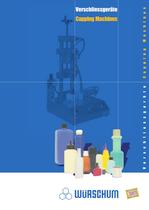
C a p p i n g e t ä r e g s s e i l h c s Capping Machines r Verschliessgeräte M a c h i n e s Seite 2 e 16.09.2007 16:36 Uhr V *wü-verschliess
Open the catalog to page 1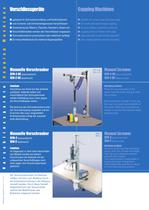
Capping Machines geeignet fiir Schraubverschltisse und Eindriickdeckel zum sicheren und drehmomentgenauen Verschliessen Anwendung bei Glasern, Flaschen, Kanistern, Dosen etc. VerschlieReinsatze werden den Verschltissen angepasst Schraubermotoren pneumatisch oder elektrisch betatigt Ein VerschlieBeinsatz fiir mehrere KappengrrjRen suitable for screw caps and press caps for a safe and exact torque capping for jars, bottles, containers, cans etc. capping tools are fitted to the caps pneumatically or electrically operated One capping tool for several cap sizes Manuelle Verschrauber Verschluss von...
Open the catalog to page 2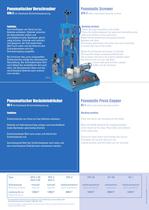
Pneumatischer Verschrauber Gebinde aufsetzen. Gebinde zwischen anschlieRend beide Starttaster gleich- zeitig driicken. Gebinde wird zentriert fahrt nach unten und bei Andruck des Schraubvorgang ausgelost Bei Erreichen des zuvor eingestellten Drehmomentes erfolgt die automatische Abschaltung. Der Schraubermotor fahrt nach Ablaut der einstellbaren Zeit nach oben, die Spannbacken lösen und das verschlossene Gebinde kann entnom- Pneumatic Screwer SPA-2 with a two-hand security control Working method: Place the cap manually on the bottle. Place the bottle between the jaws and thereafter press both...
Open the catalog to page 3
*wü-verschliess 16.09.2007 16:36 Uhr Seite 1 Halbautomatischer Verschließer Semi-automatic Capper SPA-20 für Schraubverschlüsse und Eindrückdeckel SPA-20 for screw caps and press caps Funktion: Verschluss von Hand auf das Gebinde aufsetzen. Gebinde wird vom Transportband dem Verschließer zugeführt. Die Gebinde werden zentriert und bei Bedarf gespannt. Schraubermotor fährt nach unten und bei Andruck des Schraubermotors wird der Schraubvorgang ausgelöst. Working method: Place the cap manually on the bottle. The bottle is fed by the conveyor to the capper. The bottle will be positioned and when...
Open the catalog to page 4All Würschum GmbH Dosieranlagen-Abfüllmaschinen catalogs and technical brochures
Archived catalogs
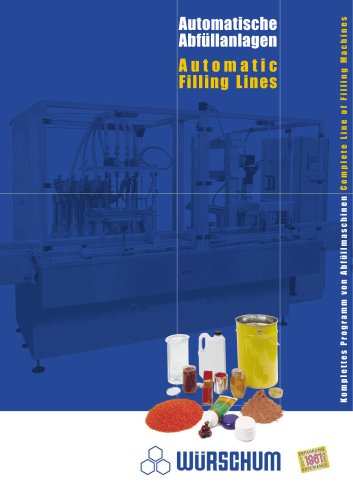 Automatic Filling Lines
4 Pages
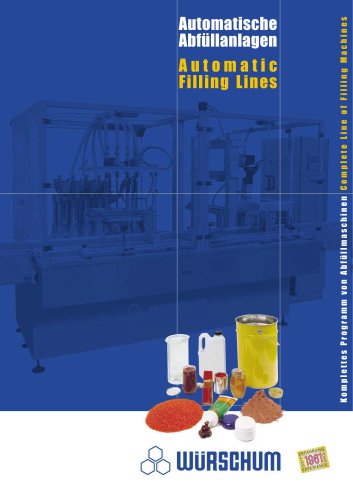 automatic line
4 Pages
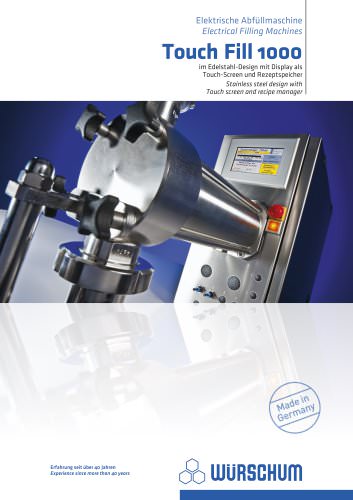 Machine in Motion
4 Pages
 Filling Machine
4 Pages
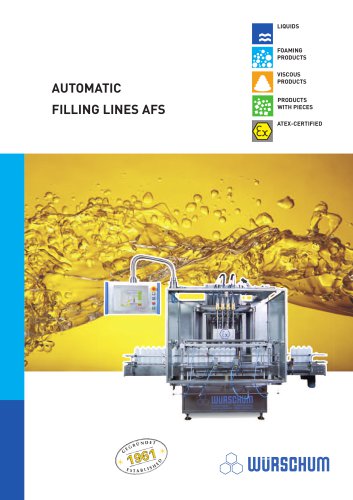 Filling Line AFS Modular
4 Pages
 Filling Machine H 500-P
4 Pages
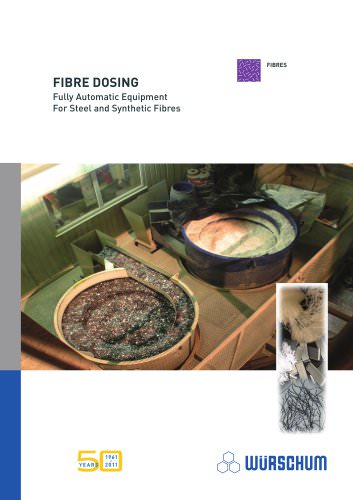 Fibre-Dosing MD 400
8 Pages



- Pump
- Industrial pump
- Pump with electric motor
- Stationary pump
- Chemical pump
- Vessel
- Cylinder
- Fully automatic filling machine
- Metal tank
- Liquids filling line
- Stainless steel vessel
- Filling system for the food industry
- Liquids dispensing system
- Bottle filling system
- Gear pump
- Food filler
- Volumetric filling line
- Automatic dispensing system
- Semi-automatic filling system
- Filler for the chemical industry