
- Catalogs
- WMH Herion Linner Gruppe
- Transmissions

Transmissions

Transmissions
- Toothing Quality: Gears have a toothing quality of 6 e25 or 7 e25.
- Material: Primarily 1.7131 (16MnCr5), with some gears made from 1.0503 (C45).
- Pressure Angle: Consistent at 20°.
- Helix Angle: Helical gears have a helix angle of 19° 31'42''.
- Carburizing and Hardening: Gears are carburized and teeth are induction hardened to 60 HRC.
- Case Hardening: Some gears are case hardened for durability.
- Grinding: Master gears are ground for precision.
- Milling: Spur gears with milled teeth are available, with specifications for hubbed and hubless designs.
- Modules: Available in modules from 1.0 to 6.0.
- Teeth Count: Gears with teeth counts from 12 to 120.
- New Products: Some gears are marked as new additions.
- Dimensions: Detailed dimensions for each gear, including outer diameter (da), pitch diameter (d), and base diameter (db).
- Part Numbers: Unique part numbers for identification and ordering.
Provides detailed specifications for racks and pinions, including materials like C45 soft, C45 hardened, and 16MnCr5 case-hardened. Describes tooth systems as straight or helical and provides maximum permissible torques with adequate lubrication at 1.5 m/s speed.
Procedures:
Assembly instructions for racks include positioning and fixing with clamps, mounting with screws at defined torque, and checking parallelism and alignment. Outlines formula for calculating center distance between pinion and rack.
Standards and Recommendations:
Emphasizes lubrication importance for linear guideways, ballscrews, pinions, racks, and chain drives. Recommends specific lubrication systems like FlexxPump and provides technical data.
Relubrication Units:
Highlights FlexxPump series for grease and oil applications, with specifications on volume, pressure, and operating conditions. Units can be controlled via LCD or FlexxMaster, with battery or direct 24V grid connection options.
Accessories and Customization:
Offers various accessories like tube connectors and mounting pieces. Custom solutions and a range of standard lubrication greases for different applications.
Key Data from Tables:
Tables provide part numbers, module sizes, and specifications for mounting pieces with straight and helical teeth. Lists relubrication units with details on outlets and machine control system compatibility.
- Cartridge/Bellow Capacity: 400 cm³
- Applicable Grease: Up to NLGI 3
- Voltage Requirement: 24 Volt
- Pressure: 70 bar
- Oil Storage Capacity: Up to 500 ml
- Dimensions: 130x130x35 mm
- Material: Polycarbonate
- Controls up to 4 FlexxPump units, each with a maximum of 4 outlets
- Low current consumption: Max 0.3A at 24VDC
- Relubrication units are delivered without lubricant; bellows with grease are available as accessories.
- FlexxPump units with more than two outlets require the FlexxMaster control module for programming and monitoring.
- Splitters for FlexxPump units allow connection of up to 8 lubrication points, depending on the unit design.
- Splitters should be connected with hoses of 6mm outer diameter, maintaining minimal distance to outlets.
- Pressure differences between outlets should not exceed 3 bar.
- Temperature range for splitters: +10°C to +60°C.
- WMH Herion MicroMax, DuoMax, QuattroMax, and SixMax models available with grease options.
- Time-controlled and impulse-controlled executions available, programmable via machine control systems.
Outlines procedures for cleaning and lubricating mechanical components, focusing on racks and chain drives. Emphasizes using specific cleaning and lubrication products like WMH-R01 spray for cleaning and WMH-F01 grease for lubrication. Cleaning involves removing dirt and oil particles with the spray, followed by wiping with a dry cloth. Lubrication requires applying grease to the rack and lubrication pinion, ensuring thorough coverage.
Recommendations:
For H1/NSF applications, alternative products WMH-R02 cleaner and WMH-F02 grease are recommended. Stresses cleaning importance for proper grease adhesion to metal surfaces, preventing lubrication loss.
Lubrication of Chain Drives:
Describes using PU-foam rollers for chain lubrication, storing and transferring oil to chain links. Highlights minimal lubricant requirement at chain lubrication points and effectiveness of minimal oil quantities in preventing wear.
Technical Information on Lubricants:
Provides detailed specifications for various greases, including WMH F01, F02, and F03. Each grease is described in terms of composition, temperature range, and suitable applications. For instance, WMH F01 is suitable for high-load open gears, while WMH F02 is a synthetic grease with high thermal stability and NSF/H1 approval for food contact.
Accessories and Additional Components:
Information on accessories like tensioning elements, protective covers, and relubrication units like the FlexxPump is provided. The FlexxPump is noted for its compact design and suitability for applications with limited lubrication points.
- Lubricant Specifications: Based on synthetic hydrocarbons with a special thickener with high metal affinity. NSF/H1 registered, safe for food contact. Key attributes include resistance to water and steam, high thermal and oxidation stability, excellent wear protection, and a wide temperature range from -40°C to +140°C.
- WMH Special Cleaner R01 Spray: Effectively removes grease and dirt from metal, glass, stone, and some plastics. Evaporates quickly without residues. Users should test surfaces before application as it may damage lacquer, rubber, and plastic parts.
- Cleaner R02 Spray: A liquid hydrocarbon cleaner suitable for cleaning and as a carrier medium for diluting food-grade lubricants. Non-toxic, waterproof, and compatible with elastomers and metals.
- Specifications: Used for linking lubrication points with plastic tubes in relubrication systems. Can handle a maximum pressure of 30 bar and a temperature range of -30°C to +100°C. Made from nickel-plated brass, NBR, and stainless steel, featuring integrated O-rings for easy sealing and easy mounting and dismounting.
- Hoses: Available in various specifications, including pre-filled with different types of grease or transparent for oil. Maximum length is 10 meters.
- Additional Accessories: Include brackets for relubrication units, tube scissors, cables, batteries, and syringes for oil filling.
- Components: Lists various locking assemblies, taper bushes, and clamping bushes with specifications like dimensions, materials, and part numbers. Used for mechanical connections, available in self-centering and non-self-centering types.
Specifications:
- Diameter range: 8 mm to 63 mm
- Total length: 100 mm to 5,750 mm
- Pitch: 2 mm to 50 mm
- Ball screw nuts with pitches up to 50 mm with internal and external ball recirculation, and up to 100 mm with internal ball recirculation.
- Machined shaft ends can be customized according to specific designs or customer requirements.
Design and Manufacturing:
Ballscrews are manufactured based on customer drawings or specifications. Key parameters include nominal diameter, thread lead, total thread length, end journal configuration, nut configuration, accuracy grade, working speed, maximum static and working load, preload drag torque, nut safety requirements, and lubrication hole position.
Nut Designs:
Outlines various nut designs, including single and double nuts, with options for internal and external recirculation systems. Nut shapes include square, round, and flanged designs, with specific configurations for high lead and multiple start threads.
Load Capacities:
Provides tables with dynamic and static load capacities for different ballscrew configurations, indicating suitability for various applications.
Customization and Standards:
Custom nuts and spindles are available upon request, with options for different diameters, leads, and lengths. Standard right-hand threads are provided, with left-hand threads available on request. Compliance with DIN 69051 standards is supported.
Additional Features:
- Reduced axial play and nuts with wipers are available.
- Precision ground ball grooves enhance performance.
- Various designs cater to miniature, regular, high lead, and super high lead applications.
Conclusion:
Serves as a comprehensive guide for selecting and specifying ballscrews for industrial applications, offering a wide range of configurations and customization options to meet specific requirements.
Two main cooling types for ballscrews: Type I and Type II. Type I is designed for high-speed machine tools and machining centers, featuring a nut and hollow shaft design to handle high Dm-N values up to 200,000, ensuring high positioning accuracy. Type II is suitable for high-load applications, like injection molding machines and presses, offering new possibilities to replace hydraulic systems with electronic drive systems. The cooling fluid in Type II is led through openings inside the nut, with slight differences in outer dimensions compared to standard types.
Designed for high reliability, utilizing computer simulation and FEM analysis for excellent thermal properties. Support high speeds with a Dm-N value up to 200,000, preventing thermal deformation and enabling high-speed operation. The cooling system prevents thermal distortion, strengthens durability by reducing heat-induced material weakening, extends lubricant life, ensures smooth temperatures, shortens warm-up times, and enhances feeding accuracy.
Provides detailed specifications for ballscrew machining, including part numbers, sizes, and dimensions for various components. Includes information on fixed and simple support units, both pedestal and flange types, with specifications for radial and axial load capacities.
Testing results show ballscrews can operate smoothly even after exposure to harsh environments, like wood particle accumulation over 200 km. Recommendations for machining ballscrews are provided, with options for custom machining according to specific drawings and requirements.
For further details or custom requirements, advises contacting the engineering department. Mentions availability of lead screws and custom manufacturing options upon request.
Provides detailed specifications for various mechanical components, including trapezoidal threaded spindles, nuts, and ball screws. Key parameters like dimensions, material quality, and DIN standards are specified. For instance, trapezoidal threaded spindles are made from material 1.4305 with a lead tolerance of 0.05/300 mm and straightness of 0.3/300 mm.
Procedures:
Recommendations for machining lead screws are provided, emphasizing precision in dimensions and using specific tools and techniques. Outlines assembly and disassembly procedures for ball screws and nuts, highlighting need to prevent ball bearings from falling out during these processes.
Standards and Norms:
Components adhere to DIN 103 standards, ensuring compatibility and quality. Specifies quality grades like 7e and 8H for different components, indicating precision and suitability for various applications.
Recommendations:
Advises on using specific materials for different components, like hardened ball bearing steel for nuts and induction-hardened steel for screws. Suggests using oil and grease sealing wipers for effective sealing.
Key Data from Tables:
Tables provide comprehensive data on dimensions, load capacities, and part numbers for various components. For example, ball screws are available in sizes ranging from 16x5 to 80x10, with dynamic load capacities from 7 kN to 69 kN.
Critical Information:
Emphasizes importance of maintaining precision in machining and assembly to ensure longevity and performance of components. Highlights availability of custom lengths and preloaded units for specific applications.
Provides detailed specifications for various mechanical components, including flanges, bearings, and bevel gears. Includes dimensions, part numbers, and material specifications.
Flange and Bearing Specifications:
- Lists through holes, counterbores, depths, and pitch circle diameters for square and oval flanges.
- Part numbers range from 502-008-006 to 502-040-006 for square flanges and 502-025-006 to 502-040-006 for oval flanges.
- Bearings used are specified with part numbers and types, like 608ZZ and 6203ZZ.
Lead Screw Support Units:
- Specifications for fixed lead screw support units include shaft diameters, hole counts, and bearing sets.
- Part numbers range from 502-008-007 to 502-040-007.
- Units contain components like bearing housing, cover spacer, seal, locknut, and setscrew.
Load Ratings:
- Provides radial and axial load ratings for simple and fixed supports, both pedestal and flange types.
- Dynamic and static load capacities are listed for each part number.
Bevel Gears:
- Information on bevel gears includes module, number of teeth, pitch diameter, and pressure angle.
- Gears are available with straight or helical teeth and are made from material 1.0503 (C45).
- Specifications include dimensions, ratios, and load capacities.
Additional Notes:
- Mentions availability of custom-made gears and importance of using appropriate bearings to handle axial pressures.
- Highlights interchangeability of standard bevel gears and options for heat treatment for higher load capacities.
Conclusion:
Serves as a comprehensive guide for selecting and understanding specifications of mechanical components used in precision engineering applications.
- Chain DIN 8187: Available in sizes like 6 x 2.8 mm and 8 x 3.0 mm, with pitches of 6.0 mm and 8.0 mm respectively. Inner width and roller diameter are specified for each size.
- Sprocket DIN 8192: Details include addendum radius, width of radius, and tooth width. Material is specified as steel with a minimum strength of 500 N/mm².
- Selection of sprockets and chains should be based on number of teeth, diameter, and weight requirements as listed in tables.
- All components adhere to DIN standards, ensuring compatibility and quality.
- Choose appropriate chain and sprocket combination based on application requirements, considering factors like load and environmental conditions.
- Tables provide detailed measurements for each part number, including number of teeth, diameters, and weights.
- Materials and specific dimensions are provided for each configuration, ensuring precise selection for engineering applications.
- Chain DIN 8187: Chains have a pitch of 12.7 mm, an inner width of 6.4 mm or 7.75 mm, and a roller diameter of 7.75 mm or 8.51 mm. Material is steel with a minimum strength of 500 N/mm².
- Sprocket DIN 8192: Sprockets feature an addendum radius of 13.0 mm, a width of radius C of 1.3 mm, and a tooth width B1 or B2 of 5.9 mm or 7.2 mm, respectively.
- Number of Teeth: Ranges from 8 to 125 for different sprocket types.
- Dimensions: Includes outer diameter (da), pitch diameter (d), and base diameter (db).
- Weight: Provided in kilograms for each configuration.
- Part Numbers: Unique identifiers for each sprocket and chain configuration.
- Chains and sprockets are made from steel with a minimum tensile strength of 500 N/mm².
- Specifications adhere to DIN standards, ensuring compatibility and quality.
- Part Numbers and Dimensions: Lists various part numbers with corresponding dimensions and specifications, including tensioning angles and torque requirements.
- Tensioning Mechanism: Tensioning pressure is adjustable, with specific angles provided for pretensioning. Process involves slightly tightening bolt 'A', adjusting tensioner housing, and then securing bolt with appropriate torque.
- Chain Track Adjustment: Chain tension sprocket and rider are held between nuts, allowing precise chain track adjustment. Locknut remains tight to maintain settings.
- Material Specifications: Various materials are specified for components, including high molecular weight polyethylene and C-steel, with details on corrosion resistance for different substances.
- Timing Belts for Power Transmission: Highlights advantages of timing belts over traditional systems, emphasizing efficiency and suitability for modern power transmission needs.
- Specifications Table: Lists part numbers with dimensions and material specifications.
- Corrosion Resistance Table: Provides resistance ratings for different materials against various substances.
- Ensure proper tensioning by following specified procedures and torque requirements.
- Use correct materials and components as per specifications to ensure optimal performance and longevity.
- Trapezoidal Profile: Commonly used for low to medium power transmission. Available in various metric and inch sizes, including endless and open length options.
- HTD Profile (High Torque Drive): Features a curvilinear tooth form for uniform stress distribution and improved load transition. Available in HTD 3, 5, 8, and 14 pitches.
- RPP Profile: A development of HTD profile with a parabolic tooth design, offering increased power transmission and reduced interference. Available in RPP 3, 5, 8, and 14 pitches.
- Polyurethane timing belts with a parabolic profile, compatible with RPP pulleys and interchangeable with other systems. Available in endless, long length, and open-ended types.
- Designed for high torque applications, allowing up to 100% increase in belt load with same pulley size. Offers noise reduction and extended system life without changing pulleys. Available in 8 and 14 mm pitches.
- Utilizes a quiet parabolic tooth profile with high efficiency (approximately 98%). Suitable for compact drive systems with smaller pulleys. Available in 8 and 14 mm pitches.
- Detailed tables provide lengths, pitches, and tooth counts for various belt types, including RPP, RPP Plus, and polyurethane timing belts.
- Standard widths and materials (neoprene, polyurethane, steel) are specified for each profile.
- Belts can be customized for specific applications, including special lengths, double-sided belts, and different tension members.
Provides detailed specifications for various timing belts and gear units, including HTD profiles (5M, 8M, 14M), clamping belt plates, belt tensioners, and tensioning rollers. Lists dimensions and materials, like aluminum, and provides part numbers for ordering.
Procedures:
Instructions for mounting and calculating timing belts are included, with references to specific pages for detailed guidance. Outlines steps for selecting belt pitch and sprocket, calculating peripheral force, determining belt width, and checking cord tension and elongation.
Standards and Recommendations:
Safety factors and friction coefficients are provided for different materials and load conditions. Emphasizes importance of checking belt resistance after selection and provides average values for standard steel cords.
Key Data from Tables:
Tables include detailed measurements for various belt types, like T5, AT5, T10, AT10, and HTD, with specific dimensions for each. Transmission values and maximum traction loads are also provided, highlighting importance of selecting correct belt width and pitch.
Critical Information:
Attention is drawn to fact that joined belts have a 50% reduction in transmittable force compared to open-end belts. Provides guidelines for calculating belt speed, acceleration, and safety factors for different applications, like elevators and woodworking machines.
Additional Offerings:
Mentions custom-made gear units available on request, emphasizing high performance and silent operation. Includes a stock program for bevel gear units and shaft-mounted spur gear reducers.
- Bevel gears are made of case-hardened steel with spiral teeth, lapped for precision.
- Casing is constructed from a light metal alloy.
- Oil specifications are 10 - 12° E at 50 °C.
- Keyways conform to DIN 6885/1 standards.
- Multiple configurations are available, including 1 input shaft with 1 or 2 output shafts, and 2 input shafts with 2 output shafts.
- Gear ratios range from 1:1 to 5:1, affecting power input and torque output.
- Maximum transmitting torque and input power are specified for each configuration.
- Performance varies with speed, with detailed tables showing power input and torque output at different RPMs.
- Part numbers are provided for each configuration, with examples illustrating how to specify gear units based on construction type, shaft diameter, and gear ratio.
- Tables provide detailed measurements for each configuration, including dimensions and weight.
- Performance tables show how power and torque change with different gear ratios and speeds.
1. Bevel gears are standard on side A, with additional input shafts possible on sides D, E, and F. Ventilation and oil drain screws are standard on side D for both standing and hanging installations. Ventilation is delivered separately.
2. Screw jacks are available in various diameters and pitches upon request.
3. Specific configurations for Tr60x9 and KGT 63x10 indicate that screw heads are not recessed.
Accessories and Components:
1. Various sizes and configurations of accessories like swivel plates, flange nuts, clevis, and rod heads are available. Materials include special bronze and other specified materials.
2. Expansion bellows are made from materials like PN-100 or PN-200, with specific temperature ranges and resistance properties. Secured with galvanized metal collars and may include limiting devices to prevent over-expansion.
3. Safety catch nuts are available for both compression and tensile loads, with options for monitoring wear through limit switches.
Material and Resistance Properties:
1. Materials are specified for different temperature ranges and resistance to dust, water, oil, chemicals, and sparks.
2. Expansion bellows are designed to prevent engagement with threads in tilted or horizontal positions.
Installation and Safety:
1. For installations involving personal safety, like theater stages or lifting platforms, components are designed according to current regulations, including anti-drop systems and synchronizing devices.
2. Handwheels and pedestal bearings are used for manual adjustment and support of long shafts at high speeds.
Ordering Information:
1. Orders require specific data including WMH type, material, head type, lift, extension length, and minimum length.
2. Provides detailed tables with part numbers, sizes, and specifications for various components.
Catalog excerpts

part of your drive Stock Programme
Open the catalog to page 1
^ < part of your drive Antriebstechnik GmbH Antriebstechnik GmbH
Open the catalog to page 2
Liebe Kunden, gerade in der heutigen Zeit ist es wichtig, neue und innovative Produkte zu entwickeln und zu realisieren. In unserem neuen Katalog, den wir Ihnen heute vorstellen möchten, haben wir neben den regelmäßigen Erweiterungen unseres Programms zwei Neuheiten, auf die wir Sie besonders aufmerksam machen wollen. Dies ist zum einen das „Spielfreie Stirnradsystem“, das sowohl in gerad- als auch schrägverzahnter Ausführung erhältlich ist und somit ein Novum darstellt. Auf den Seiten A 1 – A 3 finden Sie die Auflistung unserer Normteile, die - ebenso wie Sonderanfertigungen - ab sofort verfügbar...
Open the catalog to page 3
Kontakt | Contact So erreichen Sie uns | How to reach us Der schnelle Weg zu guten Lösungen | Fastest way to get what you need Bestellungen | Order by phone: E-Mail Bestellung | E-Mail to order: Anfragen für Sonderanfertigungen und Zeichnungsteile | Requests for custom-made parts and parts acc. to drawing Anfragen | Requests by phone: E-Mail Anfragen | E-Mail to request: Bei Bauteilen und Konstruktionen, die von unserem Standard-Lieferprogramm abweichen, bieten wir unseren Kunden die Möglichkeit, Zeichnungsteile und Sonderanfertigungen in Auftrag zu geben. Unsere Konstruktionsabteilung unterstützt...
Open the catalog to page 4
WMH Herion Service Center Standard Weiterbearbeitung Standard further processing Seit dem Jahr 2000 hat sich das WMH Herion Service Center erfolgreich etabliert. Damit stehen wir Ihnen jederzeit als kompetenter Partner bei Beratung und Durchführung von Weiterbearbeitungen aus unserem Standardprogramm zur Verfügung. Since the year 2000 the WMH Herion service center was successfully established. Thus we are to you at any time as competent partners at the time of consultation and execution of further processing from our standard program at the disposal. Ihre Vorteile Your advantages · Fachkundige...
Open the catalog to page 5
Spur gears Lubrication systems Locking assemblies Ballscrews & accessories Lead screws & accessories Bevel gears Worm gear units & Worm reducer Splined shafts & sleeves Bevel gear unit Mechanical screw jacks Nachdruck, auch auszugsweise, nur mit unserer Genehmigung. Wir weisen ausdrücklich darauf hin, daß alle Katalogdaten Richtwerte darstellen, bei denen wir uns notwendige Änderungen vorbehalten. Reproduction, in whole or in part, only with written permission. We have the right to change or to modify all catalogue dates if necessary. WMH Herion Antriebstechnik GmbH · 85283 Wolnzach · Germany...
Open the catalog to page 6
Spur Gears stock programme Spielfreies Stirnradsystem - NEU - Technische Grunddaten Spielfreies Stirnradsystem geschliffen gerade & schräg Masterräder - Technische Grunddaten & Einsatzbeispiele Masterräder geschliffen gerade & schräg Stirnräder geschliffen gerade & schräg Stirnräder gefräst gerade Stirnräder gefräst gerade; metrische Teilungen Stirnräder gefräst schräg Stirnräder gefräst gerade, induktiv gehärtet Stirnräder gefräst gerade, induktiv gehärtet; metrische Teilungen Stirnräder gefräst gerade, rostfrei Stirnräder Kunststoff spanabhebend bearbeitet, gerade Stirnräder Kunststoff gespritzt,...
Open the catalog to page 7
^ < part of your drive
Open the catalog to page 8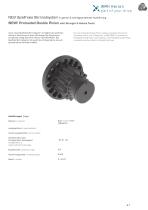
NEU! Spielfreies Stirnradsystem in gerad- & schrägverzahnter Ausführung NEW! Preloaded Double Pinion with Straight & Helical Teeth Unser neues Spielfreies Stirnradsystem ermöglicht den spielfreien Antrieb in Verbindung mit einer Zahnstange. Die Anbindung an ein Getriebe erfolgt über einen Flansch nach ISO 9409-1. Das Spielfreie Stirnradsystem ist sowohl als schrägverzahnte als auch geradverzahnte Variante erhältlich. Our new Preloaded Double Pinion enables a back-lash-free drive in connection with a rack. A ange acc. to ISO 9409-1 connects the Preloaded Double Pinion with a gearbox. The Preloaded...
Open the catalog to page 9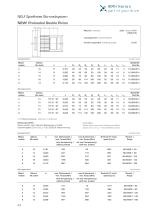
NEU! Spielfreies Stirnradsystem NEW! Preloaded Double Pinion Material | material einsatzgehärtet | case-hardened Verzahnungsqualität | toothing quality straight teeth Geradverzahnt Modul module helical teeth Zähnez. No. teeth Modul module x = Prolverschiebung | addendum modication Belastungstabellen: Werte wurden unter folgenden Bedingungen ermittelt: Geschwindigkeit: 2,5 m/s; KA = 1,25; 20.000h; Fettschmierung Load tables: Values determined under following conditions: speed: 2,5 m/s; KA = 1,25; 20.000h; grease Geradverzahnt Modul module straight teeth Zähnez. No. teeth max. Drehmoment | max....
Open the catalog to page 10
NEU! Spielfreies Stirnradsystem NEW! Preloaded Double Pinion Montageanleitung für gerad- und schrägverzahnte Spielfreie Stirnradsysteme | assembly instruction for Preloaded Double Pinions with straight and helical teeth 1. Anbau an das Getriebe | assemble to the gearbox 2. Aufsetzen des Vorspannritzels | attach the preloaded pinion on the shaft 3. Anbringen des Druckstücks mit Hirth-Verzahnung | put on the pressure plate with Hirth-Coupling 4. Ermittlung der richtigen Position | choose the correct angular orientation Kleine Überlappung an der Flanke | little displacement on that side Kontakt...
Open the catalog to page 11
^ < part of your drive
Open the catalog to page 12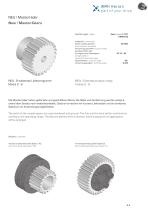
NEU ! Masterräder New ! Master-Gears Ausführungen | type aufgekohlt | carburized Zähne induktiv gehärtet teeth induction hardened Verzahnung geschliffen | ground teeth geradeverzahnt oder schrägverzahnt linkssteigend straight teeth or helical, left hand, helix angle Eingriffswinkel | pressure angle Verzahnungsqualität | toothing quality NEU - Erweitertes Lieferprogramm Modul 2 - 6 NEW - Extended product range module 2 - 6 Die Masterräder haben gehärtete und geschliffene Zähne. Die Nabe und die Bohrung werden entsprechend dem Einsatz noch weiterbearbeitet. Dadurch erreichen wir kürzere Lieferzeiten...
Open the catalog to page 13
^ < part of your drive MaSterrader, geschliffen, geradverzahnt Master-Gears, Ground, Straight Teeth Verzahnungsqualitat | toothing quality G e25 Zahne induktiv gehartet GO HRC teeth induction hardened geradeverzahnt | straight teeth Eingriffswinkel | pressure angle 20° Zahnez. Bestell-Nr. Zahnez. Bestell-Nr.
Open the catalog to page 14All WMH Herion Linner Gruppe catalogs and technical brochures
 Linear Guideways
8 Pages
 Quality Racks
2 Pages
 Positioning Systems
6 Pages
 Master Gears
5 Pages
 Rack-and-Pinion Drive
2 Pages
 Rack Guideways GUR Series
4 Pages
 Linear Actuators
4 Pages
 Flange Pinions
2 Pages
 Support Units for Screws
9 Pages
 Locking Assemblies & Bushes
20 Pages
 Timimg Belts & Pulleys
6 Pages
 Rack Guideways Z Series
6 Pages
 Ball Screw
3 Pages
 Preloaded Double Pinion
4 Pages
 Bushes
1 Page
 Q5
Q52 Pages
 PART OF YOUR DRIVE - WMH Herion
12 Pages
 Transmissions 2014
468 Pages
 Spur Gears 2014
60 Pages
 Racks 2014
38 Pages
 Rack & Pinion Drive 2014
36 Pages
 Slewing Bearings 2014
14 Pages
 Ball Screws 2014
30 Pages
 Lead Screws & Threaded Nuts 2014
16 Pages
 Bevel Gears 2014
13 Pages
 Worm Gear Units 2014
12 Pages
 Locking Assemblies & Bushes 2014
20 Pages
 Couplings 2014
20 Pages
 Sprockets 2014
54 Pages
 Chains 2014
24 Pages
 Belts & Pulleys 2014
6 Pages
 Bevel Gear Units 2014
22 Pages
 Screw Jacks 2014
30 Pages
 Linear Drives 2014
24 Pages
 Rack & Pinion Drive
40 Pages


Archived catalogs
 Linear Drives 2010
308 Pages