
- +++foj_breadcrumb_home_catalogs+++ Catalogs
- Wilo
- Wilo-Sub TWI 4-6


- +++fo_headerStand_company_tab+++ Company
- +++fo_headerStand_product_tab+++ Products
- +++fo_headerStand_catalogs_tab+++ Catalogs
- +++Fo_Layout_Header_TrendsTab+++ News & Trends
- +++fo_headerStand_salon_tab+++ Exhibitions
Wilo-Sub TWI 4-6

Wilo-Sub TWI 4-6
1. General Information
This manual is an essential part of the Wilo-Sub TWI 4-6 pump product, providing instructions for installation and operation. It must be kept near the product and followed strictly to ensure safe and proper use. The manual reflects the current product version and safety standards at the time of printing.
2. Safety Instructions
Safety guidelines are critical and must be read by all installers and operators. Warnings are categorized by severity: DANGER (immediate risk of death or severe injury), WARNING (risk of serious injury), CAUTION (risk of equipment damage), and NOTE (operational advice). Only qualified personnel should perform installation and maintenance. Compliance with accident prevention and electrical safety regulations is mandatory.
3. Transport and Storage
- Inspect the pump upon receipt for damage and report promptly.
- Use designated lifting brackets for transport; never lift by the cable.
- Protect the pump from moisture, frost, heat, sunlight, and mechanical damage.
- Seal pressure outlets to prevent contamination.
- Store horizontally on a firm, level surface.
- Protect power cables from damage and moisture; note motor filling freezes below -8°C.
4. Intended Use
The pumps are designed for clean or slightly contaminated water without long fibers or abrasive particles. Typical uses include boreholes, cisterns, domestic water supply, irrigation, and industrial pressure boosting. Pumps must be fully submerged and installed vertically or horizontally with a cooling jacket pipe. Use outside these parameters is improper and voids warranty.
5. Product Specifications
5.1 Type Code
Example: WILO-Sub TWI 4.01-09-B EM, where components indicate pump type, borehole diameter, flow rate, stages, generation, and motor type.
5.2 Technical Data
- Max sand content: 50 g/m³
- Voltage: Single-phase 230 V (4"), three-phase 400/480 V (4" and 6")
- Protection class: IP68
- Max flow rate: up to 25 m³/h (4"), up to 97 m³/h (6")
- Max head: up to 340 m (4"), up to 520 m (6")
- Discharge sizes: 1¼" to 3" depending on pump size
- Medium temperature: +3 to 30 °C
- Max submersion depth: 350 m
- Max switching frequency: 20 starts per hour
5.3 Standard Delivery
- Submersible motor pump with integrated non-return valve
- Connection cable (length varies)
- 230 V control box with capacitor, thermal protection, on/off switch
- Installation and operating manual
5.4 Optional Accessories
- Non-return valve at borehole outlet
- Dry-run protection (float switch or electrode)
- WILO-ER control unit for motor protection and water level monitoring
- Motor cables (kits or by meter)
- Pressure and storage tanks
- Plug & Pump packages for fluid control and pressure switching
6. Description and Function
The pump is a fully submersible, multistage motor pump with radial or semi-axial impellers, featuring a built-in non-return valve, optimized bearings, robust cable protection, and corrosion-resistant stainless steel parts. The motor is hermetically sealed with varnished windings and self-lubricating bearings. Cooling is via heat transfer to the pumped medium flowing along the motor housing, requiring minimum flow velocities of 10 cm/s (4") or 16 cm/s (6").
6.1 Soft Start and Frequency Converter Use
- Maintain minimum cooling flow velocity at all times.
- Current must not exceed rated motor current.
- Soft starter ramp times: 0-30 Hz max 1 sec; 30 Hz to rated frequency max 3 sec.
- Starting voltage minimum 55% of rated voltage.
- Bypass soft starter after normal operation to reduce losses.
- Frequency converter operation allowed only between 30 Hz and rated frequency.
- Allow at least 60 seconds cooling between stops and restarts.
- Voltage spikes max 1000 V; voltage rise max 500 V/µs.
- Additional filters required if control voltage exceeds 400 V.
7. Installation and Electrical Connection
7.1 Installation
- Install vertically or horizontally with cooling jacket pipe.
- Use water jacket for boreholes larger than pump size to ensure cooling.
- Recommended borehole sizes: 6" for 4" pumps >9 m³/h, 8" for 6" pumps >30 m³/h.
- Ensure sufficient water inflow matching pump capacity.
- Lower pump using hoist with chain/tripod or winch; never by cable.
- Maintain minimum 0.3 m clearance above borehole bottom.
- Check insulation resistance before and during lowering (minimum 2 MΩ).
- Use fixed or flexible piping sized 1¼" to 3"; secure flexible pipes with safety cables.
- Install non-return and shut-off valves at borehole outlet.
- For water pressures >180 m water column, use non-return valve rated ≥20 bar at pump outlet.
7.2 Electrical Connection
- Qualified electricians must perform electrical installation per local regulations.
- Supply voltage and current must match pump specifications.
- Use compliant cables and follow control box wiring diagrams.
- Verify maximum cable length based on motor current and cable cross-section.
- Improper connection risks fatal electric shock.
Technical Specifications
Detailed electrical and mechanical data include cable cross-sections, motor power ratings, operating voltages, and current consumption for single-phase (EM) and three-phase (DM) motors. Cable diameters and maximum lengths vary by motor power and starting method (direct or star-delta). Motor weights per meter of cable are specified.
- Single-phase motors: 230 V, 50/60 Hz, 0.25 kW to 2.2 kW.
- Three-phase motors: 400 V (50 Hz) or 480 V (60 Hz), 0.37 kW to 45 kW.
- Capacitor sizes and current consumption detailed for single-phase motors.
- Cable sizing recommendations prevent voltage drops.
Installation and Operation Instructions
Electrical Connection: The cable between control box and pump must remain intact (contains capacitors for EM versions). Grounding is mandatory. Motor protection via thermal or magnetic switches is required.
Rotation Direction Check (Three-phase motors): Verify correct rotation by measuring discharge water pressure. Incorrect rotation reduces flow and requires swapping two power phases.
Commissioning: Verify electrical connections, motor protection, and fuse ratings before startup. Check phase current against nameplate and voltage tolerance ±10%. Vent pressure connection to avoid shocks. Close valves during startup to minimize pressure surges and sand ingress. Limit starts to 20 per hour. Operate within catalog performance curve range. Avoid running with closed valves for long periods.
Operating Conditions
- Medium temperature range: 3°C to 30°C at nominal current.
- Minimum cooling water flow velocity: 10 cm/s (4" motors), 16 cm/s (6" motors).
- Reduce pump capacity proportionally for higher temperatures; do not exceed 55°C.
- Motor filling level checks and corrections must be done by qualified personnel; refilling allowed only by manufacturer for TWI4 motors.
Maintenance and Troubleshooting
Maintenance and repairs require qualified personnel. Disconnect power and secure against accidental re-energization before work. Cable repairs must be done by certified electricians. No special maintenance needed during normal operation.
- Common issues and solutions:
- Pump does not start: Check supply voltage, cable integrity, motor protection settings.
- Frequent starts: Reduce start cycles to prevent overheating.
- Pump runs but no water: Check water level, vent pump, clean intake filters, verify motor rotation.
- Frequent cycling: Adjust pressure switch differential, check electrode installation, adjust expansion tank pre-charge or size.
Regulatory Compliance and Certifications
The product complies with European directives: Machinery Directive 98/37/EC, Electromagnetic Compatibility Directive 2004/108/EC, Low Voltage Directive 2006/95/EC. Harmonized standards include EN 809, EN 50081-1, EN 50082-1, EN 60034-1. Declaration of conformity is valid only if no unauthorized modifications are made.
Contact and Support
Wilo AG offers international support with subsidiaries and offices worldwide. Spare parts orders must include complete nameplate data to avoid errors.
International Offices
- Asia: China, Korea, Taiwan, Vietnam, Kazakhstan, Lebanon, Saudi Arabia, UAE.
- Europe: Extensive presence including many countries such as Germany, France, UK, Italy, Russia, and others.
- Americas: USA, Argentina.
- Africa: South Africa.
German Regional Sales Offices
- Hamburg (North)
- Berlin (East)
- Dresden (Saxony/Thuringia)
- Munich (Southeast)
- Stuttgart (Southwest)
- Frankfurt (Rhine-Main)
- Düsseldorf (West)
Specialized Teams and Services
- Competence teams for Building Technology, Municipality, Construction, and Mining sectors.
- Customer service includes repairs, spare parts, commissioning, inspection, technical advice, and quality analysis.
- Customer service availability: Monday to Friday 7:00–17:00; weekends and holidays 9:00–14:00 with electronic standby and callback guarantee.
Additional Information
- Further subsidiary addresses available on www.wilo.de and www.wilo.com.
- Telephone charges for German calls vary; mobile network charges may differ.
- Document status as of August 2007.
Critical Points
- Global network ensures local support and service availability.
- Clear segmentation of sales offices and competence teams enables targeted assistance.
- Multiple contact channels enhance accessibility.
+++fo_catalog_detail_extractsFromCatalogTitle+++ Catalog excerpts

Wilo-Sub TWI 4-6 Einbau- und Betriebsanleitung Installation and operating instructions RUS Инструкция по монтажу и эксплуатации Notice de montage et de mise en service Instrucciones de instalación y funcionamiento Montaj ve kullanma kıla
+++foj_catalog_detail_pageCatalogLinkLabel+++ Open the catalog to page 1
Installation and operating instructions Notice de montage et de mise en service Instrucciones de instalación y funcionamiento Montaj ve kullanma kılavuzu Инструкция по монтажу и эксплуатации
+++foj_catalog_detail_pageCatalogLinkLabel+++ Open the catalog to page 3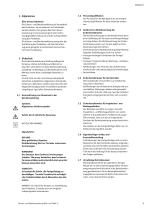
1 Allgemeines Einbau- und Betriebsanleitung Über dieses Dokument Die Einbau- und Betriebsanleitung ist Bestandteil des Produktes. Sie ist jederzeit in Produktnähe bereitzustellen. Das genaue Beachten dieser Anweisung ist Voraussetzung für den bestimmungsgemäßen Gebrauch und die richtige Bedienung des Produktes. Die Einbau- und Betriebsanleitung entspricht der Ausführung des Produktes und dem Stand der zugrunde gelegten sicherheitstechnischen Normen bei Drucklegung. 2 Sicherheit Diese Betriebsanleitung enthält grundlegende Hinweise, die bei Aufstellung und Betrieb zu beachten sind. Daher ist diese...
+++foj_catalog_detail_pageCatalogLinkLabel+++ Open the catalog to page 5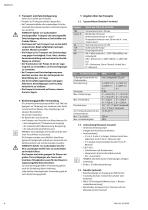
Sofort nach Erhalt des Produkts: Produkt auf Transportschäden überprüfen, Bei Transportschäden die notwendigen Schritte innerhalb der entsprechenden Fristen beim Spediteur einleiten. VORSICHT! Gefahr vor Sachschäden! Unsachgemäßer Transport und unsachgemäße Zwischenlagerung können zu Sachschäden am Produkt führen. Die Pumpe darf zum Transport nur an dem dafür vorgesehenen Bügel aufgehängt / getragen werden. Niemals am Kabel! Die Pumpe ist bei Transport und Zwischenlagerung gegen Feuchtigkeit, Frost, Hitze, direkter Sonneneinstrahlung und mechanischer Beschädigung zu schützen. Der Druckstutzen...
+++foj_catalog_detail_pageCatalogLinkLabel+++ Open the catalog to page 6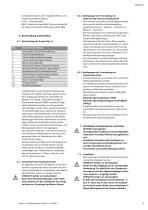
• Schrumpfschläuche, oder Vergußmuffen (zur Verlängerung des Motorkabels) • Druck-, Vorratsbehälter • WILO-Fluidcontrol oder WILO-Druckschaltung ER als Plug & Pump Pakete (siehe gesonderte EBA) 6 Beschreibung und Funktion 6.1 Beschreibung der Pumpe (Fig. 4) Pos. Pumpe Wilo-Sub in DM Ausführung Tauch-Elektrode Masse Tauch-Elektrode Wassermangel Tauch-Elektrode Oberes Niveau Motor-Anschlußkabel Dynamisches Niveau (Pumpe in Betrieb) Statisches Niveau (Pumpe abgeschaltet) Schaltkasten (mit Trockenlaufschutz) Netzanschluss / Spannungsversorgung Druckschalter mit Manometer Druck-/Vorratsbehälter Absperrarmatur...
+++foj_catalog_detail_pageCatalogLinkLabel+++ Open the catalog to page 7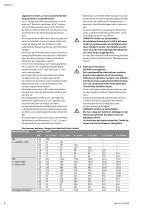
angebracht werden, um eine ausreichende Kühlung des Motors zu gewährleisten! Für 4“ Pumpen mit Nennvolumenstrom >9 m³/h wird ein 6“ Bohrloch empfohlen, für 6“ Pumpen >30 m³/h Nennvolumenstrom ein 8“ Bohrloch. Der Wasserzufluß im Bohrloch oder Brunnen muss ausreichend für die Förderleistung der Pumpe sein. Die Pumpe wird mit Hilfe eines Flaschenzuges mit Kette und Dreifuß, schwere Pumpen mittels Seilwinde herabgelassen. Die Installation sollte außerhalb des Wasserzulaufs bzw. des Filterrohres erfolgen. Die Pumpe darf niemals trocken laufen. Dazu muss sichergestellt werden, dass selbst in Trockenperioden...
+++foj_catalog_detail_pageCatalogLinkLabel+++ Open the catalog to page 8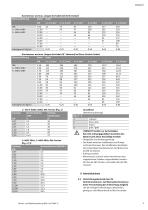
Durchmesser und max. Längen des Kabels bei Direkt Anlauf: Motorausführung Motor Kabel kW DM 3~ 50Hz 400V 3~ 60Hz 480V Durchmesser und max. Längen des Kabels (6“-Motoren) bei Stern-Dreieck Anlauf: Motorausführung Motor Kabel kW DM 3~ 50Hz 400V 3~ 60Hz 480V Einbau- und Betriebsanleitung Wilo-Sub TWI4-6 schwarz blau / grau braun grün / gelb VORSICHT! Gefahr vor Sachschäden! Bei nicht ordnungsgemäßem Anschluss des Motors kann dieser beschädigt werden! Überprüfen Sie die Netzspannung Das Kabel zwischen Schaltkasten und Pumpe nicht durchtrennen. Der Schaltkasten beinhaltet die notwendigen Kondensatoren...
+++foj_catalog_detail_pageCatalogLinkLabel+++ Open the catalog to page 9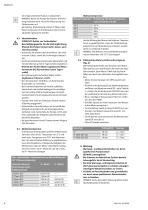
der eingeschalteten Pumpe zu überprüfen. HINWEIS: Wenn die Pumpe bei falscher Drehrichtung betrieben wird, tritt eine Reduzierung des Förderstroms auf. Bei falscher Drehrichtung müssen 2 Phasen des Netzanschlusses (im Schaltkasten oder am Kontaktgeber) getauscht werden. 8.2 Inbetriebnahme VORSICHT! Gefahr vor Sachschäden! Beschädigungsgefahr für die Gleitringdichtung. Niemals die Pumpe trocken laufen lassen, auch nicht kurzzeitig! • Nochmals alle elektrischen Anschlüsse, den elektrischen Schutz, sowie die Sicherungen überprüfen. • Die Stromaufnahme phasenweise überprüfen und mit den Werten auf...
+++foj_catalog_detail_pageCatalogLinkLabel+++ Open the catalog to page 10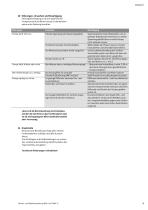
10 Störungen, Ursachen und Beseitigung Störungsbeseitigung nur durch qualifiziertes Fachpersonal durchführen lassen! Sicherheitshinweise unter Wartung beachten. Störungen Pumpe läuft nicht an Falsche Spannung oder Spannungsabfall. Pumpe läuft fördert aber nicht Die Fördermenge ist zu niedrig. Pumpe springt zu oft an. Spannung beim Anlauf überprüfen, ein zu geringer Kabeldurchschnitt kann zu einem Spannungsabfall führen und die Pumpe nicht anlaufen lassen. Unterbrechung des Anschlusskabels. Widerstände der Phasen messen, Pumpe heraufziehen und die Kabel kontrollieren. Der Motorschutzschalter wurde...
+++foj_catalog_detail_pageCatalogLinkLabel+++ Open the catalog to page 11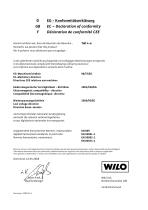
EG - Konformitätserklärung EC – Declaration of conformity Déclaration de conformité CEE Hiermit erklären wir, dass die Bauarten der Baureihe : Herewith, we declare that this product: Par le présent, nous déclarons que cet agrégat : in der gelieferten Ausführung folgenden einschlägigen Bestimmungen entspricht: in its delivered state comply with the following relevant provisions: est conforme aux dispositions suivants dont il relève: EG-Maschinenrichtlinie EC-Machinery directive Directives CEE relatives aux machines Elektromagnetische Verträglichkeit - Richtlinie Electromagnetic compatibility -...
+++foj_catalog_detail_pageCatalogLinkLabel+++ Open the catalog to page 12
Hiermede verklaren wij dat dit aggregaat in de geleverde uitvoering voldoet aan de volgende bepalingen: Con la presente si dichiara che i presenti prodotti sono conformi alle seguenti disposizioni e direttive rilevanti: Por la presente declaramos la conformidad del producto en su estado de suministro con las disposiciones pertinentes siguientes: EG-richtlijnen betreffende machines 98/37/EG Directiva sobre máquinas 98/37/CE Direttiva bassa tensione 2006/95/EG Directiva sobre compatibilidad electromagnética 2004/108/EG Gebruikte geharmoniseerde normen, in het Norme armonizzate applicate, in particolare:...
+++foj_catalog_detail_pageCatalogLinkLabel+++ Open the catalog to page 13+++foj_catalog_stand_metaTitle+++ All Wilo catalogs and technical brochures
 Wilo-HiPeri 1-4/5
36 +++fo_common_label_pages+++ Pages
 Wilo-Economy MHIE
34 +++fo_common_label_pages+++ Pages
 Wilo-Yonos ECO BMS
28 +++fo_common_label_pages+++ Pages
 General Overview 2020
78 +++fo_common_label_pages+++ Pages