- Catalogs
- WIKA Alexander Wiegand SE & Co. KG
- Pressure | Temperature | Level | Calibration Water and wastewater technology

Pressure | Temperature | Level | Calibration Water and wastewater technology
Pressure | Temperature | Level | Calibration Water and wastewater technology
WIKA is a global leader in pressure and temperature measurement, providing high-precision instruments and services worldwide since 1946. The company delivers over 50 million products annually, playing a significant role in water and wastewater technology.
Water is a vital natural resource, with limited availability for direct use. The document highlights the challenges of providing clean drinking water, predicting that by 2025, over three billion people may lack access. Technology is crucial in water sourcing, treatment, and distribution for agriculture, industry, and households.
Strict laws ensure the quality of drinking water, sourced from groundwater, rainwater, surface water, and seawater. Technologies like reverse osmosis and distillation are used for desalination. WIKA's submersible pressure transmitters monitor groundwater levels.
Industries must comply with strict legal requirements for water management, optimizing usage and minimizing wastewater. Processes like SIP and CIP are used for sterilization, with filtration ensuring water quality. Pressure transmitters and mechanical instruments are essential for monitoring and controlling water quality in industrial applications.
Modern wastewater treatment involves mechanical and biological cleaning in multiple phases. Advanced measurement and control technologies are vital for efficient wastewater management.
WIKA's products and solutions are integral to sustainable water management, ensuring reliable measurement and control across various applications.
- Rain Overflow Basins: These basins store excess water during heavy precipitation, using submersible pressure transmitters for reliable level control to prevent pump dry-running and tank overflow.
- Wastewater Pumping Stations: These stations lift wastewater to levels where it can flow naturally to treatment plants, using submersible pressure transmitters and resistance thermometers for level and temperature measurement to prevent pump failure.
- Pressure Transmitters: Models like A-10, O-10, S-11, and S-20 offer features such as compact design and suitability for viscous media.
- Electronic Pressure Switches: Models like PSD-30 and PSA-31 feature robust displays and flexible mounting configurations.
- Process Transmitters: UPT-21 and UPT-20 provide universal process measurement with multi-functional displays.
- Mechatronic and Mechanical Instruments: Include pressure gauges with switch contacts and electrical output signals.
- Differential Pressure Gauges: Used for monitoring filter systems and tank levels, with high overpressure safety.
- Non-linearity: Ranges from ≤ 0.075% to 0.5% of span.
- Measuring Range: From 0 ... 0.6 mbar to 0 ... 15,000 bar.
- Output Signals: Include 4 ... 20 mA, HART®, PROFIBUS® PA, and FOUNDATION™ Fieldbus.
- Special Features: Include flush process connections and high temperature resistance.
Designed to open or close a circuit based on pressure changes, known for high precision and stability. Suitable for gauge and differential pressure with various setting ranges.
Used for aggressive gaseous and liquid media, offering overpressure safety and suitable for high dynamic pressure loads.
Suitable for liquid and gaseous media, covering pressures from 0.6 to 1,000 bar, manufactured to EN 837-1 standards.
Isolate the pressure measuring instrument from the medium, reducing maintenance and protecting against pressure spikes.
Consist of a thermowell, connection head, and measuring insert, allowing for on-site calibration without disconnecting electrical connections.
Offer various measuring ranges and outputs, used in industries requiring high measurement accuracy.
Display measured values and control process values with integrated alarm outputs.
Convert temperature-dependent changes into proportional standard signals, commonly used in industrial applications.
1. Pressure Transmitters: Submersible pressure transmitters with a measuring range from 0 to 25 bar, featuring explosion protection and optional titanium casing.
2. Optoelectronic Switches: Compact OEM switches capable of handling up to 25 bar pressure and temperatures from -30 to +100°C.
Submersible pressure transmitters are used for level measurement in various applications, designed to be independent of liquid characteristics.
1. Calibration Services: WIKA offers calibration for pressure and temperature measuring instruments with high precision.
2. Calibration Systems: Include portable pressure generation and fully automated calibration systems.
Includes power supply units, adapters, sealings, and thermowells.
WIKA has a worldwide presence with contact information for various regions.
Catalog excerpts
Pressure | Temperature | Level | Calibration Water and wastewater technology
Open the catalog to page 1
Alexander Wiegand, Chairman and CEO, WIKA As a family-run business acting globally, with over 9,000 highly qualified employees, the WIKA group of companies is a worldwide leader in pressure and temperature measurement. The company also sets the standard in the measurement of level and flow, and in calibration technology. With manufacturing locations around the globe, WIKA ensures flexibility and the highest delivery performance. Every year, over 50 million quality products, both standard and customer-specific solutions, are delivered in batches of 1 to over 10,000 units. Founded in 1946, WIKA...
Open the catalog to page 2
Water is the most important natural resource for both man and nature – and in seemingly abundant supply. Seemingly. Of all the immeasurable water supplies that our earth holds, only a small part is directly usable in reality. Almost everywhere where water is to be used for drinking, it must first be cleaned, softened, desalinated or sterilised. If we look at the earth's surface, then we see that more than 70 percent is water. Most, however, is seawater. Salty and undrinkable. Of the entire volume of all water resources, around 97 percent is salt water, and only about 3 percent is freshwater....
Open the catalog to page 4
Status, problems, opportunities The global situation is worsening as the thirst for drinking water grows everywhere, and not only through the growth in world population. An important role for the better usage and development of water resources is played by modern technology for water sourcing, treatment and distribution. Here, a particularly large part is also played by agriculture, which today, averaged around the world, requires about 70 percent of all water supplies, industry a further 20 percent, and private housing around 10 percent. Here, highly advanced systems and processes are used,...
Open the catalog to page 5
Drinking water Drinking water is the most elementary foodstuff – its supply therefore has the highest priority. For this reason, clean drinking water has been a UN human right since 2010. The high demands on quality and availability through strict laws, precise guidelines and corresponding structures are, generally, so perfectly fulfilled, that drinking water, for most people in the Western world, is taken for granted. The high investment that goes into an uninterrupted water supply is not even recognised by most consumers. Drinking water is obtained from the widest variety of sources: groundwater,...
Open the catalog to page 6
Drinking water From deep down In many countries, especially in Europe, the primary source of drinking water is from groundwater. In Germany this accounts for approximately 70 percent of the water supply. The water extracted from various depths – quite often several hundred metres under the earth's surface – as a rule is hygienically perfect. WIKA submersible pressure transmitters from stainless steel have been applied for many years in drinking water supply. The measuring instruments can be easily installed and operated completely submerged in water. They deliver reliable measuring signals throughout...
Open the catalog to page 7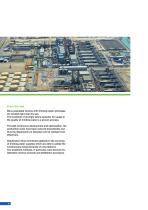
From the sea Many populated centres with drinking water shortages are located right near the sea. The treatment of strongly saline seawater for usage to the quality of drinking water is a proven process. Through continuous development and optimisation, the production costs have been reduced dramatically and thus the desalination of seawater can be realised costeffectively. Desalination thus contributes globally to the securing of drinking water supplies which are able to satisfy the continuously rising demands of conurbations. Two treatment methods, in particular, have become established: reverse...
Open the catalog to page 8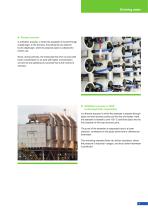
Drinking water Reverse osmosis is a filtration process, in which the seawater is forced through a diaphragm. In the process, the pollutants are retained by the diaphragm, while the cleaned water is collected for further use. Since, during osmosis, the molecules flow from an area with lower concentration to an area with higher concentration, so here we are speaking of a process that is the inverse of osmosis. Distillation process or “MSP” (multi-stage flash evaporation) is a thermal process in which the seawater is passed through pipes via heat recovery zones and into the end heater. Here, the...
Open the catalog to page 9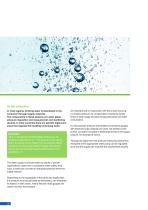
To the consumer In most regions, drinking water is distributed to the consumer through supply networks. The components in these systems are water pipes, pressure regulation and measurement and monitoring devices. In most countries there are specific legal provisions that regulate the handling of drinking water. Examples: Thus, in the German Drinking Water Ordinance, the essence is described in § 1: “The purpose of the regulation is to protect human health from the adverse effects resulting from the contamination of water intended for human use, by ensuring its purity and fitness for consumption...
Open the catalog to page 10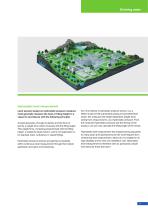
Drinking water Hydrostatic level measurement Level sensors based on hydrostatic pressure measurement generally measure the level or filling height in a vessel in accordance with the following principle: A liquid generates, through its density and the force of gravity, a weight force which increases with the filling height. This weight force, increasing proportionally with the filling height, is called the liquid column, and is not dependent on, for example, foam, turbulence or vessel fittings. Hydrostatic pressure sensors are gaining in popularity within continuous level measurement through their...
Open the catalog to page 11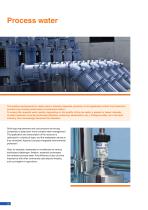
Process water The quality requirements for water used in industry depends, primarily, on its application within the production process (e.g. cooling, boiler feed or production water). To ensure the required water quality, depending on the quality of the raw water, a greater or lesser intensity of water treatment must be performed (filtration, softening, desalination, etc.). Ultrapure water, as in the food industry, thus increasingly becomes the standard. Strict legal requirements and cost pressure are forcing companies to adopt ever-more complex water management. The application and consumption...
Open the catalog to page 12All WIKA Alexander Wiegand SE & Co. KG catalogs and technical brochures
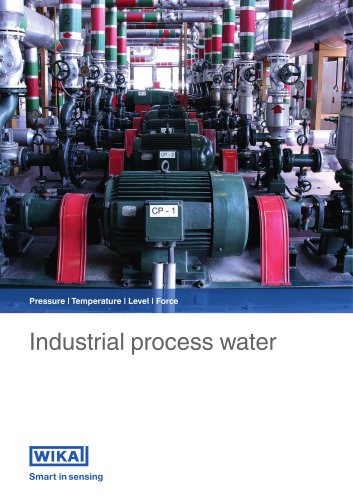 Industrial process water
4 Pages
 WIKA Productportfolio
120 Pages