- Catalogs
- WIKA Alexander Wiegand SE & Co. KG
- Hydrogen Proven solutions for new challenges

Hydrogen Proven solutions for new challenges
Hydrogen Proven solutions for new challenges
WIKA is a global leader in pressure and temperature measurement, employing over 11,200 people since its founding in 1946. The company offers a wide range of high-precision instruments and services, with manufacturing locations worldwide to ensure flexibility and high delivery performance.
WIKA has been a key partner in the hydrogen industry, providing solutions for hydrogen production, distribution, and storage. The company addresses challenges such as extreme temperatures and pressures, and the impact of hydrogen migration on materials.
- Embrittlement: WIKA uses special alloys like 316L and Alloy C276 to prevent mechanical failure due to hydrogen embrittlement.
- Permeation: Gold plating is used to prevent hydrogen permeation in sensors, reducing signal drift.
- Leak Prevention: Metal seals are preferred to prevent hydrogen leaks, and WIKA instruments undergo helium leak testing.
- Precision: Instruments must handle pressures up to 1,050 bar and temperatures as low as -258 °C. WIKA offers specialized sensors for these conditions.
WIKA provides solutions for various electrolysis methods, including alkaline, PEM, and SOEC electrolysers, addressing challenges in pressure, temperature, and media handling.
WIKA offers solutions for hydrogen storage, addressing pressures from 20 to 1,000 bar and challenges like extreme temperatures for both gaseous and liquid hydrogen.
WIKA supports stationary and mobile fuel cell applications, providing certified instruments for hydrogen compatibility while maintaining high safety standards despite regulatory changes.
WIKA offers a wide range of products for the hydrogen industry, including flow meters, level sensors, and temperature sensors, each designed to meet specific requirements and conditions.
- Measuring Insert MI Cable: Options include 1 x Pt100 or 2 x Pt100 with a range of -196 to +600 °C. Connection methods are 2-, 3-, and 4-wire, with Ex i and Ex d options.
- HART® Temperature Transmitter (T32): Accepts inputs from various sensors with an accuracy of less than 0.1%, outputs 4 to 20 mA with HART® protocol, and features a TÜV-certified SIL version.
- Thermowell (TW10): Available in tapered, straight, or stepped forms with pressure ratings up to 2,500 lbs.
- Surface Resistance Thermometer (TR50): Similar to MI cable with surface mounting process connection.
- UPT-20: Universal process transmitter with a range from 0 to 4,000 bar.
- CPT-20, CPT-21: Process pressure transmitter with a capacitive ceramic measuring cell.
- MH-3-HY: Designed for mobile hydrogen applications with a range of 0 to 600 bar.
- IS-3 and E-10: Intrinsic safety and flameproof enclosure options for high-pressure applications.
- DPT-20: Differential pressure transmitter with SIL 2 certification.
- IV20: Block-and-bleed valve for pressure measuring instruments.
- IV30, IV31, IV50, IV51: Valve manifold for differential pressure instruments.
- HPNV: High-pressure needle valve for various applications.
Special solutions for low-temperature measurement in hydrogen applications, featuring high accuracy and reproducibility.
WIKA offers valve solutions to reduce fugitive emissions and ensure safe process isolation.
WIKA provides helium leak testing systems with high detection limits and automation options for hydrogen applications.
WIKA offers analysis, support, maintenance, repair, installation, commissioning, calibration, and inspection services tailored to customer needs.
WIKA has a worldwide presence with contact information for various regions provided.
Catalog excerpts
Proven solutions for new challenges
Open the catalog to page 1
Alexander Wiegand Chairman and CEO, WIKA About us As a family-run business acting globally, with over 11,200 highly qualified employees, the WIKA group of companies is a worldwide leader in pressure and temperature measurement. The company also sets the standard in the measurement of level, force and flow, and in calibration technology. With manufacturing locations around the globe, WIKA ensures flexibility and the highest delivery performance. Every year, over 50 million quality products, both standard and customer-specific solutions, are delivered in batches of 1 to over 10,000 units. Founded...
Open the catalog to page 2
Hydrogen applications have been established in the process industry for decades, with demand primarily being driven by refineries, methanol & ammonia production and also in direct reduction in iron and steel production. Conventional hydrogen production typically uses natural gas or coal as feedstock. It is expected, in the future, that hydrogen will have to play an important role in decarbonising the world’s economy - if produced from renewable energy sources e.g. solar and wind energy. Hydrogen processing, production, distribution and storage exposes the equipment used to extreme conditions,...
Open the catalog to page 3
Embrittlement – Safely prevent mechanical failure Permeation – With gold against the smallest ions Permanent contact to hydrogen may lead to so-called hydrogen embrittlement. The hydrogen can penetrate the material structures leading to a deterioration of the mechanical properties and eventually mechanical failure. Hydrogen is the simplest element on the periodic table and its atomic radius is the smallest of the elements. However, hydrogen occurs naturally as the H₂ molecule. When touching metal surfaces only relatively small energy is required to dissociate the hydrogen molecule into single...
Open the catalog to page 4
Precision under extreme conditions Depending on the physical state in which hydrogen is stored different extremes in handling the media have to be tackled. Hydrogen is stored in gaseous form at a pressure of up to 700 bar. Due to temperature effects and safety factors, pressure sensors need to be capable of measuring up to 1,050 bar in, for example, hydrogen fuelling stations. In liquid form the hydrogen has a temperature of -253 °C or below. Temperature measurement solutions have to be designed in such a way that they can also measure this temperature at a high accuracy while keeping the good...
Open the catalog to page 5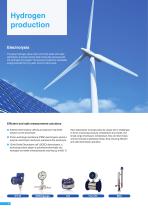
Hydrogen production Electrolysis The green hydrogen value chain commonly starts with water electrolysis: A process where water molecules are being split into hydrogen and oxygen. The process is fuelled by renewable energy sourced from e.g. solar, wind or hydro power. Efficient and safe measurement solutions ■ Alkaline electrolysers utilising a potassium hydroxide solution as the electrolyte ■ Proton exchange membrane (PEM) electrolysers where a polymer electrolyte membrane represents the electrolyte ■ “Solid Oxide Electrolyser cell” (SOEC) electrolysers, a technology where steam is split electrochemically...
Open the catalog to page 6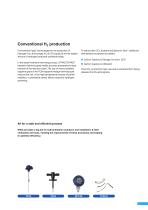
Conventional H₂ production Conventional “grey” technologies for the production of hydrogen (H₂) and syngas (H₂ & CO) supply by far the largest amount of hydrogen produced worldwide today: In the steam-methane reforming process, XTRACTO-PAD® tubeskin thermocouples enable accurate temperature measurement of the reformer tubes. The use of monocrystalline sapphire glass in the TC84 sapphire-design thermocouple reduces the risk, in the high-temperature process of partial oxidation, of premature sensor failure caused by hydrogen poisoning. To reduce their CO₂ footprint and become “blue”, additional...
Open the catalog to page 7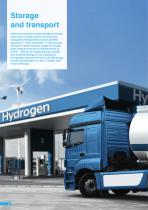
Storage and transport Unless the production of the hydrogen is located at the point of usage it has to be stored and transported. Transportation is done by either gas grids or – more commonly – in various types and sizes of tanks. Pressure ranges for storage tanks range from 20 bar for liquefied tanks up to 700 – 1,000 bar for compressed gas vessels. Also liquefied hydrogen (LH₂) is playing an increasingly important role due to its high energy density. Its temperature of -253 °C creates additional challeng
Open the catalog to page 8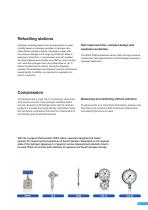
Refuelling stations Hydrogen refuelling stations are the prerequisite to make mobility based on hydrogen possible. A hydrogen refuelling station typically consists of hydrogen supply with low-pressure storage in the range up to 250 bar, either in gaseous or liquid form, a compression area with mediumand high-pressure accumulator up to 900 bar and a cooling unit, since the hydrogen has to be cooled down to -40 °C before it is filled into the vehicle. During the refuelling process, the temperature and pressure must be monitored at several points. In addition, an approval for explosion protection...
Open the catalog to page 9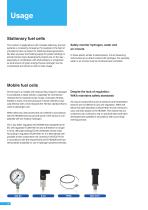
Usage Stationary fuel cells Safely monitor hydrogen, water and air circuits The number of applications with complex stationary fuel cell systems is constantly increasing. For example in the field of emergency back-up power for replacing diesel generators. But also as power and heating supply for public buildings or private homes many development projects are on the way – especially in combination with photovoltaics or windpower as local source of green energy. Excess hydrogen can be compressed and stored on-site for later usage. In these plants, similar to electrolysers, not all measuring instruments...
Open the catalog to page 10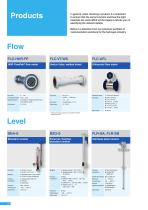
In general, when choosing a product, it is important to ensure that the correct version and thus the right materials are used. WIKA will be happy to advise you on specifying the relevant details. Below is a selection from our extensive portfolio of instrumentation solutions for the hydrogen industry. HHR FlowPak® flow meter Venturi tube, welded sheet Ultrasonic flow meter Pipe size Special feature Standard version External chamber, standard version FLR-SA, FLR-SB Stainless steel version Material ■ Stainless steel 1.4571/316TI Process ■ Flange DIN, ANSI, EN Process ■ Mounting thread Guide tube...
Open the catalog to page 12All WIKA Alexander Wiegand SE & Co. KG catalogs and technical brochures
 Industrial process water
4 Pages
 WIKA Productportfolio
120 Pages