
- Catalogs
- Wieland-Werke AG
- Wieland-K12


- Products
- Catalogs
- News & Trends
- Exhibitions
Wieland-K12
Wieland-K12
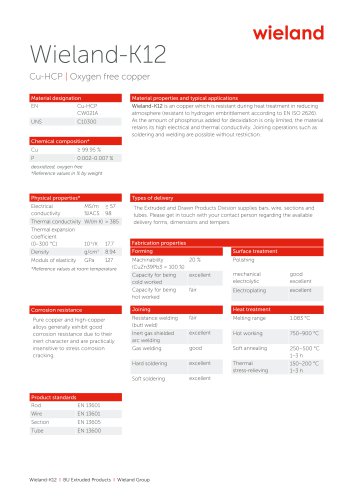
Wieland-K12 is a high-purity copper alloy with excellent electrical conductivity (≥ 57 MS/m, 98% IACS) and thermal conductivity (> 385 W/(m·K)). It has a thermal expansion coefficient of 17.7 x 10⁻⁶/K and a density of 8.94 g/cm3. The modulus of elasticity is 127 GPa.
Chemical Composition
The alloy consists of ≥ 99.95% copper and 0.002–0.007% phosphorus, making it deoxidized and oxygen-free.
Material Properties and Applications
Wieland-K12 is resistant to hydrogen embrittlement and maintains high electrical and thermal conductivity. It is suitable for soldering and welding without restrictions. The material exhibits good corrosion resistance and is insensitive to stress corrosion cracking.
Types of Delivery
The product is available in bars, wire, sections, and tubes. Specific dimensions and tempers can be discussed with the supplier.
Material Designation
EN Cu-HCP, CW021A, UNS C10300.
Joining Techniques
Resistance welding (fair), inert gas shielded arc welding (excellent), gas welding (good), hard soldering (excellent), and soft soldering (excellent).
Heat Treatment
Melting range: 1,083 °C. Hot working: 750–900 °C. Soft annealing: 250–500 °C for 1–3 hours. Thermal stress-relieving: 150–200 °C for 1–3 hours.
Surface Treatment
Polishing (mechanical and electrolytic) is good to excellent. Electroplating is excellent.
Product Standards
Rod and wire conform to EN 13601, sections to EN 13605, and tubes to EN 13600.
Forming
Machinability is rated at 20% compared to CuZn39Pb3. The capacity for cold working is excellent, while hot working is fair.
Dimensions and Mechanical Properties
- Rod and Wire: Various tempers with tensile strengths ranging from 200 to 350 MPa and hardness from 35 to 110 HV.
- Profiles: Tensile strengths up to 280 MPa and hardness from 35 to 120 HV.
- Tubes: Tensile strengths up to 360 MPa and hardness from 35 to 100 HV.
Catalog excerpts
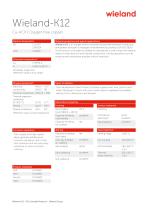
Material designation Material properties and typical applications EN Cu-HCP Chemical composition* deoxidized, oxygen free *Reference values in % by weight Wieland-K12 is an copper which is resistant during heat treatment in reducing atmosphere (resistant to hydrogen embrittlement according to EN ISO 2626). As the amount of phosphorus added for deoxidation is only limited, the material retains its high electrical and thermal conductivity. Joining operations such as soldering and welding are possible without restriction. Physical properties* Types of delivery Electrical MS/m > 57 Thermal conductivity W/(mK) > 385 Thermal expansion coefficient *Reference values at room temperature The Extruded and Drawn Products Division supplies bars, wire, sections and tubes. Please get in touch with your contact person regarding the available delivery forms, dimensions and tempers. Fabrication properties Capacity for being excellent mechanical good cold worked electrolytic excellent Corrosion resistance Pure copper and high-copper alloys generally exhibit good corrosion resistance due to their inert character and are practica[[y insensitive to stress corrosion cracking. Capacity for being fair Soft soldering excellent Wieland-K12 I BU Extruded Products I Wieland Group
Open the catalog to page 1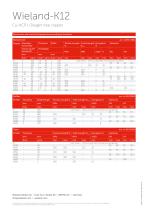
Dimensions and mechanical properties according to standards D - - cold drawn - without specified mechanical properties Wieland-Werke AG I Graf-Arco-StraB.e 36 I 89079 Ulm I Germany [email protected] I wieland.com This brochure is for your general information only and is not subject to revision. No claims can be derived from it unless there is evidence of intent or gross negligence. The data presented is not guaranteed and does not replace expert advice.
Open the catalog to page 2All Wieland-Werke AG catalogs and technical brochures
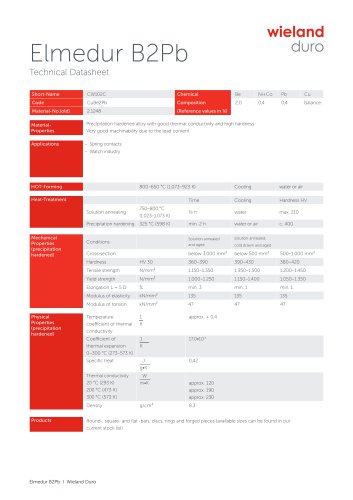 Elmedur B2Pb
2 Pages
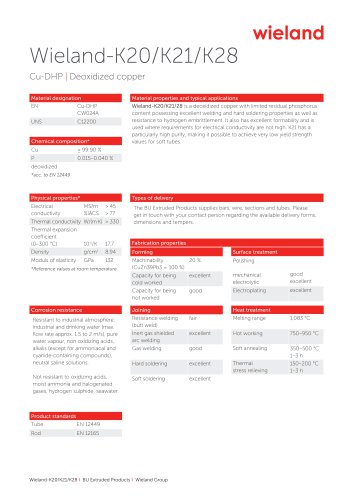 Wieland-K20/K21/K28
2 Pages
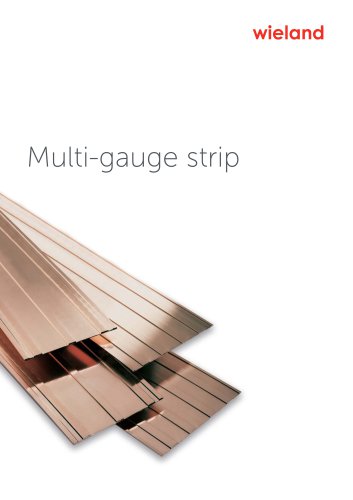 Multi-gauge strip
6 Pages
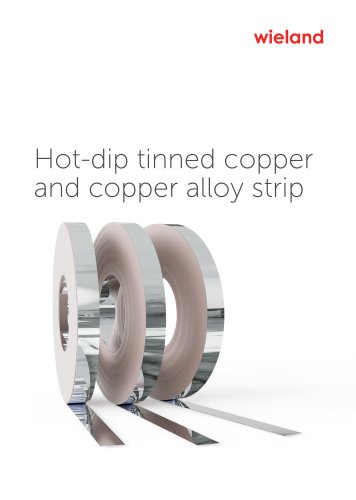
Archived catalogs
 Geberit Mapress
56 Pages


