
- Catalogs
- Wieland-Werke AG
- Hot-dip tinned copper and copper alloy strip


- Products
- Catalogs
- News & Trends
- Exhibitions
Hot-dip tinned copper and copper alloy strip
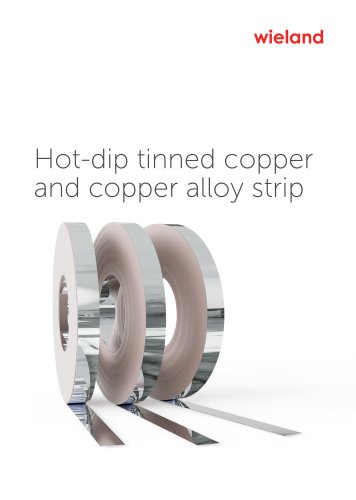
Hot-dip tinned copper and copper alloy strip
- SnPUR®: Pure tin with low hardness, ensuring low contact resistance and good solderability.
- SnTEM®: A hard, brittle CuSn intermetallic compound with low friction, suitable for multipole connectors.
- SnTOP®: Tin-silver composition with 4% silver, offering good friction, abrasion resistance, and solderability, suitable for temperatures up to 160°C.
Catalog excerpts
Hot-dip tinned copper and copper alloy strip
Open the catalog to page 1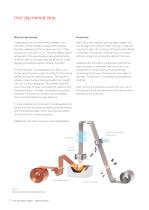
Hot-dip tinned strip Characteristic for hot-dip tinned coatings is the formation of intermetallic phases (IMP) between the base material and the tin layer, see Fig. 2. They consist of Cu3Sn and Cu6Sn5. The intermetallic phase produced in this way ensures a very good bonding of the tin layer to the base material as well as a high degree of protection against whisker formation. Strip with a well-cleaned and activated surface is given through the molten tin bath, see Fig. 1. After leaving the tin bath, the coating is still liquid and adheres to the strip. The liquid tin is blown by an air stream...
Open the catalog to page 2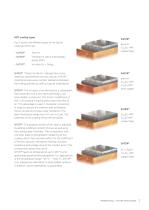
HDT coating types Fig. 2 shows the different types of hot-dip tin coatings which are: . – SnPUR® : Pure tin – SnTEM® : Thermal tin 100 % intermetallic phase (IMP) SnPUR®: These hot-dip tin coatings have a low hardness and therefore are very ductile. SnPUR® coatings ensure a low contact resistance between the mating partners as well as a good solderability. SnTEM®: The tin layer is transformed by a subsequent heat treatment into a very hard and brittle CuSn intermetallic compound. The friction coefficient of this CuSn surface is significantly lower than that of tin. This advantage is used in multipole...
Open the catalog to page 3
Copper and copper alloy strips with hot-dip tinning layers are standardized in DIN EN 13148. This standard describes the following characteristics: - Nature of the coating: In order to avoid surface defects caused by transport (e. g. fretting corrosion), the strip may have a lubricating film on the surface. - Appearance of the coating: As a consequence of using liquid tin there are visible crystallisation phenomena which, however, have no influence on the contact properties of the coating. - Solderability: The soldering properties are essentially dependent on the type of coating and the thickness...
Open the catalog to page 4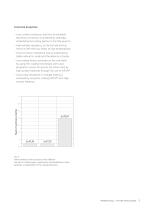
Funcional properties - Low contact resistance, and thus an excellent electrical connection is achieved by optimally embedding the mating partner in the free pure tin. - High whisker resistance, as the hot-dip tinning forms its IMP with low stress at high temperatures. - Good corrosion resistance due to a passivating, stable natural tin oxide and the absence of pores. - Low mating forces, achieved on the one hand by using thin coating thicknesses with a low proportion of pure tin and on the other hand by high surface hardness through the use of SnTEM® - Good wear resistance in multiple mating...
Open the catalog to page 5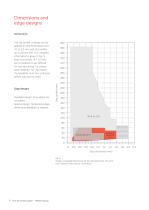
Dimensions and edge designs Dimensions Hot-dip tinned coatings can be applied to strip thicknesses from 0.1 to 2.0 mm and strip widths up to almost 400 mm. Detailed information is given in Fig. 5. Strip thicknesses of > 1.6 mm are considered to be “difficult for hot-dip tinning” for certain base materials. For this reason, the feasibility must be confirmed before placing the order. Standard design: Strip edges are uncoated. Special design: tinned strip edges, dimensions available on request. Edge designs Traverse wound coils Strip thickness (mm) Fig. 4: Ranges of available dimensions for hot-dip...
Open the catalog to page 6
[email protected] I wieland.com This printed matter is not subject to revision. No claims can be derived from it unless there is evidence of intent or gross negligence. The product characteristics are not guaranteed and do not replace our experts' advice. Wieland-Werke AG I Graf-Arco-Straße 36 I 89079 Ulm I Germany
Open the catalog to page 8All Wieland-Werke AG catalogs and technical brochures
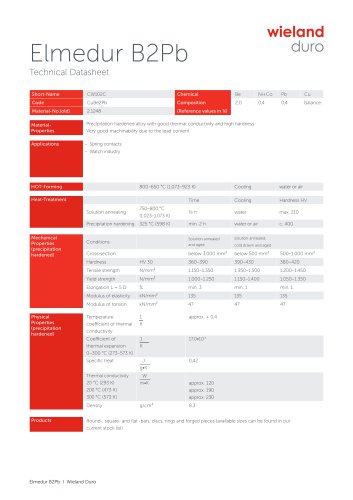 Elmedur B2Pb
2 Pages
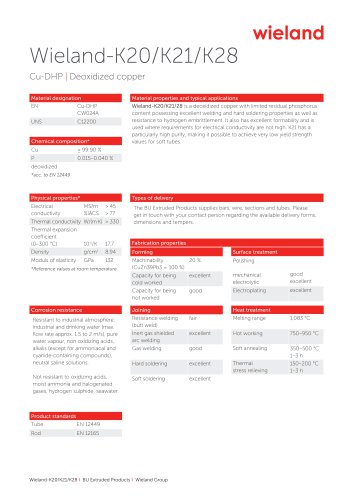 Wieland-K20/K21/K28
2 Pages
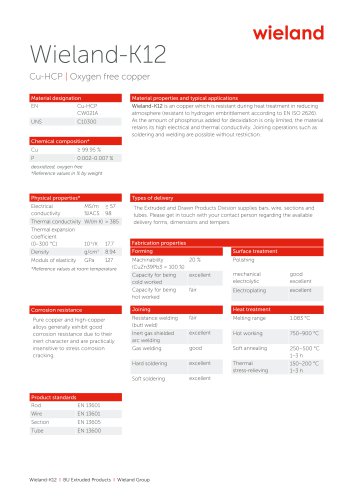 Wieland-K12
2 Pages
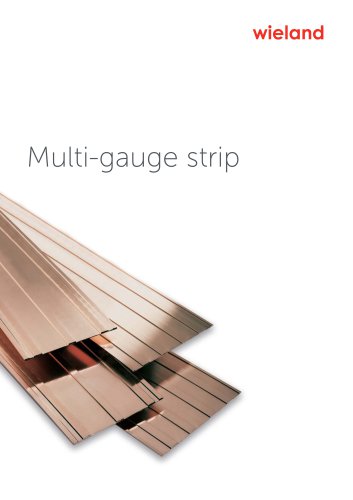 Multi-gauge strip
6 Pages
Archived catalogs
 Geberit Mapress
56 Pages


