
- Catalogs
- WIELAND ELECTRIC
- Timers

Timers

Timers
The document provides an in-depth analysis of timers and switching relays developed by Schleicher Electronic, part of Wieland Electronics. These devices are recognized for their precision, robustness, and high quality, essential for industrial, manufacturing, and trade applications.
The NGG series represents advanced timer technology, incorporating microprocessor advancements for diverse industrial applications. Key features include:
- Up to 33 functions, including cost-effective PLC monitoring.
- Multi-function relays in 22.5 mm housings with up to 8 functions such as operate and release delay, interval on/off, clock generator, and pulse shaper.
- USD 51 model with non-resetting on power failure, digital set time preselect, and actual value display from 0 seconds to 999.9 hours.
- Electro-mechanical relays designed for harsh environments, offering mechanical reliability and fault tolerance.
The NGG timers are globally applicable, supporting multi-voltage inputs from AC/DC 16.8 V to 264 V. They feature ergonomic designs with easy-to-use controls, large analog scales, and rotary switches for setting functions and time ranges. LEDs indicate status, and the timers can operate in any orientation.
These timers are ideal for less complex machines and modifications, offering significant rationalization potential across procurement, warehousing, application, and disposal stages. Applications include motor start-up delays, burner control, and time-controlled machining processes.
The NGG relays are environmentally friendly, featuring cadmium-free contacts and recyclable, halogen-free housings. They meet high EMC standards and operate in temperatures from -25°C to +60°C.
The document details various timer models, including:
- Multi-function and mono-function relays with multiple time ranges.
- Single-range timers and fixed-time relays.
- Electro-mechanical timers like the DZA 52-S L and DZR 52-S L with features such as synchronous motors and magnetic coupling.
- Electronic timers like the KZT 510K with operate and release delay for various industrial applications.
The NGG series timers are versatile, reliable, and environmentally conscious, making them suitable for a wide range of industrial applications. Their design and functionality ensure they remain a critical component in industrial automation.
Wieland Electric GmbH, Brennerstraße 10 – 14, D-96052 Bamberg. Phone: +49 (951) 9324-0, Fax: +49 (951) 9324-198, Website: www.wieland-electric.com
Catalog excerpts
Always up to the minute Timers 152.2. C 11/04 archive image swisslog SCHIERHOLZ
Open the catalog to page 1
The immensely robust timers from Schleicher Electronic – Wieland’s electronics competence centre in Berlin – set standards. To this day our reputation is based on ultra-high precision and the proverbial reliability of our products, as reflected by the number of guaranteed switching cycles. For decades the whole manu-facturing sector was based on control by timers, whose durability and repeatability had a crucial influence on servicing and production costs. Cutting Edge Our relays are designed for the world market, and naturally fulfil all European and international norms. Continuous technical...
Open the catalog to page 2
T imers 2 | 3 The latest is the NGG series with ultra-modern microprocessor technology, covering almost all typical industrial applications and offering considerable potential for rationalization. These convincing multi-function relays in their slim environmental housings for DIN rail assembly demonstrate the technical possibilities that exist today. They offer 33 functions ranging from established standards to completely new applications, such as cost-effective monitoring of a connected PLC. Alongside this rigorous new concept for current and future industrial requirements, Wieland’s tried-and-tested...
Open the catalog to page 3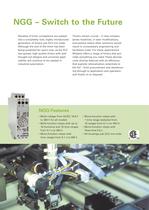
Decades of timer competence are packed into a completely new, highly miniaturized generation of timers just 22.5 mm wide. Although the end of the timer has been being predicted for years now, as the PLC has spread, high quality timers with well thought-out designs and universal appli-cability will continue to be needed in industrial automation. Timers remain crucial – in less complex series machines, in later modifications, everywhere where other solutions would result in unnecessary engineering and hardware costs. For these applications Wieland offers a range of timers that provides everything...
Open the catalog to page 4
4 | 5 Multi-Voltage on the Move With a clearly structured front panel and a field for lettering, these well-designed devi ces make for easy operation and con- trol. Function and time settings are changed from the front using a standard screwdriver on large, easy to set analog scales and rotary switches while the relay remains installed. All the controls are flush with the front or slightly recessed, to reliably prevent accidental changes to settings. LEDs show the state of the excitation input, the position of the contacts and the countdown. NGG relays operate in any orientation. They are quickly...
Open the catalog to page 5
The precision relays of the NGG series control the shortest of times to one hundredth of a second, and extremely long processes too. 16 different setting ranges can be selected on the RANGE switch on the front of the relay, allowing precision switch-ing of times from 0.05 s to 300 h. Before the devices are installed the time range can be set quickly from the side. After the time range has been chosen, the required time within the range is set on the large, easy to read disk. As well as the very flexible multi-range relays, we also have mono versions and relays with fixed times, for example to...
Open the catalog to page 6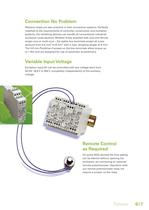
Connection No Problem Wieland relays are also practical in their connection systems. Perfectly matched to the requirements of controller construction and contactor systems, the switching devices can handle all conventional industrial conductor cross-sections. Whether finely stranded with wire-end ferrule, single-core or multi-core – the stable box terminals accept all cross- sections from 0.5 mm2 to 6 mm2 with a max. stripping length of 9 mm. The 3.0 mm Pozidrive-2 screws on the box terminals allow torque up to 1 Nm and are designed for use of automatic screwdrivers. Variable Input Voltage Excitation...
Open the catalog to page 7
Industrial. Day In, Day Out Their robustness and solid electronics make the slim timers perfect for application in all sorts of industrial environment. • Designed for ambient temperatures between –25 °C and +60 °C • Isolation up to 300 V between control circuitry and the relay outputs • Very high interference immunity, meet very high EMC standards • Output relays correspond to utilization category AC-15 at 230 V / 3 A, DC-13 at 24 V / 2 A Environmentally Aware The good ecological balance sheet of the NGG relays, characterized by meticulous selection of materials and well thought-out production,...
Open the catalog to page 8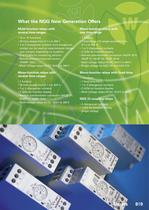
Multi-function relays with several time ranges • 16 or 10 functions • 16 time ranges from 0.1 s to 300 h • 1 or 2 changeover contacts (2nd changeover contact can be used as instantaneous change-over contact, depending on function) • 2 or 3 LEDs for monitoring function • Remote potentiometer connection (NGMP 1001) • Multi-voltage relays AC/DC 16.8 V to 264 V Mono-function relays with several time ranges • 1 function • 16 time ranges from 0.1 s to 300 h • 1 or 2 changeover contacts • 2 LEDs for function display • Remote potentiometer connection (NGZP 71, NGZP 72, NGZP 72-S) • Multi-voltage relays...
Open the catalog to page 9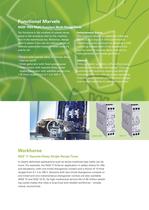
Instantaneous Signal This function allows an additional influence on the output signal in time controls and closed-loop control circuits by allowing on/off switching independent of the elapsed time. Can be used for operate delay, interval on, clock generator and pulse generator. Addition If the excitation variable is off and the countdown thus interrupted, the operate-delayed functions with auxiliary supply can add the individual intervals until the preset operating time has been reached and the timed changeover contact switches to operated condition. Functional Marvels Workhorse Ten functions...
Open the catalog to page 10
Method of Function When the excitation variable (B1-A2) is switched on and the auxiliary supply (A1-A2) is also on, the timed changeover contact switches to operated condition and the countdown starts. The countdown restarts each time the excitation variable is switched off and on during the delay time. If the break or make time of the excitation variable is longer than the delay time t, the timed changeover contact switches to normal condition and stays there even if the excitation variable is switched on again. The timed changeover contact switches to normal condition immediately when the auxiliary...
Open the catalog to page 11All WIELAND ELECTRIC catalogs and technical brochures
 RST® Catalog
268 Pages
 RST®MICRO MICRO CONNECTION
12 Pages
 DIN RAIL TERMINAL BLOCKS
176 Pages
 samos®PRO COMPACT
12 Pages
 podis®5G6 POWER DISTRIBUTION
2 Pages
 podis®HELLO CHARGING
4 Pages
 wieplan
2 Pages
 HELLO WIND
20 Pages
 Full speed ahead
16 Pages
 samos®pro
2 Pages
 selos+fasis
188 Pages
 sensor pro
8 Pages
 HELLO LIGHT
32 Pages
 Modular flexibility
12 Pages
 PCB connector 8105 B
2 Pages
 revos mini Q5
2 Pages
 revos E-2000
16 Pages
 METALYNX2
16 Pages
 Revos docking
2 Pages
 wiecon
2 Pages
 revos basic
2 Pages
 Installation Column
16 Pages
 Machine building
24 Pages
 PCB Terminals - Catalog
144 Pages
 Metalynx² - Brochure
16 Pages
 smart Installation - Brochure
24 Pages
 gesis® FLEX - Brochure
12 Pages
 wienet VPN router
12 Pages
 Terminal Block Catalog
160 Pages
 safety - Catalogue 2015
118 Pages
 gesis® indoor - Catalog 2015
288 Pages
 Machine building - Brochure
24 Pages
 gesis® RST® - Catalog 2015
228 Pages
 gesis® ELECTRONIC
84 Pages
 Interface Catalog 2012
108 Pages
 Wieland product range
40 Pages
 safety sensors
112 Pages
 Safety products
10 Pages
 PCB Terminals
126 Pages
 wietap - Overvoltage Protection
12 Pages
 wipos - Power Supply Units
4 Pages








Archived catalogs
 AT Catalog 2006 Page 0290-0327
38 Pages
- Connector
- Power supply unit
- Panel PC
- DC power supply
- Industrial panel PC
- Data connector
- AC/DC power supply
- Electrical power supply connector
- LCD panel PC
- Metal connector
- Surge protector
- Proximity switch
- Circular connector
- Polymer connector
- Junction block
- IO module
- Screw-in connector
- Socket electrical connector
- Industrial connector