
- Catalogs
- WIELAND ELECTRIC
- PC Board Terminals and pluggable Connectors (THR)

PC Board Terminals and pluggable Connectors (THR)
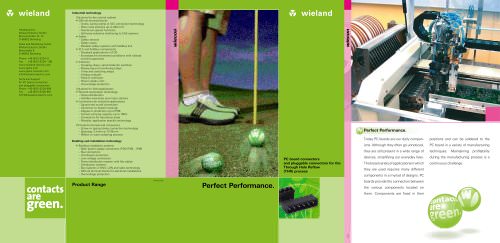
PC Board Terminals and pluggable Connectors (THR)
PC boards are integral to numerous devices, providing connections between components. The manufacturing process of these boards involves various techniques to ensure profitability and efficiency.
Product Range
Wieland Electric GmbH offers a wide range of industrial technology solutions, including DIN rail terminal blocks, safety sensors, PLC and fieldbus components, and connectors for industrial applications. These products are designed to meet various environmental and safety standards.
Manufacturing Processes
The document outlines different manufacturing processes for PC boards, including Through Hole Technology (THT), Surface Mount Technology (SMT), and the Through Hole Reflow (THR) process. Each process has its own advantages and is suitable for different types of components.
Through Hole Reflow (THR) Process
The THR process combines THT and SMT, allowing components to be mounted on plated-through drill holes and reflow soldered. This process is also known as "Pin in Paste" (PIP) and is ideal for components requiring high mechanical stability.
PC Board Layout and Solder Paste Application
The layout of the PC board must be designed with the reflow process in mind to ensure reliable solder joints. Parameters such as drill hole diameter and residual ring width are crucial. The solder paste application process involves multiple printings and adjustments to achieve the desired solder amount.
Quality of Solder Joints
Solder joints made with the THR process differ from those made by other methods. The document emphasizes the importance of evaluating these joints according to IPC-A-610C standards, especially when using shorter pin lengths.
Temperature Requirements
The THR process subjects components to lower maximum temperatures but longer durations compared to wave soldering. This necessitates the use of temperature-resistant materials to prevent defects like the "popcorn effect."
Conclusion
The document provides a comprehensive overview of the THR process, highlighting its advantages and the critical parameters for successful implementation. It emphasizes the need for careful design and material selection to ensure high-quality solder joints.
Catalog excerpts

wiecon wiecon PC board connectors and pluggable connectors for the Through Hole Reflow (THR) process Perfect Performance. Today PC boards are our daily companions. Although they often go unnoticed, they are still present in a wide range of devices, simplifying our everyday lives. The broad variety of applications in which they are used requires many different components in a myriad of designs. PC boards provide the connection between the various components located on them. Components are fixed in their positions and can be soldered to the PC board in a variety of manufacturing techniques. Maintaining profitability during the manufacturing process is a continuous challenge. 2 Perfect Performance. Product Range Headquarters: Wieland Electric GmbH Brennerstraße 10 -.14 D-96052 Bamberg Sales and Marketing Center: Wieland Electric GmbH Benzstraße 9 D-96052 Bamberg Phone +49 (9 51) 93 24 -.0 Fax +49 (9 51) 93 24 -.1 98 www.wieland-electric.com www.gesis.com www.gesis-network.com [email protected] Technical Support for PC board connectors and pluggable connectors: Phone +49 (9 51) 93 24-994 Fax +49 (9 51) 93 26-991 [email protected] Industrial technology Solutions for the control cabinet • DIN rail terminal blocks – Screw, spring clamp or IDC connection technology – Wire cross sections up to 240 mm2 – Numerous special functions – Software solutions interfacing to CAE systems • Safety – Safety sensors – Safety relays – Modular safety systems with fieldbus link • PLC and fieldbus components – Standard applications in IP 20 – Increased environmental conditions with railroad and ship approvals • Interface – Coupling relays, semiconductor switches – Measuring and monitoring relays – Timer and switching relays – Analog modules – Passive interfaces – Power supply units – Overvoltage protection Solutions for field applications • Remote automation technology – Power distribution – Fieldbus interfaces and motor starters • Connectors for industrial applications – Square and round connectors – Aluminum or plastic housings – Degree of protection up to IP 68 – Current-carrying capacity up to 100 A – Connectors for hazardous areas – Modular, application specific technology PC board terminals and connectors – Screw or spring clamp connection technology – Spacings: 3.5 mm to 10.16 mm – Reflow or wave soldering process Building and installation technology • Building installation systems – Main power supply connectors IP 20 / IP 65 ... IP 68 – Bus connectors – Combined connectors – Low-voltage connectors – Power distribution system with flat cables – Distribution systems – Bus systems in KNX, LON and radio technology – DIN rail terminal blocks for electrical installations – Overvoltage protection 0144.0 S 07/09
Open the catalog to page 1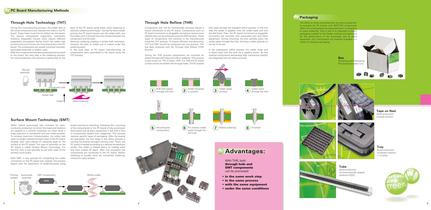
Printing (solder) Automated assembly SMD SMT components During this manufacturing process, the solder tails of the wired components are inserted into holes in the PC board. These holes must first be drilled into the board. The various components (capacitors, transistors, resistors, Integrated Circuits (ICs)) require different preparatory procedures during which the solder tails are bent and cut to fit into the mounting holes in the PC board. The components are usually mounted manually: automated assembly is seldom used. After the components have been prepared and mounted to the board, the next...
Open the catalog to page 2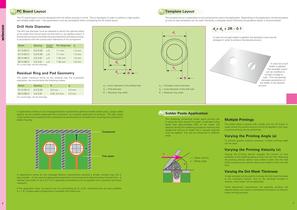
ds dh R dh dp R a v wiecon 6 The PC board layout must be designed with the reflow process in mind. This is necessary in order to achieve a high quality and reliable solder joint. Two parameters must be considered when completing the PC board layout. Series Spacing R dP 8113 / 8213 5.0 / 5.08 0.5 mm 2.5 mm 8513 / 8813 3.5 / 3.81 0.35 - 0.4 mm 2.0 mm PC Board Layout Drill Hole Diameter The drill hole diameter must be selected to permit the optimal reflow of the solder from the pin back into the hole (i.e. by capillary action). It should also be sized to facilitate the automated pick and place process,...
Open the catalog to page 3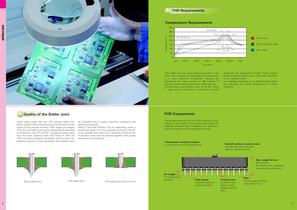
350 300 250 200 150 100 50 0 0,0 50,0 100,0 150,0 200,0 250,0 300 wiecon THR solder joint Solder joints made with the THR process differ from those made by other manufacturing processes due to the nature of the process involved. With longer pin lengths (2.5 mm), the solder joints can be inspected and evaluated in accordance with IPC-A-610C. Comparing solder joints from the wave soldering bath with those of THR, the THR connections appear somewhat thinner since the soldering meniscus is less developed. This property must be evaluated from a quality assurance standpoint and defined accordingly....
Open the catalog to page 4All WIELAND ELECTRIC catalogs and technical brochures
 RST® Catalog
268 Pages
 RST®MICRO MICRO CONNECTION
12 Pages
 DIN RAIL TERMINAL BLOCKS
176 Pages
 samos®PRO COMPACT
12 Pages
 podis®5G6 POWER DISTRIBUTION
2 Pages
 podis®HELLO CHARGING
4 Pages
 wieplan
2 Pages
 HELLO WIND
20 Pages
 Full speed ahead
16 Pages
 samos®pro
2 Pages
 selos+fasis
188 Pages
 sensor pro
8 Pages
 HELLO LIGHT
32 Pages
 Modular flexibility
12 Pages
 PCB connector 8105 B
2 Pages
 revos mini Q5
2 Pages
 revos E-2000
16 Pages
 METALYNX2
16 Pages
 Revos docking
2 Pages
 wiecon
2 Pages
 revos basic
2 Pages
 Installation Column
16 Pages
 Machine building
24 Pages
 PCB Terminals - Catalog
144 Pages
 Metalynx² - Brochure
16 Pages
 smart Installation - Brochure
24 Pages
 gesis® FLEX - Brochure
12 Pages
 wienet VPN router
12 Pages
 Terminal Block Catalog
160 Pages
 safety - Catalogue 2015
118 Pages
 gesis® indoor - Catalog 2015
288 Pages
 Machine building - Brochure
24 Pages
 gesis® RST® - Catalog 2015
228 Pages
 gesis® ELECTRONIC
84 Pages
 Interface Catalog 2012
108 Pages
 Wieland product range
40 Pages
 safety sensors
112 Pages
 Safety products
10 Pages
 PCB Terminals
126 Pages
 wietap - Overvoltage Protection
12 Pages
 wipos - Power Supply Units
4 Pages
 Timers
20 Pages









Archived catalogs
 AT Catalog 2006 Page 0290-0327
38 Pages