
- Catalogs
- White Drive Motors And Steering
- RS Technical Information


RS Technical Information
RS Technical Information
- Operating Recommendations: Use hydraulic oils with anti-wear, anti-foam, and demulsifiers. Maintain fluid viscosity between 20 - 43 cSt at operating temperature and keep fluid temperature below 85°C. Ensure oil cleanliness level of ISO 17-14 or better.
- Installation & Start-Up: Ensure full contact of the motor's mounting flange with the application surface. Use appropriate mounting hardware and align components to avoid excessive loads. Run the motor at no load and half speed for 15-30 minutes to remove air from the system.
- Motor Protection: Prevent over-pressurization by providing adequate relief protection. Use counterbalance valves or relief cartridges to manage overrunning conditions.
- Hydraulic Motor Safety Precaution: Do not use hydraulic motors to hold suspended loads due to potential creep. Use mechanical brakes for load holding.
- Motor/Brake Precaution: Motors/brakes are for static or parking use. Ensure system pressure does not exceed brake capacity. Use a separate case drain back to the tank for proper brake operation.
- Motor Circuits: Two types of circuits are used: series connection (for uniform speed across motors) and parallel connection (for full torque at each motor).
- Speed Sensors: Various sensor options are available for monitoring motor speed.
- Protection Circuitry: Includes features to protect the motor from over-pressurization and other potential issues.
- Free Turning Rotor & Valve Cavity: Designed for specific operational benefits and protection.
- Overview: Describes series and features of light-duty motors, including typical applications and specifications.
- Displacement Performance: Details on performance metrics for different series.
- Technical Information: Includes allowable shaft load, bearing curves, and thrust load specifications.
Performance testing is crucial for evaluating a motor's ability to convert flow and pressure into speed and torque. Testing is conducted in a state-of-the-art facility with automated equipment and custom software to ensure accurate and reliable data. Standardized test routines, including test stand calibration and fluid temperature stabilization, are used to maintain consistency.
The catalog provides curves showing allowable radial loads along the motor's longitudinal axis. Two capacity curves for the shaft and bearings are shown, with the lower of the two at any point being the limiting factor. The bearing curves are based on laboratory analysis and testing, while shaft loading considers a 3:1 safety factor and 330 Kpsi tensile strength.
ISO 281 provides a standard for dynamic load ratings of roller bearings, allowing consistent comparisons between manufacturers. Manufacturers' ratings are adjusted based on laboratory investigations and practical experience, considering factors like material, lubrication, and load magnitude.
When selecting a wheel drive motor, factors such as maximum motor RPM, torque, and load must be considered. Equations are provided to calculate these criteria, including Total Tractive Effort (TE), which is the sum of rolling resistance, grade resistance, acceleration force, and drawbar pull. Motor torque and wheel slip calculations are also detailed.
Using pulleys or sprockets can create a torque-induced side load on the motor shaft and bearings. Calculations for side load are provided, and these must be compared to the motor's bearing and shaft load curves to ensure they fall within acceptable ranges.
Various hydraulic equations are provided for calculating theoretical speed, torque, and power in and out, using factors like displacement, pressure, and flow rate.
Tightening torques for shaft nuts are provided as guidelines, with recommendations to consult hub manufacturers for specific torque requirements. Proper engagement of the hub with the shaft taper is emphasized to maximize torque transfer and minimize shaft breakage.
- Speed Sensors: The document discusses single and dual element speed sensors, highlighting their benefits such as high resolution for slow speed applications and direction monitoring. The sensors are designed to avoid high-pressure areas, reducing potential leak points. Improvements include a self-centering flange and easy serviceability.
- Features/Benefits: Key features include a grease fitting for protection, internal seals, flexible connectors, and a modular design for easy servicing. The dual element sensor offers up to 120 pulses per revolution and directional sensing.
- Sensor Options: Various connector options are available, each with specific pulse per revolution capabilities and direction detection features.
- Protection Circuitry: The sensors include protection against reverse battery, overvoltage, and power supply spikes, enhancing durability in real-world applications.
- Free Turning Rotor: The 'AC' option provides increased clearance for better performance in high flow/high rpm applications, though it may slightly reduce volumetric efficiency at high pressures.
- Valve Cavity: This option allows integration of various cartridge valves for enhanced safety and control, including relief cartridges and flow control valves.
- Slinger Seal: Available on select series, these seals prevent material buildup around the shaft, extending seal life.
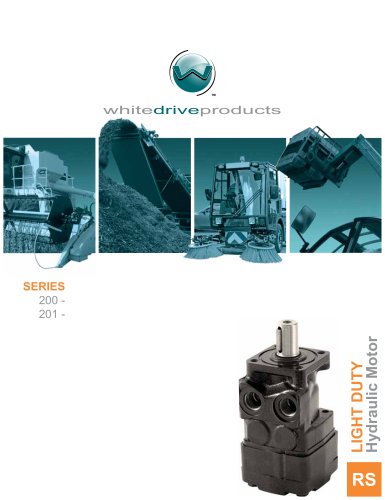
- Overview: The RS Series motors are economical yet advanced, featuring the Roller Stator® design for reduced friction and increased power. They are compatible with industry-standard mounts and shafts.
- Features/Benefits: The motors offer high volumetric efficiencies, superior seal life, and long-lasting drive links due to their design.
- Typical Applications: These motors are suitable for conveyors, carwashes, positioners, light-duty wheel drives, and more.
- Specification: Detailed specifications are provided for different motor codes, including displacement, speed, flow, torque, and pressure ratings.
Catalog excerpts
MOTORS Technical Information RS Orbital Motors
Open the catalog to page 1
White is a leading global provider of motor and steering solutions that power the evolution of mobile and industrial applications around the world.
Open the catalog to page 2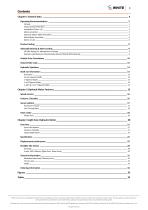
3 Contents Chapter 1 General Data ______________________________________________________________________ 4 Operating Recommendations ________________________________________________________________________ 5 Oil type ___________________________________________________________________________________________________ Fluid viscosity & Filtration ____________________________________________________________________________________ Installation & Start- Up ______________________________________________________________________________________ Motor protection ___________________________________________________________________________________________...
Open the catalog to page 3
Chapter 1 General DataTopics: • Operating Recommendations • Product testing • Allowable Bearing & Shaft Loading • Vehicle Drive Calculations • Induced Side Load • Hydraulic Equations WHITE can accept no responsibility for possible errors in catalogues, brochures, and other printed material. WHITE reserves the right to alter its products without notice. This also applies to products already on order provided that such alterations can be made without subsequent changes being necessary in specifications already agreed. All trademarks in this material are the property of the respective companies....
Open the catalog to page 4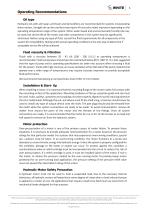
Operating Recommendations Oil type Hydraulic oils with anti-wear, anti-foam and demulsifiers are recommended for systems incorporating these motors. Straight oils can be used but may require VI (viscosity index) improvers depending on the operating temperature range of the system. Other water based and environmentally friendly oils may be used, but service life of the motor and other components in the system may be significantly shortened. Before using any type of fluid, consult the fluid requirements for all components in the system for compatibility. Testing under actual operating conditions...
Open the catalog to page 5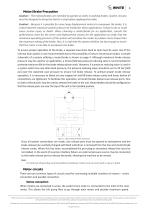
Motor/Brake Precaution Caution! - The motors/brakes are intended to operate as static or parking brakes. System circuitry must be designed to bring the load to a stop before applying the brake. Caution! - Because it is possible for some large displacement motors to overpower the brake, it is critical that the maximum system pressure be limited for these applications. Failure to do so could cause serious injury or death. When choosing a motor/brake for an application, consult the performance chart for the series and displacement chosen for the application to verify that the maximum operating pressure...
Open the catalog to page 6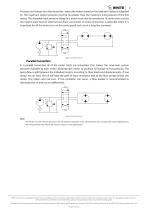
7 Pressure and torque are distributed be- tween the motors based on the load each motor is subjected to. The maximum system pressure must be no greater than the maximum inlet pressure of the first motor. The allowable back pressure rating for a motor must also be considered. In some series circuits the motors must have an external case drain connected. A series connection is desirable when it is important for all the motors to run the same speed such as on a long line conveyor. Figure 2 Series Circuit Parallel Connection In a parallel connection all of the motor inlets are connected. This makes...
Open the catalog to page 7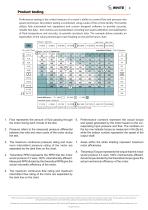
Product testing Performance testing is the critical measure of a motor's ability to convert flow and pressure into speed and torque. All product testing is conducted using a state of the art test facility. This facility utilizes fully automated test equipment and custom designed software to provide accurate, reliable test data. Test routines are standardized, including test stand calibration and stabilization of fluid temperature and viscosity, to provide consistent data. The example below provides an explanation of the values pertaining to each heading on the performance chart. Intermittent...
Open the catalog to page 8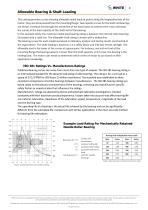
Allowable Bearing & Shaft Loading This catalog provides curves showing allowable radial loads at points along the longitudinal axis of the motor. They are dimensioned from the mounting flange. Two capacity curves for the shaft and bearings are shown. A vertical line through the centerline of the load drawn to intersect the x-axis intersects the curves at the load capacity of the shaft and of the bearing. In the example below the maximum radial load bearing rating is between the internal roller bearings illustrated with a solid line. The allowable shaft rating is shown with a dotted line. The...
Open the catalog to page 9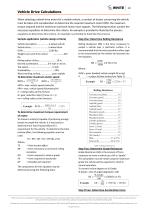
Vehicle Drive Calculations When selecting a wheel drive motor for a mobile vehicle, a number of factors concerning the vehicle must be taken into consideration to determine the required maximum motor RPM, the maximum torque required and the maximum load each motor must support. The following sections contain the necessary equations to determine this criteria. An example is provided to illustrate the process. equations to determine this criteria. An example is provided to illustrate the process Sample application (vehicle design criteria) Step One: Determine Rolling Resistance Rolling Resistance...
Open the catalog to page 10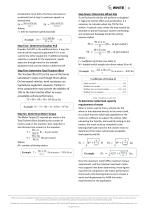
Acceleration Force (FA) is the force necessary to accelerate from a stop to maximum speed in a desired time. t = time to maximum speed (seconds) Step Seven: Determine Wheel Slip To verify that the vehicle will perform as designed in regard to tractive effort and acceleration, it is necessary to calculate wheel slip (TS) for the vehicle. In special cases, wheel slip may actually be desirable to prevent hydraulic system overheating and component breakage should the vehicle become stalled. Step Four: Determine Drawbar Pull Drawbar Pull (DP) is the additional force, if any, the vehicle will be required...
Open the catalog to page 11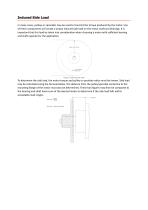
Induced Side Load In many cases, pulleys or sprockets may be used to transmit the torque produced by the motor. Use of these components will create a torque induced side load on the motor shaft and bearings. It is important that this load be taken into consideration when choosing a motor with sufficient bearing and shaft capacity for the application. Figure 5 Induced side load To determine the side load, the motor torque and pulley or sprocket radius must be known. Side load may be calculated using the formula below. The distance from the pulley/sprocket centerline to the mounting flange of the...
Open the catalog to page 12All White Drive Motors And Steering catalogs and technical brochures
 White Brochure
20 Pages
 OML | OMM Technical Information
32 Pages
 ORBITAL X Technical Information
54 Pages
 OMS Technical Information
53 Pages
 OMSU Technical Information
17 Pages
 OMEW Technical Information
19 Pages
 RE Technical Information
59 Pages
 HP 30 Technical Information
42 Pages
 WS Technical Information
36 Pages
 DH | DS Technical Information
43 Pages
 SbX Technical Information
28 Pages
 OSPM Technical Information
33 Pages
 LAGC Technical-Information
20 Pages
 LAGU Technical-Information
18 Pages
 LAGZ Technical Information
22 Pages
 S10 | S20 Technical Information
39 Pages
Archived catalogs
 OMS
OMS53 Pages
 OMSW
OMSW21 Pages
 VIS 40, 45
65 Pages
 HP 30
HP 3042 Pages
 RS Orbital Motors
36 Pages
 WM
WM8 Pages
 WD
WD14 Pages
 WP
WP18 Pages
 RS Series 200-201
15 Pages
 WR
WR18 Pages
 WG
WG22 Pages
 HB/HK
HB/HK22 Pages
 WS
WS26 Pages
 CE
CE21 Pages
 RE
RE27 Pages
 DR
DR23 Pages
 DT
DT18 Pages
 BK series 913
4 Pages
 SB
SB7 Pages
 FD
FD6 Pages
 2012 Product Catalog
259 Pages
 HB
HB20 Pages
 D9
D914 Pages
 Product Catalog
258 Pages
 FD
FD6 Pages
 BK series 910
4 Pages
 DT
DT20 Pages
 WS
WS22 Pages
 RS D9 Series Hydraulic Motors
16 Pages
 RG Series
32 Pages
 White Hydraulics - Drive products
204 Pages

- Magnetic speed sensor
- Rotational speed sensor
- Orbital hydraulic motor
- Flow divider
- Gear hydraulic motor
- Non-contact speed sensor
- Industrial hydraulic motor
- Hydraulic flow divider
- Compact speed sensor
- Compact hydraulic motor
- High-pressure hydraulic motor
- Axle steering system
- Robust speed sensor
- High-torque hydraulic motor
- Variable-displacement hydraulic motor
- Hydraulic motor for heavy-duty applications
- Low-speed hydraulic motor
- 2-channel flow divider
- Two-speed hydraulic motor