
- Catalogs
- West Control Solutions
- Mineral-insulated- RTD (Pt100)

- Company
- Products
- Catalogs
- News & Trends
- Exhibitions
Mineral-insulated- RTD (Pt100)
1 / 2 PagesView full catalog
Mineral-insulated- RTD (Pt100)
Product catalog summary
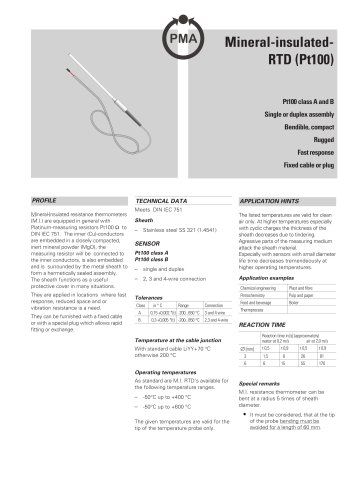
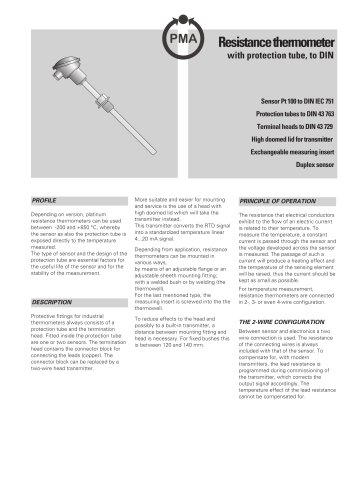
Overview: Mineral-Insulated (M.I.) resistance thermometers are designed with Platinum-measuring resistors Pt100 Ω compliant with DIN IEC 751 standards. These thermometers are encased in a stainless steel sheath filled with inert mineral powder (MgO) for protection and durability, making them suitable for environments requiring fast response, reduced space, and vibration resistance. They can be equipped with either a fixed cable or a special plug for easy installation or replacement.
Technical Specifications:
- Compliance: Meets DIN IEC 751 standards.
- Sheath Material: Stainless steel SS 321 (1.4541).
- Sensors: Pt100 class A and B, available in single and duplex configurations with 2, 3, and 4-wire connections.
- Tolerances: Class A: 0.15 +0.002*(t) °C for -200 to 650 °C (3 and 4-wire); Class B: 0.3 +0.005*(t) °C for -200 to 850 °C (2, 3, and 4-wire).
- Operating Temperatures: Standard ranges are -50°C to +400°C and -50°C to +600°C, applicable to the probe tip only.
Application Guidelines: The specified temperatures are valid for clean air. At higher temperatures, especially with cyclic loads, the sheath may degrade. Aggressive media can attack the sheath material, and smaller diameter sensors have reduced lifespans at high temperatures. Applications include chemical engineering, petrochemistry, food and beverage, and more.
Reaction Time: The reaction time varies with the medium and sheath diameter. For example, a 3 mm diameter sheath has a reaction time of 1.5 seconds in water at 0.2 m/s and 26 seconds in air at 2.0 m/s.
Special Considerations: M.I. thermometers can be bent at a radius five times the sheath diameter, but bending should be avoided within 60 mm of the probe tip.
Ordering Information: Assemblies are custom-made based on specifications. Options include sheath diameter, measuring range, connection type, and cable length. Accessories such as adjustable compression fittings and connectors are available.
See more
All West Control Solutions catalogs and technical brochures
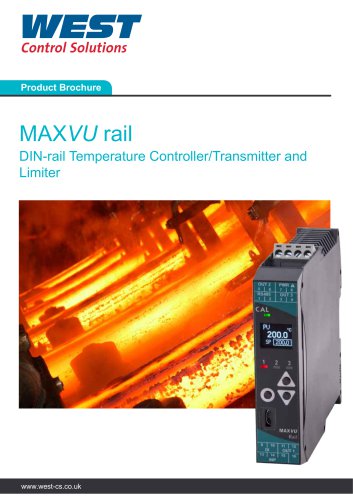
 Rail Line Brochure
6 Pages
 Product Catalogue
52 Pages
 KS98-2 Brochure
6 Pages
 Dual Loop Temperature Controller
15 Pages
 CAL Thermostats Brochure
4 Pages
 CAL Controller Brochure
4 Pages
 Company Profile
16 Pages
 3-phase with heatsink
8 Pages
 2-phase with heatsink
8 Pages
 3-phase without heatsink
4 Pages
 2-phase without heatsink
4 Pages







Archived catalogs
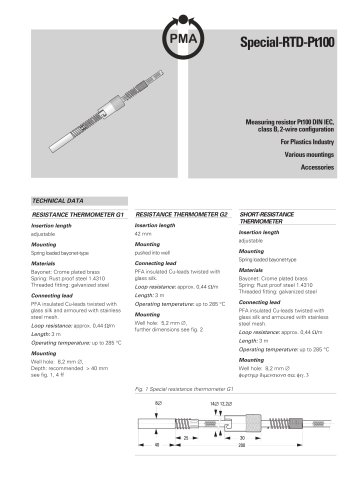 Special-RTD-Pt100
2 Pages
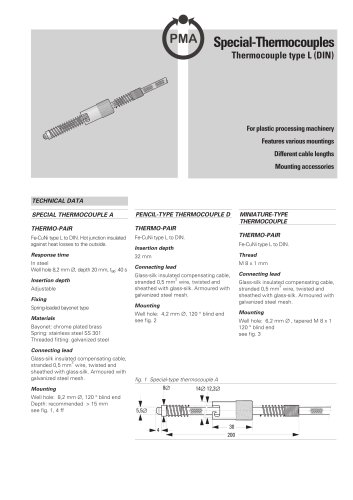 Special Thermocouple
2 Pages
 Thermocouples
4 Pages





Related Searches
- Pressure transmitter
- Analog pressure transmitter
- Digital temperature control
- Waterproof pressure transmitter
- Membrane pressure transmitter
- Stainless steel pressure transmitter
- Temperature controller
- Digital temperature controller
- Absolute pressure transmitter
- IP65 pressure transmitter
- Automation temperature controller
- IP67 pressure transmitter
- PID temperature control
- Compact pressure transmitter
- PID temperature controller
- Temperature regulator
- Digital thermostat
- Universal temperature control
- Electronic thermostat
- Configurable temperature control
*Prices are pre-tax. They exclude delivery charges and customs duties and do not include additional charges for installation or activation options. Prices are indicative only and may vary by country, with changes to the cost of raw materials and exchange rates.
About DirectIndustry
DirectIndustry is a marketplace that offers B2B players a complete experience, from product sourcing to purchase. DirectIndustry is an entity of VirtualExpo Group.
Are you a buyer?
Are you a supplier?