
- Catalogs
- WEIMA Maschinenbau GmbH
- WEIMA Briquette presses, packaging presses & drainage presses


WEIMA Briquette presses, packaging presses & drainage presses

WEIMA Briquette presses, packaging presses & drainage presses
WEIMA is a leading global manufacturer of shredders, briquetters, and drainage presses, with over 40,000 machines delivered worldwide since its founding in 1980. The company specializes in converting waste materials into valuable raw materials using compression technology.
WEIMA operates on a 65,000 sqm production area with over 300 employees and has a presence in major markets such as Europe, the USA, China, and India.
WEIMA is dedicated to environmental protection and resource conservation through advanced shredding technology, aiming to contribute to a cleaner planet by developing energy-efficient recycling machines.
- Wood: Used in carpentry and furniture industries for energy-efficient burning or sale.
- Paper: Enhances safety and reduces dust emissions by briquetting shredded documents.
- Biomass: Converts materials like straw and hay into high-calorific briquettes for feed production.
- Metal: Reduces volume and improves smelting properties of metal chips and milling waste.
WEIMA offers customizable round and rectangular briquettes, with round briquettes ranging from 40 to 90 mm in diameter and rectangular ones measuring 150 x 60 mm.
- Clamping Presses: Suitable for medium throughput with low maintenance.
- Matrix Presses: Ideal for high throughput and industrial operations with higher pressing pressures.
The C Series provides economical and compact solutions with features like vertical material pre-compaction, Siemens PLC control, and robust hydraulics, producing high-strength round briquettes up to 70 mm in diameter.
Features include low maintenance hydraulic cylinders, optimized material input via screw conveyors, and minimal wear in the press chamber due to hardened wear sleeves.
Briquetting machines offer customizable configurations through a modular design, allowing integration into existing production plants with flexible setups.
Equipped with Siemens PLC control for user-friendly operation, the machines ensure high-quality briquette production with dust-reduced pre-compaction systems.
Features include temperature-monitored hydraulic units and safety switches for oil temperature, with easy maintenance components like chrome-plated clamps.
Detailed technical data for various models include briquette diameter, throughput rates, hydraulic motor power, and space requirements.
The TH Standard S series offers high throughput rates with options for Duo, Trio, or Quattro versions, designed for non-stop operation with standard oil cooling.
The TH Industrial series is designed for high briquette quality and industrial standards, suitable for multi-shift operations and easy integration into production lines.
Features include automatic operation with sensors, increased discharge height, oil cooling for multi-shift operation, and robust construction for handling foreign materials.
Technical specifications for the PUEHLER E and G series include disc diameter, throughput rate, and customizable configurations for material feed and discharge.
WEIMA machines offer seamless integration into production lines with state-of-the-art data interfaces and customizable configurations.
WEIMA provides regional service centers, refurbished machinery, training courses, and service packages with original parts to ensure reliable production.
Catalog excerpts

BRIQUETTE PRESSES PACKAGING PRESSES DRAINAGE PRESSES
Open the catalog to page 1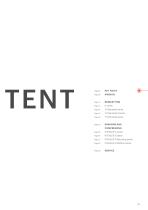
Page 24 TH Standard series Page 32 TH Standard S series Page 40 TH Industrial series COMPRESSING Page 58 PUEHLER A series Page 64 PUEHLER E series Page 72 PUEHLER G Recycling series Page 80 PUEHLER G ReWork series
Open the catalog to page 3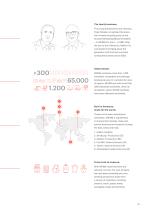
The family business. The young entrepreneur and visionary, Peter Rössler, recognized the potential of waste recycling early on and founded Weinsberg Maschinenfabrik – or WEIMA for short – in 1980. After the turn of the millennium, Martin Friz succeeded in bringing about the generation shift and has now been running the business since 2003. Global leader. WEIMA produces more than 1,200 shredders, briquetters and drainage presses per year on a production area of approx. 65,000 sqm with more than 300 employees worldwide. Since its foundation, about 40,000 machines have been delivered worldwide....
Open the catalog to page 5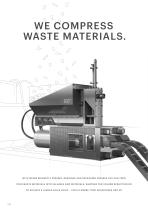
WE COMPRESS WASTE MATERIALS.
Open the catalog to page 6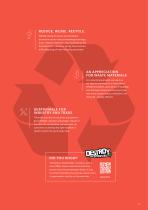
REDUCE. REUSE. RECYCLE. WEIMA stands for active environmental protection and for robust shredding technology that’s “Made in Germany”. Our machines lay the foundation for a resource-saving future and are at the beginning of many recycling processes. AN APPRECIATION FOR WASTE MATERIALS As a recycling specialist, we see it as our duty to contribute to a clean planet. WEIMA shredders, granulators, briquetting and drainage presses are thus becoming ever more sophisticated, productive, and above all – energy-efficient. SUSTAINABLE FOR INDUSTRY AND TRADE The wide selection of machines and options gives...
Open the catalog to page 7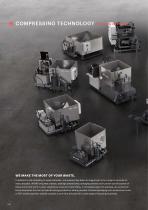
COMPRESSING TECHNOLOGY WE MAKE THE MOST OF YOUR WASTE. In addition to the shredding of waste materials, compression has been an integral part of our range of services for many decades. WEIMA briquette presses, drainage presses and packaging presses are in proven use thousands of times around the world. Loose, voluminous wood and metal chips, or shredded paper, for example, are turned into handy briquettes that can be used for energy production where possible. Pressed packaging such as aluminum cans or PET bottles and their drained contents in turn form the basis for a wide range of recycling...
Open the catalog to page 8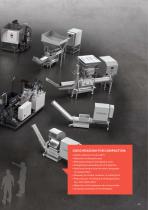
GOOD REASONS FOR COMPACTION: Volume reduction of up to 95 % Reduction of disposal costs Minimized transport and logistics costs Energetically sustainable use of briquettes Additional revenue from the sale of briquettes or pressed discs Recovery of coolant, emulsion, or cutting fluid Reduced burn-off during the smelting process (e.g. with metal chips) Reduction of the explosion risk of loose dusts Increased cleanliness in the workplace
Open the catalog to page 9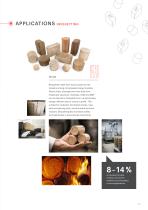
Wood Briquettes made from wood waste are the classics among compressed energy bundles. Wood chips, shavings and even dust from chipboard, plywood, multiplex, OSB and MDF can be burned in briquette form in a particularly energy-efficient way or sold at a profit. This is ideal for carpentry and joinery shops, sawmills and planing mills, and the entire furniture industry. Briquetting also increases safety and cleanliness in wood shops nationwide. 8 - 14 % is typically the ideal moisture content for material to be briquetted in wood applications.
Open the catalog to page 11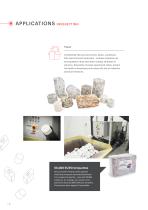
Paper Confidential files and documents, labels, cardboard, filter dust and even banknotes – all these materials can be briquetted if they have been suitably shredded in advance. Briquettes increase operational safety, protect the health of employees and reduce the risk of explosion and dust emissions. 50,000 EURO briquettes Did you know? Federal banks regularly shred and compress discarded banknotes into compact briquettes – also with WEIMA machines. On average, the volume corresponds to about 50,000 EURO per briquette. Putting them back together? Impossible.
Open the catalog to page 12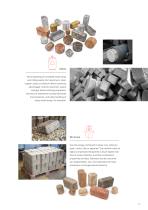
Metal The briquetting of shredded metal chips and milling waste from aluminum, steel, copper, brass or titanium offers numerous advantages: Volume reduction, space savings, better smelting properties, recovery of expensive cooling lubricants and emulsions, and safer handling of sharp metal scrap, for example. Biomass Use the energy contained in straw, hay, tobacco, peat, cotton, flax or legumes! The calorific value of highly compressed briquettes is much higher than that of loose materials, and their combustion properties are ideal. Biomass has also become an indispensable, low-cost alternative...
Open the catalog to page 13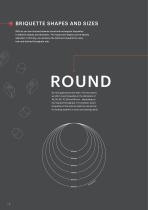
BRIQUETTE SHAPES AND SIZES With us you can choose between round and rectangular briquettes in different shapes and diameters. The respective lengths can be flexibly adjusted. In this way, you produce the optimum briquette for every task and desired throughput rate. ROUND No two applications are alike. For this reason, we offer round briquettes in the diameters of 40, 50, 60, 70, 80 and 90 mm – depending on the required throughput. For example, wood briquettes of this size are ideal for use as fuel for heating systems in wood-processing plants.
Open the catalog to page 14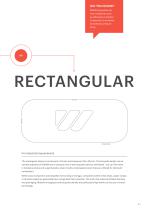
DID YOU KNOW? WEIMA briquettes are free of additives such as adhesives or binders. Compaction is achieved by hydraulic pressure alone. Actual size For industrial requirements The rectangular shape is reminiscent of bricks and measures 150 x 60 mm. The briquette length can be variably adjusted at WEIMA and is certainly one of the briquette classics worldwide. You can find them in hardware stores and supermarkets, where mostly compressed wood chips are offered for domestic combustion. While wood companies use briquettes for burning or storage, companies where metal chips, paper scraps or biomass...
Open the catalog to page 15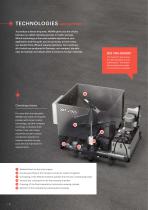
To produce a dense briquette, WEIMA gives you the choice between so-called clamping presses or matrix presses. Which technology is the most suitable depends on your application and the goals you are pursuing. In both cases, you benefit from efficient volume reduction. Our machines, all of which are produced in Germany, are compact, durable, easy to maintain and robust when it comes to foreign materials. DID YOU KNOW? The maximum press force for matrix presses is up to 3,900 kg/cm2. That would be like placing the weight of a small car on a peanut. Clamping presses For more than four decades, WEIMA...
Open the catalog to page 16All WEIMA Maschinenbau GmbH catalogs and technical brochures
 WEIMA Single-shaft shredders
76 Pages
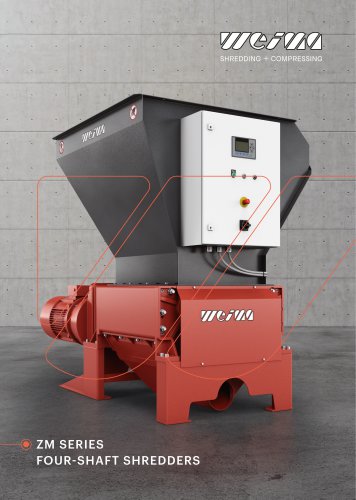 WL 4 | Single-shaft shredder
8 Pages
 C series | Briquette presses
8 Pages
 WL 6 | Single-shaft shredder
8 Pages
 WL 4 | Single-shaft shredder
8 Pages
 WL 8 | Single-shaft shredder
8 Pages
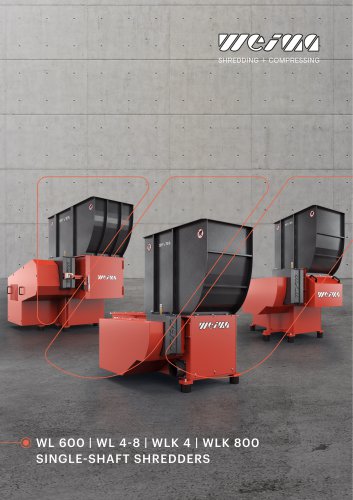 WL 4 | Single-shaft shredder
8 Pages
 HD 500 | HD 700K | HD 1500
4 Pages
 TH 1500 | TH 2800 | TH 3400
5 Pages
 TH 3400 – Briquette Press
5 Pages
 C 140 – Briquette Press
4 Pages
 SPIDER HRS-SERIES
8 Pages
 Series WSM Granulators
2 Pages
 WLK
WLK5 Pages
 Briquetting presses
8 Pages
 Four-shaft shredder
2 Pages
 Series WT
2 Pages
 Granulator
2 Pages


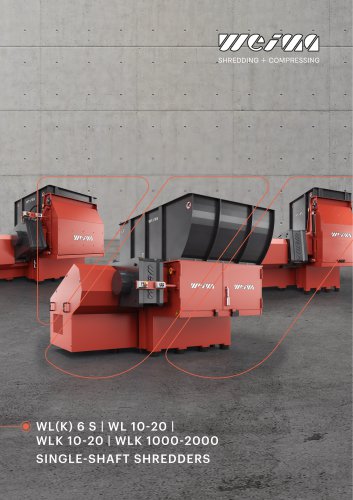


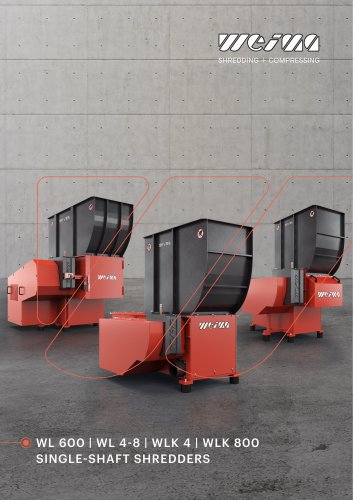




- Waste shredder
- Primary shredder machine
- Single shaft shredder machine
- Double shaft shredding machine
- Wood shredder
- Metal shredder
- Plastic shredding machine
- Paper shredder
- Rugged shredder
- Cardboard shredder
- Compact shredder
- Energy-efficient shredder
- Tire shredder
- Heavy-duty shredding machine
- Electronics scrap shredder
- Chip briquette press
- Automatic briquetting press
- Hydraulic briquette press
- Secondary shredder