- Catalogs
- Weilong Intelligent Technology (Dongguan) Co., Ltd.
- WL0623 Rotary Solenoid Industrial Application


- Company
- Products
- Catalogs
- News & Trends
- Exhibitions
WL0623 Rotary Solenoid Industrial Application
WL0623 Rotary Solenoid Industrial Application
- Vending Machines and Package Sorting: Used for controlling product release and sorting gates.
- Valve Actuation: Essential for quarter-turn ball control.
- Medical Equipment: Utilized in sample control and lock releases.
- Office Automation: Applied in printer control and document diverters.
- Security Systems: Used in electronic locks.
- Textile Machines: Beneficial for yarn control and thread cutting.
Catalog excerpts

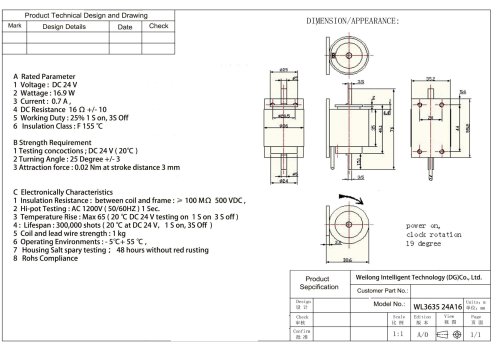
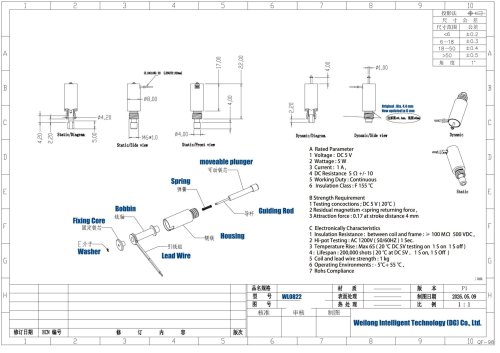
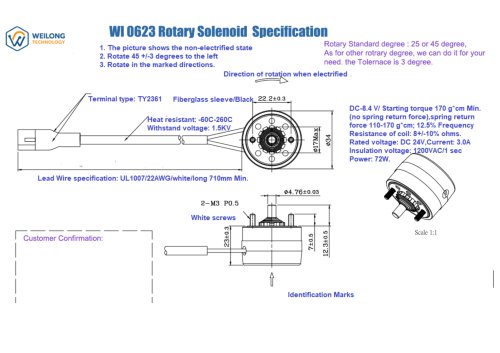
Wl 0623 Rotary Solenoid Specification 1. The picture shows the non-electrified state 2. Rotate 45 +/-3 degrees to the left 3. Rotate in the marked directions. Rotary Standard degree : 25 or 45 degree, As for other rotrary degree, we can do it for your need, the Tolernace is 3 degree. Direction of rotation when electrified Terminal type: TY2361 Fiberglass sleeve/Black, 22.2±o.3 eat resistant: -60C-260C Withstand voltage: 1. DC-8.4 V/ Starting torque 170 g'cm Min. (no spring return force),spring return force 110-170 g‘cm; 12.5% Frequency Resistance of coil: 8+/-10% ohms. Rated voltage: DC 24V,Current: 3.0A Insulation voltage:^1200VAC/1 sec Power: 72W. Lead Wire specification: UL1007/22AWG/white/long 710mm Min. Customer Confirmation: Identification Marks
Open the catalog to page 1
WL0623 Rotary Solenoid Industrial Application A rotary solenoid features a fast response and precise control over angles, which have made this actuator an essential tool for many industries. A rotary solenoid can control product release in vending machines and package sorting gates. Valve actuation, specifically quarter-turn ball control, is another major use. Its use in sample control and lock releases for medical equipment can be beneficial. Office automation, such as printer control and document diverters, can also use the rotary solenoid. The rotary solenoid applies in security systems, specifically...
Open the catalog to page 2
WI 0623 works based on electromagnetic principles and utilizes a unique mechanism for converting rotation. Once voltage is applied to the solenoid coil, a magnetic field is generated. The magnetic field then interacts with a specially designed armature that is usually slotted or curved and a stationary magnetic circuit The magnetic forces generated by the two fields rotate the armature and shaft in opposition to a return spring's resistance. Once the actuator is switched off, the return mechanism returns to its original position and completes the cycle with precise accuracy
Open the catalog to page 3
The Wl 0623 actuator is made up of a robust housing that holds a precise solenoid coil. The actuator also includes a rotating armature /plunger that works as a moving core and is usually supported by bearings or bushings that allow for smooth rotation. The torsion return spring is responsible for providing reliable return force. The shaft is usually D-shaped or flat and is responsible for providing torque rotation externally. Magnetic pole pieces and a jack iron provide a magnetic circuit with maximum efficiency. External mounting tabs and electrical terminals such as spade connectors or leads...
Open the catalog to page 4
1 The major components that determine Uie performance are the electromagnetic coil, which acts as the energy converter; the resistance and the number of turns of the coil are of critical importance to determine the current and the torque produced. 2 The rotary armature, which is a ferromagnetic rotating core, has its geometry defined to determine the torque-angle relationship. 3 The torsion return spring provides a constant reset force and also determines the neutral position. The output shaft hasto be strong enough to withstand shear stress. The hearings or bushings are provided to reduce friction...
Open the catalog to page 5
1 Load Analysis—ensure the actuator has sufficient torque to meet the load requirement with a margin. 2 Thermal Management—address the issue by appropriate duty cycle or heat sinking. 3 Shaft Coupling—ensure that minor misalignments are accommodated. 4 Electrical drive—use a switch or relay of appropriate rating. 5 Back emf has to be suppressed by a flyback diode to prevent damage to the control circuit. Mounting—provide a rigid mounting to react to the torque produced by the actuator. 6 Environment—determine if sealed units are required to prevent dust and moisture ingress.
Open the catalog to page 6
1 Overheating/Burnout: Causes Include tue duty cycle exceeded, too High an ambient temperature, and too high a voltage. 2 Reduced Torque/Staliing: Causes Include mechanical binding, bearing wear too low a supply voltage, and magnetic component degradation. 3 Failure to Return: Causes include a broken return spring and contamination/ jamming in the mechanism. 4 Intermittent Operation: Causes include faulty wiring, incorrect connections, and a failing coil. 5 Excessive Koise/Wear: Causes Include lack of lubrication, 6 Incorrect mounting, and impact due to Insufficient damping in the end stops....
Open the catalog to page 7
Buying Chucking list Of INI 0623 Rotary Solenoid Torque Requirement: Check that the model selected has a 20-30% torque reserve. Rotation Angle: Check that the stroke length selected is a standard stroke length 123 degrees/45 degrees/90 degrees!. Voltage a Duty Cycle: Check that the voltage selected is the same as the power supply Check that the selected model has a suitable duty cycle for the application. Shaft Configuration: Check the diameter shape (D-sh ape, flat!, and length of the shaft. Mounting Style: Check the shape of the housing and the mounting hole pattern. Electrical Connection:...
Open the catalog to page 8All Weilong Intelligent Technology (Dongguan) Co., Ltd. catalogs and technical brochures
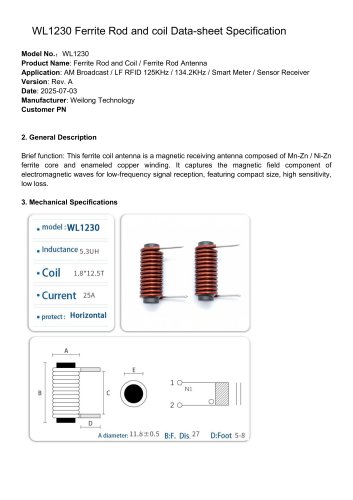 WL1230 Rod Core Ferrite Coil
3 Pages
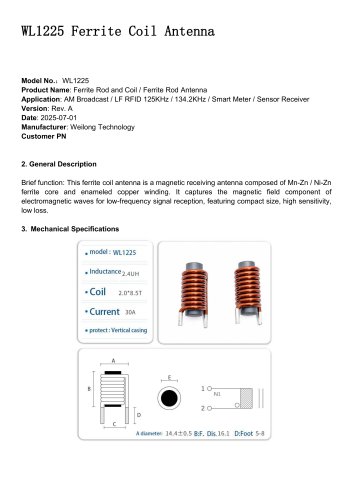 WL1225 Ferrite Coil Antenna
3 Pages
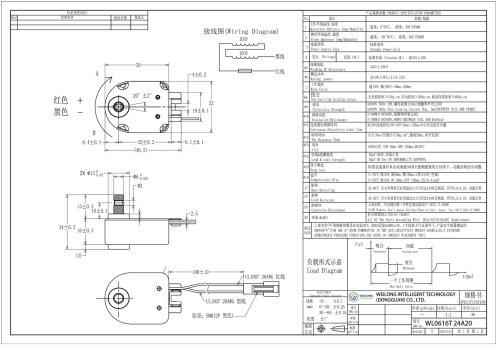 WL0616 Holding Solenoid
8 Pages
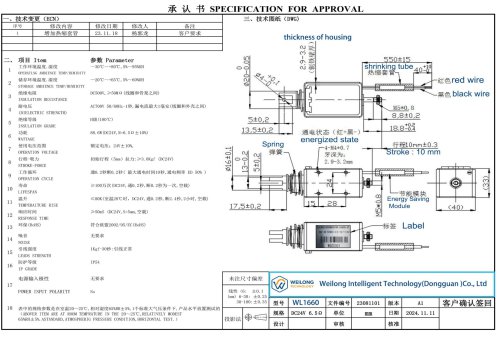 WL3031 Holding electromagnet
8 Pages
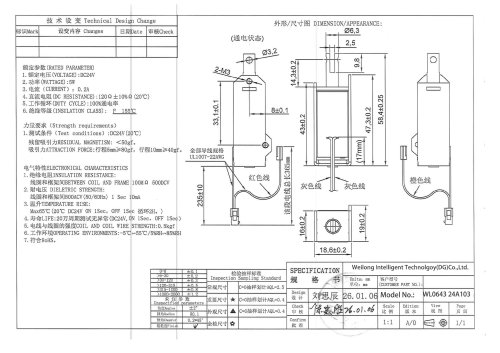 WL 0643 Pull Solenoid
7 Pages
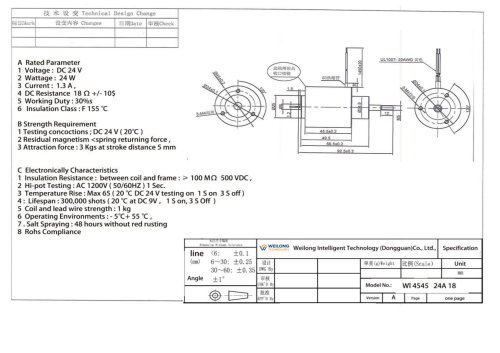 WL4545 push pull solenoid DC
8 Pages