
- Catalogs
- Weiler Abrasives
- Superabrasives Brand DIABON

Superabrasives Brand DIABON

Superabrasives Brand DIABON
SWATY PROFESSIONAL DIABON grinding tools are engineered for high-performance applications, offering enhanced temperature stability, wear resistance, and productivity compared to standard bakelite grinding wheels. They are ideal for CNC tool grinding and applications requiring significant stock removal.
Grinding tools are categorized by bond types: Bakelite, Polyimide, Hybrid, Metal, and Vitrified-bonded, each suitable for different material removal rates and applications.
Key parameters include peripheral speed, grinding tool diameter, and feed rate. The grinding factor (G) is crucial for efficiency, representing the ratio of removed workpiece material to consumed abrasive. Superabrasives like CBN and diamond grits provide superior hardness and thermal stability.
Grinding tools are designated according to EN 13236 and FEPA standards. Selection considers workpiece material, grinding method, and machine type. Superabrasive grit size and concentration are chosen based on required surface roughness and grinding depth.
Peripheral speeds and feed rates are recommended for various grinding procedures. Tables are provided for determining tool RPM and optimal parameters for different applications.
Guidelines include proper mounting of grinding tools, coolant usage, and dressing of grinding tools to maintain efficiency and tool life.
The document reviews various grinding applications, including peripheral surface grinding, internal and external cylindrical grinding, tool grinding and sharpening, profile grinding, CNC tool grinding, and cutting.
This document provides detailed specifications and guidelines for various grinding processes, including cylindrical grinding, tool grinding, and sharpening. It outlines parameters for peripheral speed, feed rate, and grinding depth, as well as safety and quality standards for grinding tools.
- Cylindrical Grinding: External cylindrical grinding has a peripheral speed of 15-40 m/min with grinding depths from 0.5 to 3.0 mm. Internal cylindrical grinding has similar speed parameters but with depths from 0.5 to 2.0 mm.
- Tool Grinding and Sharpening: Involves peripheral speeds of 0.5 to 6.0 m/min and grinding depths of 0.02 to 0.01 mm.
- Creep Feed/Flute Grinding: Peripheral speeds range from 18-22 m/s, with full flute depths up to 6 mm.
- Clearance Angle Grinding: Involves speeds of 18-22 m/s and grinding depths of 0.3 to 1.5 mm.
- Side Surface Grinding: Speed parameters are similar, with adjustments based on the superabrasive layer geometry.
- Manufacturers must adhere to ISO 13236 and FEPA standards, ensuring safety through speed tests and quality control of dimensions, hardness, and balance.
- Tools must be marked with the manufacturer's name, product dimensions, specifications, and safety warnings.
- Grinding machines must be stable with strong protective housings. Users should inspect tools before mounting and ensure proper machine preparation.
- Cooling is recommended to improve surface quality, using a water solution with up to 2% oil.
- Grinding tools should be dressed with vitrified bonded SiC tools, with grit size coarser than the superabrasive grits.
- Resin bonded CBN tools for flat surface grinding can be dressed by grinding into soft steels.
- Orders should specify tool form, dimensions, and specifications. Repeat orders can use the tool identification number.
- Grinding reports should include surface finish observations, material removal volume, and wear volume of the rim layer.
The document provides detailed specifications for various DIABON grinding tools, including dimensions and configurations. Standard bore diameter is ∅ 20 H7, with custom diameters available upon request. The product range includes tools for wood and CNC applications, with specific order samples provided for each tool type.
The document emphasizes the importance of proper handling, storage, and selection of grinding tools. It outlines procedures for mounting and safety precautions, including the use of personal protective equipment and maintaining a clean work environment.
Grinding tools should be handled with care and stored in environments free from mechanical damage and adverse conditions. Proper selection based on tool labels and catalog information is crucial.
Tools must be mounted according to manufacturer instructions, using appropriate flanges and ensuring the workpiece is secure. Safety guards are mandatory, and tools should be tested at maximum speed before use.
Rough handling, improper storage, and using damaged tools are discouraged. Excessive pressure and inappropriate mounting flanges should be avoided to prevent damage and ensure safety.
Common grinding problems are addressed, with recommendations for tool selection and adjustments. Cooling and tool dressing are suggested solutions for issues like poor cutting capacity and overheating.
Catalog excerpts

Types of grinding tools 4 - 6 Definition of grinding and general information 8-11 Designation, selection and ordering 12 - 16 Instructions for the use of grinding tools 20 - 22 Review of grinding tools by type 25 - 60
Open the catalog to page 1
SWATY PROFESSIONAL DIABON EXTENDED PERFORMANCE GRINDING TOOLS e grinding wheels, Compared to standard bakelit e a greater PROFESIONAL DIABON hav ance grinding wheels SWATY ding strength. extended perform y and higher tensile and ben bility, better thermal conductivit temperature sta case of extensive stock ing grinding applications, in ding tool. They are suitable for demand mechanical loads on the grin sequently large thermal and removal and con primarily in the field eels have become established SIONAL DIABON grinding wh worked materials and PROFES are required due to ever harder Extended performance...
Open the catalog to page 3
Page Contents Shapes of grinding tools . . . . . . . Grinding and general information . . • Basic grinding parameters • Basic factors of grinding • Superabrasive grits • Application of resin bonded CBN and diamond grinding tools • • • • • • • • 4 8 8 9 9 11 Designation, selection and ordering . . 12 Example of grinding tool designation Shapes of grinding tools Material of the grinding tool body Grinding tool dimensions Selecting the art and type of superabrasive grit Selecting the superabrasive grit size Bond selection Superabrasive grit concentration Recommendations and tips . . . . . . • Recommended...
Open the catalog to page 5
GRINDING AND GENERAL INFORMATION Grinding with superabrasives is a procedure in which the cutting part of the abrasives consists of a large number of non-uniformly distributed cutting edges. These cutting edges are formed using superabrasive grit. Superabrasive particles are bonded into the abrasive rim layer of the grinding tool together with certain fillers using phenol-formaldehyde or polyimide resin. The grinding tool body provides appropriate strength and rigidity, reduces vibrations and the heat. Basic grinding parameters T s vs Ps vw Vb a vs bk vs D n Ps a vw Vb – – – – – – – peripheral...
Open the catalog to page 10
Basic grinding factors - workpiece; (material, shape, hardness) - type of grinding - grinding parameters; (vs, a, Qw) - grinding tool; appropriate shape and body, appropriately selected components of the abrasive rim layer - dressing of the grinding tool - cooling and lubrication - type and condition of the grinding machine The efficiency and cost-efficiency of grinding with superabrasives are affected by all of the above factors. This catalogue focuses primarily on the correct selection of grinding tools, as well as on the interactions and our recommendations regarding other factors. Superabrasive...
Open the catalog to page 11
The proportion of use of superabrasives increases on a constant basis. Swaty uses superabrasive grits from the world’s most reputable manufacturers. Hardness Thermal conductivity Poor Medium Chemical resistance Thermal stability Good Strength SiC grit Aluminium oxide grit CBN grit Comparison of the cost-efficiency of grinding of different types of steel. 100 90 80 70 60 50 40 savings 30 overhead 20 work 10 0 grinding tool Al2O3 10 CBN CBN
Open the catalog to page 12
APPLICATION OF RESIN BONDED CBN AND DIAMOND GRINDING TOOLS 11
Open the catalog to page 13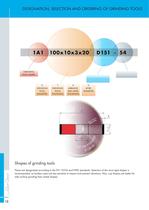
DESIGNATION, SELECTION AND ORDERING OF GRINDING TOOLS 1A1 100x10x3x20 D151 - 54 GRINDING TOOL SHAPE D GRINDING TOOL DIAMETER T GRINDING TOOL THICKNESS X ABRASIVE RIM LAYER THICKNESS H BORE DIAMETER Shapes of grinding tools These are designated according to the EN 13236 and FEPA standards. Selection of the most rigid shapes is recommended, as bodies cores are less sensitive to impact and prevent vibrations. Also, cup shapes are better for side surface grinding than wheel shapes. 12
Open the catalog to page 14
WorstBest SINTER-ALUMINIUM - Medium weight material used for rigid grinding wheel bases. It adequately dampens vibrations, removes heat and provides good mechanical strength. DURALUMINIUM – A heavier material which should be used when more stable bases are needed. It provides good mechanical strength and also better heat removal than sinter-aluminium. STEEL – Steel bases are significantly heavier than the other four types of materials. They are used whenever good mechanical properties need to be ensured even with thin abrasives, for example cutting-off wheels (1A1R). BAKELITE – A lighter material...
Open the catalog to page 15
Selection of superabrasive grit size The size of abrasive grits determines the effect of grinding and the surface roughness. The most cost-effective choice is the coarsest granulation that still achieves the required surface roughness. If a greater amount of material needs to be removed during grinding, a combination of two step coarse grinding and finish grinding is the most cost-effective. In the table, grit sizes according to the FEPA, US ASTM and German DIN standard are stated for comparison. To simplify, one can view the sizes according to the FEPA standard as approximately corresponding...
Open the catalog to page 16
Superabrasive grit concentration The concentration should be selected with respect to the grinding procedure. Low concentrations are recommended for fine abrasive grits, with large contact surfaces between the abrasive and workpiece and in manual grinding; high concentrations are more suitable for coarse grits and small contact surfaces and whenever large profile stability of the grinding tool is required. This is expressed as the quantity of diamond or cubic boron nitride grits in carats/cm3 of the superabrasive rim layer (1 ct = 0.2 g). The diagrams show the volume percentage of superabrasive...
Open the catalog to page 18
RECOMMENDATIONS AND TIPS FOR SELECTING OPERATING PARAMETERS Apart from a correct selection of DIABON superabrasives shapes and specification, it is important to observe recommendations on peripheral speeds, which are given in the table below (along with rpm) for optimum grinding with Swaty abrasives. Recommended peripheral speeds Diamond grinding tools GRINDING PROCEDURE Surface grinding Internal cylindrical grinding External cylindrical grinding Tool sharpening CNC tool grinding Wet grinding 20 - 30 10 - 20 20 - 30 18 - 28 18 - 22 CBN grinding tools Dry grinding 15 - 20 8 - 12 Wet grinding 22...
Open the catalog to page 19All Weiler Abrasives catalogs and technical brochures
 METALL STEIN
68 Pages
 GRINDING TOOLS
22 Pages
 CBN-Vitrified SPECIAL
2 Pages
 Diamond dressing tools
11 Pages
 Abrasives tools
2 Pages
 Duoble layer grinding wheels
2 Pages
 Cutting and grinding 2x2
1 Page
 THIN WHEELS & FLAP WHEELS
56 Pages
 CENTERLESS OPTIMUS
2 Pages
 HiRaILtech
4 Pages
 LBD230-MAX
2 Pages
 Grinding Flap discs
2 Pages
 ICE SPRING
2 Pages
 GRINDROLL-W
2 Pages
 HYBRID BONDS
4 Pages
 Diamond saw blades
20 Pages
 Flap Discs Skorpio ANGLED
2 Pages
 Flap Discs Skorpio CERAMIC
2 Pages
 Skorpio Discs Soft Polish
2 Pages
 Flap Discs Profi Green Line
2 Pages
 Discs PolirCO SPECIAL
2 Pages
 Cleaning wheels StripitCO
2 Pages
 Foundry Grinding Wheels
2 Pages
 Roll Grinding
2 Pages
 Superabrasives Brand DIACOM
68 Pages
 Diamond Saw blade
20 Pages
 Cut-off wheels 100 - 250 mm
2 Pages


Archived catalogs
 METALYNX METAL FABRICATION
28 Pages
 METAL FABRICATION Swaty Comet
36 Pages
 Catalogue
95 Pages
- Saw blade
- Surface treatment brush
- Washing brush
- Metal brush
- Circular saw blade
- Circular brush
- Surface treatment wheel
- Cut-off disc
- Flap disc
- Metal cutting disc
- Deburring brush
- Plastic brush
- Steel brush
- Cylindrical grinding wheel
- Finishing flap disc
- Finishing brush
- Diamond saw blade
- Stainless steel flap disc
- Surfacing wheel
- Steel cutting disc