1. Catalogs
  2. Weidmüller
  3. Relay modules and solid-state relays

Relay modules and solid-state relays

Relay modules and solid-state relays
1 / 236 PagesView full catalog

Relay modules and solid-state relays

Product catalog summary
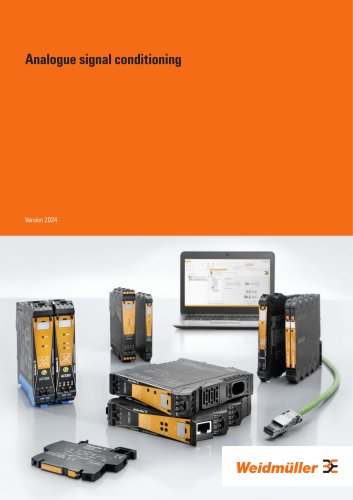
Overview: The document is a catalogue from Weidmüller, focusing on digital signal processing, specifically relay modules and solid-state relays. It highlights Weidmüller's expertise in industrial connectivity, offering innovative and sustainable solutions for power, signal, and data environments.
Product Specifications: The catalogue details various relay modules and solid-state relays, including TERMSERIES, TERMOPTO, MICROOPTO, and MCZ-SERIES. Key features include space-saving designs, pluggable modules, and various connection options like screw and tension clamp connections. The products are designed for a wide range of applications, with international approvals and compatibility with different voltage and current specifications.
Technical Features: The relay modules and solid-state relays are designed to handle different load circuits and control inputs, with options for DC and AC outputs. They offer features like zero-cross switching, phase angle control, and high power handling capabilities. The catalogue provides detailed selection tables to help users choose the right product based on their specific requirements.
Innovations: The TERMSERIES introduces a variable-voltage input for 6 mm designs, allowing control with voltages from 24 to 230 V DC/DC. An integrated fibre-optic technology in the ejector enhances the ease of use and status indication.
Applications: The products are suitable for various industrial applications, including power electronics, safety relays, and timer functions. They are designed to meet the needs of industries like rail, with specific versions like the TRAK version for rail industry requirements.
Additional Resources: The PDF includes internal page links and links to the online catalogue for more detailed information and images. It also provides a matrix for selecting relay modules and solid-state relays based on output configuration, input voltage, and connection system.
TERMSERIES: This series includes relay modules and solid-state relays available in 6 mm and 12 mm widths. They feature a unique multi-voltage input ranging from 24 V to 230 V DC and AC, making them versatile for various applications. The design includes illuminated ejectors for visibility, partition plates, and cross-connections for universal use.
MICROOPTO: The MICROOPTO series offers semiconductor relays with a 6 mm width, providing short-circuit-proof outputs and a long lifetime of over 1,100 years. They include a short circuit alarm via signal contact, enhancing reliability.
SAI Distributors: These distributors are available in IP68 for safe and flexible signal connections in the field. They are suitable for applications like crane switches and wear-and-tear monitors.
Technical Specifications: The document provides detailed technical data for relay modules, including rated switching voltage, continuous current, mechanical service life, and environmental conditions. It also includes ordering data for various voltage inputs and configurations.
Key Features: The products are designed for space-saving with a 6.4 mm modular width, offer clear status displays, and have options for screw and tension clamp connections. The multi-voltage input feature allows for flexibility in automation applications.
Specifications: The relays are available in a 6.1 mm width, offering both screw and PUSH IN wire connections. They are designed to handle a range of input voltages (5 V DC to 230 V AC) and output voltages, with variations in control and load side specifications. The relays are equipped with protective circuits, including varistors and reverse polarity protection, to ensure safe operation.
Technical Data: The relays have a rated voltage of 300 V, an impulse withstand voltage of 4 kV, and a dielectric strength of 1.2 kVeff for 1 minute. They operate within an ambient temperature range of -20 °C to +60 °C and can be stored between -40 °C and +80 °C. The relays are approved by CE, cULus, and GOSTME25 standards.
Applications: TERMOPTO relays are suitable for applications with resistive, slightly inductive, and capacitive loads. For purely inductive or capacitive loads, additional safeguards may be required. MICROOPTO relays are designed for high-quality optos and solid-state relays, capable of handling inductive loads up to 10 A with error signaling capabilities.
Ordering Information: The document lists various models with specific order numbers for different voltage and connection types. Accessories such as plug-in cross-connections, markers, and screwdrivers are also available.
Key Features: The relays feature a space-saving design, plug-in cross-connections, and enclosed construction. They are equipped with status indicators and protective circuits to enhance reliability and safety in industrial environments.
Specifications: The document outlines the technical specifications for various relay modules and solid-state relays. Key parameters include control voltage, power rating, cut-in and dropout voltages, input frequency, and status indicators. The relays are designed to operate within a range of 12-28 V DC and 5 V TTL, with a power rating of 150 mW. The cut-in voltage is greater than 10.7 V, and the dropout voltage is less than 10.6 V. The input frequency is specified at 100 kHz, and a green status LED is used for indication.
Procedures and Protective Measures: The relays incorporate protective circuits such as varistors and reverse polarity protection. They are designed to handle a maximum continuous current of 50 mA with a voltage drop of 90 mV at maximum load. The relays are short-circuit-proof and include a varistor on the load side. Typical switch-on and switch-off delays are less than 1 µs and 4 µs, respectively.
Environmental and Safety Standards: The relays are operational within an ambient temperature range of -25 °C to +60 °C and can be stored between -40 °C and +60 °C. They comply with UL 94 flammability rating V-0 and can operate in environments with up to 93% relative humidity without condensation. Approvals include CE, cULus, and GOSTME25. Insulation coordination is in accordance with EN 50178, with a rated voltage of 300 V and an impulse withstand voltage of 4 kV.
Physical Dimensions and Connections: The relays are compact, with dimensions of 98 mm x 6.1 mm x 88 mm. They feature screw connections with a clamping range of 0.5 to 4 mm². The nominal torque for connections is 0.6 Nm, and the ingress protection class is IP 20.
Applications and Accessories: The relays serve as universal interfaces between controllers and actuators, suitable for switching small to medium-sized loads. They are designed for easy installation with tension-spring connection systems and pluggable cross-connections. Accessories include supply terminals, markers, and screwdrivers, with detailed ordering data provided for various configurations.
Technical Specifications: The document includes technical data for relay modules, such as nominal current, nominal voltage, dielectric strength, ambient temperature range, ingress protection class, and approvals. It also covers the mechanical service life and switching frequency at rated load.
Power Solid-State Relays: The document describes power solid-state relays designed for high AC loads up to 75 A, featuring noiseless and wear-free switching. These relays are suitable for applications like pipe trace heating and motor phase controls. Technical data includes rated control voltage, power rating, switching voltage, continuous current, and protective circuits.
Safety Features: The RIDERSERIES FG relays include force-guided contacts for safety-critical applications, ensuring synchronous switching status and providing high diagnostics coverage. These relays are resistant to vibration and offer various connection options.
Applications: The relays are suitable for diverse industrial applications requiring reliable switching capacities, mechanical operating displays, and options for test buttons. The document emphasizes the relays' suitability for safety systems and high-current applications.
Specifications: The document outlines specifications for different relay models, including rated control voltage, rated current, power rating, response/dropout voltage, switch-on/off delay, and contact material. For example, the RRD relay series includes models with 3 change-over contacts and options for AC/DC coils, while the RPW series offers 2 and 3 change-over contact configurations.
Ordering Data: Detailed ordering information is provided for each relay type, including type codes, order numbers, and options for test buttons and LED indicators. The document also lists accessories such as plug-in modules, end brackets, and screwdrivers.
Overview: This document provides technical specifications and details for various Power Solid-State Relays (PSSR) used in electronic applications. It includes information on single-phase and three-phase relays, control units, and accessories.
Specifications:
  • Impulse Withstand Voltage: 4 kV (1.2/50 µs)
  • Clearance and Creepage Distances: ≥ 8 mm
  • Surge Voltage Category: III
  • Pollution Severity: 2
  • Standards: EN 60947-4-3, EN 60950, IEC 60335-1
Single-Phase Relays:
  • PSSR 230 V AC / 1 PH AC 25 A: Rated for 160-240 V AC/DC, continuous current of 25 A, and a maximum switching current of 20 A at 40°C.
  • PSSR 24 V DC / 1 PH AC 35 A: Rated for 24-600 V AC, continuous current of 24 A, and a maximum switching current of 50 A.
  • PSSR 24 V DC / 1 PH AC 50 A HP: Rated for 24-600 V AC, continuous current of 50 A, and a maximum switching current of 60 A.
  • PSSR 24 V DC / 1 PH AC 75 A HP: Rated for 24-600 V AC, continuous current of 75 A, and a maximum switching current of 90 A.
Three-Phase Relays:
  • PSSR 24 V DC / 3 PH AC 20 A: Rated for 24-520 V AC, continuous current of 20 A, and a maximum switching current of 300 A (10 ms).
  • PSSR 230 V AC / 3 PH AC 20 A: Rated for 24-520 V AC, continuous current of 20 A, and a maximum switching current of 300 A (10 ms).
Control Units:
  • PSSR Control Unit: Monitors up to 5 consumers, includes error message feedback, and has an undercurrent switching threshold of 0.84 x Iteach.
General Data:
  • Ambient Temperature (Operational): -55°C to +100°C
  • Storage Temperature: -55°C to +125°C
  • Humidity: 40-85% (indoor) no condensation
Accessories: Refer to the Power Solid-State Relay Accessories page for additional components and dimensioned drawings.
Overview: The document provides technical specifications and applications for various tools and safety relays, focusing on the Weidmüller SAFESERIES SIL relays and the BT-SERIES timers. It includes details on the materials, standards, and certifications relevant to these products.
Specifications:
  • Screwdrivers: Made from high-alloy chromium-vanadium-molybdenum steel with a matt chrome finish. Includes slotted and Pozidriv types with SoftFinish grips.
  • SAFESERIES SIL Relays: Certified to EN 61508 for SIL3, with wide voltage input from 24 to 230 V AC/DC. Available with G3 protection for extreme conditions.
  • BT-SERIES Timers: Offers functions like pick-up delay and pulse emitter, with multi-voltage supply range suitable for industrial use.
Procedures and Applications:
  • Safety Relays: Used for emergency shutdowns, safe control of back-up systems, and monitoring furnace firing systems. They ensure safe conditions in critical situations and are certified by TÜV-NORD.
  • Timers: Provide solutions for industrial applications with various time ranges and functions, including multifunction with or without control input.
Standards and Certifications:
  • SAFESERIES SIL relays are certified by TÜV-NORD and comply with EN 61508 for SIL3.
  • VARITECTOR SPC surge protection devices are certified for safety requirement level SIL 3 according to EN 61508.
Recommendations:
  • Use SAFESERIES SIL relays for reliable emergency shutdowns and safe process applications.
  • Consider the G3 coating for applications in corrosive environments.
  • Utilize BT-SERIES timers for precise control in industrial settings.
Technical Data Highlights:
  • SAFESERIES SIL relays feature wide-range input voltage, externally accessible fuses, and are short-circuit-proof.
  • BT-SERIES timers offer a wide range of time settings from 0.1 seconds to 120 hours.
Overview: This document provides technical specifications and operational guidelines for a series of timers and related components, including connection systems, functions, and ordering data. It covers various models and their functionalities, such as on-delay, pulse emitter, interval time-delay, and more.
Locking/Unlocking Mechanism: The rotary switches for ON/OFF time adjustment and the option selector can be locked using a special pen-style tool. To lock, insert the key into the keyhole and turn clockwise until covered by a red cover. Unlock by turning in the opposite direction.
Connection Systems: The units support screw and tension clamp connections with specific wire end ferrule requirements. Dimensions for each connection type are provided.
Specifications: The timers have a rated voltage range of 24 to 230 V AC and 24 to 48 V DC, with a voltage tolerance of 85 to 110%. They feature a reset time of at least 0.1 seconds and an insulation resistance of 100 MΩ at 500 V DC. The ingress protection class is IP30, with terminal block IP20.
Functions: Various functions are detailed, including on-delay, pulse emitter, interval time-delay, off-delay, passing make, and on and off-delay functions. Each function is described with its operational sequence and connection points.
Ordering Data: The document lists different models with their connection systems, types, quantities, and order numbers. Models include BTM-S, BTM-Z, BTMF-S, BTMF-Z, BTR-S, BTR-Z, BTTT-S, BTDS-S, and BTDS-Z.
JACKPAC® Overview: JACKPAC® offers a modular solution with IP 67 protection for signal conditioning in industrial environments. It supports easy installation without additional enclosures and is ideal for decentralized applications.
Technical Data: Detailed technical data for various components, including rated control voltage, current, power rating, and environmental conditions, are provided. The document also includes information on approvals and insulation coordination.
Overview: The document provides a comprehensive guide on Weidmüller's product assistant for distribution boxes and assemblies, detailing the selection and combination of components for customized enclosure solutions. It also covers technical aspects of relay modules and solid-state relays, including their advantages, historical background, and standards.
Product Assistant for Distribution Boxes: The Weidmüller product assistant allows users to quickly select and purchase components for distribution boxes. Options include empty enclosures, mounting rails, terminal strips, and distribution boxes with Ex-protection. Users can start with any component and add others to create a tailored solution. The assistant provides relevant data, including drawings and pictures, to aid in planning.
Online Resources: Weidmüller offers an online product catalogue available 24/7, providing detailed product specifications and additional information. The M-Print® PRO software is available for designing and printing labels, compatible with Weidmüller's printing systems.
Relay Modules and Solid-State Relays: The document compares electromechanical relay modules (EMR) and solid-state relays (SSR), highlighting their respective advantages. EMRs are versatile, have no leakage current, and offer multiple contacts, while SSRs have a long operational lifetime, small dimensions, and fast response times.
Technical Appendix: The appendix provides a historical background on relays, explaining their function and evolution into relay modules. It discusses protective separation, standards compliance, and protective circuits for contacts. The document emphasizes the importance of choosing the right relay type based on application requirements, particularly for switching reliability at low currents/voltages.
Standards and Compliance: The document lists relevant standards for relay modules, relays, and relay bases, including DIN EN 50178, DIN EN 61810-1, and EMC standards. It also discusses coil suppression circuits to protect control electronics from damage due to release voltage in DC circuits.
Technical Appendix: Relay Modules
Varistor: The varistor operates based on breakdown voltage with fast reaction times, allowing higher energy levels to be shunted. However, this leads to component aging, reducing breakdown voltage over time and increasing leakage current. Advantages: Low surge, short release delay. Disadvantages: High current load on contacts when switching on; more complicated and expensive at greater capacities.
RC Combination: The RC element uses a capacitor to compensate for voltage spikes, filtering out interference pulses when voltage rises. It protects against interference pulses and prevents faulty switching operations. Advantages: Short release delay, low price. Disadvantages: Cannot be used for all operating voltages and capacities.
Glossary: Relay Modules
AC: Refers to alternating values like voltage or current, with specifications valid for 50 Hz unless otherwise indicated.
Adhesion (contacts): Occurs when the relay armature does not return to its starting position after coil voltage is turned off.
Approvals and Testing Marks: Independent confirmations from governmental or private services certifying compliance with regulations.
Contact Material: Different materials offer varying performance. For example, pure gold offers excellent corrosion resistance but is too soft for solid metal use, while silver-tin-oxide is suitable for high input and output loads.
Continuous Current Limit: The highest current a closed contact can continuously conduct at specified temperature limits.
Derating Curve: Shows the reduction of continuous current at higher ambient temperatures to prevent exceeding temperature limits.
Electrical Lifespan: Specifies the number of switching cycles for a relay under full operational capacity, based on conditions like ambient temperature and contact load.
Specifications:
The document outlines the electrical lifespan of PCB relays, specifying that it is determined by the criteria for "useful life" at severity level B according to IEC 61810-2. It emphasizes the importance of avoiding usage beyond the specified lifespan and notes that the lifespan remains constant up to a 0.8 power factor. For loads with a power factor less than 0.8, consultation is recommended.
Relay Failure:
Relay failure is defined by IEC 61810 as malfunctions exceeding a certain number, including issues with contact closing, opening, and insufficient dielectric strength. Users must ensure these malfunctions do not pose risks, as they can lead to excessive heat or fire.
Flammability:
Flammability is classified according to UL 94, with relevant classes for relays being V-0, V-1, V-2, and HB.
Environmental Conditions:
Standard conditions include an annual average relative humidity of >75% at 21°C, with specific guidelines to avoid icing or condensation during storage and operation.
Electrical Specifications:
Details on impulse withstand voltage, inductive loads, inrush current, and insulating material groups are provided. Insulation coordination is specified according to EN 50178.
Switching Characteristics:
Maximum switching current, frequency, and power are defined, along with mechanical service life and minimum switching capacity. The behavior of mono-stable relays is also described.
Installation Guidelines:
Mounting distance and position are discussed, emphasizing insulation requirements and heat dissipation.
Operational Parameters:
Nominal current, voltage, and torque specifications are outlined, along with operating temperature and voltage range.
Protection and Safety:
Protection degrees according to IEC 60529 are detailed, covering protection against touch contact, foreign bodies, and water ingress.
Relay Operation:
Relay times, including sparkover, drop-out, and bounce times, are explained. The reliability of relays is depicted using a "bathtub curve."
Regulatory Compliance:
The document mentions compliance with the RoHS Directive 2002/95/EC, restricting the use of certain hazardous substances.
RoHS Compliance: The document outlines the requirements for electrical and electronic devices to comply with the RoHS Directive, which limits hazardous substances like mercury, cadmium, lead, hexavalent chrome, PBB, and PBDE. The maximum allowable weight percentage in materials is specified, with exemptions possible under certain conditions.
Relay Components: The document explains self-heating in components, series-circuit relay contacts, and the benefits of increased contact opening for DC load breaking capacity. It includes a glossary of terms related to relay modules, such as SIL (Safety Integrity Level), standardised labelling of connections, and various types of relay contacts and insulation.
Overvoltage Categories: Devices are categorized from I to IV based on their intended connection to electrical installations and the measures taken to limit surge voltages. Each category specifies the type of devices and their connection to the electrical system.
Switching Characteristics: Definitions for switch-off and switch-on delays, switching capacity, current, cycle, and voltage are provided. The document also describes the manual operation of relays using a test button and the precautions necessary during its use.
Solid-State Relays: The document details the operation of opto modules and solid-state relays, highlighting their use in potential isolation, signal conditioning, and switching amplification. It explains the design types, such as face-to-face and coplanar, and the importance of maintaining isolation and clearance distances.
Input Circuits: The document discusses the input circuits for opto modules, including DC, AC/DC, and AC inputs, and the protective devices used to prevent interference and ensure proper operation.
Technical Appendix: Solid-State Relays

Output Circuit (Load Circuit):
The document outlines the operating voltage range for opto modules and solid-state relays, emphasizing that exceeding or falling below this range can lead to premature wear and destruction. It highlights the importance of derating curves to manage the relationship between current and ambient temperature. Protective devices like diodes or varistors are used to manage overvoltages, and some modules include a power boost for handling current spikes.
DC and AC Output:
For DC outputs, polarity must be observed, and auxiliary voltage may be required for precise control and short-circuit protection. AC outputs use semiconductors like TRIACs or thyristors to switch AC voltage.
Switching Amplification:
The document describes the use of bipolar transistors for low currents and MOSFETs for high load currents in DC applications. For AC, TRIACs are used, combining the function of antiparallel thyristors.
Load Types and Challenges:
Different load types (resistive, inductive, capacitive) pose challenges for load circuit arrangements. The document advises on designing components to handle potential overloads, especially with glow lamps and capacitive loads, which can cause high inrush currents. Inductive loads require diodes to manage voltage spikes during switching off.
Protective Measures:
Various protective measures are discussed, including free-wheeling diodes for DC, zener and suppressor diodes, varistors for AC/DC, and RC elements for AC to manage interference pulses and prevent faulty operations.
Glossary:
The glossary provides definitions for terms related to solid-state relays, including AC/DC, approvals and testing marks, clearance and creepage distances, continuous current, derating, and more. It explains the importance of galvanic isolation, impulse withstand voltage, and environmental conditions affecting relay performance.
Insulation Specifications: The document outlines insulation coordination according to EN 50178, focusing on type of insulation, nominal voltage, pollution severity level, impulse withstand voltage, and surge voltage category.
Glossary of Terms: Key terms related to solid-state relays are defined, including leakage current, load categories (LC A to LC F), maximum switching current and power, mounting distance and position, nominal control current, switching voltage, torque, operating and storage temperature, pollution severity levels, power rating, protection degree (IP Code), rated control and isolation voltage, RoHS compliance, Schmitt trigger, self-heating, short-circuit-proof, solid-state relay, status indicator, surge voltage category, switch-off and switch-on delay, transients, type of insulation, voltage drop, and withstand test voltage.
Pollution Severity Levels: Four degrees of pollution are defined, ranging from no contamination (degree 1) to continual conductivity due to contaminants like conductive dust (degree 4).
Protection Degree (IP Code): The document explains the IP Code, which indicates protection against touch contact and foreign bodies (first digit) and water ingress (second digit), with levels ranging from 0 (no protection) to 8 (protection against constant submersion).
RoHS Directive: The document mentions compliance with the RoHS Directive 2002/95/EC, which restricts the use of hazardous substances in electrical and electronic devices.
Surge Voltage Categories: Overvoltage categories I to III are described, detailing the types of devices and installations they apply to, and the measures for limiting transient surge voltages.
Index: The document includes an index of various product types and their order numbers, indicating their respective pages.
Overview: This document is a catalogue for the year 2014/2015 from Weidmüller, a company specializing in industrial connectivity solutions. It includes a comprehensive list of relay modules and solid-state relays, along with their specifications and order numbers.
Main Sections:
  • Product Listings: The document provides detailed listings of various relay modules and solid-state relays, identified by unique order numbers. Each product entry includes specifications such as voltage, current ratings, and configuration details.
  • General Terms: The catalogue mentions that all orders are subject to Weidmüller's general terms of delivery, which are available on their website or can be sent upon request.
  • Company Information: Weidmüller positions itself as a partner in industrial connectivity, offering products, solutions, and services globally. The company emphasizes its commitment to innovation and sustainability in addressing technological challenges.
  • Contact Information: The document provides contact details for Weidmüller Interface GmbH & Co. KG, including their address in Detmold, Germany, phone and fax numbers, and email address.
Key Insights: The catalogue serves as a resource for ordering relay modules and solid-state relays, with a focus on industrial applications. It highlights Weidmüller's role in setting standards in industrial connectivity and their dedication to customer support and innovation.
See more

Catalog excerpts

Relay modules and solid-state relays-1

Weidmüller – Your partner in Industrial Connectivity Relay modules and solid-state relays Catalogue 2014/2015 Let’s connect. Digital signal processing As experienced experts we support our customers and partners around the world with products, solutions and services in the industrial environment of power, signal and data. We are at home in their industries and markets and know the technological challenges of tomorrow. We are therefore continuously developing innovative, sustainable and useful solutions for their individual needs. Together we set standards in Industrial Connectivity. Weidmüller Interface GmbH & Co. KG Klingenbergstraße 16 32758 Detmold, Germany T +49 5231 14-0 F +49 5231 14-292083 [email protected] www.weidmueller.com Your local Weidmüller partner can be found on our website: www.weidmueller.com/countries Digital signal processing

 Open the catalog to page 1

Relay modules and solid-state relays-3

Dear Customers, The PDF versions of our catalogues offer practical additional functions, helping you to find your way around our product range and simplifying the ordering process. In addition to the catalogue, the PDF also contains: • Internal page links • Links to the online catalogue Try it out for yourself. Click the order number to obtain more detailed information and close-up images via you web browser. The links in the PDF file also enable you to go directly to the next desired catalogue page. Further Weidmüller product catalogues can be accessed by clicking the following:

 Open the catalog to page 3
Relay modules and solid-state relays-5

Relay modules and solid-state relays Relay modules and solid-state relays Relay modules and solid-state relays in 6 mm width Industrial relay modules Power electronics Safety relay Appendix Weidmiiller Solutions & Service Technical appendix/Glossary Index Type / Index Order No. Addresses worldwide

 Open the catalog to page 5
Relay modules and solid-state relays-6

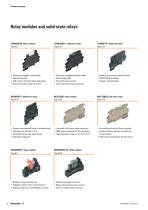
Product overview Relay modules and solid-state relays TERMSERIES - Relay modules Page A.8 TERMOPTO - Solid-state relays Page A.42 • All-purpose, pluggable relay modules • Space-saving width • AgNi contact with and without gold plating • Screw and tension clamp connection • All-purpose, pluggable solid-state relays • Space-saving width • DC and AC output variants • Screw and tension clamp connection • solation of potentials in terminal format I • With PUSH IN technology • Compact, enclosed design MICROOPTO - Solid-state relays Page A.54 MCZ-SERIES relay modules Page A.64 MCZ-SERIES solid-state...

 Open the catalog to page 6
Relay modules and solid-state relays-7

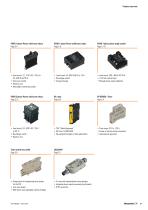
Product overview PSSR 1-phase Power solid-state relays PSSR 1-phase Power solid-state relays PSSR 1-phase phase angle control Page 04_ Page C. 8_ Page C. 10_ • Load circuit: 12...275 V AC / 25 A or • Load circuit: 24...600 V/50 A or 75 A 'Load circuit: 200...460 V AC/70 A 24...600 V AC/35 A • No-voltage switch • 4-20 mA control input • Zero-cross switch • Compact design • Manual phase angle calibration • Attachable monitoring module PSSR 3-phase Power solid-state relays • No-voltage switch • De-energise/Energise to Safe applications • Screw or tension clamp connection • International approvals...

 Open the catalog to page 7
Relay modules and solid-state relays-8

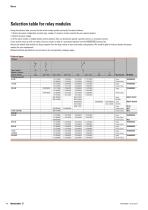
Selection table for relay modules Using the selection table, you can find the article number quickly and easily. Proceed as follows: 1.) Select the output configuration (contact type, number of contacts, contact material) for your required product. 2.) Select the input voltage. 3.) If the search results in multiple product article numbers, then you should also specify a product series or a connection system. If your search comes up with no results, then you may be in need of a customised solution from the RIDERSERIES product line. Almost any desired relay module can be put together from the large...

 Open the catalog to page 8
Relay modules and solid-state relays-9

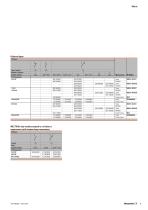
Preferred types ➊ Output Type of contact Number of contacts Contact material ➋ Voltage/Input 24 V AC Screw PUSH IN Screw PUSH IN Screw PUSH IN Screw PUSH IN Tension clamp Screw Tension clamp Screw PUSH IN Screw PUSH IN Tension clamp Screw Tension clamp RIDER - RCI KIT RIDER - RCM KIT RIDER - RCI KIT RIDER - RCM KIT MCZ TERMSERIES RIDER - RCI KIT RIDER - RCM KIT MCZ TERMSERIES MCZ TRAK relay modules adapted to rail industry requirements (with tension-clamp connections) ➊ Output Contact Poles Contact material ➋ Voltage/Input 24 V DC 36 V DC 48-110 V DC

 Open the catalog to page 9
Relay modules and solid-state relays-10

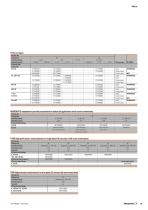
Selection table for solid-state relays Using the selection table, you can find the article number quickly and easily. Proceed as follows: 1.) Configure the load side for your desired product. 2.) Select the control voltage. 3.) If the search results in multiple product article numbers, then you should also specify a product series or a connection system. We would be glad to help you develop the proper solution for your requirements. Detailed technical specifications may be found in the corresponding catalogue pages. Preferred types ➊ Load side Voltage type Switching voltage Switching current...

 Open the catalog to page 10
Relay modules and solid-state relays-11

Preferred types ➊ Load side Voltage type Switching voltage Switching current ➋ Control side Voltage/UC 24 V UC Screw Tension clamp Tension clamp Screw Screw Tension clamp Tension clamp Screw Tension clamp Screw Tension clamp Screw Tension clamp Tension clamp Screw Tension clamp TERMSERIES TERMSERIES TERMSERIES MCZ TERMSERIES MICROOPTO components specially customised for industrial applications (with screw connections) ➊ Load side Voltage type Switching voltage Switching current ➋ Control side/Voltage 24 V DC Remark Electronic CO contact 1 kHz switching frequency Short-circuit-proof Thermal overload...

 Open the catalog to page 11
Relay modules and solid-state relays-13

Relay modules and solid-state relays in 6 mm width Relay modules and solid-state relays in 6 mm width Relay modules and solid-state relays in 6 mm width TERMSERIES – Overview TERMSERIES – solid-state relays TERMOPTO – Overview TERMOPTO – solid-state relays MICROOPTO – Overview MICROOPTO – solid-state relays MCZ-SERIES – relay modules MCZ-SERIES – solid-state relays TERMSERIES – relay modules Relay modules and solid-state relays in 6 mm width – Overview

 Open the catalog to page 13
*Prices are pre-tax. They exclude delivery charges and customs duties and do not include additional charges for installation or activation options. Prices are indicative only and may vary by country, with changes to the cost of raw materials and exchange rates.