


Weforma Catalog US imperial / metric
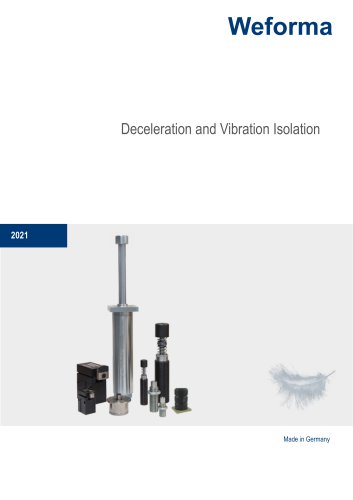
Weforma Catalog US imperial / metric
This document provides a comprehensive overview of products and technologies related to deceleration and vibration isolation, manufactured by a German company with over 40 years of experience. The company specializes in machinery and plant engineering, offering customized solutions and a broad product portfolio.
The production facility spans 4000 m² and utilizes highly automated CNC machines, achieving a net output ratio of over 90%. The company is committed to innovation, holding patents for various advanced shock absorbers and pallet stoppers.
Quality is ensured through comprehensive in-process inspections and final inspections using computer-controlled test systems. Products are tested for temperature resistance, corrosion, leakage, and service life.
The document lists various products including industrial shock absorbers, deceleration cylinders, speed controls, rotary dampers, gas springs, and pallet stoppers. Each product is designed to meet specific application needs, with options for customization.
Detailed technical specifications are provided for shock absorbers, including parameters such as impact mass, impact speed, external forces, and number of strokes per hour. The document includes formulas for calculating effective mass, counter force, stroke, deceleration time, and deceleration rate.
The company adheres to international standards such as DIN ISO 9001:2015, EN 81-20/50, ASME A17.1-2004, and EN 81-22:204, ensuring high-quality and reliable products.
The document highlights the company's commitment to providing high-quality, innovative solutions for deceleration and vibration isolation, supported by extensive experience and a strong focus on customer-specific solutions.
The document provides detailed specifications for various models of shock absorbers, including WE-M, WS-M, and WP-M series. These models are characterized by their adjustable, self-compensating, and progressive features, respectively. The document lists dimensions, energy absorption capacities, stroke lengths, and thread types for each model.
Installation and operational guidelines are implied through the detailed specifications and performance metrics. The document emphasizes the importance of selecting the correct model based on the required energy absorption and stroke length.
The shock absorbers are designed to operate within a temperature range of -20°C to +80°C, with optional configurations for extreme temperatures. They are compliant with USDA-H1 standards for use in the food industry and can withstand pressures up to 7 bar.
For optimal performance, the document suggests using models with nitrated guidance systems and hardened stainless steel components. Special seals and oils are recommended for extended life and reliability.
The document includes tables detailing the energy absorption, effective mass, impact speed, and return spring force for each model. These metrics are crucial for determining the appropriate shock absorber for specific applications.
Highlighted features include high energy absorption capabilities, long-life surface protection (ProSurf), and integrated end stops. The document also mentions the availability of special models made from stainless steel.
Various accessories such as lock nuts, stop limit nuts, and clamping flanges are included to enhance the functionality and installation of the shock absorbers.
The document serves as a comprehensive guide for selecting and utilizing Weforma shock absorbers, providing all necessary technical details and performance data to ensure proper application and longevity.
The document provides detailed specifications for various models of shock absorbers, including WE-M, WS-M, and WP-M series. Each model is available in different sizes (1.25 x 2, 1.25 x 3, 1.25 x 4, etc.) and configurations (U, UF). Key specifications include energy absorption, effective mass, constant load, and external tank options. The document also lists the impact speed range for each series: WE-M (0.02 - 6.0 m/s), WS-M (0.10 - 6.0 m/s), and WP-M (0.40 - 8.0 m/s).
The document outlines the procedures for selecting the appropriate shock absorber based on the application requirements. It includes guidelines for calculating the energy absorption and effective mass to ensure optimal performance.
The shock absorbers are manufactured in Germany and adhere to high-quality standards. The document specifies the materials used, such as PU and steel, and provides instructions for adding material codes (A/AS) to the part numbers.
Recommendations are provided for the installation and maintenance of the shock absorbers. It is advised to use the correct torque when installing the units and to ensure that the end stop is required 1 mm before the stroke ends for models with clevis mounting.
Detailed dimensions are provided for each model, including thread sizes, lengths, and diameters. The document also lists available accessories such as lock nuts, foot mounting, square flanges, and stop limit nuts.
The tables in the document provide numerical data on energy absorption (Nm/HB), effective mass (kg), and return spring force (N). These values vary across different models and configurations, allowing for precise selection based on specific application needs.
This document provides detailed specifications and features of Weforma's Mega-Line shock absorbers, focusing on models 3.0 and 4.0. It includes information on energy absorption, dimensions, materials, and performance characteristics.
- Energy Absorption: Mega-Line 3.0 offers energy absorption ranging from 4000 to 24000 Nm per stroke, while Mega-Line 4.0 provides similar capabilities.
- Stroke Length: Both models have stroke lengths ranging from 50 mm to 250 mm (1.97 to 9.84 inches).
- Thread Size: Mega-Line 3.0 uses M85x2, and Mega-Line 4.0 uses M115x2.
- Temperature Range: Operates between -20°C to +80°C (-4°F to 176°F).
- Adjustability: Models are available in adjustable (WE-M), self-compensating (WS-M), and progressive (WP-M) versions.
- Construction: Includes a nitrated guidance system, hardened piston, and titanium aluminum nitride coating for extended life.
- Special Models: Options for stainless steel and USDA-H1 compliance for the food industry.
- Impact Speed: WE-M models range from 0.0 to 6.0 m/s, WS-M from 0.10 to 6.0 m/s, and WP-M from 0.40 to 8.0 m/s.
- Return Spring Force: Varies by model, with forces ranging from 120 N/min to 280 N/max.
- Detailed dimensions are provided for each model, including length, width, and mounting specifications.
- Includes options for clevis mounting, lock nuts, square flanges, and stop limit nuts.
- Optional features include external tanks for higher energy absorption and protection bellows for enhanced durability.
This document provides detailed specifications and performance metrics for various models of shock absorbers, specifically the WS-M and WE-M series. It includes dimensions, energy absorption capabilities, effective mass ranges, and return spring forces.
- WM-ZDK Series: Double-acting dampers without spring return. As one piston rod travels in, the opposite rod travels out. Key models include WM-ZDK 2-120 and WM-ZDK 3-060, with stroke lengths of 120 mm and 60 mm, respectively, and energy absorption capacities of 250 Nm and 1000 Nm.
- WM-ZD Series: Double-acting dampers with spring return. The opposite rod remains out when one travels in. Models like WM-ZD 2-050 and WM-ZD 2-120 offer stroke lengths from 50 mm to 120 mm and energy absorption up to 250 Nm.
- WV-M Series: Speed controls with variable adjustment and extended life due to special seals and oils. They feature hardened stainless steel piston rods and integrated end stops. Models range from WV-M 0.25 to WV-M 1.0x40, with stroke lengths from 14 mm to 40 mm and maximum feed forces up to 3600 N.
- WM-VD Series: Double-acting speed controls with precise adjustment in both push and pull directions. They feature anodised aluminium housing and hard-chrome plated piston rods. Models like WM-VD 32-100 and WM-VD 36-150 offer stroke lengths from 50 mm to 250 mm and maximum forces up to 4000 N.
- Speed rates for these products range from 0.015 to 40 m/min.
- All products are designed for extended life with special seals and oils.
- Surface protection includes ProSurf long-life surface protection and anodised aluminium housing.
- Specifications: The rotary dampers are available in various models, each with specific torque ratings measured in Newton-meters (Nm) and inch-pounds (in lbs). The torque values range from 0.0025 Nm to 9 Nm.
- Materials: The dampers are made from plastic and aluminum die-cast materials, ensuring durability and performance.
- Temperature Range: The operational temperature range is from -5°C to +50°C (23°F to 122°F).
- Applications: These dampers are suitable for controlling the rotational movements of flaps, hoods, and lids.
- Compliance: The products comply with the RoHS Directive 2002/95/EC.
- Specifications: The gas springs are designed with high corrosion resistance, featuring powder-coated housing and ceramic-coated piston rods. They are maintenance-free and ready for installation.
- Temperature Range: The standard operational temperature range is -30°C to +80°C (-22°F to +176°F), with an optional range of -45°C to +200°C (-49°F to +392°F).
- Force Diagram: The extension force is determined by the filling pressure and the cross-sectional area of the piston rod. The force varies with temperature, approximately 3.3% per 10°C change.
- Ordering Information: Customers must specify the extension force when ordering. The document provides a detailed guide on selecting and ordering the appropriate gas spring model based on specific requirements.
- The document includes tables listing the torque values, opening angles, and weights for various rotary damper models.
- Diagrams illustrate the dimensions and installation positions for both rotary dampers and gas springs.
1. Working Pressure: 4 - 8 bar (58.02 - 116.03 psi)
2. Compressed Air: Treated
3. Tube Diameter: 6 - 8 mm (0.24 - 0.31 inch)
4. Stroke: Horizontal 15 mm (0.59 inch), Vertical 8 mm (0.31 inch)
5. Mass and Speed: Varies by model, up to 1200 kg and 50 m/min
6. Housing: Aluminium, black anodized
7. Stop: Hardened, with optional sensor for end position
8. Compliance: RoHS Directive 2002/95/EC
Key Features
- Precise deceleration and singulation of pallets
- Adjustable hydraulic deceleration with pneumatic piston return
- Special versions available for clean room environments
- Optional proximity switch preparation
Models and Variants
- WPS-H200, WPS 500, WPS 600, WPS-F 250, WPS-F 400
- Standard and "NV" versions (with preparation for proximity switch)
Accessories
- Various sensors, cables, and mounting brackets available
- Specific accessories for each model listed with part numbers
Applications
- Designed for rolling conveyor systems
- Suitable for different pallet systems with interchangeable positioning bolts
- Anti-bounce stopper to prevent pallet bounce back
Additional Information
- Detailed dimensions and weights provided for each model
- Ordering information includes standard and NV versions
- Accessories pages provide further details on available components
(1) Liability is based on fault, with full liability for intentional and gross negligence. For minor negligence, liability is limited to damages related to life, bodily injury, or health, and significant breaches of essential contractual duties, with compensation limited to foreseeable damages.
(2) Limitations apply to breaches by persons represented by the company, except in cases of malicious concealment or guarantee of goods.
(1) Personal data collected includes names, contact details, bank details, and payment history, processed under Article 6 Para 1 clause 1 b) GDPR.
(2) Data recipients include Weforma Dämpfungstechnik GmbH, order processors, subcontractors, and public bodies.
(3) Data storage is limited to necessary durations, with specific time limits for different types of data.
(4) Customers have rights to information, correction, deletion, restriction, objection, and data portability.
(1) General statute of limitations for claims from defects is one year from delivery, with exceptions for buildings and building materials.
(2) Special statutory regulations remain unaffected.
(1) German law applies, excluding international law.
(2) Jurisdiction for disputes is Stolberg, with options for actions at the place of delivery or buyer's general jurisdiction.
Catalog excerpts

Deceleration and Vibration Isolation
Open the catalog to page 1
40 Jahre Erfahrung 40 years of experience Kunden in 75 Ländern Customers in 75 countries PRODUCTS FOR YOUR SUCCESS As a specialist in innovative deceleration and vibration isolation technology, we develop and manufacture produtcts for machinery and plant engineering. Our success is based on the development of modifications and customised solutions, backed by over 40 years experience and an in-house production facility. Shock Absorbers Heavy-Duty Shock Absorbers Deceleration Cylinders Speed Controls Rotary Dampers Gas Springs Pallet Stoppers Vibration Isolation
Open the catalog to page 3
PRODUCTION In a production space of 4000 m² (43055 sf), highly automated CNC machines manufacture our deceleration and vibration isolation components. With a real net output ratio of over 90% and highly reliable processes, we achieve rapid and dependable product availability. From the prototype to series production, take advantage of our many years of experience. INNOVATIONS Our engineers are continuously pushing developments in our deceleration and vibration isolation components. Patents, e.g. for Mega-Line industrial shock absorbers with high energy absorption, shock absorbers with protected...
Open the catalog to page 4
QUALITY Comprehensive in-process inspections during the production and assembly guarantee the high quality of our products. The final inspection is performed on computer-controlled test systems, which can record forces of up to 2 million newtons, and which amongst other things calculate and allow comparison of the precise deceleration curves. Various test methods are used to check our deceleration and vibration isolation components in relation to temperature (-70 to +180°C), corrosion (salt spray), leakage and service life. SPECIAL SOLUTIONS A broad standard product portfolio makes us a competent...
Open the catalog to page 5
Industrial Shock Absorbers Heavy-Duty-, Elasto-Fluid- and Elevator Shock Absorbers Deceleration Cylinders, Speed Controls Rotary Dampers Pallet Stoppers Metal cushions
Open the catalog to page 7
Industrial Shock Absorbers
Open the catalog to page 9
Benefits Stop Cap AP / AP2 Stop cap with steel core and PU cap (AP) • 40% noise reduction • Increased protection of the impact surface Steel cap with steel core and PUM cap fiberglass-reinforced (AP2) • Longer life time compared to stop cap AP and plastic cap A Integrated end-stop Pro Surf • Improved surface protection against corrosion • QPQ Coating, specialized type of carbonitriding case hardening (carbonitriding, polishing, post-oxidizing) Enlarged Piston hardened, aluminium-titanium-nitride coated High energy absorption and extended life time Salt spray test Sprühdauer in h / Spray duration...
Open the catalog to page 10
Noise reducing stop cap with a high security steel-fixing ring Pro Adjust Integrated end stop Protected Adjustment (patented) Hardened, aluminium-titanium-nitride coated Machined flats for spanner Helix Principle + 300% Energy / - 50% Costs Pressure Tube Adjustable one-piece nitrite hardened pressure tube, that fits closely to the housing thus giving good guidance ProTec Solid base without retaining ring www.weforma.com | Made in Germany
Open the catalog to page 11
Selection Five basic criteria are required for sizing the shock absorbers 1. Formulae EFFECTIVE MASS Additional external forces acting on the mass e.g. propelling force F (N) Number of strokes of the shock absorber per hour X (1/h) (At 1/h: number of strokes per year) Number of parallel shock absorbers In individual cases, other additional information may be required. * Calculation for optimum setting. Allow a safety margin! For a utilizaltion per stroke >80 % the approval of Weforma is necessary! Kinetic energy Propelling force Drive power Propelling force energy Pneumatic drive force Impact...
Open the catalog to page 12
Selection MASS ON DRIVEN ROLLERS MASS WITH MOTOR DRIVE m = 1.200 kg v = 1,5 m / s HM = 2,5 P = 3 kW S = 0,075 m X = 50 / h ROTARY TABLE WITH PROPELLING FORCE Ve MASS WITH PROPELLING FORCE www.weforma.com | Made in Germany
Open the catalog to page 13
Thread Ordering Example self-compensating linear self-compensating linear for side forces self-compensating linear, compact adjustable, linear adjustable for side forces self-compensating progressive self-compensating progressive for side forces Energy absorption Made in Germany | www.weforma.com
Open the catalog to page 14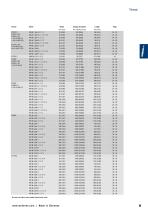
Energy absorption We reserve the right to make changes without further notice! www.weforma.com | Made in Germany
Open the catalog to page 15
Shock Absorbers Energy absorption Energy absorption 0,4 - 9 Nm / Stroke 3.5 - 80 in-lbs / Stroke 4 - 22 Nm / Stroke 35 - 195 in-lbs / Stroke FEATURES Enlarged Piston High energy absorption (M4-M12) Max. +400% Energy (0,1 - 0,2) Max. -50% Costs / Nm ProSurf Long-life surface protection Characteristics Adjustable (WE-M) Self-compensating (WS-M) Progressiv (WP-M) Extended Life Time Nitrated guidance system Piston rod: hardened stainless steel (M4-M12) Piston: hardened, Titanium aluminium nitride (M4-M12) Special seals + oils Temperature -20°C - +80°C / -4°F - 176°F Option: -50°C - +60°C / -58°F...
Open the catalog to page 16
Return spring force M 4 x 4: 0,8 Nm (7 lbs) / M 5 x 4: 1,0 Nm (9 lbs) M 6 x 5: 1,2 Nm (10 lbs) / M 8 x 5: 2 Nm (17 lbs) M 10 x X: 4 Nm (35 lbs) / M 12 x 10: 8 Nm (70 lbs) F *A: Plastic / AP: Soft Touch / AS: Steel PERFORMANCE Stroke Energy absorption Effective mass -1 (soft) Impact Speed www.weforma.com | Made in Germany Return spring force Constant load
Open the catalog to page 17
Impact Speed WE-M: 0,2 - 3,5 m/s (0.65 - 11.5 ft/s) WS-M / WP-M: 0,2 - 5,0 m/s (0.65 - 16.5 ft/s) Return spring force 0,1: 2,5 N/min - 6 N/max (0.56 lbs/min - 1.35 lbs/max) 0,15: 3,6 N/min - 8 N/max (0.81 lbs/min - 1.8 lbs/max ) 0,2: 3,5 N/min - 7 N/max (0.65 lbs/min - 16.5 lbs/max) Torque: max. force by using the flats 0,1: 2 Nm (17 lbs) / 0,15: 6 Nm (53 lbs) / 0,2: 10 Nm (88 lbs) *A: Plastic / AP: Soft Touch / AS: Steel PERFORMANCE Stroke Energy absorption Effective mass Constant load Made in Germany | www.wefor
Open the catalog to page 18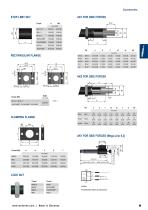
Accessories STOP LIMIT NUT AK1 FOR SIDE FORCES Thread RECTANGULAR FLANGE Thread (GW) M 10 x 1; M 12 x 1 3/8-32 UNEF; 7/16-28 UNEF; 1/2-20 UNF CLAMPING FLANGE AK1 FOR SIDE FORCES (Mega-Line 0,2) B www.weforma.com | Made in Germany Included Proximity Switch, Switch cap,
Open the catalog to page 19All Weforma catalogs and technical brochures
 Weforma Catalog 23/24
316 Pages
Archived catalogs
 Catalogue
319 Pages
 Weforma Deceleration Technology
84 Pages
- Double-acting cylinder
- Hydraulic cylinder
- Pneumatic cylinder
- Single-acting cylinder
- Piston cylinder
- Anti-vibration mount
- Shock buffer
- Hydraulic absorber
- Standard cylinder
- ISO cylinder
- Mechanical buffer
- Aluminum alloy cylinder
- Metal anti-vibration mount
- Industrial buffer
- Compression spring
- Metal damper
- Anti-vibration damper