


Weforma Catalog 23/24

Weforma Catalog 23/24
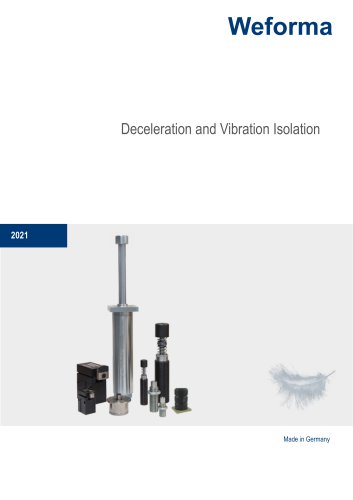
This document provides a comprehensive overview of a company specializing in deceleration and vibration isolation technology. It highlights their extensive product range, production capabilities, innovation, and quality assurance processes.
The company has over 40 years of experience, employs 130 people, and serves customers in 80 countries. They focus on developing and manufacturing products for machinery and plant engineering, emphasizing customized solutions.
Production occurs in a 4,000 m² facility with highly automated CNC machines, achieving a real net output ratio of over 90%. This ensures rapid and reliable product availability from prototype to series production.
The company continuously develops its products, holding patents for high-energy absorption shock absorbers and electrical pallet stoppers, showcasing their innovative capabilities.
Comprehensive inspections during production and assembly ensure high product quality. Final inspections are conducted on computer-controlled systems capable of handling forces up to 2 million newtons. Products are tested for temperature, corrosion, leakage, and service life.
The company offers a broad range of products, including industrial shock absorbers, heavy-duty shock absorbers, deceleration cylinders, rotary dampers, gas springs, pallet stoppers, air springs, and PUR buffers. They provide optimized solutions that are fast, flexible, and of high quality.
Modern shock absorber technology is essential for highly automated machines with short cycle times. Weforma shock absorbers disperse mass energy linearly or progressively, increasing production capabilities, extending machine life, reducing noise, and simplifying design.
Shock absorbers operate on oil displacement principles, where the piston rod's movement displaces oil through progressively closing holes, reducing speed proportionally. The displaced oil is compensated by an accumulator.
Products include features like noise-reducing stop caps, improved surface protection against corrosion, integrated end-stops, and enlarged pistons for high energy absorption and extended life.
The document provides detailed specifications for various models of shock absorbers, including WE-M, WS-M, and WP-M series. Key parameters include weight, impact speed, return spring force, torque, and temperature range. The materials used are PTFE and stainless steel, with a maximum operating temperature of +80°C, and optional ranges from -50°C to +120°C. The products are RoHS compliant.
Ordering information is provided for the WS-M 1,0 - 1BO model, with instructions available in multiple languages. The document also includes guidelines for optional threads and the necessity of an end stop 1 mm before the stroke ends.
The shock absorbers comply with the RoHS Directive 2002/95/EC. They are designed with a ProSurf housing and a hardened stainless steel piston rod.
For optimal performance, the document suggests using the products within the specified temperature range and adhering to the recommended torque values. Special models are available for specific applications, such as those requiring stainless steel or compliance with USDA-H1 for the food industry.
The tables provide dimensions, energy absorption capacities, effective mass ranges, and constant load specifications for different models. For example, the WE-M 1,0 model has an energy absorption capacity of 220 Nm/HB and a weight of 0.29 kg.
Important parameters include the impact speed range (e.g., WE-M: 0.08 - 6.0 m/s), return spring force (e.g., 15 N/min - 31 N/max for 1,0 models), and torque (30 Nm for all models). The document emphasizes the importance of using the correct lock nut and stop limit nut for installation.
- Helix Principle: Increases energy absorption by up to 300% and reduces costs by up to 50% per Nm
- ProAdjust: Protected adjustment feature
- ProTec: Solid body design without retaining ring for extended life
- Integrated end stop and special seals and oils for enhanced performance
- Special models available in stainless steel, suitable for pressure chambers up to 7 bar and compliant with USDA-H1 for the food industry
- Clevis mounting and foot mounting options available
- Shock absorbers with clevis mounting are delivered without a return spring, which is available on request
This document provides technical specifications and details for shock absorbers, focusing on the Mega-Line series. It includes information on performance, dimensions, and technical data across multiple languages.
The document outlines the specifications for different models of shock absorbers, including weight, impact speed, return spring force, temperature range, housing material, and piston rod material. All models comply with the RoHS Directive 2002/95/EC.
Performance metrics include impact speed ranges for different models (WE-M, WS-M, WP-M) and return spring force values. The temperature range for operation is between -20°C and +80°C.
Dimensions are provided for various models, detailing measurements such as length, width, and diameter for components like the square flange and clevis mounting.
The document highlights the energy absorption capabilities of the shock absorbers, with specific values for different models and configurations. It also mentions the effective mass range for each model.
Additional features include the Helix Principle for energy efficiency, ProAdjust for protected adjustment, and ProTec for a solid body design. The document also notes the availability of optional return springs and the requirement for an end stop before the stroke ends.
This document serves as a comprehensive guide to the technical specifications and features of the Mega-Line shock absorbers, providing essential information for selection and application in various industrial settings.
The document provides detailed specifications for shock absorbers, including temperature ranges from -20°C to +80°C, with optional ranges of -50°C to +60°C or 0°C to +120°C. The piston rod is made of hardened, hard chrome-plated steel, and the body is zinc-plated steel. Energy absorption is high, up to 11,520 kNm/h, with various models offering different stroke lengths and energy absorption capacities.
For ordering, it is necessary to add the letter 'A' after the part number. An end stop is required 2-3 mm before the stroke ends to ensure proper operation.
The document mentions the use of special oils that are food-grade according to USDA-H1 standards, suitable for applications in the food industry, medical technology, and outdoor machinery. The shock absorbers are designed for both standard and maritime environments.
Tables provide detailed performance metrics such as effective mass, impact speed, and return spring force for different models. Dimensions are specified for each model, including weight and various measurements in millimeters.
The tables list models WS-M and WE-M with varying stroke lengths (50mm to 400mm) and energy absorption capacities (up to 11,520,000 Nm/h). The effective mass ranges from 260 kg to 158,000 kg, with impact speeds between 0.3 m/s and 5.0 m/s.
The shock absorbers are suitable for use in the food industry, medical applications, and outdoor environments, with versions available for standard and maritime applications.
The document outlines the standards for stainless steel used in marine environments, specifying different classes according to ISO, US, and VDI standards. It highlights the use of special packaging for applications in semiconductor, food, and medical industries.
The materials used include hardened stainless steel for piston rods and special seals and oils for extended life. The construction is compact, suitable for limited installation spaces, and designed to handle high energy absorption up to 135,000 Nm/h.
The document details the performance characteristics of shock absorbers, including energy absorption, effective mass, impact speed, and return spring force. It also mentions the ProSurf long-life surface protection and RoHS compliance according to Directive 2002/95/EC.
The stainless steel models are suitable for pressure chambers up to 7 bar and are USDA-H1 compliant for the food industry. The document recommends these models for environments with side forces up to 15° without additional mounting parts.
Detailed tables provide technical data such as stroke, energy absorption, effective mass, and dimensions for various models. The document includes specifications for optional threads and accessories available on request.
The document provides examples of ordering information and highlights the availability of special models and additional accessories upon request.
- High energy absorption up to 31,200 Nm per stroke.
- Customizable deceleration characteristics.
- Operating temperature range: -20°C to +80°C, with optional ranges of -50°C to +60°C and 0°C to +120°C.
- Special stainless steel versions available.
- Pressure chambers can withstand up to 7 bars.
- Compliant with USDA-H1 standards for the food industry.
- For initial orders, technical data is required.
- Product codes include WN-M 1,0-XXXX and WN-M 1,25x1-XXXX.
- Various models with different energy absorption capacities and dimensions.
- Models range from WN-M 0,1 to WN-M 3,0, with varying stroke lengths and energy absorption capabilities.
- Detailed dimensions and specifications are provided for each model.
- Disposable shock absorbers made from plastic and metal.
- Designed for single-use applications with energy absorption up to 11,000 Nm.
- Suitable for impact speeds up to 5 m/s and strokes ranging from 6 to 80 mm.
- Extended lifetime pistons with hardened titanium aluminum nitride coating.
- Integrated end-stop and special seals for high-temperature applications.
- RoHS compliant according to Directive 2002/95/EC.
- Specifically designed for use in PET machines, blow molding machines, and injection molding machines.
- Suitable for high-speed, repetitive applications requiring exceptional durability and performance.
The HLS series shock absorbers operate with two chambers filled with hydraulic oil and nitrogen. The piston rod acts as a gas accumulator. Upon impact, the piston rod is pushed into the cylinder, displacing the oil through throttle orifices into the pressure tube, moving the separator piston towards the steel cap and compressing the nitrogen. When the mass is released, the nitrogen pressure returns the piston rod to its original position.
These heavy-duty shock absorbers have a maximum energy absorption of 335,000 Nm. They feature a hard chrome-plated piston rod for extended life, special seals and oils, and surface protection with zinc plating or painting. The damping can be customized according to client specifications. They operate within a temperature range of -20°C to +80°C, with an optional range of -40°C to +100°C. They are RoHS compliant according to Directive 2002/95/EC. Typical applications include cranes and swivel bridges.
The document provides detailed technical data for various models of the HLS series, including stroke length, energy absorption per stroke, maximum counterforce, piston return force, maximum angular tolerance, and weight. For example, the HLS-40-050 model has a stroke of 50 mm, energy absorption of 3,800 Nm, and a maximum counterforce of 80,000 N.
Rear flanges are recommended only for shock absorbers with a stroke up to 300 mm. Additionally, the use of a protection bellow reduces the stroke by 20 mm.
The document provides detailed specifications for various models of shock absorbers and springs, including dimensions, maximum angular tolerance, weight, and force parameters. Models such as HLS-110-114, HLS-110-400, and others are listed with their respective technical data.
Instructions are provided for the recommended use of rear flanges, which are advised only for shock absorbers with a stroke up to 300 mm. The document also includes guidelines for the application of cleaning agents and packaging requirements, emphasizing consultation with Weforma before use.
The document references compliance with DIN EN ISO 12944-2-C5-I for outdoor applications, ensuring that the housing and seal bushing are painted according to these standards.
Recommendations are made for the use of piston rods, which are chrome plated and hardened for indoor applications, and nickel and chrome plated for outdoor use. The document also advises on the use of wooden boxes for packaging, adhering to national regulations according to ISPM 15.
The tables provide key data such as kinetic energy, propelling force energy, total energy, and effective counterforce for different scenarios involving shock absorbers. Calculations for energy absorption and selection criteria for various models are detailed.
The document explains the operating principle of the WES series shock absorbers and springs, which are based on the hydrostatic compression of visco-elastic fluids. It highlights the dual function of damping and spring action achieved through fluid friction and elastomer compressibility.
The document provides technical details about the WES series of shock absorbers and springs, which utilize the hydrostatic compression of visco-elastic fluids. These components can function as both shock absorbers and springs, or each function can be used separately.
- Damping Medium: High-viscosity elastomer
- Energy Absorption: Maximum 1,000,000 Nm
- Surface Protection: Pressure tube zinc plated, housing painted
- Deceleration: Progressive, customer-specific
- Temperature Range: -10ºC to +60ºC
- Compliance: RoHS Directive 2002/95/EG
- Applications: Sluices, flight simulators, metal industry
Shock Absorber: The kinetic energy is dissipated through fluid friction in the throttling port of the piston head or in the annular space between the piston and the reservoir.
Spring: The spring effect is achieved through the compressibility of the visco-elastic fluid, which can compress up to 15% in volume. The piston rod returns to its initial position as the compressed fluid relaxes.
The document includes detailed tables listing the dimensions and performance metrics for various models in the WES series, such as energy absorption capacity, counterforce, and weight.
The WES-F series of Elasto-Fluid springs are used in rolling mills and can also serve as pistons for roller bending. These springs are based on standard designs but can be modified to meet specific customer requirements.
- Compact construction
- Good reproducibility of deceleration characteristics
- Simple assembly with no adjustment necessary
- Specific applications include rolling mills and other industrial uses.
The WES-F series elasto-fluid springs are designed to utilize the compressibility of pre-tensioned elastomers. These springs are adaptable to customer needs based on standard models. When an axial force is applied, the piston rod penetrates the elastomer, increasing pressure. Upon force reduction, the elastomer relaxes, returning the piston to its initial position. This technology is commonly used in cold and hot rolling mills to support upper rollers with 2 or 4 springs, allowing hydraulic leveling and maintaining roller position.
The elasto-fluid springs function by compressing the elastomer with an axial force, which increases pressure. When the force is reduced, the elastomer relaxes, returning the piston to its original position. This principle is applied in various industrial settings, including roller bending and as pistons.
The document provides detailed technical specifications, including dimensions, force parameters, and material properties. Key parameters include return force, maximum counterforce, and stroke length. The springs are made with zinc-plated housing and stainless steel piston rods, ensuring durability and compliance with RoHS Directive 2002/95/EG.
These springs are suitable for heavy-duty applications such as heavy flaps, covers, and lids. They are also used as extensions to gas springs in various industrial applications.
The WES-F series springs can be customized based on standard construction forms to meet specific customer requirements. The document includes examples of different housing designs, connection types, and surface protection options.
Performance metrics such as initial force, progression, and stroke calculations are provided. The document outlines the calculation methods for stroke and return force, ensuring precise application in industrial settings.
The WES-F series elasto-fluid springs offer a versatile and customizable solution for industrial applications requiring precise force control and durability. Their adaptability and robust design make them suitable for a wide range of uses, from roller mills to heavy-duty covers.
The document provides detailed specifications for various shock absorbers and deceleration cylinders used in inclined lifts and other applications. Key specifications include dimensions, stroke lengths, nominal speeds, and weight capacities for different models such as ADS-26, ADS-40, and SAD-50 series.
Installation recommendations suggest mounting positions, with a preference for vertical installation with the piston rod down. The document also outlines the self-adjusting capabilities of the cylinders within their performance range.
The products comply with several directives, including the EC-Type Examination Directive 95/16/EC and RoHS Directive 2002/95/EC. Safety features include limit switches conforming to DIN EN 50047 standards.
For optimal performance, it is recommended to install the cylinders vertically. The document also highlights the importance of using special seals and oils to ensure extended product life.
The document lists performance metrics such as maximum impact speed and mass at various inclination angles. It also provides data on maximum compression forces and return forces for different models.
The shock absorbers and deceleration cylinders are suitable for inclined lifts, cable cars, and funiculars, with a temperature operating range of -30°C to +50°C.
The tables provide detailed measurements and performance data for each model, including stroke lengths, maximum speeds, and weight capacities. The tables also specify the dimensions and mounting options for each product.
The document provides detailed specifications for various models of speed controls and double-acting systems, including WM-ZDK, WM-ZD, WV-M, and WM-V series. Key parameters include stroke length, energy absorption, impact speed, return spring force, and weight. The document also specifies the materials used, such as hardened stainless steel for piston rods and special seals and oils for extended life.
The WM-ZDK and WM-ZD series operate on a double-acting principle. The WM-ZDK operates without a spring return, meaning as one piston rod travels in, the opposite rod travels out. In contrast, the WM-ZD series includes a spring return, where the opposite rod remains out when one rod travels in.
The document outlines performance metrics such as speed rates (0.015 - 40 m/min), high feed force (up to 10,000 N), and temperature range (-20°C to +80°C). It emphasizes the use of special seals and oils for longevity and compliance with RoHS Directive 2002/95/EC.
Detailed dimensions for each model are provided, including thread sizes and optional accessories like lock nuts and stop caps. The document also includes ordering information and optional thread specifications.
For optimal performance, the document recommends precise adjustment capabilities, continuous adjustment over the entire stroke, and the use of anodized aluminum for surface protection. It also highlights the importance of using hardened stainless steel and special seals for extended product life.
The tables provide a comprehensive overview of each model's specifications, including stroke length, speed force, speed rates, return spring force, and weight. For example, the WM-V series offers a speed force of up to 3,700 N and a weight range from 350g to 1,050g depending on the model.
- Materials: Aluminium, steel, and stainless steel options are available, with specific models using plastic and aluminium die-cast.
- Torque Range: Models offer torque capabilities from 0.08 Nm to 700 Nm, with specific high-torque models reaching up to 110 Nm for continuous rotary movements.
- Temperature Range: Operational temperatures range from -10°C to +60°C, with some models operating from -5°C to +50°C.
- Compliance: All models are RoHS compliant according to Directive 2002/95/EC.
- WRD-H Series: Offers high torque up to 700 Nm, suitable for both clockwise and counter-clockwise damping.
- WRD-HK Series: Designed for continuous rotary movements with high torque up to 110 Nm, adjustable for direction.
- Stainless Steel Models: Feature corrosion resistance for use in wet environments, with special food-grade oils available.
- Temperature range: Standard -30°C to +80°C, optional -45°C to +200°C.
- RoHS compliant according to Directive 2002/95/EC.
- High corrosion resistance with powder-coated housing and ceramic-coated piston rod.
- Minimal friction coefficient for low extension forces.
- Integrated grease chamber and sliding bearing.
- Lower breakaway force.
- Installation position: Any.
- Maintenance-free and ready for installation.
- Pull-in force must be specified when ordering.
- Various models with different dimensions and force capacities.
- Example: WM-GZ-19-30 has a stroke of 30mm and a force range of 30 to 360 N.
- Thread sizes and other dimensional details provided for each model.
- Gas spring refilling kit for on-site adjustments, compatible with 200 bar nitrogen bottles.
- Gas spring release kit for controlled nitrogen discharge.
- Gas spring filling station for various models (except WM-G-70).
- Available in various types including electric and pneumatic options.
- Electric pallet stoppers are energy-efficient and cost-optimized, with a temperature range of +5°C to +60°C.
- Features include rotary movement for return, eliminating the need for vertical stroke.
- Working Pressure: 4 - 8 bar
- Compressed Air: Treated
- Tube Diameter: 6 - 8 mm
- Stroke: Horizontal and vertical strokes vary by model
- Weight: Varies by model
- WPS-H200: Handles masses from 5 to 200 kg with speeds up to 50 m/min. Features include adjustable hydraulic damping and optional proximity switch.
- WPS 500: Supports masses up to 1200 kg and speeds up to 40 m/min. It includes a hardened stop and optional proximity switch.
- WPS 600: Designed for rolling conveyor systems, it supports masses up to 1200 kg and speeds up to 30 m/min. It features single-acting operation and optional proximity switch.
- WPS-F 250: Suitable for masses up to 450 kg and speeds up to 40 m/min. It offers single and optional double-acting operation with a proximity switch.
- WPS-F 400: Handles masses up to 850 kg and speeds up to 40 m/min, with similar features to the WPS-F 250.
- All models are RoHS compliant according to Directive 2002/95/EC.
- Special versions are available for clean room environments classified as Cl. 5 (ISO), Cl. 100 (US), Cl. 3 (VDI).
- High resistance to acids, chemicals, and detergents.
- Corrosion resistance.
- Wear resistance at high temperatures and under significant mechanical stress.
- Offshore industry
- Pharmaceutical and process industries
- Chemical industry
- Pulp and paper industry
- Food industry
- Various models (WBE, WBZ, WBD) with different dimensions and load capacities.
- Operating pressure range: 1 - 8 bar.
- Temperature range: -30°C to +70°C (up to +90°C for short durations).
- Components are available in high-temperature versions with threaded studs.
- Load capacities are specified at different operating pressures (2 bar, 4 bar, 6 bar).
- Natural frequency and recommended design height are provided for each model.
- Lateral misalignment tolerance: max. 10 mm.
- Tilt capability: max. 15°.
- Return force: 350 - 950 N.
- Maximum lateral displacement: 10 mm
- Maximum inclination angle: 15°
- Return force: 350 - 950 N
- Operating pressure: 1 - 8 bar
- Temperature range: -30°C to +70°C (up to +90°C for limited time)
- Compatible with lubricated and non-lubricated compressed air
- Air springs feature a side-filling valve for easy filling and adjustment.
- They provide excellent horizontal stability, eliminating the need for additional stops or guides.
- Recommended for use in air compressors, generators, and presses.
- Materials used include microcellular polyurethane elastomer, resistant to oils, greases, ozone, UV radiation, and aging.
- Operating temperature for elastomer springs: -30°C to +80°C.
- Load capacities and dimensions for various models (WSR and WBL series) are provided, detailing height, load, and natural frequency at different pressures.
- The tables also specify installation dimensions and weight for each model.
- End stops for machines and crane systems.
- Vibration isolation and support of equipment.
The document details the use of microcellular polyurethane elastomer for applications in lifting systems, mechanical engineering, and industrial transport technology. The material is noted for its long lifespan and resistance to oils, greases, ozone, UV radiation, and aging. It can be fixed using threaded bolts or base plates and operates effectively within a temperature range of -35°C to +80°C, with a limited tolerance up to +100°C.
The elastomer is suitable for crane installations, mechanical engineering, and material handling techniques. It is also used in elevator buffers, adhering to EC-Type Examination Directive 95/16/EC and EN 81-20/50 standards, with a temperature range of -30°C to +80°C.
The document provides detailed specifications for various models of WCB and WAP series, including dimensions, weight, and performance metrics such as energy absorption and maximum force. The performance is measured under different speeds (1 m/s to 4 m/s) and includes static and dynamic load capacities.
Tables in the document list dimensions (A, B, L, GW) and weights for different models, along with maximum deflection and static load capacities. The tables also specify the energy absorption and maximum force for each model under various conditions.
These plates offer effective vibration damping and insulation, with a closed-cell system suitable for underwater use. They are available in various dimensions and can withstand pressure and thrust. The application range is from -30°C to +70°C, with high resistance to hydrolysis and chemicals.
The document includes detailed technical data such as static and dynamic load ranges, mechanical loss factors, tensile strength, elongation at break, and thermal conductivity for different color-coded models of damping plates.
The document provides detailed specifications for various materials and products, including their mechanical and thermal properties. Key parameters include tensile strength, elongation at break, rebound elasticity, specific volume resistance, and thermal conductivity. Standards such as DIN 53455-6-4, DIN EN ISO 8307, and DIN IEC 93 are referenced.
The document outlines the procedures and standards for testing and measuring the properties of materials. It includes references to international standards for ensuring consistency and reliability in measurements.
The materials and products are applicable in various sectors such as construction, mechanical engineering, transport technology, civil engineering, elevator technology, sanitation, HVAC, medical technology, prefabricated housing, engine suspension, building bedding, sound insulation, and vibration decoupling.
Different product variants are described, including their dimensions, load capacities, natural frequencies, and weights. The document provides detailed tables listing these specifications for each variant.
The document highlights the use of stainless steel for its corrosion resistance and durability. It also mentions the temperature range for operation and the resistance to aging and deformation.
The document includes general terms and conditions for sales, specifying the applicability of the terms to business relationships with customers, particularly those who are entrepreneurs or public entities. It emphasizes the exclusivity of the seller's terms unless explicitly agreed otherwise.
Catalog excerpts

Dämpfungs- und Schwingungstechnik Deceleration and Vibration Isolation
Open the catalog to page 1
40 Jahre Erfahrung 40 years of experience Kunden in 80 Ländern Customers in 80 countries PRODUKTE FÜR IHREN ERFOLG Als Spezialist für innovative Dämpfungs- und Schwingungstechnik entwickeln und produzieren wir Produkte für den Maschinen- und Anlagenbau. Mit unserem 40-jährigen Know-how und der Produktion vor Ort, ist die Entwicklung von Modifikationen und Sonderlösungen die Basis unseres Erfolges. PRODUCTS FOR YOUR SUCCESS As a specialist in innovative deceleration and vibration isolation technology, we develop and manufacture produtcts for machinery and plant engineering. Our success is based...
Open the catalog to page 3
PRODUKTION / PRODUCTION Auf 4.000 m² Produktionsfläche fertigen hochautomatisierte CNC-Maschinen unsere Dämpfungs- und Schwingungskomponenten. Mit einer Fertigungstiefe von mehr als 90% und einer hohen Prozesssicherheit erreichen wir eine schnelle und zuverlässige Verfügbarkeit der Produkte. Vom Prototyp bis zur Serie stehen wir Ihnen mit unserer langjährigen Erfahrung zur Seite. In a production space of 4,000 m², highly automated CNC machines manufacture our deceleration and vibration isolation components. With a real net output ratio of over 90% and highly reliable processes, we achieve rapid...
Open the catalog to page 4
QUALITÄT / QUALITY Umfassende Zwischenkontrollen gewährleisten während der Produktion und Montage die hohe Qualität unserer Produkte. Die Endkontrolle erfolgt auf computergesteuerten Testanlagen die Kräfte bis 2 Mio. Newton aufnehmen können und die u.a. präzise Dämpfungskurven ermitteln und vergleichbar machen. In verschiedenen Testverfahren werden unsere Dämpfungs- und Schwingungskomponenten auf Temperatur (-70 - +180° Celsius), Korrosion (Salzsprühnebel), Leckage und Lebensdauer geprüft. Comprehensive in-process inspections during the production and assembly guarantee the high quality of our...
Open the catalog to page 5
Made in Germany | www.weforma.com
Open the catalog to page 6
INHALT · INDEX Industrial Shock Absorbers ▪ Amortisseurs Industriels Deceleratori Industriali ▪ Amortiguadores Industriales Schwerlast-, Elasto-Fluid- und Aufzugsdämpfer Heavy-Duty-, Elasto-Fluid- and Elevator Shock Absorbers ▪ Amortisseurs pour Charges Lourdes Deceleratori per Carichi Pesanti ▪ Amortiguadores para Cargas Pesadas Dämpfungszylinder, Ölbremsen Deceleration Cylinders, Speed Controls ▪ Freins Hydrauliques, Régulateurs de Vitesse Regolatori di Velocità, Freni Idraulici ▪ Frenos Hidráulicos, Controladores de Velocidad Rotary Dampers ▪ Amortisseurs Rotatifs ▪ Ammortizzatori Rotanti...
Open the catalog to page 7
Industrial Shock Absorbers Amortisseurs Industriels Deceleratori Industriali Amortiguadores Industriales Berechnung / Calculation + 2D / 3D CAD Download
Open the catalog to page 9
Grundlagen · Fundamentals Informations de base · Informazioni di base · Fundamentos D Hochautomatisierte Maschinen mit kürzestmöglichen Zykluszeiten stellen immer höhere Anforderungen an die moderne Dämpfungstechnik. Die Verwendung von Federn (1), Gummipuffern (1) und Luftdämpfern (2) gewährleistet keinen ausreichenden Schutz, weil sie Bewegungsenergien nur speichern und kaum eine Regulierung zulassen. Highly automated machines with the shortest possible cycle times are placing increasingly high demands on modern shock absorber technology. The use of springs (1), rubber buffers (1) and air dampers...
Open the catalog to page 10
Stoßdämpfer · Shock Absorbers Amortisseurs · Deceleratori · Amortiguadores D Industriestoßdämpfer sind in sich geschlossene, nach dem Verdrängungsprinzip arbeitende Bauelemente. Wird die Kolbenstange durch äußere Krafteinwirkung eingedrückt, verdrängt der Kolben das Öl durch die vorhandenen Drosselbohrungen , die sich proportional zum gefahrenen Hub verringern. Als Folge wird die Einfahrgeschwindigkeit zwangsläufig geringer. Das durch die Kolbenstange verdrängte Öl wird durch einen Speicher kompensiert. Shock absorbers are closed hydraulic components which operate on the basis of oil displacement....
Open the catalog to page 11
Vorteile · Benefits Avantages · Vantaggi · Ventajas Anschlagkappe mit Stahlkern und PU-Kappe (AP) • 40% Geräuschminderung • Schonung der Aufprallfläche Anschlagkappe mit Stahlkern und PUM-Kappe glasfaserverstärkt (AP2) • Erhöhte Lebensdauer im Vergleich zu Anschlagkappe AP und Kunststoffkappe A Stop cap with steel core and PU cap (AP) • 40% noise reduction • Increased protection of the impact surface Steel cap with steel core and PUM cap fiberglass-reinforced (AP2) • Longer life time compared to stop cap AP and plastic cap A • Integrierter Festanschlag • Integrated end-stop Chapeau butoir avec...
Open the catalog to page 12
Vorteile · Benefits Avantages · Vantaggi · Ventajas • Anschlagkappe zur Geräuschminderung mit mech. Sicherung • Noise reducing stop cap with a high security steel-fixing ring • Chapeau butoir réducteur de bruit fixation sécurisée • Testina d’urto per riduzione del rumore, con anello in acciaio di fissagio di sicurezza • Cabeza de choque para la reducción del ruido con el fusible mecánico Pro Adjust • geschützte Einstellung (patentiert) • Integrierter Festanschlag • Integrated end stop • Butée de fin de course intégrée • Battuta di fine corsa integrata • Tope fijo integrado • Protected Adjustment...
Open the catalog to page 13
Berechnung ▪ Selection Zur Berechnung der Industriestoßdämpfer werden fünf Grundangaben benötigt: Five basic criteria are required for sizing the shock absorbers: Äußere, zusätzlich auf die Masse wirkende Kräfte z.B. Antriebskraft F(N) Additional external forces acting on the mass e.g. propelling force F (N) Anzahl der Hübe des Stoßdämpfers je Stunde X (1/h) (bei 1/h: Anzahl der Hübe pro Jahr) Number of strokes of the shock absorber per hour X (1/h) (At 1/h: number of strokes per year) Anzahl der Stoßdämpfer parallel In Einzelfällen können zusätzliche Informationen notwendig sein. Number of parallel...
Open the catalog to page 14All Weforma catalogs and technical brochures
 Weforma Catalog US imperial / metric
222 Pages
Archived catalogs
 Catalogue
319 Pages
 Weforma Deceleration Technology
84 Pages
- Double-acting cylinder
- Hydraulic cylinder
- Pneumatic cylinder
- Single-acting cylinder
- Piston cylinder
- Anti-vibration mount
- Shock buffer
- Hydraulic absorber
- Standard cylinder
- ISO cylinder
- Mechanical buffer
- Aluminum alloy cylinder
- Metal anti-vibration mount
- Industrial buffer
- Compression spring
- Metal damper
- Anti-vibration damper