


Catalogue

Catalogue
The document outlines the specifications of shock absorbers, highlighting their enhanced performance and cost efficiency. Key features include an enlarged piston that provides up to 400% more energy absorption and reduces costs by up to 50% per Nm. The shock absorbers are designed for extended life with a nitrated guidance system and a piston that is hardened and coated with aluminium-titanium nitride. They operate within a temperature range of -20°C to +80°C, with an optional range of -50°C to +120°C. Special models are available in stainless steel for pressure chambers up to 7 bar and are compliant with USDA-H1 standards for the food industry.
The document provides detailed dimensions and specifications for various models of shock absorbers, including WE-M, WS-M, and WP-M series. It includes information on impact speed, return spring force, and torque specifications. The document also outlines the materials used, such as hardened stainless steel for the piston rod and PTFE for certain components.
The shock absorbers conform to the RoHS Directive 2002/95/EC, ensuring they meet environmental and safety standards. They are also available in versions that comply with USDA-H1 standards for use in the food industry.
For optimal performance, it is recommended to use the shock absorbers within the specified temperature ranges and to select the appropriate model based on the specific application requirements, such as pressure chamber compatibility and environmental conditions.
The tables provide detailed measurements and specifications for each model, including dimensions, weight, impact speed, and effective mass. They also include ordering information and optional features such as proximity switches and stop limit nuts.
The document outlines the specifications for a range of mechanical components, including temperature ranges from -20°C to +80°C, with optional ranges extending from -50°C to +120°C. The components are designed for maximum security with integrated end stops and are suitable for use in pressure chambers up to 7 bar. Special editions are available in stainless steel, compliant with USDA-H1 standards for the food industry.
Procedures and Standards:
The components adhere to RoHS Directive 2002/95/EC, ensuring they meet environmental and safety standards. The piston rods are made from hardened stainless steel, and the housing is finished with a black coating.
Performance and Benefits:
The Helix Principle allows for up to 300% energy efficiency and a reduction in costs by 50% per Nm. The Pro Adjust feature provides protected adjustment, while the Pro Tec design offers a robust body without a retaining ring. The components boast extended life due to a nitrated guidance system and special seals and oils.
Dimensions and Technical Data:
The document provides detailed dimensions and technical data for various models, including weight, impact speed, return spring force, and torque. For example, the WE-M 1.25 x 1 model weighs 0.45 kg and has an impact speed range of 0.02 - 6.0 m/s.
Recommendations:
The document recommends using these components for applications requiring high energy absorption and cost-effective mounting solutions. Special models are available for specific industrial needs, such as the food industry.
Tables and Graphs:
The document includes tables detailing the dimensions and performance metrics of different models, such as the WE-M, WS-M, and WP-M series, with specifications like thread size, maximum torque, and effective mass range.
The document provides detailed specifications for shock absorbers under the Mega-Line series, including models WE-M, WS-M, and WP-M. Key specifications include:
- Weight: Ranges from 0.95 kg to 1.20 kg for 1.5 series and 2.0 kg to 3.0 kg for 2.0 series.
- Impact Speed: Varies by model, with WE-M ranging from 0.02 to 6.0 m/s, WS-M from 0.10 to 6.0 m/s, and WP-M from 0.40 to 8.0 m/s.
- Return Spring Force: Varies by model and size, with a maximum of 80 N.
- Torque: Maximum force using flats is 40 Nm.
- Temperature Range: Standard range is -20°C to +80°C, with an optional range of -50°C to +120°C.
- Materials: Housing is black finish, and the piston rod is made of hardened stainless steel.
- RoHS Compliance: Conforms to Directive 2002/95/EC.
The document includes detailed dimensional data for various models, specifying measurements such as diameter, length, and thread sizes. These dimensions are crucial for ensuring compatibility and proper installation in different applications.
The document outlines the performance capabilities of the shock absorbers, including energy absorption, effective mass, and constant load options. It also highlights the benefits of the Helix Principle, which offers up to 300% energy efficiency and cost savings.
Optional threads and accessories are available, with details provided on page references for further customization. The document also mentions the availability of special models in stainless steel for specific industries, such as the food industry, compliant with USDA-H1 standards.
Key benefits include protected adjustment, solid body construction without retaining rings, extended life due to nitrated guidance systems, and cost-effective mounting solutions. The document emphasizes the importance of integrated end stops for maximum security.
The document provides detailed specifications for shock absorbers, including dimensions, materials, and performance characteristics. The shock absorbers are made from hardened stainless steel and comply with RoHS Directive 2002/95/EC. They are available in various sizes and configurations, with specific measurements provided for each model.
Procedures:
Installation options include clevis mounting, foot mounting, and square flange mounting. The document also mentions the availability of special models and accessories, such as lock nuts and stop limit nuts.
Standards and Compliance:
The shock absorbers conform to the RoHS Directive 2002/95/EC, ensuring they are free from hazardous substances. They are designed for use in various industries, including food, medical, and electrical engineering.
Recommendations:
The document highlights the benefits of the shock absorbers, such as corrosion resistance, solid housing, and extended life due to special seals and oils. It recommends their use in environments with temperatures ranging from -20°C to +80°C.
Performance Data:
Performance metrics include impact speed, return spring force, and energy absorption capacity. The document provides detailed tables with specific values for each model, indicating their suitability for different applications.
Applications:
The shock absorbers are suitable for use in wet environments, food industry, outdoor machinery, medical applications, shipping, and electrical engineering. They offer quick delivery times and are available in a range of sizes from Mega-Line M4 to M64.
- Thread and Dimensions: The document provides detailed specifications for various threads and dimensions, including M42x1.5, M64x2, and others, with corresponding measurements for components such as lock nuts and flanges.
- Performance Characteristics: The document outlines performance metrics for different models (e.g., WM-E 3.0, WM-E 4.0), including energy absorption, effective mass, and return spring force. It also specifies the constant load and external tank requirements.
- Materials and Construction: Components are made from materials like special plastic and stainless steel, designed to operate within a temperature range of -5°C to +50°C. Special models are available for higher temperatures, compliant with RoHS Directive 2002/95/EC.
- Mounting and Accessories: Various mounting options are described, including foot and clevis mounting, with included accessories like lock nuts and feet. Dimensions for each mounting type are provided.
- Shock Absorbers: The document details both hydraulic and air-cushioned shock absorbers, highlighting their cost-effectiveness, material composition, and specific applications, such as in the furniture industry.
- Tables provide specific measurements for each model, including dimensions (A, B, C, etc.), energy absorption rates, and weight limits.
- Performance data includes maximum and minimum values for energy absorption and effective mass, tailored to different operational needs.
The document outlines various models of shock absorbers and their specifications. The WAS-Z 0950 model is designed for a 10 mm drill, made of plastic, and conforms to the RoHS Directive 2002/95/EC. It features pneumatic damping without self-return.
Applications:
The shock absorbers are primarily used in the furniture industry and glass molding machinery. The WM-EG and WM-SG series are specifically designed for high-temperature environments in the glass industry, with self-compensating or adjustable deceleration characteristics.
Technical Characteristics:
The document provides detailed technical specifications, including stroke, effective mass, impact speed, and weight for different models. For example, the WM-SG series has an impact speed range of 0.2 - 4.5 m/s and operates in temperatures from 0°C to +120°C.
Design Features:
Key design features include integrated end-stops, high-temperature seals, hardened aluminium-titanium coated pistons, and ProSurf surface protection for high corrosion resistance. The shock absorbers are designed for quick assembly and tailored to customer specifications.
Performance and Benefits:
The shock absorbers are designed to prevent damage to glass bottles during molding by softening the movement of the collet arm. They are suitable for dirty and high-temperature environments, ensuring durability and minimizing the risk of injury.
The document discusses components with high corrosion resistance, specifically hardened aluminium-titanium coated pistons designed for long service life. It includes various thread sizes and stroke measurements for different models, indicating their adaptability to different applications.
The document outlines the use of shock absorbers in pallet systems to stop pallets at end positions, detected by proximity switches. It describes the development of self-compensating shock absorbers with innovative valve construction that adjusts based on the weight of the pallets, ensuring optimal deceleration and preventing system faults.
The document highlights the flexibility of deceleration cylinders in terms of stroke and deceleration characteristics. It emphasizes the importance of surface protection, temperature range (-20°C to +80°C), and RoHS compliance (Directive 2002/95/EC) for extended life and reliability.
The i-Mega-Line shock absorber series is introduced, featuring control via PC or PLC for precise braking forces. It consists of three components: shock absorber, control unit, and control module. The series offers two models with different stroke lengths and is adaptable to varying temperatures to maintain a constant damping curve.
Tables in the document provide detailed specifications for various models, including thread sizes, stroke lengths, impact speeds, and energy absorption capacities. The document also includes information on the materials used, such as zinc-plated housing and stainless steel piston rods, to ensure durability and performance.
The document outlines various types of deceleration and damping mechanisms, including push, pull, and combined push-pull systems. It specifies different mounting options such as spherical end bearings, female rod clevis, and angle joints. The document also provides detailed dimensions and force specifications for different models, such as WM-Z and WM-ZL series, with maximum compression forces ranging from 250 N to 10,000 N.
Procedures:
The document describes the installation and adjustment procedures for deceleration cylinders and door dampers. It emphasizes the importance of using specific components in combination, such as the clevis flange with spherical end bearings.
Standards and Norms:
The products conform to the RoHS Directive 2002/95/EC, ensuring compliance with environmental and safety standards. The document also references DIN standards for certain components.
Recommendations:
Recommendations include using zinc-plated housing for surface protection and hard-chrome plated piston rods for extended life. The document suggests adjustable damping options for flexibility in application.
Performance and Technical Characteristics:
The document provides detailed performance metrics, including energy absorption, return spring force, and impact speed. It also lists the weight and dimensions for various models, highlighting their suitability for different applications.
Key Data from Tables:
The tables provide a comprehensive overview of the technical specifications for each model, including stroke length, maximum force, dimensions, and weight. For example, the WM-ZL 2-050 model has a stroke of 50 mm and a maximum compression force of 3100 N.
Benefits:
The document highlights benefits such as adjustable deceleration, extended product life due to special seals and oils, and compliance with safety standards. It also mentions the versatility of mounting positions and the robustness of materials used.
The document outlines the specifications for speed controls and double-acting speed controls, with speed rates ranging from 0.015 to 40 m/min. The adjustment is continuous, and the materials used include hardened stainless steel for the piston rod and a black finish or anodized aluminum for the housing. The operating temperature range is -20°C to +80°C, and the products comply with the RoHS Directive 2002/95/EC.
The speed controls offer high feed force capabilities, with some models reaching up to 10,000 N. The products are designed for extended life with special seals and oils, ensuring durability and reliability in various applications.
The document provides detailed dimensions for various models, including WV-M and WM-V series, with specifications for thread sizes, stroke lengths, and weight. Each model is designed to accommodate specific force and speed requirements.
Accessories such as stop caps, rectangular flanges, and lock nuts are included or available for purchase. These components enhance the functionality and installation of the speed controls.
The speed controls offer precise adjustability, high performance in both pull and push directions, and a robust design with surface protection. The double-acting models provide damping characteristics for enhanced control.
The document provides detailed calculations for kinetic energy (Wk), propelling force energy (WA), and total energy (Wkg) for different models. It includes formulas for calculating these energies based on mass, velocity, and stroke parameters. The calculations are demonstrated with examples for specific models like HLS-100-600-XXXX and LdS-50-400-XXXX.
Operating Principle:
The LDS series operates using hydraulic oil and nitrogen. The piston rod's movement displaces oil through throttle orifices, reducing speed proportionally to the stroke. A nitrogen accumulator compensates for the displaced oil, increasing pressure during the stroke and returning the piston rod when the load is released.
Applications and Benefits:
The LDS models are suitable for automated warehouses, stacker cranes, and cranes. They feature customer-specific deceleration characteristics, zinc-plated or painted housing, and extended life cycles with hardened, chrome-plated piston rods. The temperature range is -20ºC to +80ºC, with an option for -40ºC to +100ºC, and they conform to RoHS Directive 2002/95/EC.
Technical Data and Models:
The document lists various LDS models with specifications such as stroke length, energy per stroke, maximum counterforce, angular tolerance, and weight. It provides mounting recommendations for horizontal and vertical installations and notes on emergency and constant load capacities.
Safety and Recommendations:
For utilization per stroke greater than 80%, approval from Weforma is necessary. The document emphasizes the importance of optimal settings and safety margins in calculations.
The document provides detailed specifications for various models of shock absorbers, specifically the LDS series. Each model is characterized by its stroke length, energy absorption capacity, and maximum counterforce. The document includes tables listing dimensions and performance metrics for each model, such as the LDS-125 and LDS-160 series, with stroke lengths ranging from 50 mm to 1200 mm and energy absorption up to 552,000 Nm.
Procedures:
The document outlines the recommended procedures for selecting and ordering shock absorbers. Key information required includes mass, speed, propelling force, drive power, number of strokes per hour, temperature, and stroke dimensions. It emphasizes the importance of providing accurate specifications to ensure the correct product is selected.
Standards and Recommendations:
It is recommended to use a rear flange only for shock absorbers with a stroke up to 300 mm. For installations above 2 meters, a security chain is advised for safety reasons. The document also highlights the importance of horizontal mounting for optimal performance.
Key Features and Benefits:
The shock absorbers are designed for heavy-duty applications with features such as linear deceleration characteristics, low return forces, and long service life due to hardened and chrome-plated piston rods. They operate within a temperature range of -20ºC to +80ºC, with optional extensions to -40ºC to +100ºC. The absorbers are customizable to meet specific customer needs.
Operating Principle:
The document explains the operating principle of the shock absorbers, which involves a separation piston, nitrogen gas, and hydraulic oil. The piston rod and pressure tube work together to manage the energy absorption and deceleration process.
Accessories:
Various accessories are available for the LDS series, including proximity switches, security chains, and metal wipers. These accessories enhance the functionality and safety of the shock absorbers in different applications.
Conclusion:
The document provides comprehensive technical details and guidelines for selecting, installing, and using LDS series shock absorbers. It emphasizes customization, safety, and performance efficiency, making it a valuable resource for engineers and technicians in the field.
The document provides detailed specifications for various models of shock absorbers, including dimensions, force parameters, and weight. Key models include HLS-110-114, HLS-110-400, HLS-110-500, and HLS-110-600, with specifications such as maximum angular tolerance, piston return force, and counterforce.
Procedures:
Instructions for use and assembly of LDS and HLS series shock absorbers are provided. Key points include operating temperature ranges, installation guidelines, and maintenance recommendations. It is emphasized that shock absorbers should be installed rigidly and vibration-free, with specific instructions on mounting and handling.
Standards and Norms:
The document references compliance with DIN ISO 12944-C5L for surface protection and packaging standards according to ISPM 15. It also outlines the materials and coatings used for indoor and outdoor applications.
Recommendations:
Recommendations include using a front flange mounting for strokes over 300 mm and ensuring the filling valve is positioned correctly for maintenance. The use of a security chain is advised for installations above 2 meters.
Key Data from Tables:
The tables provide detailed measurements and force specifications for each shock absorber model, including stroke length, maximum forces, and weight. These data points are critical for selecting the appropriate shock absorber for specific applications.
Critical Information:
Important safety warnings are included, such as the risk of injury from opening the shock absorber and the need for regular checks for function and leakage. The document also stresses the importance of adhering to the specified technical data and installation instructions to ensure proper operation.
The document provides detailed specifications for the WES series shock absorbers and springs, which are based on the principle of hydrostatic compression of visco-elastic fluids. Key parameters include kinetic energy, propelling force energy, total energy, effective mass, impact speed, and counterforce. The document also includes various formulas for calculating effective counterforce and other related metrics.
The WES series utilizes the compressibility and viscosity of visco-elastic fluids to provide dual functionality as both shock absorbers and springs. The shock absorber function is achieved through fluid friction in the piston head, while the spring effect is due to the compressibility of the elastomer, which can reach up to 15% in volume.
The WES series offers high energy absorption (up to 1,000,000 Nm) with a compact design, progressive deceleration characteristics, and maintenance-free operation. The temperature range is from -20ºC to +60ºC, and the products conform to RoHS Directive 2002/95/EC. Applications include railway, sluice, military, and engineering sectors.
The document provides detailed dimensions and technical characteristics for various models within the WES series, including stroke length, energy absorption capacity, counterforce range, and weight. These specifications are crucial for selecting the appropriate model for specific applications.
The document outlines the necessary information for selecting and ordering shock absorbers for inclined lifts. Key specifications include compliance with EN 81-22 or other standards, minimum and maximum mass at impact, nominal travel speed, installation position (valley or mountain station), incline, number of parallel shock absorbers, and required stroke.
The shock absorbers operate on the principle of oil displacement. When the piston rod is pushed into the cylinder, the piston displaces the oil through throttle orifices, reducing the speed proportionally to the stroke. A nitrogen accumulator compensates for the displaced oil volume, and a plastic stop cap reduces impact noise. The system includes a limit switch for monitoring, compliant with DIN-EN 50047.
The shock absorbers are suitable for inclined lifts and cable cars. They feature a closed system with no external tank required, zinc-plated housing, chrome-plated piston rod, and operate within a temperature range of -30ºC to +50ºC. They are TÜV certified according to DIN EN 81-22 and conform to RoHS Directive 2002/95/EC.
Performance tables provide detailed specifications for different models (SAD-50-200, SAD-50-550, SAD-50-950), including stroke length, maximum impact speed, and mass at various inclination angles. These tables help in determining the appropriate model based on specific operational requirements.
The document outlines the selection criteria for elevator shock absorbers, requiring information such as selection guidelines (EN 81-1/2 or others), impacting mass (minimum and maximum), nominal driving speed, installation position (lift cache or counterbalance), number of shock absorbers in parallel, and required stroke.
ADS shock absorbers operate on the principle of oil displacement. When the piston rod is pushed into the cylinder, the piston displaces the oil through throttle orifices, reducing the speed proportionally to the stroke. A nitrogen accumulator compensates for the displaced oil volume, increasing pressure during the stroke. Upon release, the piston rod is returned by nitrogen pressure or a return spring. A plastic stop cap reduces impact noise, and an oil sight glass allows for easy oil level checks. A limit switch according to DIN-EN 50047 monitors the extended piston rod.
These shock absorbers are suitable for passenger and load elevators, offering protection with a painted housing and chrome-plated piston rod. They operate within a temperature range of -20° to +80°C and include a limit switch for security. They comply with the lift directive 95/16/EC and EN 81-1/2, and are RoHS conforming.
The document provides detailed dimensions and performance characteristics for various models, such as ADS-26 and ADS-50 series, including stroke length, mass capacity, nominal speed, and weight.
The document describes lockable gas springs with features such as continuous locking over the entire stroke, high corrosion resistance, and minimal friction for low extension forces. The housing is powder-coated, and the piston rod is ceramic-coated. These springs are maintenance-free, ready for installation, and can operate in temperatures ranging from -20°C to +80°C, with an optional range of -45°C to +200°C. An adjustable filling force is available as an option.
Types and Applications:
The document outlines four types of gas springs:
- Type 1: Blockable in both directions, allowing spring travel despite being blocked, with applications in seat height adjustment.
- Type 2: Features fixed blocking under load, with applications in adjustable inclinations.
- Type 3: Similar to Type 2 but with reversed oil and gas chambers, used for adjustments.
- Type 4: Combines features of Type 2 and Type 3, providing fixed blocking in both directions, suitable for rocker mechanisms and medical couches.
Technical Data:
The document includes detailed tables listing dimensions, forces, and other specifications for various models of gas springs. These tables provide information on stroke length, force range, and dimensions for different types and sizes of gas springs.
Standards and Compliance:
The gas springs conform to the RoHS Directive 2002/95/EC, ensuring they meet environmental and safety standards.
- Compact design with minimal space requirements.
- Lateral flexibility allowing up to 30 mm misalignment.
- Capability to tilt up to 30°.
- Dual function combining vibration isolation and height adjustment.
- Insulating properties irrespective of load.
- Easy installation and maintenance-free operation.
- No friction, eliminating stick-slip effects.
- Compliant with CrVI-free and RoHS Directive 2002/95/EC.
- Product: WBZ - Double Convolution Air Spring.
- Size: Various dimensions available, with air connection G 1/4.
- Operating pressure: 0 - 8 bar.
- Temperature range: -40°C to +50°C (up to +70°C).
- Return force: 120 - 300 N.
- Load capacity varies with height and pressure, detailed in tables for specific models.
- Natural frequency and desired degree of isolation are specified for optimal performance.
- Minimum installation space and height requirements are specified for each model.
- Instructions for ordering and installation are provided, ensuring correct application.
The document provides detailed specifications for various Weforma products, including air springs, rolling lobes, and elastomer springs. Key parameters include operating pressure (1-8 bar), temperature range (-30°C to +70°C, with a short-term maximum of +90°C), lateral misalignment (max. 10 mm), and tilt capability (max. 15°). Return force ranges from 350 to 950 N.
Product Models and Load Capacities:
Several models such as WBE-G450-ECO, WBZ-G450-ECO, and WBD-G450-ECO are listed with their respective load capacities at different pressures (2, 4, and 6 bar) and heights. For example, the WBE-G450-ECO model has a load capacity of 9.0 kN at 2 bar and 27.0 kN at 6 bar.
Vibration Isolation and Actuation:
The document emphasizes the use of Weforma products for vibration isolation and actuation in applications like air compressors, generators, and presses. The products are designed for compact spaces and feature side-mounted filling valves for easy adjustment.
Dimensions and Installation:
Detailed dimensions for each product model are provided, including minimum height, diameter, and weight. The document also highlights the ease of installation and cost reduction benefits due to the simple mounting process.
Material and Options:
Products are made from PUR (polyurethane) material, offering options for softer or harder versions. The maximum tilting angle is 15°, and the temperature range is -30°C to +80°C.
Applications and Benefits:
Weforma products are suitable for use as limit stops in machines, support for equipment, and vibration isolation. They offer solid design, very good horizontal stability, and easy mounting, leading to cost savings in assembly.
Working pressure ranges from 4 to 8 bar with treated compressed air. The tube diameter is specified between 6 to 8 mm. The document details various models of pallet stoppers, including WPS-L 310, WPS-F 250, WPS-F 400, and WPS 600, each with specific dimensions and weight capacities.
Performance and Features
The pallet stoppers are designed for precise deceleration and separation of pallets, supporting masses up to 1200 kg and speeds up to 40 m/min. They are available in single and double-acting versions, with optional pneumatic return and proximity switches for end position detection. The housing is made of black anodized aluminum, with hardened stops.
Benefits and Advantages
The document highlights the benefits of using these pallet stoppers, such as precise positioning, smooth braking through adjustable hydraulic shock absorbers, and compliance with RoHS Directive 2002/95/EC. Special versions are available for clean room environments.
Dimensions and Ordering Information
Each model is provided with detailed dimensions and weight specifications. The document also includes ordering information for proximity switches and accessories.
Additional Features
Anti-bounce stoppers are mentioned to prevent bounce back from undamped pallet stoppers and the return of workpiece carriers when the transfer system is shut down. These are easy to mount and available with optional sensors for end position detection.
Catalog excerpts

Quality Control
Open the catalog to page 2
Dampfungstechnik ■ Deceleration Technology Industrial Shock Absorbers ■ Amortisseurs Industriels ■ Deceleratori Industrial! ■ Amortiguadores Industriales Dampfungszylinder & Olbremsen Deceleration Cylinders & Speed Controls ■ Freins Hydrauliques & Regulateurs de Vitesse 86 Regolatori di Velocita & Freni Idraulici ■ Frenos Hidraulicos & Controladores de Velocidad Schwerlastdampfer, Elasto-Fluid Dampfer & Aufzugsdampfer Heavy-Duty Shock Absorbers, Elasto-Fluid Shock Absorbers & Shock Absorber for Elevators Amortisseurs pour Charges Lourdes, Amortisseur a Fluide Viscoelastique & Amortisseurs pour...
Open the catalog to page 3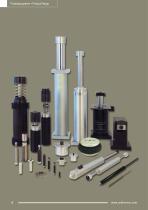
Produktprogramm ▪ Product Range
Open the catalog to page 4
Stoßdämpfer ▪ Shock Absorbers Amortisseurs ▪ Deceleratori ▪ Amortiguadores D Industriestoßdämpfer sind in sich geschlossene, nach dem Verdrängungsprinzip arbeitende Bauelemente. Wird die Kolbenstange durch äußere Krafteinwirkung eingedrückt, verdrängt der Kolben das Öl durch die vorhandenen Drosselbohrungen , die sich proportional zum gefahrenen Hub verringern. Als Folge wird die Einfahrgeschwindigkeit zwangsläufig geringer. Das durch die Kolbenstange verdrängte Öl wird durch einen Speicher kompensiert. Shock absorbers are closed hydraulic components which operate on the basis of oil displacement....
Open the catalog to page 5
Vorteile ▪ Benefits Avantages ▪ Vantaggi ▪ Ventajas Anschlagkappe mit Stahlkern und PU-Kappe (AP) • 40% Geräuschminderung • Schonung der Aufprallfläche Anschlagkappe mit Stahlkern und PUM-Kappe glasfaserverstärkt (AP2) • Erhöhte Lebensdauer im Vergleich zu Anschlagkappe AP und Kunststoffkappe A Stop cap with steel core and PU cap (AP) • 40% noise reduction • Increased protection of the impact surface Steel cap with steel core and PUM cap fiberglass-reinforced (AP2) • Longer life time compared to stop cap AP and plastic cap A • Integrierter Festanschlag • Integrated end-stop Chapeau butoir avec...
Open the catalog to page 6
Vorteile ▪ Benefits Avantages ▪ Vantaggi ▪ Ventajas • Anschlagkappe zur Geräuschminderung mit mech. Sicherung • Noise reducing stop cap with a high security steel-fixing ring • Chapeau butoir réducteur de bruit fixation sécurisée • Testina d’urto per riduzione del rumore, con anello in acciaio di fissagio di sicurezza • Cabeza de choque para la reducción del ruido con el fusible mecánico Pro Adjust • geschützte Einstellung (patentiert) • Integrierter Festanschlag • Integrated end stop • Butée de fin de course intégrée • Battuta di fine corsa integrata • Tope fijo integrado • Protected Adjustment...
Open the catalog to page 7
Zur Berechnung der Industriestoßdämpfer werden fünf Grundangaben benötigt: Äußere, zusätzlich auf die Masse wirkende Kräfte z.B. Antriebskraft F(N) Additional external forces acting on the mass e.g. propelling force F (N) Anzahl der Hübe des Stoßdämpfers je Stunde X (1/h) (bei 1/h: Anzahl der Hübe pro Jahr) Number of strokes of the shock absorber per hour X (1/h) (At 1/h: number of strokes per year) Anzahl der Stoßdämpfer parallel In Einzelfällen können zusätzliche Informationen notwendig sein. Number of parallel shock absorbers In individual cases, other additional information may be required....
Open the catalog to page 8
Donnees de base ▪ Dati di base ▪ Cálculo Masse mit Antriebskraft, waagerecht ▪ mass with propelling force, horizontal masse propulsée en translation par une force motrice ▪ MASSA TRASLANTE CON FORZA MOTRICE ORIZZONTALE Masa con fuerza motriz, horizontal Masse senkrecht nach: unten (C2) / oben (C3) ▪ Mass vertical propelling force: downward (C2) / upward (C3) Masse propulsée en translation vertical: vers l bas (C2) / vers le haut (C3) ▪ Massa con una forza motrice: verso il basso (C2) / verso l‘alto (C3) Masa verticalmente hacia: abajo (C2) / arriba (C3) SCHWENKBARE MASSE MIT ANTRIEBSMOMENT ▪...
Open the catalog to page 9
MASSE MIT MOTORANTRIEB ▪ MASS WITH MOTOR DRIVE ▪ MASSE PROPULSÉE PAR MOTEUR MASSA MOTORIZZATA ▪ Masa con accionamiento por motor DREHTISCH MIT ANTRIEB ▪ ROTARY TABLE WITH PROPELLING FORCE ▪ TABLE EN ROTATION ENTRAINÉE PAR UN MOTEUR TAVOLA ROTANTE CON AZIONAMENTO ▪ Mesa giratoria con accionamiento por motor SCHWENKBARE MASSE MIT ANTRIEBSKRAFT ▪ MASS WITH PROPELLING FORCE ▪ MASSE PIVOTANTE AVEC FORCE MOTRICE MASSA OSCILLANTE CON FORZA MOTRICE ▪ Masa oscilante con fuerza motriz Bei Auslastung pro Hub > 80% Freigabe von Weforma erforderlich! • For a utilizaltion per stroke >80 % the approval of Weforma...
Open the catalog to page 10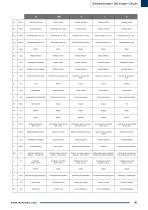
Donnees de base ▪ Dati di base ▪ Cálculo kinetische Energie Kinetic energy Energie cinétique Energia cinetica Energía cinética Propelling force energy Energie motrice Energia motrice Energía motriz Total energy per hour Energie totale par heure Energía total por hora effektive Masse Effective mass Masse effective Massa effettiva Masa efectiva Impact speed Vitesse d’impact Velocità d’impatto effektive Geschwindigkeit Effective speed Vitesse effective Velocità effettiva Velocidad efectiva Number of strokes per hour Nombre de courses par heure Número de carreras por hora Propelling force Force motrice...
Open the catalog to page 11
Gewinde ▪ Threads ▪ Filetage Gewinde Thread Filetage Filettatura Roscas Baureihe Series Série Serie Serie Hub Stroke Course Corsa Carrera Energieaufnahme Energy absorption Energie d‘absorption Assorbimento d‘energia Absorción de energía Länge Length Longueur Lunghezza Longitud Seite Page Page Pagina Página Bestellinformation Ordering Example Exemple de commande Esempio d‘ordinazione Ejemplo de pedido selbsteinstellend linear selbsteinstellend linear für Seitenkräfte selbsteinstellend linear, kompakt einstellbar, linear einstellbar für Seitenkräfte selbsteinstellend progressiv selbsteinstellend...
Open the catalog to page 12All Weforma catalogs and technical brochures
 Weforma Catalog 23/24
316 Pages
 Weforma Catalog US imperial / metric
222 Pages
Archived catalogs
 Weforma Deceleration Technology
84 Pages
- Double-acting cylinder
- Hydraulic cylinder
- Pneumatic cylinder
- Single-acting cylinder
- Piston cylinder
- Anti-vibration mount
- Shock buffer
- Hydraulic absorber
- Standard cylinder
- ISO cylinder
- Mechanical buffer
- Aluminum alloy cylinder
- Metal anti-vibration mount
- Industrial buffer
- Compression spring
- Metal damper
- Anti-vibration damper