


CNC MACHINED MATERIALS STARTING FROM STOCK

1 / 5 PagesView full catalog
CNC MACHINED MATERIALS STARTING FROM STOCK
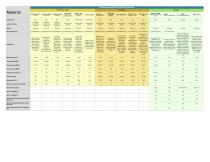
Product catalog summary
Overview: The document provides comprehensive details on CNC machined materials and 3D printing technologies, focusing on their specifications, properties, applications, and finishes.
CNC Machined Materials:
- Non-Ferrous Alloys: Includes Aluminum (7075 T6, 6082, 5083), Brass OT58, Copper C101, and Bronze CuSn12, known for high strength and corrosion resistance, used in aerospace, automotive, and industrial components.
- Iron Alloys: Covers C45 Steel, Carbon Steel, Steel 18NiCrMo5, and Stainless Steel (316L, 304), valued for mechanical strength and fatigue resistance, suitable for heavily stressed parts.
- Plastics: Includes Nylon 6 + MoS2, Delrin, PEEK, and PTFE, chosen for mechanical properties and chemical resistance, used in manufacturing bushings, gears, and seals.
3D Printing Technologies:
- HP Multi Jet Fusion (MJF): Uses Nylon PA12 and PA11, offering chemical resistance for functional prototypes and final parts, applicable in automotive and consumer electronics.
- Fused Deposition Modeling (FDM): Features ABS and Extreme™ Carbon fiber materials, known for mechanical properties, used in automotive and consumer goods.
- LED MSLA + 4KSPER™ Technology: Provides ABS-like and high-temp resins, offering smooth surfaces and high detail for prototypes and functional parts.
Key Properties and Parameters:
- Density: Affects weight and application suitability.
- Max Workable Size: Influences design constraints.
- Mechanical Properties: Includes tensile strength, yield strength, and elongation at break, critical for material performance under stress.
- Thermal Properties: Includes melting point and maximum operating temperature, important for heat exposure applications.
Applications and Recommendations:
- Material selection is based on requirements like strength, corrosion resistance, and thermal stability.
- Recommendations include choosing materials based on the application environment, such as marine, aerospace, or industrial settings.
Material Overview: The document describes materials suitable for high-temperature environments and prototyping, characterized by smooth surfaces, thermal load-bearing capabilities, and aesthetic appeal, useful for molds and functional prototypes.
Material Properties:
- Semi-transparent Material: Ideal for prototyping, can be polished for enhanced transparency.
- Elastic and Ductile Material: Similar to polyamides, suitable for functional objects requiring a smooth finish, resilient under impact.
Technical Specifications:
- Tolerance: Minimum tolerance is ± 0.20mm below 100mm and ± 0.25% above 100mm.
- Tensile Strength: Ranges from 29 MPa to 36 MPa.
- Young's Modulus: Values range from 619 GPa to 1850 GPa.
- Elongation at Break: Varies from 2% to 18%.
- Hardness: Rockwell M Hardness ranges from Shore 70 D to Shore 80 D.
- Heat Deflection Temperature (HDT): At 0.45 MPa, HDT ranges from 68°C to 190°C.
Limitations: Maximum operating temperatures and water absorption rates are not specified.
See more
Catalog excerpts
Non-ferrous alloys Iron alloys Plastics
Open the catalog to page 1All Weerg catalogs and technical brochures
 PVC
PVC2 Pages
 ABS Medical
1 Page
 PPS Glass Filled
1 Page
 PEEK Annealed
1 Page
 PEEK Carbon Fiber
1 Page
 Versatile w135 Resin
1 Page
 Ceramic Resin
1 Page
 PP-like Resin
1 Page
 Best Price classic Resin
1 Page
 Poliporpilene
1 Page
 TPU
TPU1 Page
 Nylon PA6 Carbon Fiber
1 Page
 Nylon PA12 Carbon Fiber
1 Page
 Nylon PA11
1 Page
 Nylon PA12
1 Page

Related Searches
- Machining service
- Machining
- Metal machining
- CNC machining
- ISO machining
- Automotive machining
- Stainless steel machining
- Medical machining
- Plastic machining
- Plastic 3D printing
- Electronic machining
- Machining for the aerospace industry
- Industrial 3D printing
- Copper machining
- Prototyping 3D printing
- Machining for the food industry
- FDM 3D printing
- Resin 3D printing
- ABS 3D printing
*Prices are pre-tax. They exclude delivery charges and customs duties and do not include additional charges for installation or activation options. Prices are indicative only and may vary by country, with changes to the cost of raw materials and exchange rates.
About DirectIndustry
DirectIndustry is a marketplace that offers B2B players a complete experience, from product sourcing to purchase. DirectIndustry is an entity of VirtualExpo Group.
Are you a buyer?
Are you a supplier?