


Catalogue Weiss

Catalogue Weiss
WEISS GmbH offers a wide range of automation solutions, including mechanics, software, and electronics, aimed at efficient and quick commissioning of installations. Their product line focuses on handling components, transport systems, and custom equipment solutions.
- Rotary Indexing Tables: Known for reliability and maintenance-free operation, available in fixed-speed and programmable models, including cleanroom-certified versions.
- Linear Assembly Systems: Designed for precise assembly processes, integrating seamlessly with other WEISS components.
- Handling Systems: Includes pick & place modules, linear axes, and lifting-rotating units, designed for robust and user-friendly operation.
- High precision rotary indexing tables with various indexing options and cycle frequencies up to 210 cpm.
- Easy integration with features like electronic wear compensation and modular designs.
- Energy-efficient, maintenance-free products with extended warranties when using WEISS control systems.
WEISS emphasizes its German roots while maintaining a global presence, focusing on complete solutions and high quality through vertical integration and strict quality control. They consider total cost of ownership, offering energy-efficient and long-lasting products.
WEISS GmbH stands out in the automation industry with innovative, robust, and user-friendly products, supported by extensive engineering expertise and a commitment to quality and customer satisfaction.
- Tool Plate Diameter: TC 700T up to 3000 mm, TC 1000T up to 5000 mm.
- Dial Diameter: TC 700T is 700 mm, TC 1000T is 1000 mm.
- Direction of Rotation: Clockwise, counter-clockwise, or reciprocating.
- Indexings: Options from 2 to 60, with special increments available.
- Cycle Frequency: Up to 120 cpm for TC 700T and 60 cpm for TC 1000T.
- Voltage: Standard 230/400 V 50 Hz, with special voltages available.
- Drive Motor: Ranges from 0.37 to 3 kW for TC 700T and 0.55 to 3.0 kW for TC 1000T.
- Weight: TC 700T is 660 kg, TC 1000T is 1530 kg.
- Indexing Precision: Varies with indexing number, higher precision available upon request.
- Ensure motor and brake accessibility for servicing.
- Consult WEISS for overhead mounting positions and permissible drilling depths.
- Use EF2 control system for brake wear reduction and performance optimization.
- TS 004E Control Card: User-friendly interface, motor protection, and failure analysis capabilities.
- EF2 Control System: Frequency converter control, web-based interface, and remote diagnostics.
- Permissible tilting moments, operating forces, and tangential moments specified for both locked dial plate and center section.
- Combined loads require inspection by WEISS.
- Calculation formulas for mass inertia and indexing precision provided.
- Options for additional indexing plates and customization available.
The document details the TR series rotary indexing tables and EF1/EF2 control systems, highlighting design, functionality, and technical parameters.
Frequency converter control systems EF1 (Lenze) and EF2 (Siemens) include Profibus and ProfiNet interfaces, equipped with a TM 15 Module for digital I/O interface and SIL3 (STO) safety features.
TR series tables are noted for large central openings, flat design, and high parts accuracy, available in four sizes with customizable diameter and thickness.
- Dial ring inside and outside diameters
- Surface finish (anodized)
- Cycle rate (up to 120 cycles/min)
- Voltage requirements (230/400 V 50 Hz)
- Weight and mounting position
- Indexing precision and tolerances
- Vertical force (FN)
- Tangential moment (TR)
- Tilting moment (MK)
- Radial force (FR)
Instructions include bore patterns and alignment procedures, emphasizing flatness of the mounting plate for specified tolerances.
The document concludes with the advantages of the EF2 rotary table control system, emphasizing efficiency in brake wear reduction and overall performance.
The document highlights control systems, installation options, and technical data for various models.
- Designed for WEISS electromechanical rotary indexing tables.
- Web-based user interface for easy commissioning.
- Soft start-up to prevent brake wear and gear damage.
- Remote support and diagnostics capabilities.
- Compatibility with global mains standards.
- Compact all-in-one hardware with fieldbus connections (Profibus and Profinet) and digital I/O interface.
- Integrated SIL2 safety function with optional SIL3 measures.
- Various installation options including 19" rack, PCB holder, and protective housing.
- Detailed fitting dimensions for different models and components.
- Models include TR 750A, TR 1100A, TR 1500A, TR 2200A, NC 150T, NC 220T, and NC 320T.
- Specifications cover dial plate diameter, tool plate diameter, direction of rotation, max table speed, transmission ratio, and more.
- Load data includes permissible tilting moments, operating forces, and tangential moments.
- User-programmable with high torque and precision.
- Brushless AC servo motor drive for dynamic positioning.
- High degree of synchronism and repeat accuracy.
- Various sizes and mechanical interfaces for customer-specific servo motors.
- Facilitates secure and fast commissioning.
- Includes safety and service features like absolute-value measuring system and Safe Torque Off (SIL 2, PL “d”).
- Supports multiple communication interfaces including Profibus-DP, DeviceNet-CAN, EtherNet/IP, Modbus TCP, and more.
The document focuses on various models and their capabilities.
- Designed for heavy-duty applications with features such as large central openings, user programmability, and high precision.
- Key specifications include indexing ring dimensions, load capacities, power requirements, and communication interfaces.
- Setup and operation procedures include connecting the control system with a handheld device for quick start-up, entering load mass moment of inertia and step angle for operation, and adjusting speeds and ramps for optimal performance.
Includes safety features such as an absolute-value measuring system, Safe Torque off (SIL 2, PL “d”), and comprehensive monitoring functions. Worldwide service and C-UL-US listing are available.
All components are integrated with plug-in connections, and cables are oil-resistant and cable-chain compatible. The design allows for easy connection of third-party motors.
Users are advised to ensure the flatness of the mounting plate to achieve specified tolerances. Combined loads should be inspected by WEISS before operation.
The WAS – WEISS Application Software provides easy access to various options and allows for secure and fast commissioning. The software supports up to 128 teachable positions and 10 drive programs.
The rotary indexing tables are robust, versatile, and designed for high precision and heavy loads, making them suitable for a wide range of industrial applications.
The document focuses on models TO 150C, TO 220C, TO 750C, and TW series (TW 150, TW 200, TW 300).
- TO 150C, TO 220C, TO 750C: Vary in torque, speed, and load capacity. Positioning precision ranges from ±25" to ±7".
- TW Series: Offers continuous torques of 33 Nm, 100 Nm, and 200 Nm respectively, with peak torques significantly higher.
- Support programmable indexing times and angles, with up to 128 teaching positions and 10 storable programs.
- Installation requires consultation for overhead mounting positions and ensuring a large steel baseplate for stability.
- Equipped with absolute measuring systems and safety features like Safe Torque Off (SIL 2, PL “d”).
- Compliant with global standards, including UL approval.
- Supports multiple interfaces including Profibus-DP, DeviceNet-CAN, EtherNet/IP, and Modbus TCP.
- WAS - WEISS Application Software facilitates easy programming and diagnostics, with remote maintenance capabilities.
- Integrated components with oil-proof cables suitable for cable chains.
- Connection options include RS232 and Ethernet, with additional USB to RS232 converters available.
- TW series offers hybrid-drive technology, providing higher power density and precision compared to pneumatic solutions.
- Features like electronic overload protection and precise zero-point positioning enhance operational reliability.
The document highlights its modular design, efficiency, and flexibility.
- Features a sophisticated modular cell design, combining a rotary indexing table with a transfer system.
- Operates with a cam drive and belt system, reducing transport times and increasing productivity.
- Capable of handling various electrical sources and encoder types, supporting multiple communication protocols.
Allows for adjustment of processing times and supports maintenance-free operation. Includes independently functional assembly cells with decentralized control packages.
High positioning precision, smooth and impact-free motion sequences, high availability, and a modular system design. Maintenance-free, high reusability, and ESD-capable antistatic transport.
Provides detailed technical data for various components, including belt sections, corner units, and workpiece carriers.
The LS 280 system is designed for high productivity and flexibility, with a focus on reducing transport times and increasing cycle rates.
The document includes information on mechanical and electrical specifications, software capabilities, and installation requirements.
- HP 70T/140T Handling Systems: Programmable strokes, high positioning precision, and repeatability accuracy.
- Linear Motor Axes (HL 50/100): High dynamic performance with maximum speeds and accelerations.
- HG 12/25 Linear Motor Axes: Continuous forces and peak forces with thermal sensors for monitoring.
- Ensure forces do not exceed specified limits during operations.
- Maintain constant temperature conditions to ensure accuracy.
- Use the WAS – WEISS Application Software for easy programming and diagnostics.
- Power supply options include 24 VDC and various AC voltages.
- Communication interfaces include Profibus-DP, DeviceNet-CAN, EtherNet/IP, Modbus TCP, and more.
- Features include Safe Torque Off (SIL 2, PL “d”) and comprehensive safety monitoring functions.
- Options for automatic lubrication and maintenance-free operation are available.
The document provides comprehensive technical data and operational guidelines for WEISS handling systems and linear motor axes, emphasizing flexibility, precision, and ease of integration with existing systems.
The document provides detailed technical specifications for various linear motor axes and rotating units.
- HN 50: Continuous force of 65 N, peak force of 180 N, max speed of 4 m/s, and max load capacity of 15 kg.
- HN 100: Continuous force of 150 N, peak force of 380 N, max speed of 4 m/s, and max load capacity of 25 kg.
- HN 200: Continuous force of 250 N, peak force of 700 N, max speed of 4 m/s, and max load capacity of 50 kg.
- HN 400: Continuous force of 500 N, peak force of 1400 N, max speed of 4 m/s, and max load capacity of 100 kg.
Details rotating units (ST and SW series) designed for high-torque applications, featuring user programmability, adjustable speed and acceleration, and suitability for cleanroom environments.
The WEISS Application Software (WAS) supports user programmability for positions and speeds, storing up to 128 teaching positions and 32 programs.
The document includes a section for technical enquiries and order forms, requesting details such as the number of axes, electrical components, and specific requirements for the handling units.
This document serves as a comprehensive guide for selecting and configuring linear motor axes and rotating units, providing essential technical data and software capabilities to meet various industrial applications.
The document outlines specifications for components, including cable lengths and interfaces, and details the SH lifting-rotating unit.
The SH 75 model is highlighted for its compact design, high power density, and excellent dynamics due to the latest servo drives.
Key technical data for the SH 75 includes a user-programmable stroke, endless rotation, repeatability accuracy, and weight specifications.
The system supports various communication protocols and allows user programmability of positions and speeds.
The Pick-o-Mat system integrates a rotary indexing table with handling, pressing, and lifting modules, synchronized via a central drive.
The Pick-o-Mat system can be customized with base frames, plates, and adapter plates according to customer specifications.
The document provides detailed technical specifications and operational guidelines for the SH 75 lifting-rotating unit and the Pick-o-Mat automated assembly system, emphasizing flexibility, precision, and ease of integration.
The document focuses on its various modules, customization options, and customer-specific solutions.
The pressing module can exert a maximum force of 200N, with a spring-mounted overload protection system.
Customers can specify the number of modules, maximum handling weight, and choose between standard or custom adapter plates.
Options include PM 1100Z with TC 320T or PM 1500Z with TR 1100A, with cycles per minute and vertical stroke specifications.
Standard drive motors are 230/400 V 50 Hz, with options for special voltages.
Customers can choose from round or square base frames, with height adjustments and shock-absorbing feet.
The document emphasizes the ability to provide customized solutions, including design, precision, dimensions, and color.
The SR and SK series offer various model sizes and features like integrated switch cabinets and height-adjustable feet.
Each machine is delivered with a test report, ensuring quality and precision.
The document outlines various dimensions for components such as rotary plates and base plates, specifying materials and surface treatments.
Details on standard assembly, bore hole patterns, and processing according to specific drawings are provided.
Information on model, number of stations, and dimensions is required.
The document lists SR and SK series designs with specific height measurements and customization options.
The software facilitates quick commissioning, troubleshooting, and parameter substitution without requiring detailed hardware knowledge.
Supported protocols include Digital I/O, Profibus-DP, DeviceNet-CAN, EtherNet/IP, Modbus TCP, and more.
The software allows for up to 128 teachable positions and 32 positioning programs.
The document includes a disclaimer about the non-binding nature of the information and limits liability for inaccuracies.
Catalog excerpts

Technology that inspires WEISS Product Range Product Range WEISS GmbH | Siemensstraße 17 | 74722 Buchen Phone +49(0)6281 5208-0 | Fax +49(0)6281 5208-99 [email protected] | www.weiss-international.com Mechanics | Software | Electronics
Open the catalog to page 1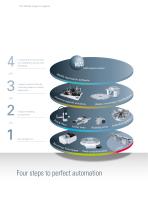
The WEISS range at a glance I would like to commission my installation quickly and efficiently I require machine frames, mounting bases or custom equipment ific solu tings, Bases, moun I require handling components Rotating units freely programmable Four steps to perfect automation
Open the catalog to page 2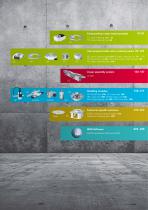
Fixed position rotary indexing tables TC rotary indexing table 12 TR rotary indexing ring 48 User-programmable rotary indexing tables 62 -123 NC rotary indexing table 64 NR rotary indexing ring 74 CR/ TH heavy duty ring 86 TO torque rotary indexing table 104 TW rotary indexing table 114 Linear assembly system Handling modules HP Pick& Place 150 HL Linear axis 158 HN Linear axis 166 ST/SW rotary unit 182 SH Lifting-rotating unit 192 PM Pick-o-Mat 198 Customer-specific solutions Plate SR/SK indexing machine bases 214 Additional indexing plate 222 WAS Software WEISS Application Software (WAS)
Open the catalog to page 3
assemble activate done
Open the catalog to page 4
Robust, innovative and user-friendly These are the characteristics of every WEISS product. Anyone who has ever integrated one of our well-engineered components into an installation will appreciate the benefits they offer. Minimum effort is required and there are no long set-up times. Instead, users get a highly convenient solution that covers all bases in terms of handling and speed of integration.
Open the catalog to page 5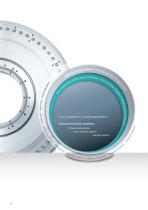
port service Integrat tion Software Core competence: electromechanics Electromechanical basic components Rotary indexing tables Linear assembly systems Handling systems
Open the catalog to page 6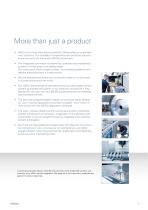
More than just a product • We do not simply manufacture products. We provide our customers with solutions. Our decades of experience and profound industry know-how are built into every WEISS component. • The integrated command of electronics, software and mechanical systems is what gives us a leading edge: Our customers have a single contact, no interface problems and receive everything from a single source. • We are represented where our customers need us: in Germany, in Europe and around the world. • Our 100% vertical range of manufacture and our strict quality control system guarantee the...
Open the catalog to page 7
i Headquarter • Subsidiaries • Representatives
Open the catalog to page 8
A global partner A well-grounded attitude, continuity, tradition and innovation – these concepts form the pillars of our company philosophy. As a family business, we fel a strong connection to Germany as a location. This is where our corporate responsibilities lie. It is also where we see the best opportunities for our company. Yet we have also established worldwide operations with numerous offices abroad in the last few years. We view ongoing globalisation not noly as a challenge, but also as a catalyst to innovation. And we recognise the opportunitiesthat being close to our customers offers...
Open the catalog to page 9
Fixed-speed rotary indexing tables Why do we manufacture so much in-house? The answer is easy: so it lasts.
Open the catalog to page 11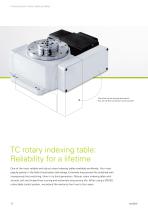
Fixed position rotary indexing tables The drive can be swung downward. You can do the conversion work yourself. TC rotary indexing table: Reliability for a lifetime One of the most reliable and robust rotary indexing tables available worldwide. Your most popular partner in the field of automation technology. Extremely long service life combined with impressively fast switching. Now in its third generation. Robust rotary indexing table with smooth, jerk and impact-free running and extremely long service life. When using a WEISS rotary table control system, we extend the warranty from two to four...
Open the catalog to page 12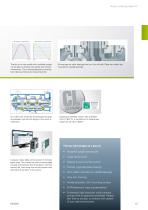
Rotary indexing table TC Thanks to the cam profile with modified sinoide, we are able to achieve very gentle and smooth movements. This is the prerequisite for the fastest indexing times and a long service life. Our roller cam drives are dimensioned as large as possible. And the full length of the cams is used here. All bearings are roller bearings that run in an oil bath. Plate cam rollers are mounted on needle bearings. Cleanroom-certified version also available: The TC150T CL is certified to air cleanliness class 5 as per ISO 14644-1. The key advantages at a glance: • Powerful upright centre...
Open the catalog to page 13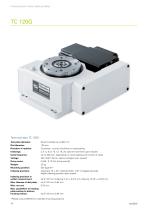
Fixed position rotary indexing tables Technical data TC 120G Tool plate diameter: Dial diameter: Clockwise - counter clockwise or reciprocating Cycle frequency: Up to 200 cpm, depending on inertia loading and number of stops 230 / 400 V 50 Hz, special voltages upon request Drive motor: Mounting position: Indexing precision: Indexing 2-10: ± 45“ indexing 16-20: ± 55“ (in degree seconds) Higher indexing precision upon request Indexing precision in radian measurement: Max. flatness of dial plate: Max. parallelism of rotating plate surface to bottom (at Ø 120 mm) 0.04 mm housing surface: *Please...
Open the catalog to page 14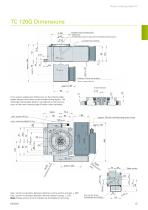
Rotary indexing table TC TC 120G Dimensions counter sunk jockey pully stationary (The dial plate is 0.5 mm higher than the stationary centre section) unmachined casting Position: Drive on bottom Option: longer pulley box Cross section If you require subsequent drilling work on the indexing table, please request information on permissible drilling depths. The illustrated rotating plate position corresponds to the basic position of the rotary indexing table (Position when delivered). approx. 98 with self-adjusting brake motor Table centre Max. centre line deviation between stationary centre section...
Open the catalog to page 15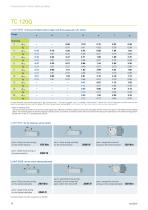
Fixed position rotary indexing tables (In the case of higher loads or longer cycle times, please ask us for advice.) J = max admissible mass inertia loading (kgm ) ts = cycle time (sec.) The time from signal “start” to message “indexer locked” is approx. 80 - 130 ms longer than the above cycle time, the exact time will depend on the motor, the speed of PLC and the optimization settings. EF2 - control system for brake wear reduction recommended (see page 44). 2 * Note on indexing times The actual measured rotation time (from the start signal to the electrical in-position signal) comprises the...
Open the catalog to page 16All WEBER catalogs and technical brochures
 TSS Spindle
2 Pages
 M30 Torque Gauge
2 Pages
 CU30 Sequence control
2 Pages
 C5S Controller
2 Pages
 BB Refill Hopper
2 Pages
 ZEB Bowl Feeder
2 Pages
 Machine Layout ST/SW
1 Page
 The TW with Hybrid-Drive
10 Pages
 FEEDING SYSTEM
2 Pages


- Piping
- Semi-rigid tube
- Electric screwdriver
- Electric rotary table
- Horizontal rotary table
- Motor-driven rotary table
- Corded electric screwdriver
- Straight electric screwdriver
- Mounting machine
- Electric linear axis
- Automatic assembling machine
- Torque meter
- Lifting manipulator
- Flexible semi-rigid tube
- Precision linear axis
- Electronic torque meter