
- Catalogs
- Weber Ultrasonics
- SONOTRODES ULTRASONIC CUTTING

- Company
- Products
- Catalogs
- News & Trends
- Exhibitions
SONOTRODES ULTRASONIC CUTTING
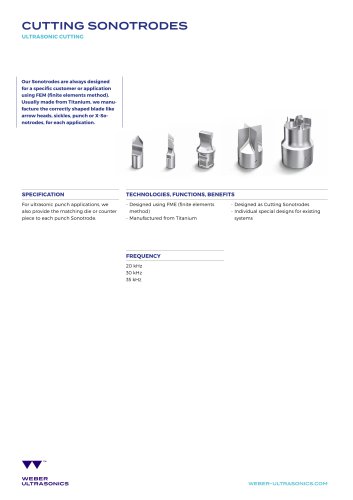
SONOTRODES ULTRASONIC CUTTING
- The sonotrodes are designed using the Finite Elements Method (FEM) to ensure precision and efficiency.
- They are manufactured from titanium, providing durability and strength.
- These are specifically designed as cutting sonotrodes, tailored for individual systems and applications.
Frequency:
- Available frequencies include 20 kHz, 30 kHz, and 35 kHz, allowing for versatility in application.
Design and Manufacturing:
- Each sonotrode is custom-designed for specific customer needs or applications using FEM.
- Typically made from titanium, the sonotrodes are crafted into various shapes such as arrowheads, sickles, punches, or X-sonotrodes to suit different applications.
Specification:
- For ultrasonic punch applications, a matching die or counter piece is provided to complement each punch sonotrode.
Ultrasonic Cutting:
- The document emphasizes the use of ultrasonic technology for cutting applications, highlighting the precision and efficiency of the sonotrodes.
Catalog excerpts

ULTRASONIC CUTTING Our Sonotrodes are always designed for a specific customer or application using FEM (finite elements method). Usually made from Titanium, we manufacture the correctly shaped blade like arrow heads, sickles, punch or X-So-notrodes, for each application. SPECIFICATION TECHNOLOGIES, FUNCTIONS, BENEFITS For ultrasonic punch applications, we - Designed using FME (finite elements - Designed as Cutting Sonotrodes also provide the matching die or counter method) - Individual special designs for existing piece to each punch Sonotrode. - Manufactured from Titanium systems WEBER ULTRASONICS
Open the catalog to page 1All Weber Ultrasonics catalogs and technical brochures
 SONIC DIGITAL HS2
1 Page
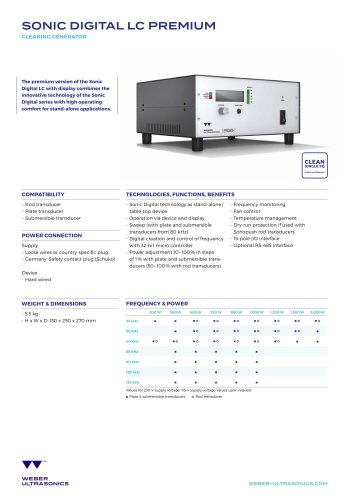 SONIC DIGITAL LC PREMIUM
1 Page
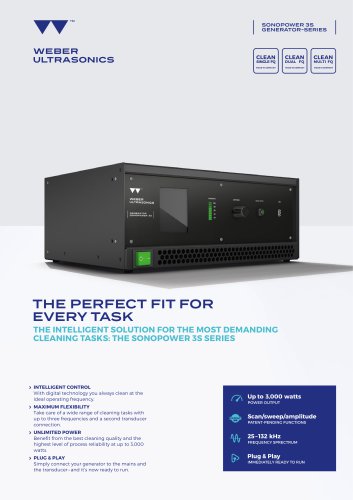 SONOPOWER 3S DUAL
2 Pages
 SONOPOWER 3S-SERIE
2 Pages
 SONIC DIGITAL LC BASIC
1 Page
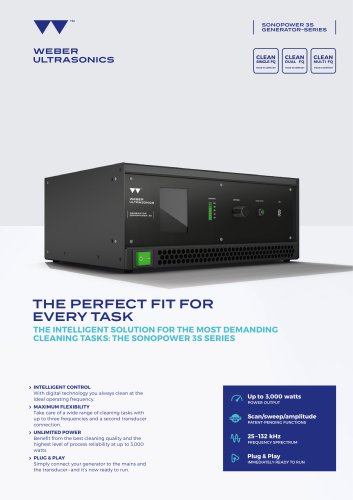 SONOPOWER 3S MULTI
2 Pages
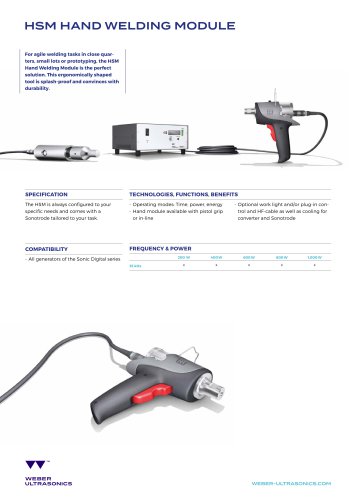 HSM HAND WELDING MODULE
1 Page
 SONIC DIGITAL MG BASIC
1 Page
 HSM HAND CUTTING MODULE
1 Page
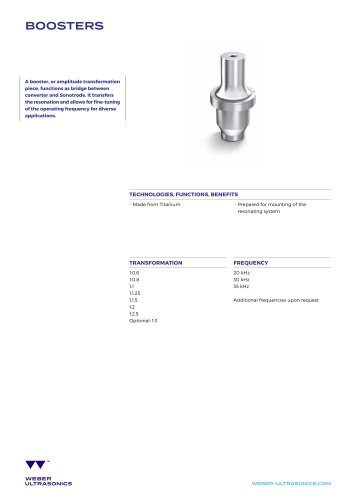 BOOSTER
1 Page
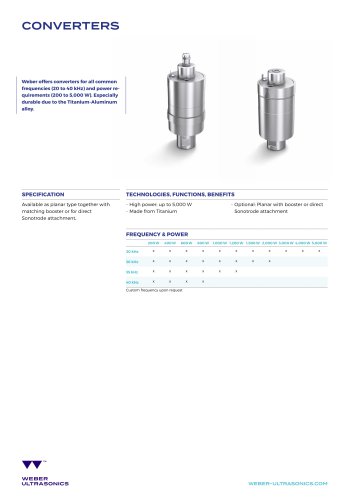 CONVERTER
1 Page
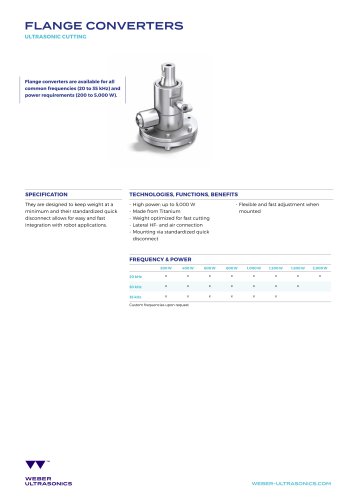 FLANGE CONVERTER
1 Page
 WORKPIECE HOLDER
1 Page
 SCHWEISS-SONOTRODEN
1 Page
 QUICK-CHANGE MODULE
1 Page
 UMC HOUSING
1 Page
 MG HOUSING
1 Page
 SONIC DIGITAL CABINET
1 Page




Archived catalogs
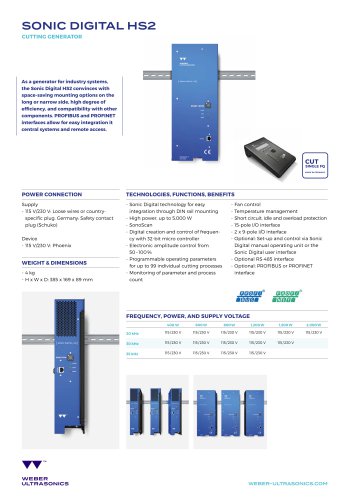 SONIC DIGITAL HS2 2017
1 Page
 SONIC DIGITAL SYSTEM
2 Pages

- Welding system
- Rectangular housing
- Automation software solution
- Process software
- Windows software
- Control software
- Visualization software solution
- Compact housing
- Manual welding machine
- Metal stand
- DIN rail converter
- Electrical cabinet
- Weber ultrasonic transducer
- Compact sealer
- Welding power supply
- Floor-mounted electrical cabinet
- Industrial workstation
- Steel bracket
- Cutting tool
- Ultrasonic sealer