
- Catalogs
- Watson-Marlow Fluid Technology Group
- APEX hose pumps datasheet


- Products
- Catalogs
- News & Trends
- Exhibitions
APEX hose pumps datasheet

APEX hose pumps datasheet
- Configurable to accept three hose element sizes, allowing for future-proofing of processes.
- Compact direct-coupled design reduces loading on the gear motor.
- Flow rates range from 2.8 to 1,200 liters per hour with a maximum pressure of 8 bar.
- Long-life hose elements significantly reduce maintenance needs.
- Lower cost of ownership due to single component changes and reduced inventory requirements.
- Continuous flow range: APEX10 (2.8 - 280 L/hr), APEX15 (5.5 - 550 L/hr), APEX20 (8.7 - 870 L/hr).
- Intermittent flow range: APEX10 (2.8 - 390 L/hr), APEX15 (5.5 - 770 L/hr), APEX20 (8.7 - 1200 L/hr).
- Capacity per revolution: APEX10 (0.046 L/rev), APEX15 (0.091 L/rev), APEX20 (0.145 L/rev).
- Maximum discharge pressure: 800 kPa (8 bar).
- Operating speed: Continuous up to 100 rpm, Intermittent up to 140 rpm.
- Temperature range: Product (-10°C to 80°C), Ambient (-20°C to 45°C).
- Pump housing: Die-cast aluminum.
- Pump rotor: Cast iron.
- Cover: Copolyester.
- Brackets, fasteners, and hose clamps: AISI 316.
- Dynamic seal: NBR.
- Cover window: PMMA.
- Cover seal and hose connection sealing bush: EPDM.
- Available hose materials include NR, NBR, EPDM, and CSM.
- Available rotors for low (0-4 bar) and medium pressure (0-8 bar).
- Port configurations: Left, right, up, and down, with standard configuration at position 2.
- Various hose connection options such as hose tail, BSP, DIN, NPT, ASA, and Tri-Clamp.
- APEX10: A (388.5 mm), A1 (374.5 mm), B (197.5 mm), E (Ø16 mm), H2max (170 mm), Lmax (474 mm), L2max (392.5 mm).
- APEX15/20: A (394.5 mm), A1 (380.5 mm), B (197.5 mm), E (Ø20 mm), H2max (170 mm), Lmax (474 mm), L2max (392.5 mm).
Catalog excerpts
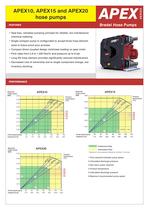
hose pumps Seal less, valveless pumping principle for reliable, low maintenance chemical metering Single compact pump is configurable to accept three hose element sizes to future-proof your process Compact direct coupled design minimises loading on gear motor Flow rates from 2.8 to 1,200 litre/hr and pressure up to 8 bar Long life hose element provides significantly reduced maintenance Decreased cost of ownership due to single component change, low inventory stocking motor power motor power motor power Continuous Duty Intermittent Duty* ' Maximum 3 hours operation followed by minimum 1 hour stop 1 Flow required indicates pump speed 2 Calculated discharge pressure 3 Net motor power required 5 Calculated discharge pressure 6 Maximum recommended pump speed
Open the catalog to page 1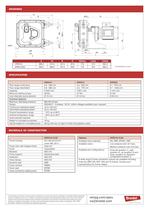
The information contained in this document is believed to be correct at the time of publication, but Watson-Marlow Bredel BV accepts no liability for any error it contains, and reserves the right to alter specifications without prior notice. All mentioned values in this document are values under controlled circumstances at our test bed. Actual flow rates achieved may vary because of changes in temperature, viscosity, inlet and discharge pressures and/or system configuration. SPX, APEX. DuCoNite®, Bioprene® and Bredel are registered trademarks. Hose Pumps
Open the catalog to page 2All Watson-Marlow Fluid Technology Group catalogs and technical brochures
 FC10/32
2 Pages
 BREDEL HEAVY DUTY HOSE PUMPS
11 Pages
 323U/D and 323U/4D
2 Pages
 120 PERISTALTIC PUMPS
8 Pages
 Flexicon brochure
13 Pages
 Food and beverage brochure
7 Pages
 MasoSine Certa brochure
7 Pages
 Bredel heavy duty pumps
11 Pages
 ASEPCO valves brochure
5 Pages
 Aflex biotech brochure
7 Pages
 Aflex industrial brochure
7 Pages
 Close coupled pumps
8 Pages
 Qdos brochure
7 Pages
 Biopharm tubing
13 Pages
 Biopharm overview
6 Pages
 Tubing guide
15 Pages
 Industrial overview
3 Pages
 Corporate brochure
11 Pages


Archived catalogs
 Qdos 30 overview brochure
12 Pages
 Overview brochure
4 Pages
 Sanitary process pumps catalog
20 Pages
 Bredel APEX 10, APEX15, APEX20
12 Pages
 114 pumphead
2 Pages
 720 SANITARY PUMPS
4 Pages
 300 and 400 series pumps
20 Pages
 SPX pump
10 Pages
 OEM pumps
16 Pages
 Close-coupled pumps brochure
8 Pages
 Hose pumps
12 Pages
 Sanitary process pumps catalogue
20 Pages
 Aseptic Filling and capping
24 Pages
 Flexicon
24 Pages
 MasoSine overview brochure
7 Pages


