
- Catalogs
- Watlow Electric Manufacturing Company
- PUMP AND GAS LINE HEATING SYSTEMS


PUMP AND GAS LINE HEATING SYSTEMS

PUMP AND GAS LINE HEATING SYSTEMS
- Power Input: 120VÅ(ac), 1 phase or 208VÅ(ac), 3 phase.
- Thermocouple Inputs: Type J or Type K, with other sensor types available.
- Power Input: IDE style fused, with optional GFCI line cord.
- Data Retention: Non-volatile memory ensures data retention upon power failure.
- Operating Conditions: Ambient temperature 0-30°C (32-86°F), 0-90% RH non-condensing.
- Accuracy: ±1°C under standard conditions.
- Display: 4-digit LED for temperature.
- Connectors: Miniature thermocouple input connectors, AMP Universal Mate-n-Lok® power output connector standard, with options for AMP CPC connectors or internal terminal block.
- Communications: RS-232 or RS-485 computer communications available.
- 1 zone: 119.3 mm H x 76.2 mm W x 190.5 mm D (4.7 in. H x 3.0 in. W x 7.5 in. D)
- 2 zone: 114.3 mm H x 152.4 mm W x 190.5 mm D (4.5 in. H x 6.0 in. W x 7.5 in. D)
- 3 zone: 114.3 mm H x 304.8 mm W x 190.5 mm D (4.5 in. H x 12.0 in. W x 7.5 in. D)
- 4 zone: 114.3 mm H x 304.8 mm W x 190.5 mm D (4.5 in. H x 12.0 in. W x 7.5 in. D)
- UL®, CE, and SEMI S2-93 depending on configuration.
- WATVIEW and ANAWIN®: 32-bit Windows®-based HMI software for setup and monitoring, including data logging, graphing, recipe, and alarm management. Developer editions allow for custom graphical interface screens.
- Heater Power Extension Cable: Type SJ, 16-3 stranded, with various connection options.
- Thermocouple Extension Cable: FEP Teflon® insulated, 24 gauge stranded.
- Watlow heaters are designed for optimal process results and should not be used in hazardous or outdoor locations, or for immersion applications. They should be installed on grounded metallic tubing systems or GFI protected circuits.
Detailed specifications for various tube sizes, lengths, and power ratings are provided, with options for trim-to-fit and sensor pocket features.
- Straight Heater Sections: Available in various sizes with silicone rubber sponge insulation.
- Elbow Heaters: 90° and 45° radius options with or without tangents.
- Tee and Bellows Section Heaters: Fit both butt-weld and flanged styles.
- Flange Heaters and Insulators: For KF screw flanges and ISO clamp flanges.
- New low watt density pump line heaters and 208VÅ(ac) option available to reduce system costs.
The document provides detailed specifications for various insulators and heaters used in pump and gas line heating systems. It includes part numbers, dimensions, voltage, wattage, and amperage for different components such as straight insulators, elbow insulators, and VCR union heaters.
Guidelines are provided for measuring components and setting up control zones. It emphasizes the importance of accurate measurements for component selection and control zone layout. Instructions for measuring straight sections, elbows, tees, and flexible sections are included.
The document outlines the maximum amperage per zone (10 amps) and suggests splitting zones at natural break points. It also recommends using separate control circuits for each flow component due to differences in mass and temperature sensitivity.
Various accessories are listed, including Y-adapters, dead plugs, and thermocouples. The document specifies the use of AMP Mate-N-Lok® connectors for all connections.
Detailed ordering information is provided, including base code numbers, insulation types, connector options, and sensor types. It also includes control system ordering details, specifying panel styles, number of zones, input types, and custom options.
The tables in the document list various heaters and insulators with their respective dimensions, voltage, wattage, and amperage. For example, a 457 mm heated straight section operates at 120 volts, 107 watts, and 0.90 amps.
Catalog excerpts

Pump Line INCREASE TOOL UPTIME AND PROCESS YIELDS PUMP AND GAS LINE HEATING SYSTEMS
Open the catalog to page 1
|Pump and Gas Line Heating Systems Problem Lines must be heated uniformly to prevent condensation in the gas delivery line or particle clogging in the pump line. Both gas and pump lines have unique thermal challenges due to many factors including poor conductivity of stainless steel, different thermal mass of plumbing components, or ambient temperature changes between the cleanroom and suboor. Condensation forms in gas lines when temperatures and/or pressure falls below the vapor state. Unheated pump lines have sublimation buildup due to poor and uneven heating. Heat trace can produce a ribboning...
Open the catalog to page 2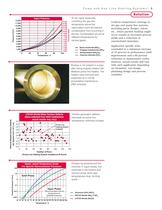
Process by-products exit the chamber in vapor phase, but vacuum pump when gas temperatures drop, forming
Open the catalog to page 3
|Pump and Gas Line Heating Systems Integrated System Solution One supplier for thermal components; one supplier for thermal systems The solution to achieving the optimum performance is through an intelligently designed heating system. Unlike other companies that just make heaters, sensors or controllers, Watlow designs and manufactures all of these thermal system components into a complete system. Working with a partner whose products are found throughout the semiconductor manufacturing process offers a single responsible supplier that understands how thermal systems t within the whole process....
Open the catalog to page 4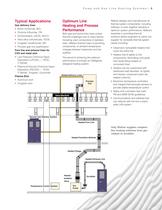
Pump and Gas Line Heating Systems | 5 Optimum Line Heating and Process Performance Typical Applications Gas delivery lines • Boron trichloride, BCl3 • Chlorine triuoride, ClF3 • Dichlorosilane, (DCS), SiH2Cl2 • Tetra ethyl orthosilicate, TEOS • Tungsten hexauoride, WF6 • Process gas line qualication Fore line and exhaust lines for CVD and metal etch • Low Pressure Chemical Vapor Deposition (LPCVD) — TEOS, Ti Nitride • Plasma Enhanced Chemical Vapor Deposition (PECVD) — TEOS, Ti Nitride, Tungsten, Oxynitride Plasma Etch • Aluminum etch • Tungsten etch Both gas and pump lines have unique thermal...
Open the catalog to page 5
|Pump and Gas Line Heating Systems Modular Pump Line Heaters The tight contact t of Watlow’s pump line heaters provide superior, uniform heating of transfer lines. Agency Certication, Recognition Compliance and Approvals (Contact factory for specic application and approvals.) • Complies with SEMI S2-93 standards • UL® recognized for U.S. and Canadian safety standards • CE • NEC (National Electrical Code), Article #427-23 • 120 and 208VÅ(ac) standard. Consult factory for other voltages • Power lead wires: 102 mm (4 in.) #18 AWG UL® 1180/CSA Teon® insulated, rated 10A, lead wire pair encapsulated...
Open the catalog to page 6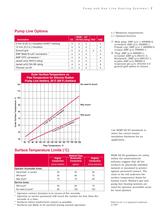
Pump and Gas Line Heating Systems | 7 Pump Line Options x = Minimum requirements o = Optional features 6 mm (0.25 in.) insulation w/HOT marking 13 mm (0.5 in.) insulation Ground grid AMP Mate-N-Lok® connectors a AMP CPC connectors b Jacket w/UL®94V-0 rating Jacket w/UL®94-HB rating Thermal cut-off a Male plug: AMP p/n 1-480698-0, w/sockets AMP p/n 350689-1. Female cap: AMP p/n 1-480699-0, w/pins AMP p/n 350690-1. b Plug: AMP p/n 206060-1, w/socket AMP p/n 66101-3. Receptacle: AMP p/n 206153-1, w/pins AMP p/n 66099-3, w/ground pin p/n 164164-2 if ground grid option is chosen. Outer Surface Temperature...
Open the catalog to page 7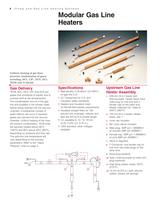
|Pump and Gas Line Heating Systems Modular Gas Line Heaters Uniform heating of gas lines prevents condensation of gases including: BCl3, ClF3, DCS, HCl3, TEOS and Ti Nitride Gas Delivery TEOS, BCl3, AlCl3, ClF3 and DCS are gases that condense or liquefy due to a phase shift at low temperatures. The condensation occurs in the gas line and puddles in the shower head before being injected into the vacuum chamber. A substantial number of wafer defects will occur if liqueed gases are injected into the vacuum chamber. Uniform heating of the lines will prevent condensation. TEOS lines are typically...
Open the catalog to page 8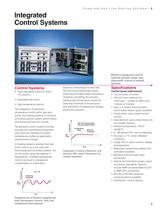
Pump and Gas Line Heating Systems | 9 Integrated Control Systems Watlow’s integrated control systems provide stable and adjustable control of heated systems. • Tight adjustable control to within 1°C (33.8°F) • Adjustable set points • High temperature alarms The integration of electronic temperature control within gas and pump line heating systems is critical to providing superior system performance and achieving maximum results. Temperature control systems provide process and maintenance engineers with maximum exibility to modify temperature proles as application requirements change. In heating...
Open the catalog to page 9
|Pump and Gas Line Heating Systems • Dimensions: 1 zone: 119.3 mm H x 76.2 mm W x 190.5 mm D (4.7 in. H x 3.0 in. W x 7.5 in. D) 2 zone: 114.3 mm H x 152.4 mm W x 190.5 mm D (4.5 in. H x 6.0 in. W x 7.5 in. D) 3 zone: 114.3 mm H x 304.8 mm W x 190.5 mm D (4.5 in. H x 12.0 in. W x 7.5 in. D) 4 zone: 114.3 mm H x 304.8 mm W x 190.5 mm D (4.5 in. H x 12.0 in. W x 7.5 in. D) Control consoles (table-top-mount) • 1 to 4 zones of control • 10A per zone maximum • 120VÅ(ac), 1 phase or 208VÅ(ac), 3 phase • Type J or Type K thermocouple inputs (other sensor types available) • IDE style fused power input...
Open the catalog to page 10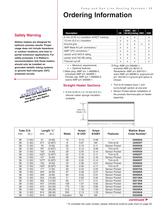
Pump and Gas Line Heating Systems | 11 Ordering Information Description Safety Warning Watlow heaters are designed for optimum process results. Proper usage does not include hazardous or outdoor locations; and total or partial immersion applications. For safety purposes, it is Watlow’s recommendation that these heaters should only be installed on grounded metallic tubing systems or ground fault interuptor (GFI) protected circuits. CE ST EDU CtOensity R MWat D o ters STEw SYNew LLine HeaOption ith 6 mm (0.25 in.) insulation w/HOT marking 13 mm (0.5 in.) insulation Ground grid AMP Mate-N-Lok® connectors...
Open the catalog to page 11
12 IPump and Gas Line Heating Systems Straight Heater Sections (continued) * To complete the code number, please reference build-to-code chart on page 20.
Open the catalog to page 12
Pump and Gas Line Heating Systems | 13 UCE ST y D REDMWCtOensit E at TLow Heaters n Sw SYNemp Line c) Optio With 90° Radius Elbow Heaters • 6 mm (0.25 in.) or 13 mm (0.5 in.) silicone rubber sponge insulation available • With or without tangents • Will t both butt-weld and anged style tubing elbows Without tangent With tangent 45° Radius Elbow Heaters • 6 mm (0.25 in.) or 13 mm (0.5 in.) silicone rubber sponge insulation available • With or without tangents • Will t both butt-weld and anged style tubing elbows Without tangent With tangent * To complete the code number, please reference build-to-code...
Open the catalog to page 13All Watlow Electric Manufacturing Company catalogs and technical brochures
 Powersafe
20 Pages
 EPM
EPM2 Pages
 Watlow Sustainability Brochure
12 Pages
 Flexible Heaters
12 Pages
 HELIMAX
2 Pages
 FIREROD® Cartridge Heaters
12 Pages
 OPTIMAX
3 Pages
 POWERSAFE
2 Pages
 2704
27048 Pages
 2704MP
4 Pages
 2704CP
4 Pages
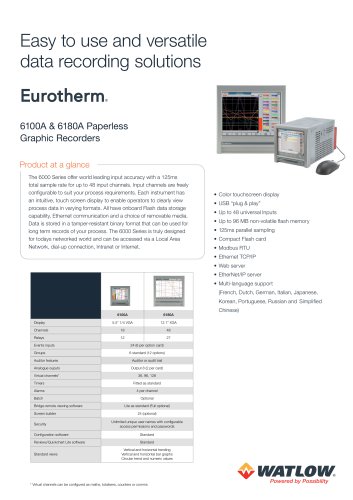 6100A & 6180A
8 Pages
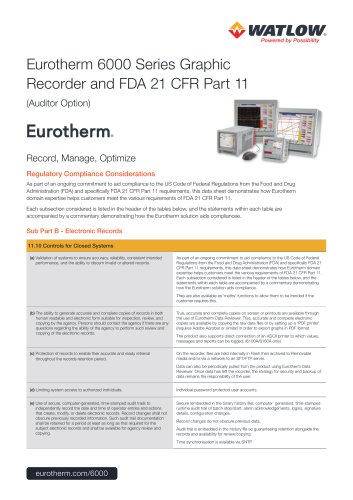 6000 Series graphic recorder
4 Pages
 Eurotherm® EPower™
22 Pages
 w OPTIMAX® Heat Exchanger
2 Pages
 SEMICONDUCTOR
18 Pages
 Operator Interfaces
12 Pages
 Indicators
6 Pages
 Power Switching Devices
40 Pages
 Data Loggers
16 Pages
 Control Panels
6 Pages
 Immersion Heaters
154 Pages
 Tubular Heaters
52 Pages
 Specialty Heaters
22 Pages
 Radiant Heaters
10 Pages
 High-Temperature Heaters
34 Pages
 Nozzle Heaters
4 Pages
 Fluid Delivery Heaters
8 Pages
 Circulation Heaters
70 Pages
 Flexible Heaters
36 Pages
 Thermostats and Accessories
12 Pages
 Air Heaters
34 Pages
 DATA LOGGER with
8 Pages
 PROCESS CONTROLLER
8 Pages
 ASPYRE
8 Pages
 FIREROD ® Cartridge Heaters
418 Pages
 Heaters from Watlow
576 Pages
 Energy Process
9 Pages
 Sensor and Controller
418 Pages
 serv-rite wire
8 Pages
 SEMICONDUCTOR PROCESSING
34 Pages
 SCR power controllers
6 Pages
 multicell heaters
8 Pages
 flexible heater
12 Pages
 fiberbar flat tubular heater
8 Pages
 thermal solutions
8 Pages
 engine heater and systems
4 Pages
 dinamite power controllers
20 Pages








Archived catalogs
 Heat Solutions Resource
24 Pages
 Thermocouple Designs
2 Pages
 Piccolo™ P304i
4 Pages
 Application Guide
411 Pages
 Application Guide catalog
216 Pages
 Plastics catalog
411 Pages


- Fitting
- Hydraulic fitting
- Electrical cable
- Screw-in fitting
- Watlow temperature sensor
- Electrical power supply connector
- Metal connector
- Automation software solution
- Resistance temperature sensor
- Digital I/O
- Power cable
- Process software
- Windows software
- IO module
- Screw-in connector
- Control software
- Insulated cable
- Insulated electrical cable
- Watlow digital temperature control