
- Catalogs
- Walther Flender
- PolyChain_timingbelts

PolyChain_timingbelts

PolyChain_timingbelts
The document introduces PolyChain® GT Timing Belts by Walther Flender Group, emphasizing their superior power transmission capabilities and compatibility with existing systems without modifications.
PolyChain® belts offer positive power transmission, constant angular velocity, and cost-effectiveness due to reduced pulley size. They are maintenance-free, operate without lubrication, and have low noise levels. The belts maintain constant tension and are resistant to oils and chemicals.
PolyChain® GT Carbon™ belts use carbon fibers for high force transmission, while GT2 belts use aramid fibers. Both types are resistant to extreme temperatures and chemicals, available in pitches of 8 mm and 14 mm.
An example demonstrates cost reduction by using PolyChain® Carbon™ belts in a metal saw, highlighting efficiency and cost-effectiveness.
Includes detailed specifications, power output values, belt lengths, and calculation formulas. Guidelines for assembly and maintenance emphasize using original components for reliability.
PolyChain® timing belts are not suitable for aircraft drive systems or applications where belt failure could cause injury. Protective measures should prevent unintended access to exposed drive systems.
Belts are available in pitches of 8 mm and 14 mm, designed for high tensile strength, with various widths and lengths. Minimum tensile strength is specified in newtons.
Permissible tangential loads are specified for different belt widths. Belts operate within a temperature range of -54°C to +85°C and resist various chemicals.
Standard and custom pulleys are available, made from materials like aluminum, steel, and polymer, with surface treatments for wear resistance.
Proper installation is critical to avoid damage. Shafts and pulleys must be aligned to prevent misalignment and wear. Electrical conductivity tests indicate belts do not conduct electricity, requiring proper earthing in explosive environments.
Fixed center distances are recommended only for slow-running systems. Idlers should be used on systems with fixed center distances.
Belt tension can be measured using frequency measurement tools like the WF Tension Meter.
Provides detailed specifications for PolyChain® GT Timing Belts, including parameters such as deflection, pitch diameter, and test force.
Proper belt tension is crucial for reliable operation. Over-tensioning can reduce service life, while under-tensioning can cause skipping.
Static initial tension is calculated using specific formulas, with tables providing minimum initial tension values for different belt widths and pitches.
Belts require minimal maintenance and should be protected from extreme conditions during storage.
Describes the use of clamping elements for securing timing belt pulleys, offering easy mounting and high fatigue strength.
Power output values are provided for different belt widths and speeds, with tables for maximum permissible tangential loads.
Detailed technical data is provided for PolyChain® GT2 and PolyChain® GT Carbon™ belts.
Design of belt drive units should consider motor power output, load collectives, safety factors, and desired service life.
Describes a calculation method for determining timing belt dimensions, considering factors such as power, torque, speed, and transmission ratio.
Custom lengths and widths are available upon request, with potential longer delivery times and minimum purchase quantities.
Timing belt pulleys are available in grey cast iron or steel, ensuring durability and reliability.
For peripheral speeds exceeding 40 m/s, consultation with application engineers is recommended.
MLC clamping sets provide a positive-locking, backlash-free connection, suitable for various applications.
Key features include backlash-free connection, easy installation, and higher power transmission compared to feather keys.
Includes worm gears, straight bevel, cylindrical gears, and right-angled gears, catering to different industrial needs.
Outlines the need for replacing existing drive systems, specifying requirements such as quantity per year and operating conditions.
Catalog excerpts

ain® GT Timing Belts
Open the catalog to page 1
Walther Flender Gruppe PolyChain® GT Timing Belts THE POWER OF [E]MOTION We are in motion for you … … with innovative, new service ideas and individual system solutions which we develop together with you. The Walther Flender Group stands for expertise, experience and commitment. With top class technology and craftsman’s know-how in the areas of drive and conveyor technology, bearing, clamping, and sintering technology, in addition to the automotive sector. We‘re looking forward to do more for you. The Walther Flender Group – we are packaged know-how for drive, conveyor, bearing and clamping technology...
Open the catalog to page 2
WALTHER FLENDER GRUPPE PGLYCHAIN® GT TIMING BELTS PAGE OS TABLE OF CONTENTS page Timing belt pulleys_ 10 Standard timing belt pulleys_ 10 Timing belt pulleys - custom models_ 10 Power output values & belt lengths_ 17 Timing belt pitch 8MGT_ 17 Timing belt pitch 14MGT_ _20 Standard line of timing belt pulleys_ 28 Description of models & tables_ 37 Project data sheet_ 45 Important notice: PolyChain9 timing belts are not suitable for use in aircraft drive systems or other drive systems where a defective belt could result in bodily injury. Suitable protective measures must be taken to encapsulate...
Open the catalog to page 3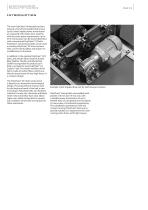
Walther Flender Gruppe PolyChain® GT Timing Belts PAGE 04 Page 4 Page Introduction The new PolyChain® timing belt systems present a line of timing belts that ensure up to 8 times higher power transmission as compared with classic drive systems; with the same space requirements, up to 30 % more power can be transmitted than with conventional PolyChain® GT belts. PolyChain® synchronous belts can be used in existing PolyChain® GT drive systems; they use the same pulleys and require no modifications to the drive. In addition to the existing PolyChain® GT2 belts, with tensile fibres made of aramid...
Open the catalog to page 4
Walther Flender Gruppe PolyChain® GT Timing Belts PAGE 05 Page 5 Page General features Positive power transmission The positive meshing of the PolyChain® belt teeth in the teeth of the drive pulleys ensures the positive synchronous transmission of power. Slippage and related deviations in speed are eliminated. No maintenance While chain drives generally have to be lubricated and require complex lubricating systems even for relatively low peripheral speeds, the PolyChain® timing belt drive unit operates entirely without lubrication. This minimizes the design and equipment requirements, in addition...
Open the catalog to page 5
Walther Flender Gruppe PolyChain® GT Timing Belts A glance at practice From a belt width of 125 mm to 68 mm: Efficient and costeffective drive technology due to innovative carbon tensile member CarbonTM By using the new PolyChain® timing belt in a heavyduty metal saw, the drive technology engineers at Walther Flender A ntriebstechnik achieved cost reductions of up to 25 % and therefore more than satisfied the customer‘s requirement for a highperformance and economical timing belt drive system. With a maximum saw blade diameter of 2.2 meters, the metal saw of a well-known Austrian component...
Open the catalog to page 6
Walther Flender Gruppe PolyChain® GT Timing Belts Design characteristics Timing belts Design & components 1. The tensile member of the PolyChain® GT CarbonTM belt is made of carbon fibres, as opposed to the PolyChain® GT2 belt, which has a tensile member consisting of aramid fibres. Both fibre types give the belts their outstanding performance properties. In addition to exceptional bending fatigue strength, the tensile members feature high notch impact strength so they also resist impacts and vibrations. Unlike polyester, aramid and carbon fibres are thermally stable and can be used at extreme...
Open the catalog to page 7
Walther Flender Gruppe PolyChain® GT Timing Belts Models Endless design Weights per metre in kg for PolyChain® GT2 Pitches PolyChain® endless timing belts are manufactured with 8 mm and 14 mm pitches and are available in a large assortment of lengths and widths. The main dimensions of the timing belt are: Pitch – Pitch length – Width The timing belt pitch is the distance in millimeters between two adjacent tooth centres, measured on the timing belt pitch line. The pitch length is the total circumference of the timing belt in millimeters, measured on the belt pitch line. The theoretical pitch...
Open the catalog to page 8
Walther Flender Gruppe PolyChain® GT Timing Belts Open-ended model (LongLength) Pitches PolyChain® GT2 Long Length (LL) timing belts are available with 8 mm and 14 mm pitches. Dimensions and weights Designation Weight per Maximetre in g mum (10 mm roll belt width) length 47.0 37 For information about dimensioning for special applications requiring other dimensions, please consult our application engineers. Technical information Permissible tangential loads in newtons (8M: 21 mm belt width, 14M: 37 mm belt width) * Minimum number of teeth 22 (8M) or 28 (14M) Minimum tensile strength in newtons...
Open the catalog to page 9
Walther Flender Gruppe PolyChain® GT Timing Belts Timing belt pulleys PolyChain® timing belt pulleys are equipped with special precision-cut teeth in the gear hobbing process. Only original timing belt pulley hobbing cutters are used. Only these original tools ensure a reliable and long-lasting timing belt drive unit. Only olyChain® timing belts and PolyChain® timing belt P pulleys with the same pitch can be used together. The main features of the timing belt pulley are: Standard timing belt pulleys The information on pages 23 to 26 describes our extensive line of standard timing belt pulleys...
Open the catalog to page 10
Walther Flender Gruppe PolyChain® GT Timing Belts Manufacturing guidelines Due to the high belt loads and speeds that can occur, the use of non-wearing materials is preferable. We offer an extensive selection of pulleys made of steel, sintered metal and polymer, in addition to high-strength aluminum. The specified minimum pulley diameters should always be o bserved: 60 mm for 8 mm pitch and 130 mm for 14 mm pitch. Recommended pulley widths Tooth code designation Pulley width designation * Smallest tooth width G mm Smallest pulley width with rim flanges** E mm * Corresponds to the nominal...
Open the catalog to page 11All Walther Flender catalogs and technical brochures
 timing belts neoprenes
108 Pages
 WF_TM_Nano
1 Page
 ML Clamping Sets
30 Pages
 frequency inverter Serie M/N
24 Pages
 Flatbelts WF Lift Power
12 Pages
Archived catalogs

- Electromotor
- Synchronous motor
- Alternating current motor
- Multipole motor
- Asynchronous motor
- Planetary gearbox
- Coaxial gearhead
- Power transmission belt
- Electromotor for industrial applications
- EC motor
- Three-phase motor
- 24 V motor
- Compact gearhead
- 4-pole motor
- 2-pole motor
- Flexible coupling
- Shaft shaft coupling
- Gear train gear reducer
- 12 V motor
- Gearbox for industrial applications