
- Catalogs
- Walther Flender
- ML Clamping Sets

ML Clamping Sets

ML Clamping Sets
The Walther Flender Group is a leader in drive and conveyor technology, clamping and bearing technology, and the automotive sector. With over 70 years of experience, they focus on innovation, quality, and customer collaboration, offering solutions from custom parts to industry-specific systems.
- Drive Technology: Includes timing belt drives, frequency inverters, and gear motors.
- Conveyor Technology: Encompasses conveyor systems and machine covers.
- Clamping and Bearing Technology: Features clamping sets and sliding bearings.
- Automotive: Offers steering and suspension parts, wheel bearing kits, and sensors.
The company is ISO 9001:2000 certified, ensuring high-quality standards. They provide individual quality assurance agreements and comprehensive after-sales support, including installation tips and system checks.
ML Clamping Sets are designed for secure torque transmission between shafts and hubs, offering easy mounting and removal, backlash-free connections, and high fatigue strength. They are suitable for construction machinery and robotics but not for aircraft drive systems.
- Easy mounting and removal with conventional tools.
- Backlash-free and releasable connections.
- High machining tolerances and self-centering elements.
- Overload protection to prevent damage.
- Economical and precise shaft/hub connections.
For dimensioning shaft and hub connections, maximum loads must be calculated. The transmissible torque and axial forces depend on the tightening torque and cannot be transmitted simultaneously. Formulas and factors for calculating the hub and shaft dimensions are provided.
The hub coefficient K is determined by the surface pressure and material yield point. Tables provide factors for different materials and pressures to ensure the hub's structural integrity.
The document lists various MLC clamping set types, each with specific torque and axial force capabilities, recommended fitting tolerances, and applications. Detailed specifications for each type are provided, including MLC 1000, 1010, 2000, and others.
The clamping sets feature slotted and non-slotted designs, with self-centering capabilities for excellent concentricity. The designs facilitate easy assembly and disassembly, with some models requiring push-up screws for release. The document emphasizes the importance of maintaining specific tolerances for secure press fits.
The transmissible torque values are provided for different numbers of clamping sets used in succession. The document also explains how to calculate the resulting torque when axial forces are present, ensuring it does not exceed the transmissible torque. Recommendations for initial tensions and tightening torques for screws are included, based on DIN 912 standards.
The document advises on the appropriate shaft/hub fitting tolerances for different diameters and provides guidelines for selecting the number of screws based on the required clamping force. It also includes instructions for dimensioning the tension flange and selecting the diameter of the pitch circle for screws.
Instructions for mounting and removal of clamping sets are provided. The document stresses the need for clean contact surfaces and the application of a thin oil film. It describes the process of tightening screws in a cross pattern and the importance of not aligning slots in the inner and outer rings. For removal, it advises loosening screws gradually and using ejector screws or gentle tapping if necessary.
The document recommends specific fits for shaft/hub bores based on ISO standards and provides guidelines for transmissible loads. It highlights the importance of material strength and surface roughness in ensuring effective power transmission.
Special versions of MLC clamping sets are available for unique applications, offering options like special materials, dimensions, and transmission torques. The document encourages consultation for custom solutions.
The document briefly mentions other products offered by the Walther Flender Group, including timing belts, shaft couplings, drive assemblies, conveyor rollers, and gears. It highlights the availability of custom solutions and the use of modern manufacturing techniques.
The tables provide detailed measurements and specifications for various clamping set sizes, including shaft diameters, dimensions, screw types, torque, and axial force. They also include recommendations for transmissible loads based on shaft/hub fit and material properties.
The Walther Flender Group offers robust and adaptable clamping solutions with a focus on quality, innovation, and customer service. Their products are designed to meet the evolving needs of modern industries.
Catalog excerpts

Walther Flender Group THE POWER OF [E]MOTION We set things in motion for you … … with innovative, new service concepts and individual system solutions which we develop with your cooperation. The Walther Flender Group stands for competence, experience and commitment. With leading edge technology and production expertise in drive and conveyor technology, clamping and bearing technology and the automotive sector. We would be glad to be able to do even more for you. For more than 70 years as a family business and market leader for timing belt drive systems, we have offered a complete product package:...
Open the catalog to page 2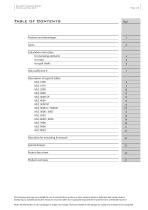
Walther Flender Group MLC Clamping sets Calculation instruction for clamping elements for hubs for quill shafts Hub coefficient K Description of types & tables MLC 1000 MLC 1010 MLC 2000 MLC 3000 MLC 3000-SP MLC 4000 MLC 5000 SP MLC 5000 A / 5000 B MLC 5006 / 5007 MLC 5050 MLC 6000 / 6050 MLC 7000 MLC 9000 MLC 9050 Directions for mounting & removal Special designs Project data sheet Product overview ML Clamping Sets are not suitable for use in aircraft drive systems or drive systems where a defective belt could result in bodily injury. Suitable protective measures must be taken to encapsulate...
Open the catalog to page 3
Walther Flender Group MLC Clamping sets Features and advantages ML clamping sets transmit torques from shafts and hubs simply and securely, because they create non-positive and backslash free connection which can be released at any time. Even for variation in stress or shock loadings, our clamping sets are distinguished by their good fail-safe behaviour and they can in fact be re-used or replaced by many times. Our adaptable installation-ready range of types is suitable for construction machinery and also for robots. ++ Easy mounting and removal Mounting and removal by tightening or loosening...
Open the catalog to page 4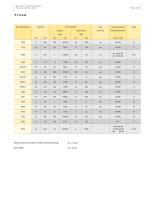
Walther Flender Group MLC Clamping sets Transmissible torques Selfaxial forces fitting tolerances Recommended surface of shaft and hub boring:
Open the catalog to page 5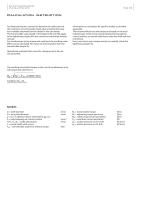
Walther Flender Group MLC Clamping sets Calculation instruction For dimensioning of a connection between the shaft and hub, the maximum occurring loads (rated value x load factor) have to be reliably determined and included in the calculation. The transmissible values listed in the table for Mt and FAX apply to the tightening torques MS and cannot be transmitted simultaneously. For simultaneous acting torque and axial load, the resulting value MR has to be calculated. This value cannot be greater than the transmissible torque Mt. Information on calculation for specific models is provided separately....
Open the catalog to page 6
Walther Flender Group MLC Clamping sets Hub calculation The hub material is subjected to tensile stress by the pressure of the clamping set in the bore. The required outer hub diameter depends on the material, the installation position of the clamping set and the surface pressure in the hub bore. To keep the stress within the flexible range, the yield point Rp0,2 is the permissible material property value. The following table shows hub diameter factors based on the three parameters mentioned above. The hub factor X is determined based on the installation position. The calculated surface pressure...
Open the catalog to page 7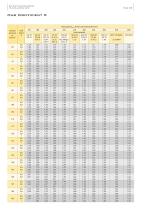
Walther Flender Group MLC Clamping sets Hub coefficient K Yield point Rp0,2 of the hub material (N/mm2) Surface pressure pN N/mm2
Open the catalog to page 8
Walther Flender Group MLC Clamping sets Description of types & tables MLC 1000 This very standard clamping set is suitable for average torques and requires precentring, the fit of which determines the concentricity. The slotted design of the double tapered rings enables relatively high mounting tolerance: for shafts between k11 and h11 and for hub bores between N11 and H11. The maximum shaft/ hub tolerance difference should be < IT9. We recommend h9/H9 for the shaft/hub fit. The large taper angles are not self-locking and facilitate the releasability of the connection. Normally, the conical pressure...
Open the catalog to page 9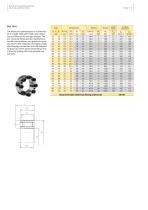
Walther Flender Group MLC Clamping sets MLC 1010 The three-part clamping set is an alternative to model 1000 with small outer diameters and likewise for average torques. The pre-centered fitting position facilitates assembly and produces very good concentricity. Due to the relatively small taper angle, the clamping connection must be released by push-up screws when dismantling. This is done by pulling the front tapered ring outward. Recommended shaft/hub fitting tolerances
Open the catalog to page 10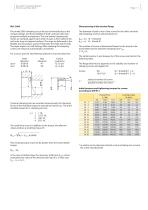
Walther Flender Group MLC Clamping sets Dimensioning of the tension flange The model 2000 clamping set can be used universally due to the compact design and the possibility of shaft- and hub-side clamping and multiple arrangement. The non-slotted clamping elements are clamped against each other in pairs as thin-walled inner and outer rings via tapered surfaces. The rings are deformed in the flexible area to produce a press fit between the shaft and the hub. The taper angle is not self-locking. After releasing the clamping screws, the rings are automatically unclamped. The diameter of pitch circle...
Open the catalog to page 11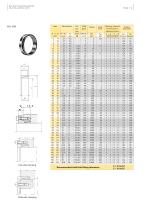
Walther Flender Group MLC Clamping sets Hub-side clamping Shaft-side clamping Axial force Recommended shaft/hub fitting tolerances Clamping clearance W (mm) prior to tightening screws Number of mounted clamping elements
Open the catalog to page 12
Walther Flender Group MLC Clamping sets MLC 3000 This clamping set is self-centring with excellent concentricity. The extremely small outer diameter is space-saving and suitable for small wheel diameters. The spacer ring between the outer flange and the hub maintains the fitting position in the axial direction to enable exact positioning without a shaft collar. The push-off threads in the outer flanges are used for dismantling. Recommended shaft/hub fitting tolerances
Open the catalog to page 13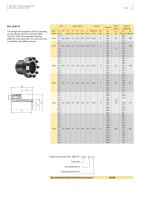
Walther Flender Group MLC Clamping sets The design and properties of this clamping set are identical to those of type 3000. The MLC 3000-SP is available with five different outer diameters "D", and each size is available with different bores. Ordering example: MLC 3000-SP – 5227 – 32 x 52 Sizecode External diameter D Recommended shaft/hub fitting tolerances
Open the catalog to page 14All Walther Flender catalogs and technical brochures
 timing belts neoprenes
108 Pages
 WF_TM_Nano
1 Page
 PolyChain_timingbelts
48 Pages
 frequency inverter Serie M/N
24 Pages
 Flatbelts WF Lift Power
12 Pages
Archived catalogs

- Electromotor
- Synchronous motor
- Alternating current motor
- Multipole motor
- Asynchronous motor
- Planetary gearbox
- Coaxial gearhead
- EC motor
- Electromotor for industrial applications
- Power transmission belt
- Three-phase motor
- 24 V motor
- Compact gearhead
- 4-pole motor
- 2-pole motor
- Flexible coupling
- Gear train gear reducer
- 12 V motor
- Gearbox for industrial applications