
- Catalogs
- VTDRIVssE Technology Limited
- VTdrive Why do we need temperature controllers

VTdrive Why do we need temperature controllers

VTdrive Why do we need temperature controllers
Temperature controllers are crucial for maintaining stable temperatures in various applications, whether for heating, cooling, or both. They ensure the setpoint temperature is maintained despite environmental changes. There are two main types: open loop, which applies continuous heating or cooling without feedback, and closed loop, which adjusts outputs based on feedback to maintain the desired temperature.
Common Applications
These controllers are used in both household and industrial settings, such as thermostats in homes and process management in industries like plastic extrusion and food processing, ensuring precise temperature regulation for quality and efficiency.
Components of a Temperature Controller
Key components include inputs (sensors like thermocouples), outputs (relay outputs, SSR drivers), setpoints, alarms, and advanced control functions like PID for maintaining conditions.
How Temperature Controllers Work
Controllers compare the actual input signal with the setpoint and adjust the output to correct discrepancies. ON/OFF control uses hysteresis, while PID control offers precise adjustments. Time proportioning simulates analog output with binary devices.
Additional Features
Modern controllers may offer communication capabilities, remote adjustments, digital inputs, and dual-color displays for enhanced usability.
Overview of Temperature Controllers
Temperature controllers manage system temperatures and come in various types, including single-loop, multi-loop, analog, limit, general-purpose, valve motor drive, and profiling controllers.
Types of Controllers
- Single-Loop Controllers: Control one thermal system with one input and multiple outputs.
- Multi-Loop Controllers: Control several loops with multiple inputs and outputs, configured via software.
- Analog Controllers: Basic, low-cost controllers for simple ON-OFF control.
- Limit Controllers: Safety devices that shut down systems in over-limit conditions.
- General-Purpose Controllers: Offer PID control with auto-tuning for industrial processes.
- Valve Motor Drive Controllers: Control valve motors without extensive PID tuning.
- Profiling Controllers: Program temperature profiles for complex processes.
Other Characteristics
- Supply Voltage: Options include low (24VAC/DC) and high voltage (110-230VAC).
- Size: Available in standard DIN sizes.
- Agency Approvals: May have UL, cUL, CE, or FM approvals.
- Front Panel Enclosure Rating: Ratings like IP65 or NEMA 4/4X indicate protection levels.
Contact Information
Shenzhen VTdrive Technology Co., Ltd.
Tel: +86-755-23060667
Fax: +86-755-33671802
Website: www.vtdrive.com
Email: [email protected]
Headquarters: 6F, Xinfeng Building B, Yangguang Industrial Zone, Xili Town, Nanshan District, Shenzhen, China.
Factory: 3F&4F, Xihe Industrial Zone, TangTou Load, Shiyan Town, Baoan District, Shenzhen, China.
Catalog excerpts
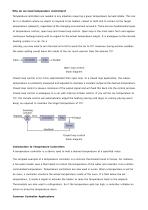
Why do we need temperature controllers? Temperature controllers are needed in any situation requiring a given temperature be kept stable. This can be in a situation where an object is required to be heated, cooled or both and to remain at the target temperature (setpoint), regardless of the changing environment around it. There are two fundamental types of temperature control; open loop and closed loop control. Open loop is the most basic form and applies continuous heating/cooling with no regard for the actual temperature output. It is analogous to the internal heating system in a car. On a cold day, you may need to turn the heat on to full to warm the car to 75°. However, during warmer weather, the same setting would leave the inside of the car much warmer than the desired 75°. Open loop control block diagram Closed loop control is far more sophisticated than open loop. In a closed loop application, the output temperature is constantly measured and adjusted to maintain a constant output at the desired temperature. Closed loop control is always conscious of the output signal and will feed this back into the control process. Closed loop control is analogous to a car with internal climate control. If you set the car temperature to 75°, the climate control will automatically adjust the heating (during cold days) or cooling (during warm days) as required to maintain the target temperature of 75°. Closed loop control block diagram Introduction to Temperature Controllers A temperature controller is a device used to hold a desired temperature at a specified value. The simplest example of a temperature controller is a common thermostat found in homes. For instance, a hot water heater uses a thermostat to control the temperature of the water and maintain it at a certain commanded temperature. Temperature controllers are also used in ovens. When a temperature is set for an oven, a controller monitors the actual temperature inside of the oven. If it falls below the set temperature, it sends a signal to activate the heater to raise the temperature back to the setpoint. Thermostats are also used in refrigerators. So if the temperature gets too high, a controller initiates an action to bring the temperature down. Common Controller Applications
Open the catalog to page 1
Temperature controllers in industry work much the same way they do in common household applications. A basic temperature controller provides control of industrial or laboratory heating and cooling processes. In a typical application, sensors measure the actual temperature. This sensed temperature is constantly compared to a user setpoint. When the actual temperature deviates from the setpoint, the controller generates an output signal to activate other temperature regulating devices such as heating elements or refrigeration components to bring the temperature back to the setpoint. Common Uses...
Open the catalog to page 2
Inputs Temperature controllers can have several types of inputs. The type of input sensor and signal needed may vary depending on the type of controlled process. Typical input sensors include thermocouples and resistive thermal devices (RTD's), and linear inputs such as mV and mA. Typical standardized thermocouple types include J, K, T, R, S, B and L types among others. Controllers can also be set to accept an RTD as a temperature sensing input. A typical RTD would be a 100Ω platinum sensor. Alternatively, controllers can be set to accept voltage or current signals in the millivolt, volt, or...
Open the catalog to page 3
Analog outputs are provided on some controllers which put out a 0–10V signal or a 4–20mA signal. These signals are calibrated so that the signal changes as a percentage of the output. For example, if a controller is sending a 0% signal, the analog output will be 0V or 4mA. When the controller is sending a 50% signal, the output will be 5V or 12mA. When the controller is sending a 100% signal, the output will be 10V or 20mA. Other Parameters Temperature controllers have several other parameters, one of which is a setpoint. Basically, a setpoint is a target value set by an operator which the controller...
Open the catalog to page 4
would activate at 180° and the low alarm at 160°. Another common set of controller parameters are PID parameters. PID, which stands for proportional, integral, derivative, is an advanced control function that uses feedback from the controlled process to determine how best to control that process. How it Works All controllers, from the basic to the most complex, work pretty much the same way. Controllers control, or hold, some variable or parameter at a set value. There are two variables required by the controller; actual input signal and desired setpoint value. The input signal is also known...
Open the catalog to page 5
All things being equal, a shorter cycle time is desirable because the controller can more quickly react and change the state of the output for given changes on the process. Due to the mechanics of a relay, a shorter cycle time can shorten the life of a relay, and is not recommend to be less than 8 seconds. For solid state switching devices like an SSR driver or triac, faster switching times are better. Longer switching times, no matter what output type, allow for more oscillation in the process value. The general rule is that, ONLY if the process will allow it, when a relay output is used, a...
Open the catalog to page 6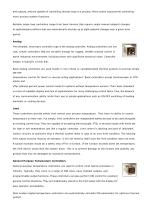
and outputs, and are capable of controlling several loops in a process. More control loops permit controlling more process system functions. Reliable single loop controllers range from basic devices that require single manual setpoint changes to sophisticated profilers that can automatically execute up to eight setpoint changes over a given time period. Analog The simplest, most basic controller type is the analog controller. Analog controllers are low cost, simple controllers that are versatile enough for rugged, reliable process control in harsh industrial environments including those with...
Open the catalog to page 7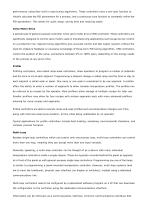
performance using their built in auto-tuning algorithms. These controllers have a pre-tune function to initially calculate the PID parameters for a process, and a continuous tune function to constantly refine the PID parameters. This allows for quick setup, saving time and reducing waste. Valve Motor Drive A special type of general-purpose controller is the valve motor drive (VMD) controller. These controllers are specifically designed to control valve motors used in manufacturing applications such as gas burner control on a production line. Special tuning algorithms give accurate control and...
Open the catalog to page 8All VTDRIVssE Technology Limited catalogs and technical brochures
 VS5 Solar pump inverter
3 Pages
 VTdrive What is a Choke Coil
2 Pages














Archived catalogs

- Electronic filter
- Passive electronic filter
- Frequency inverter
- Variable frequency drive
- AC electronic filter
- Wire-wound resistor
- Solar DC/AC inverter
- 3-phase AC drive
- Three-phase electronic filter
- 3-phase frequency converter
- Choke coil
- Three-phase DC/AC inverter
- DC/AC inverter for industrial applications
- Band-pass electronic filter
- EMI filter
- Housed resistor
- Compact frequency inverter
- IP20 frequency inverter
- Digital output frequency inverter
- Motor frequency converter