
- Catalogs
- VTDRIVssE Technology Limited
- VTdrive Variable Frequency Drive(VFD) load filters

VTdrive Variable Frequency Drive(VFD) load filters

VTdrive Variable Frequency Drive(VFD) load filters
This document discusses the use of VFD load reactors and filters, focusing on their applications, benefits, and limitations. It highlights the evolution of technology in VFD systems and the role of reactors and filters in managing voltage spikes and motor health.
VFD Load Reactors
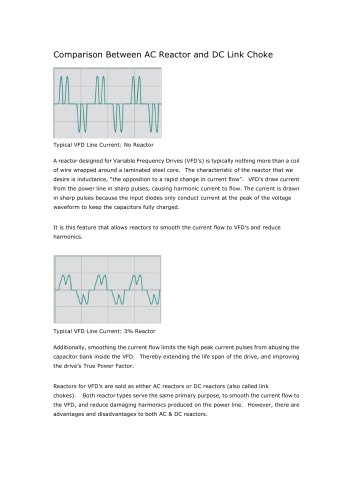
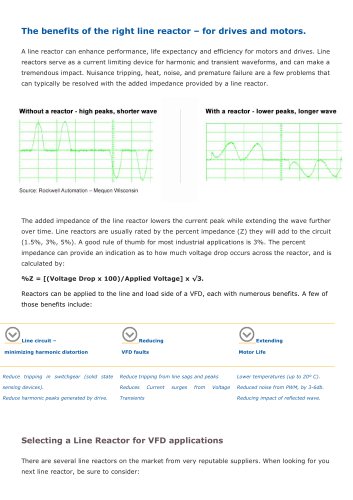
Initially used to add load impedance, reactors are now less necessary due to advancements in IGBT drives. They are sometimes used to address reflected wave problems, which can cause voltage spikes at motor terminals. However, reactors cannot effectively limit these spikes and may cause issues like resonance.
VFD Load Filters
Filters, unlike reactors, include resistors and capacitors to limit spike amplitude, improving motor health. They are more effective in reducing voltage spikes and are suitable for longer lead lengths.
Dv/dt Filters vs. Sine Wave Filters
Dv/dt filters limit peak voltage to 1,000 volts and are effective up to 1,000 feet. Sine wave filters further reduce modulation effects and are effective up to 15,000 feet.
Benefits of VFD Load Filters
- Reduce pulse dv/dt.
- Decrease common mode noise and currents.
- Increase bearing life.
- Lower motor temperature.
TCI Recommendations
TCI offers reliable dv/dt and sine wave filters. The KLC-Series V1k filter addresses voltage spikes and dv/dt issues, while the MotorGuard filter reduces carrier frequency distortion and is suitable for long lead applications.
Conclusion
Choosing between reactors and filters depends on specific application needs, with filters generally offering more comprehensive protection for motor systems.
Catalog excerpts

VFD load filters or VFD load reactors? At one time reactors were used to add load impedance in cases where the motor had a “low leakage inductance”. Over time, the higher carrier frequencies of IGBT drives all but eliminated the need to add inductance to the load. So when does it make sense to add a load reactor? Based on some of the potential issues, it may not make any sense at all. Side effects of VFD load reactors The reflected wave (or standing wave) problem associated with fast switching IGBT drives is often cited as the reason to apply a load reactor. Standing waves can create voltage spikes in excess of 1600 volts (480 circuit) at the motor terminals. This is particularly true when long motor lengths are involved (at as little as 200’). Once the reactor is installed it will slow the rise time (change in voltage) of the spike, extending it over time (change in time). As a side note – a term often used to describe change in voltage over time is dv-dt. Getting back to the reactors, they cannot actively limit the voltage spike to a safe threshold (1000 volts). In cases of very long leads load reactors may have little to no impact. Load reactors can actually create problems, such as resonance from the inductive reactor and the capacitive cable. VFD load filters As stated before, the reactor can decrease the rise time of spikes, but cannot adequately limit the amplitude of spikes. Filters, on the other hand, add additional components (resistors and capacitors) that act to limit the actual amplitude, and therefore can have a much greater impact on motor health. Dv/dt filters versus “sine wave” filters VFD output filters begin with a reactor and are built out with additional resistive and capacitive components, forming a low pass filter. They are designed to limit the peak voltage to 1,000 volts. These filters are typically applied to applications lead lengths are up to about 1,000 feet. A “sine wave” output filter goes another step beyond the dv/dt filter. These filters are “tuned” to the characteristics of the typical VFD output modulation, and effectively eliminate or greatly reduce the carrier frequency effects of modulation. These filters have been successful at lead lengths of up to 15,000 feet. Benefits of VFD load filters Slow down the pulse dv/dt.
Open the catalog to page 1
Reduce common mode noise and currents (by as much as 30%) Increase bearing life Lower motor temperature TCI – a good recommendation We have used TCI reactors and power products for years. They are a Rockwell Encompass Partner and proven in industry. TCI offers both dv/dt and sine wave type filters, each backed by a performance guarantee. The TCI dv/dt filter The KLC-Series V1k* filter was designed as an engineered solution for motor failures due to the reflected wave phenomenon. The V1K prevents voltage spikes from exceeding 1,000 V up to 2,000 feet and limits dv/dt to less than 1,000 V/ μs....
Open the catalog to page 2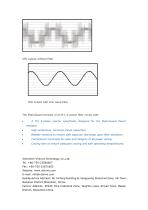
VFD output without filter VFD output with sine wave filter The MotorGuard consists of an R-L-C power filter circuit with: A TCI 3-phase reactor specifically designed for the MotorGuard Power resistors. High-endurance, harmonic-rated capacitors. Bleeder resistors to ensure safe capacitor discharge upon filter shutdown. Compression terminals for ease and integrity of all power wiring. Cooling fans to ensure adequate cooling and safe operating temperatures. Shenzhen VTdrive Technology Co.,Ltd. Tel: +86-755-23060667 Fax: +86-755-33671802 Website: www.vtdrive.com E-mail: [email protected] Headquarters...
Open the catalog to page 3All VTDRIVssE Technology Limited catalogs and technical brochures
 VS5 Solar pump inverter
3 Pages
 VTdrive What is a Choke Coil
2 Pages














Archived catalogs

- Electronic filter
- Passive electronic filter
- Frequency inverter
- Variable frequency drive
- AC electronic filter
- Wire-wound resistor
- Solar DC/AC inverter
- 3-phase AC drive
- Three-phase electronic filter
- 3-phase frequency converter
- Choke coil
- Three-phase DC/AC inverter
- DC/AC inverter for industrial applications
- Band-pass electronic filter
- EMI filter
- Housed resistor
- Compact frequency inverter
- IP20 frequency inverter
- Digital output frequency inverter
- Motor frequency converter