
- Catalogs
- VTDRIVssE Technology Limited
- VTdrive Comparison Between AC Reactor and DC Link Choke

VTdrive Comparison Between AC Reactor and DC Link Choke
VTdrive Comparison Between AC Reactor and DC Link Choke
This document compares AC reactors and DC link chokes used in Variable Frequency Drives (VFDs) to manage harmonic currents and improve power quality.
Specifications and Functionality
Reactors are coils of wire around a laminated steel core, designed to smooth current flow and reduce harmonics in VFDs. They are available as AC reactors or DC link chokes, each with distinct advantages and disadvantages.
AC Reactors
AC reactors are installed in series with the incoming AC power line. They offer protection from voltage transients but can cause voltage drops due to diode conduction overlap, potentially leading to nuisance trips. They are generally more expensive than DC reactors.
DC Link Chokes
DC reactors are placed after the input diodes, avoiding voltage drops and nuisance trips. They are less expensive as they require only one coil. However, they do not protect diodes from voltage transients.
Recommendations
For optimal performance, it is recommended to use both a 3% AC reactor and a 3% DC reactor. This combination provides comprehensive protection, reduces harmonics effectively, and balances cost and performance.
Harmonic Reduction
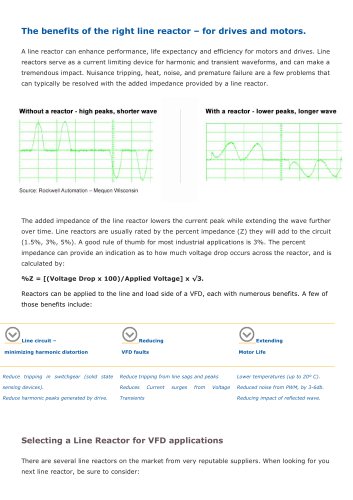
Using reactors can significantly reduce harmonic current distortion, with 6% impedance generally cutting distortion by more than half. This setup also extends the lifespan of VFDs.
Conclusion
Incorporating both AC and DC reactors offers the best solution for managing harmonics and protecting VFDs, providing a cost-effective and reliable approach to power quality management.
Contact Information
Shenzhen VTdrive Technology Co., Ltd.
Tel: +86-755-23060667
Fax: +86-755-33671802
Website: www.vtdrive.com
Email: [email protected]
Headquarters: 6F, Xinfeng Building B, Yangguang Industrial Zone, Xili Town, Nanshan District, Shenzhen, China.
Factory: 3F&4F, Xihe Industrial Zone, TangTou Load, Shiyan Town, Baoan District, Shenzhen, China.
Catalog excerpts
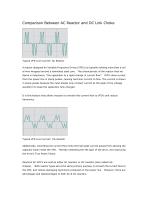
Comparison Between AC Reactor and DC Link Choke Typical VFD Line Current: No Reactor A reactor designed for Variable Frequency Drives (VFD’s) is typically nothing more than a coil of wire wrapped around a laminated steel core. The characteristic of the reactor that we desire is inductance, “the opposition to a rapid change in current flow”. VFD’s draw current from the power line in sharp pulses, causing harmonic current to flow. The current is drawn in sharp pulses because the input diodes only conduct current at the peak of the voltage waveform to keep the capacitors fully charged. It is this feature that allows reactors to smooth the current flow to VFD’s and reduce harmonics. Typical VFD Line Current: 3% Reactor Additionally, smoothing the current flow limits the high peak current pulses from abusing the capacitor bank inside the VFD. Thereby extending the life span of the drive, and improving the drive’s True Power Factor. Reactors for VFD’s are sold as either AC reactors or DC reactors (also called link chokes). Both reactor types serve the same primary purpose, to smooth the current flow to the VFD, and reduce damaging harmonics produced on the power line. However, there are advantages and disadvantages to both AC & DC reactors.
Open the catalog to page 1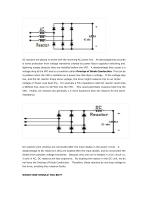
AC reactors are placed in series with the incoming AC power line. An advantage they provide is some protection from voltage transients created by power factor capacitor switching and lightning surges because they are installed before the VFD. A disadvantage they cause is a voltage drop to the VFD due to a condition called Overlap of Diode Conduction. This can be a problem when the VFD is installed on a power line that dips in voltage. If the voltage dips low, and the AC reactor drops some voltage, the drive might nuisance trip on an Under Voltage or Power Loss fault trip. For example a 5% impedance...
Open the catalog to page 2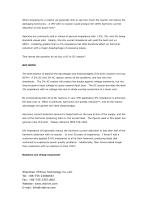
When shopping for a reactor we generally look to see how much the reactor will reduce the damaging harmonics. A VFD with no reactor could produce 60-130% harmonic current distortion on the power line.* Reactors are commonly sold in values of percent impedance with 1.5%, 3%, and 5% being standard values sold. Ideally, 5%-6% overall impedance will yield the best cost vs. effect. Installing greater than 6-7% impedance has little beneficial affect on harmonic reduction with a major disadvantage of excessive losses. That leaves the question do we buy a AC or DC reactor? The best solution to balance...
Open the catalog to page 3
Headquarters Address: 6F, Xinfeng Building B, Yangguang Industrial Zone, Xili Town, Nanshan District,Shenzhen, China. Factory Address: 3F&4F, Xihe Industrial Zone, TangTou Load, Shiyan Town, Baoan District, Shenzhen,China.
Open the catalog to page 4All VTDRIVssE Technology Limited catalogs and technical brochures
 VS5 Solar pump inverter
3 Pages
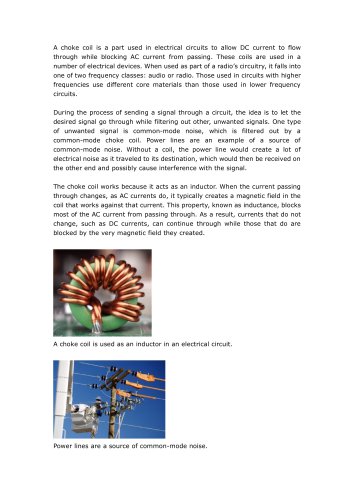 VTdrive What is a Choke Coil
2 Pages


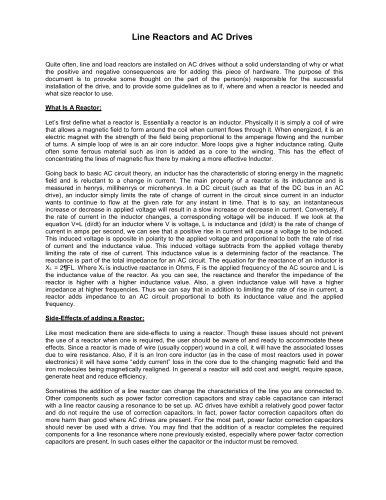













Archived catalogs

- Electronic filter
- Passive electronic filter
- Frequency inverter
- Variable frequency drive
- AC electronic filter
- Wire-wound resistor
- Solar DC/AC inverter
- 3-phase AC drive
- Three-phase electronic filter
- 3-phase frequency converter
- Three-phase DC/AC inverter
- DC/AC inverter for industrial applications
- Band-pass electronic filter
- EMI filter
- Housed resistor
- Compact frequency inverter
- IP20 frequency inverter
- Digital output frequency inverter
- Motor frequency converter