
- Catalogs
- VPInstruments
- 15 Years VPInstruments


15 Years VPInstruments

15 Years VPInstruments
Catalog excerpts
This is how compressed air works Within the industry, compressed air is a much-used form of energy. You can best compare compressed air to the air that is pumped into a bicycle tyre. Air is compressed into a bicycle tyre, you do that by using muscle power to pump up the tyre with the result that energy becomes stored in the air. With a bicycle tyre, the air provides riding comfort and road grip. In an industrial plant, the air is transported under pressure through piping, and subsequently used as energy in order to operate production machinery. Why compressed air? For many production processes,...
Open the catalog to page 2
It’s VPInstruments’ birthday! VPInstruments has been supplying flow meters & energy management systems for compressed air since 1999. Since then, many different companies have purchased products such as the VPFlowmate, the VPFlowScope and VPVision and placed them in their industrial plants. While other energy meters usually only measure consumption, VPInstruments measures many more things at the same time. Not only are you able to read out how much air is consumed, but also where, when and at what pressure. In this way, an air pressure- or gas leak can be discovered easily, or, you will quickly...
Open the catalog to page 3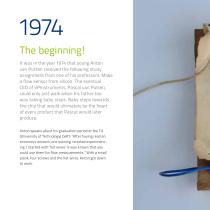
1974 The beginning! It was in the year 1974 that young Anton van Putten received the following study assignment from one of his professors: Make a flow sensor from silicon. The eventual CEO of VPInstruments, Pascal van Putten, could only just walk when his father too was taking baby steps. Baby steps towards the chip that would ultimately be the heart of every product that Pascal would later produce. Anton speaks about his graduation period at the TU (University of Technology) Delft: “After having read an enormous amount, one evening I started experimenting. I started with ‘hot wires’: it was...
Open the catalog to page 4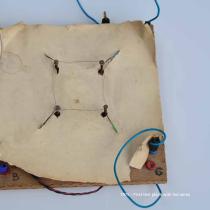
1974 - First test plank with hot wires
Open the catalog to page 5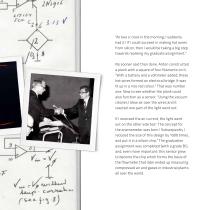
“At two o’ clock in the morning, I suddenly had it! If I could succeed in making hot wires from silicon, then I would be taking a big step towards realising my graduate assignment.” No sooner said than done. Anton constructed a plank with a square of four filaments on it. “With a battery and a voltmeter added, these hot wires formed an electrical bridge. It was lit up in a nice red colour.” That was number one. Now to see whether the plank could also function as a sensor. “Using the vacuum cleaner, I blew air over the wires and it reacted: one part of the light went out. If I reversed the air...
Open the catalog to page 7
1974-1998 Dedication to research & development The sensor was only the beginning. “At this stage, many applications were possible, and we had to research them,” says Anton. “Because once you start, you keep going. Science: it’s a sort of love.” Anton founded a company dedicated to further development of the flow sensor, AnMar Research. In the decades following 1974, the van Putten family attic changed into a real laboratory. Boxes full of folders and research were on the floor, experiments on the big table. Anton spent as much time there as possible, and his sons too fell in love: with science....
Open the catalog to page 8
The beauty of our silicon flow sensor is in limitless possibilities for measurement accuracy and dynamic range with unlimited potential for growth in commerce. One can think of gas meters, leak detection and portable calibration equipment. We believe that the future of digital flow metering starts with Silicon. Maurice van Putten Co-founder VPInstruments
Open the catalog to page 9
1998 Starting up! Pascal: “By now, the flow sensor was such a good, stable device and so far developed that I had to do something with it. And that’s why I thought: it’s now or never”. The TU Delft had introduced a new programme in order to help high-tech starters (Technostarters) in setting up a new company, and we had a working prototype. I decided to try it with the company for a year... and today fortunately things have got a bit out of hand! “Naturally I let him use the chip,” says Anton. “Pas al is more enterprising and more commerciallyc oriented than I am. Pascal was precisely what the...
Open the catalog to page 10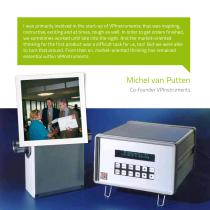
I was primarily involved in the start-up of VPInstruments; that was inspiring, instructive, exciting and at times, tough as well. In order to get orders finished, we sometimes worked until late into the night. And the market-oriented thinking for the first product was a difficult task for us, too! But we were able to turn that around. From then on, market-oriented thinking has remained essential within VPInstruments. Michel van Putten Co-founder VPInstruments
Open the catalog to page 11
1999 From prototype to product In the year 1999, the theme was product development. “The prototype we had was a good start,” says Pascal, “except that it still wasn’t easy to produce and could only be applied within systems under low pressure. Then we completely adapted the construction so that the meter was really pressure-tight and was consequently capable of making measurements under high pressure. At Gasunie in Groningen, we were allowed to test out the measuring instrument in a high-pressure gas pipeline.” So, in 1999 VPInstruments still wasn’t actually selling anything, but it made an enormous...
Open the catalog to page 12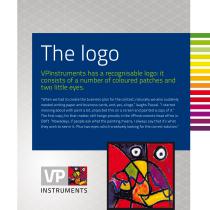
The logo VPInstruments has a recognisable logo: it consists of a number of coloured patches and two little eyes. “When we had to create the business plan for the contest, naturally we also suddenly needed writing paper and business cards, and, yes, a logo,” laughs Pascal. “I started messing about with paint a bit, projected this on a screen and painted a copy of it.” The first copy, for that matter, still hangs proudly in the VPInstruments head office in Delft. “Nowadays, if people ask what the painting means, I always say that it’s what they wish to see in it. Plus two eyes, which creatively...
Open the catalog to page 13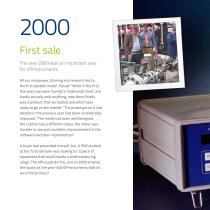
2000 First sale The year 2000 was an important year for VPInstruments. All our manpower, thinking and research led to the first sellable model. Pascal: “While in the first few years we were having to make ends meet, and hardly actually sold anything, now there finally was a product that we backed and which was ready to go on the market.” The prototype as it had existed in the previous year had been considerably improved. “The inside had been well designed, the cabinet had a different colour, the meter was handier in use and countless improvements in the software had been implemented.” A buyer...
Open the catalog to page 14All VPInstruments catalogs and technical brochures
 VPFlowScope In-line 3/8"
2 Pages
 VPFlowTerminal
1 Page
 Dew Point Sensors
12 Pages
 Hot tap drill
2 Pages
 VPVISION
12 Pages
 Power meters
12 Pages
 VPFlowScope M
12 Pages
 VPFlowScope DP
12 Pages
 VPLog-i
12 Pages
 3 Phase Power Meter
12 Pages
 VPInstruments Corporate Brochure
12 Pages
 Calibration Services
8 Pages
 VPFlowScope Start Kit
1 Page


- Volume flow monitor
- Management software solution
- Data logger
- Analysis software solution
- Real-time software
- Cloud-based software
- Waterproof flow meter
- Gas flow monitor
- Temperature datalogger
- Stainless steel flow monitor
- Industrial flow monitor
- Precision flow meter
- Industrial software
- In-line flow meter
- Data-logger with screen
- Compact flow monitor
- DC flow monitor
- RS485 flow monitor
- Mass flow monitor