


Whitepaper Aircraft doof Sogeclair

Whitepaper Aircraft doof Sogeclair
Sogeclair, a French aviation supplier, has developed a method to reduce the weight of aircraft doors by 30% using 3D-printed PMMA models from voxeljet for precision casting. This innovation was showcased at the Paris aviation show.
Lightweight Design and 3D Printing
To enhance fuel efficiency, manufacturers are increasingly demanding lightweight components. While 3D printing can produce material-saving geometries in aluminium and titanium, it is costly and currently limited to small components. For larger components like aircraft doors, combining 3D printing with precision casting offers a solution.
Precision Casting with 3D Printing
3D printing allows for the creation of precision casting models with complex geometries without expensive tooling. Sogeclair's research project focuses on aircraft doors with a bionic network of aluminium struts, maintaining strength while reducing material use by 30%. The VX1000 3D printing system from voxeljet facilitates design changes directly on the screen, streamlining prototype development.
3D Printing Process
voxeljet uses CAD files to print PMMA models in thin layers. The PMMA is excellent for burning out due to its negative expansion coefficient, preventing fractures. Once printed, the model is infiltrated with hot wax, covered with ceramic layers, and smelted in a furnace. Liquid aluminium fills the ceramic moulds, and once cured, the ceramic is removed to reveal the finished door.
Conclusion
This method combines the geometric freedom of 3D printing with the stability of precision casting, offering a cost-effective and efficient solution for producing lightweight aircraft components.
Catalog excerpts
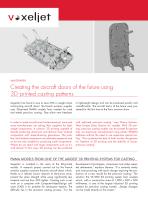
Creating the aircraft doors of the future using 3D - printed casting patterns Sogeclair has found a way to save 30% in weight when constructing aircraft doors: the French aviation supplier uses 3D-printed PMMA models from voxeljet for tried and tested precision casting. They allow new freedoms in lightweight design and can be produced quickly and cost-efficiently. The aircraft doors of the future were presented for the first time at the Paris aviation show. In order to make aircraft more fuel-economical, more and more manufacturers are asking their suppliers for lightweight components. A solution: 3D printing capable of directly producing aluminium and titanium laser sintered components with material-saving geometries. The problem: the finished components are relatively expensive and so far are only suitable for producing small components. Where do we stand with large components such as aircraft doors? “In this case, 3D printing can be combined with well-tried precision casting,” says Thierry Herrero, West Europe Sales Director for voxeljet. With 3D printing, precision casting models can be printed for geometries not previously manufactured using plastic (PMMA) additives without the need to use expensive special tooling. “This combines the best of both worlds: the geometric freedom of 3D printing and the stability of classic precision casting”. PMMA MODELS FROM ONE OF THE LARGEST 3D PRINTING SYSTEMS FOR CASTING Sogeclair is included in the users of the 3D-printed moulds. A research project carried out by the French aviation supplier concerns futuristic aircraft doors which, thanks to a refined, bionic network of aluminium struts, present the same strength while using significantly less material and are thus 30% lighter. Creating such a network on a computer with Computer-Aided-Design software (CAD) is no problem for aerospace experts. The difficulty lies in the precision casting process. “For the development of prototypes, companies must make repeated refinements,” explains Herrero. “It is certainly timely and cost-consuming with each change requiring the production of a new mould for the precision casting.” The solution: the VX1000 3D printing system from voxeljet which, with a construction area of 1,000 x 600 x 500 millimetres, is one of the largest industrial 3D printing systems for precision casting models. „Design changes can be made direc
Open the catalog to page 1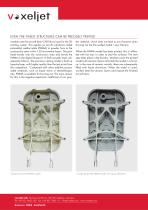
EVEN THE FINEST STRUCTURES CAN BE PRECISELY PRINTED voxeljet uses the aircraft door CAD file as input for the 3D printing system. This applies an acrylic substance called polymethyl methacrylate (PMMA) in powder form to the construction area in thin 150 micrometre layers. The print head travels over the construction area and bonds the PMMA to the digital blueprint. A fresh powder layer subsequently follows. The precision casting model is built up layer-by-layer, with higher quality than the test prints from the competition. “Compared with other additive processable materials, such as liquid resins...
Open the catalog to page 2All Voxeljet catalogs and technical brochures
 High Speed Sintering
2 Pages
 Inorganic-Direct-Binding
2 Pages
 machine-data-sheet-vx200
1 Page
 voxeljet 3D printer
1 Page
 VX200 HSS
2 Pages
 Servicebrochure_2018
6 Pages
 plastic parts
1 Page
 Imagebrochure
20 Pages
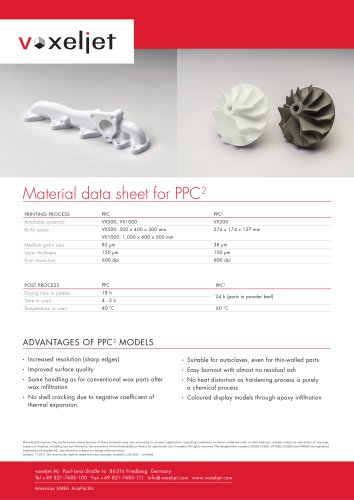 Material data sheet for PPC²
2 Pages
 Investment casting
1 Page
 Material-data-sheet
1 Page
 whitepaper Upright-Altair
2 Pages




Archived catalogs
 Servicebroschure
6 Pages
 VX200
VX2001 Page
 VX500
VX5001 Page
 VX2000
1 Page
 VX4000
1 Page
- Additive manufacturing machine
- Industrial 3D printer
- Plastic additive manufacturing machine
- Prototyping 3D printing machine
- High-performance 3D printer
- Large-format 3D printer
- High-speed 3D printer
- PA 3D printer
- 3D printer for the aerospace industry
- 3D printer for the automotive industry
- Mold manufacturing 3D printer
- Continuous operation 3D printer
- Multi-material 3D printer
- 3D printer for the electronics industry
- BJ 3D printer
- Ceramic 3D printer
- Sand 3D printer