


Material data sheet for Phenolic-Direct-Binding (PDB) sand molds
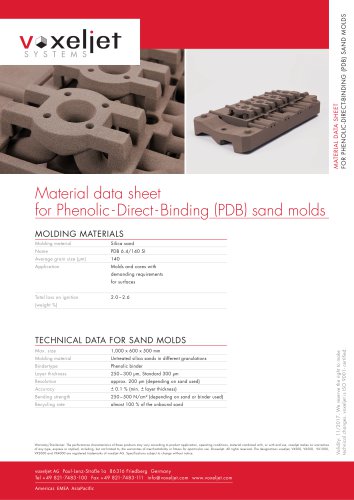
Material data sheet for Phenolic-Direct-Binding (PDB) sand molds
This section provides technical data for Phenolic-Direct-Binding (PDB) sand molds. The molding material used is untreated silica sands with different granulations, combined with a phenolic binder. The average grain size is 250-300 µm, with a standard of 300 µm. The maximum size for the molds is 1,000 x 600 x 500 mm. The bending strength ranges from 250 to 500 N/cm², depending on the sand or binder used, and the recycling rate of unbound sand is almost 100%.
The PDB sand molds are designed for molds and cores with demanding surface requirements. The total loss on ignition is between 2.0 – 2.6 weight %. The layer thickness is approximately 200 µm, and the resolution is +0.1% (minimum + layer thickness). The accuracy and bending strength depend on the sand or binder used.
The build process involves applying sand to a build platform, smoothing it out, and printing a phenolic resin binder on the sand. The platform is lowered layer by layer until the component is complete. The sand is heated using an infrared lamp during the process. After the build, the component is unpacked and cleaned manually or with compressed air or sand blasting. The component can be further hardened in a furnace, maintaining dimensional stability.
PDB sand molds are suitable for casting applications, allowing for both large and small wall thicknesses. The casting behavior is similar to conventional phenolic resin binders, with low binder content resulting in moderate gas discharge. PDB molds can also be infiltrated with epoxy resins for high tensile strengths. After the furnace process, the models exhibit minimal changes over time.
The performance characteristics of these products may vary based on application, operating conditions, and material combinations. voxeljet provides no express or implied warranties, including merchantability or fitness for a particular use. Specifications are subject to change without notice.
Catalog excerpts

MATERIAL DATA SHEET FOR PHENOLIC-DIRECT-BINDING (PDB) SAND MOLDS Material data sheet for Phenolic - Direct - Binding (PDB) sand molds MOLDING MATERIALS Molding material Silica sand Average grain size (µm) Molds and cores with demanding requirements for surfaces Total loss on ignition Molding material Untreated silica sands in different granulations Phenolic binder Layer thickness Resolution Accuracy approx. 200 µm (depending on sand used) + 0.1 % (min. + layer thickness) Bending strength 250 – 500 N/cm² (depending on sand or binder used) Recycling rate almost 100 % of the unbound sand Warranty/Disclaimer: The performance characteristics of these products may vary according to product application, operating conditions, material combined with, or with end use. voxeljet makes no warranties of any type, express or implied, including, but not limited to, the warranties of merchantability or fitness for aparticular use. ©voxeljet. All rights reserved. The designations voxeljet, VX200, VX500, VX1000, VX2000 and VX4000 are registered trademarks of voxeljet AG. Specifications subject to change without notice. voxeljet AG Paul - Lenz -Straße 1a 86 316 Friedberg Germany Tel + 49 821 - 7483 - 100 Fax + 49 821 - 7483 - 111 info @ voxeljet.com www.voxeljet.com Americas EMEA AsiaPacific Validity: 11/2017. We reserve the right to make technical changes. voxeljet is ISO 9001- certified.
Open the catalog to page 1
PROCESS The build process is as follows: Sand is applied to the build platform in the job box. The sand layer is smoothed out during the application process. Then a specially developed phenolic resin binder is printed on the sand at the locations that correspond with the cut through the component. The build platform is then lowered by one layer. The application, printing and lowering processes are repeated until the component is complete. The sand is heated using an infrared lamp in process. A sufficient strength is reached at the time of unpacking. Therefore both small and large components can...
Open the catalog to page 2All Voxeljet catalogs and technical brochures
 High Speed Sintering
2 Pages
 Inorganic-Direct-Binding
2 Pages
 machine-data-sheet-vx200
1 Page
 voxeljet 3D printer
1 Page
 VX200 HSS
2 Pages
 Servicebrochure_2018
6 Pages
 plastic parts
1 Page
 Imagebrochure
20 Pages
 Material data sheet for PPC²
2 Pages
 Investment casting
1 Page
 Material-data-sheet
1 Page
 whitepaper Upright-Altair
2 Pages


Archived catalogs
 Servicebroschure
6 Pages
 VX200
VX2001 Page
 VX500
VX5001 Page
 VX2000
1 Page
 VX4000
1 Page
- Additive manufacturing machine
- Industrial 3D printer
- Plastic additive manufacturing machine
- Prototyping 3D printing machine
- High-performance 3D printer
- Large-format 3D printer
- High-speed 3D printer
- PA 3D printer
- 3D printer for the aerospace industry
- 3D printer for the automotive industry
- Mold manufacturing 3D printer
- Continuous operation 3D printer
- Multi-material 3D printer
- 3D printer for the electronics industry
- BJ 3D printer
- Ceramic 3D printer
- Sand 3D printer