


Investment casting

Investment casting
The process begins with the creation of a CAD model, followed by the development of a PMMA model. This step is crucial for ensuring high precision in the final product.
Wax rods are prepared, and the first ceramic layer is applied. This is followed by building several ceramic layers to form a shell around the model.
The PMMA is burnt out of the ceramic shell, preparing it for the casting process. This step ensures that the shell is ready to receive the molten metal.
Aluminium is cast into the prepared shell, and the casting is then hardened to achieve the desired properties.
Individual motors are separated from the casting, and the finished castings are prepared for use.
- Model measurements can reach up to 1,000 x 600 x 500 mm.
- The process is tool-less, making it more cost-effective.
- Single items and small series can be produced quickly, within a few days.
- High accuracy is achieved with a tolerance of ±0.4% (minimum ±100 µm).
- Wax infiltration ensures a closed, smooth surface suitable for autoclaves.
- The process allows for low emission formation during burn-out and does not cause shell cracking.
- Residual ash content is less than 0.02% for polypor binder type C.
- All alloys are compatible with the lost-wax casting process.
Catalog excerpts
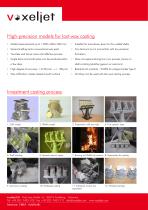
High-precision models for lost-wax casting • Model measurements up to 1.000 x 600 x 500 mm • Suitable for autoclaves, even for thin-walled shells • Same handling as for conventional wax parts • Can be burnt out in normal kiln with low emission • Tool-less and hence more cost-effective process • Single items and small series can be produced within a few days formation • Does not expand during burn-out process, hence no shell cracking (whether gypsum or ceramics) • High degree of accuracy: ±0.4% (min. +/- 100 µm) • Residual ash contents <0.02% for polypor binder type C • Wax infiltration creates closed smooth surface • All alloys can be used with lost-wax casting process Investment casting process 3. Preparation with wax rods 4. First ceramic layer 6. Several ceramic layers 7. Burning out PMMA of ceramic 8. Preparation for casting 11. Individual motors are separated
Open the catalog to page 1All Voxeljet catalogs and technical brochures
 High Speed Sintering
2 Pages
 Inorganic-Direct-Binding
2 Pages
 machine-data-sheet-vx200
1 Page
 voxeljet 3D printer
1 Page
 VX200 HSS
2 Pages
 Servicebrochure_2018
6 Pages
 plastic parts
1 Page
 Imagebrochure
20 Pages
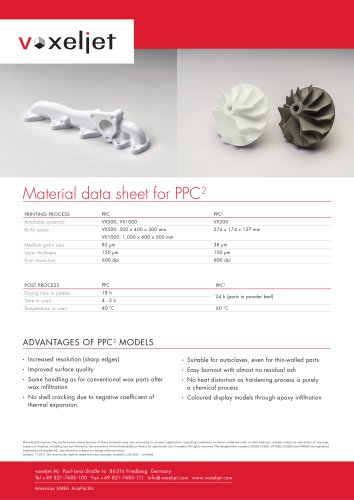 Material data sheet for PPC²
2 Pages
 Material-data-sheet
1 Page
 whitepaper Upright-Altair
2 Pages


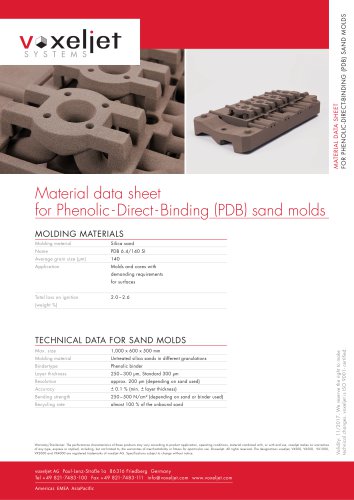


Archived catalogs
 Servicebroschure
6 Pages
 VX200
VX2001 Page
 VX500
VX5001 Page
 VX2000
1 Page
 VX4000
1 Page
- Additive manufacturing machine
- Industrial 3D printer
- Plastic additive manufacturing machine
- Prototyping 3D printing machine
- High-performance 3D printer
- Large-format 3D printer
- High-speed 3D printer
- PA 3D printer
- 3D printer for the aerospace industry
- 3D printer for the automotive industry
- Mold manufacturing 3D printer
- Continuous operation 3D printer
- Multi-material 3D printer
- 3D printer for the electronics industry
- BJ 3D printer
- Ceramic 3D printer
- Sand 3D printer