

english

english
Vacuum conveyors are systems designed for transporting bulk materials like powders, granules, tablets, and liquids using negative air pressure. They are modular and customizable, ideal for environments requiring minimal dust and contamination.
These systems use a vacuum pump to create negative pressure, moving materials through an intake opening. Materials are separated from the air in a filter system and deposited into a receiving vessel, ensuring a dust-free process suitable for various materials.
Used in industries such as chemical, pharmaceutical, food, and coatings, vacuum conveyors offer minimal maintenance, safety from ignition sources, and high hygiene standards. They are ATEX certified for explosive environments.
Capable of a maximum flow rate of 10 t/h, with conveying distances up to 80 meters and heights up to 35 meters. Performance is limited by pressure difference and conveyor diameter.
These conveyors handle a wide range of materials, including chemicals, pharmaceuticals, food products, and more, demonstrating versatility.
Design involves consultation and project management to meet client needs. The modular design allows easy integration and customization for specific applications.
VOLKMANN vacuum conveyors provide reliable, safe, and efficient bulk material handling solutions, adaptable for various industries and applications.
The document outlines vacuum conveying systems, focusing on design considerations, operational methods, and advantages of VOLKMANN conveyors, emphasizing product characteristics and environmental factors.
Three primary methods are described: lean phase, dilute phase, and dense phase, each with specific air speed, material load, and suitability for different materials.
VOLKMANN conveyors feature a modular design for easy cleaning, using stainless steel for resistance to cleaning agents and corrosive chemicals.
Advantages include flexible design, easy maintenance, GMP suitability, superior filter technology, and reliable operation without heat generation.
Examples include conveying pigments, sugar, and adhesives, highlighting VOLKMANN's global presence and focus on complete solutions.
Details on the VS and PPC vacuum conveyors, including modular design, hygienic construction, and ATEX certification, with customization options.
PPC vacuum conveyors are CIP compliant, suitable for pharmaceutical applications, and customizable for specific needs.
Used in various applications, designed for safe operation in explosive environments, and constructed without ignition sources.
Systems include bulk bag unloading and feeding stations, optimized for dust-free operation and adaptable to different environments.
Designed for direct delivery into reactors or tanks under pressure, complying with safety requirements.
Various coatings available for handling adherent powders, with special coatings for corrosive environments.
Based on VS and PPC conveyors, these systems offer precise material measurement and control.
Designed to minimize mechanical damage and ensure dust-free handling, tailored to specific applications.
PPC conveyors are used in WIP and CIP applications, suitable for clean rooms and strict exposure limits.
Facilitate positioning within production processes, offering flexibility and ease of maintenance.
Designed for efficient cleaning and material separation, suitable for explosive zones, robust, and energy-efficient.
Accessories like suction wands and hoses are available for different applications, including hygienic and conductive options.
Programmable logic controllers ensure precise control, with high-efficiency filters for top separation rates.
MULTIJECTOR® pumps are small, reliable, energy-efficient, oil-free, and maintenance-free, suitable for various conveying phases.
Specifications for MULTIJECTOR® pumps include suction air flow rates and operational characteristics.
A form for customers to specify conveying tasks and requirements, ensuring tailored solutions.
VOLKMANN offers seminars and training to improve product safety, quality, and cost efficiency.
Catalog excerpts

VACUUM CONVEYORS & BULK MATERIAL HANDLING SYSTEMS Systems and solutions for the clean, efficient and secure handling of bulk material
Open the catalog to page 1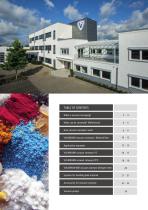
TABLE OF CONTENTS What is vacuum conveying? What can be conveyed? (References) How vacuum conveyors work VOLKMANN vacuum conveyors / Material flow Application examples VOLKMANN vacuum conveyor VS VOLKMANN vacuum conveyor PPC VOLKMANN INEX vacuum conveyor (nitrogen inert) Systems for handling bulk material Accessories for vacuum conveyor Vacuum pumps
Open the catalog to page 2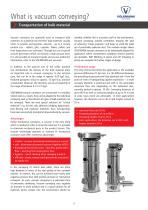
What is vacuum conveying? Transportation of bulk material Vacuum conveyors are generally used to transport bulk materials. As a general rule, the term ‘bulk materials’ usually refers to powder and granules, wherein - up to a certain particle size - tablets, pills, capsules, flakes, pellets and even larger pieces are conveyed. Through the use of special vacuum generators which can achieve a high vacuum level, it is also possible to transport liquids and viscous media (for information, refer to the VOLKMANN wet vacuum). avoided, whether this is to protect staff or the environment. Vacuum conveying...
Open the catalog to page 3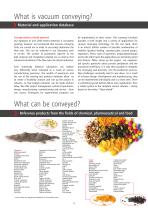
Transportation of bulk material Our database of over 2000 tested materials is constantly growing; however, we recommend that vacuum conveying trials are carried out in order to accurately determine the flow rate. This can be achieved in our laboratory and/ or on-site. The number of parameters (specific to the bulk material and installation-related) are so diverse that advanced calculation of the flow rate can only be indicative. Even chemically identical substances can behave very differently when conveyed as a result of various manufacturing processes. Our wealth of experience and the use of...
Open the catalog to page 4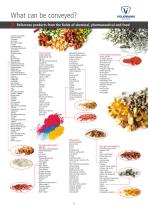
VOLKMANN IDEAS AHEAD Reference products from the fields of chemical, pharmaceutical and food Cherries (preserved) Grated coconut Coriander Herb salt Granulated sugar Lactose Licorice powder Skimmed milk powder Corn starch Maltodextrin Almond powder Flour Mentos* Milk powder Whey powder Nutmeg shell Sodium bicarbonate Bicarbonate of soda Paprika powder Peppermint Pepper powder Horse feed additives Chanterelle mushrooms Popcorn Icing sugar Puffed rice Rice/Millet Reis Krispies Beetroot mixture Cream fat powder Salt Snuff Chocolate sprinkles Smarties / M&Ms Breadcrumbs Soybean Soy flour Sorbitol*...
Open the catalog to page 5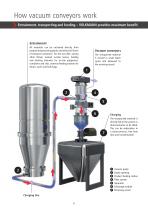
How vacuum conveyors work Entrainment, transporting and feeding – VOLKMANN provides maximum benefit Entrainment All materials can be entrained directly from production/processing plants and almost all forms of transport containers. For this we offer, among other things: manual suction lances, feeding and docking elements for on-site equipment, containers and silos, material feeding stations for drums, sacks and bulk bags. Vacuum conveyors The transported material is moved in small batch cycles and delivered to the receiving vessel. The transported material is directly fed to the system or drum/container...
Open the catalog to page 6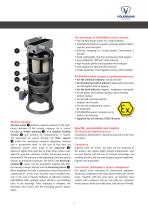
Working sequence Vacuum pump produces negative pressure in the separating container of the vacuum conveyor. Air is sucked through the intake opening (^lof a product feeding station and material for transportation is moved. The vacuumed air passes through the filter system inside the separating container depositing material and it accumulates there. In the case of fine dust, an additional cyclone insert (used in the separator |^) allows for higher flow rates due to lower filter surface load. After the separator container is filled, the vacuum pump is switched off. The pressure in the separating...
Open the catalog to page 7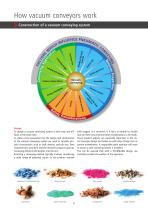
How vacuum conveyors work Construction of a vacuum conveying system Design To design a vacuum conveying system is both easy and difficult at the same time. To allow a first assessment for the design and construction of the vacuum conveying system we need to consider product characteristic such as bulk density, particle size, flow characteristics and then add the desired transport capacity, conveying distance and heights into the mix. Selecting a conveying method typically involves considering a wide range of potential issues:- Is the product reactive components of dishwasher tabs neoprene chips...
Open the catalog to page 8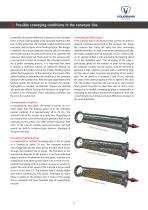
Possible conveying conditions in the conveyor line Essentially, the overall difference in pressure in the conveyor line is a result of the quantity of the conveyed material in the line, its flow properties, the conveyor height (which has to be overcome) and the layout of the feeding station / line design. In addition, the vacuum generator must be able to overcome the overall pressure loss and at the same time, generate the necessary flow speed (air flow based on the conveyor line cross-section) in order to transport the conveyed material. For a stable conveying process, it is important that there...
Open the catalog to page 9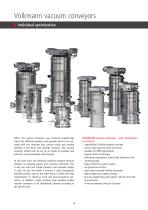
Often, the various processes (e.g. chemical engineering) mean that different powders and granules have to be conveyed with one conveyor (e.g. various colour and coating powders in the paint and coatings industry). The vacuum conveyor should then be set up as simply as possible and allow for easy disassembly and cleaning. At the same time, the selected container material must be resistant to cleaning agents and corrosive chemicals. This is why the tried and tested stainless steel modular design is used. On the one hand, it ensures a quick changeover between product and on the other hand, it fulfills...
Open the catalog to page 10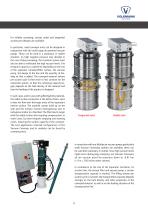
For reliable conveying, various radial and tangential suction port designs are available. In particular, small conveyor units can be designed in conjunction with the multi-stage air-powered vacuum pumps. These can be used in a stationary or mobile situation. As high negative pressure may develop in the case of plug conveying, the container system must also be able to withstand the high vacuum levels. The transport capacity is catered for depending on the size of the separator container/filter surface, the vacuum pump, the design of the line and the quantity of feeding air that is added. The conveyed...
Open the catalog to page 11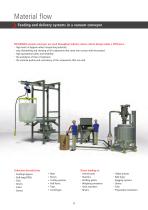
Material flow Feeding and delivery systems in a vacuum conveyor VOLKMANN vacuum conveyors are used throughout industry where critical design makes a difference: ∙∙ high levels of hygiene when transporting materials ∙∙ easy dismantling and cleaning of all components that come into contact with the product ∙∙ high operational safety and reliability ∙∙ the avoidance of risks of explosion ∙∙ the material quality and consistency of the components that are used Collection directly from: ∙∙ Feeding hoppers ∙∙ Bulk bags/FIBCs ∙∙ Silos ∙∙ Drums ∙∙ Sacks ∙∙ Sheets Direct loading of: ∙∙ Stirred tanks ∙∙...
Open the catalog to page 12All VOLKMANN catalogs and technical brochures
 MULTIJECTOR® MRVA and MRVAC
2 Pages
 MULTIJECTOR® G / GL
2 Pages
 MULTIJECTOR® M & ML
2 Pages
 Vacuum Conveyors
24 Pages
 Vacuum Cups
4 Pages
 Vacuum Pumps
16 Pages
Archived catalogs
 Vacuum Conveying
32 Pages