
- Catalogs
- Vigo Photonics
- PVMA-1TE-5-1x1-TO39-pSiAR-70


PVMA-1TE-5-1x1-TO39-pSiAR-70
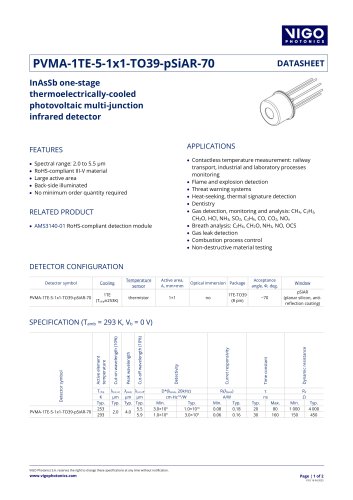
PVMA-1TE-5-1x1-TO39-pSiAR-70
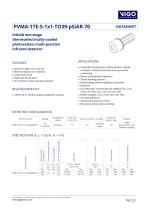
The PVMA-1TE-5-1x1-TO39-pSiAR-70 is an InAsSb one-stage thermoelectrically-cooled photovoltaic multi-junction infrared detector. It features a spectral range of 2.0 to 5.5 µm, is RoHS-compliant, and has a large active area with back-side illumination. No minimum order quantity is required.
Applications
This detector is suitable for various applications including contactless temperature measurement, flame and explosion detection, threat warning systems, heat-seeking and thermal signature detection, dentistry, gas detection and analysis, breath analysis, gas leak detection, combustion process control, and non-destructive material testing.
Detector Configuration
The detector operates with a cooling temperature of approximately 253K using a thermistor. It has an active area of 1x1 mm, no optical immersion, and is housed in a 1TE-TO39 package with an acceptance angle of approximately 70 degrees. The window is made of planar silicon with an anti-reflection coating.
Specifications
At an ambient temperature of 293 K and a bias voltage of 0 V, the detector has the following specifications:
- Cut-on wavelength: 2.0 µm
- Peak wavelength: 4.0 µm
- Cut-off wavelength: 5.5 µm
- Detectivity at peak wavelength: 3.0×109 cm·Hz1/2/W
- Current responsivity at peak wavelength: 0.08 A/W
- Time constant: 20 ns
- Dynamic resistance: 1,000 Ω
Mechanical Layout and Pinout
The detector is provided in a 1TE-TO39(8p)-pW package with a technical drawing available for reference.
Absolute Maximum Ratings
The detector has the following absolute maximum ratings:
- Ambient operating temperature: -20 to 70 °C
- Storage temperature: -20 to 85 °C
- Soldering temperature: ≤370 °C within 5 seconds
- Storage humidity: 10 to 90% without dew condensation
- Maximum incident optical power density: 100 W/cm2 for CW or pulses >1 µs, 1 MW/cm2 for pulses <1 µs
- Maximum bias voltage: -2.0 V
- Maximum TEC voltage: 0.4 V
- Maximum TEC current: 1.67 A
Spectral Response
The spectral response graphs indicate detectivity and current responsivity across wavelengths from 1.5 to 6.5 µm at chip temperatures of 253K and 293K.
Catalog excerpts
InAsSb one-stage thermoelectrically-cooled photovoltaic multi-junction infrared detector • RoHS-compliant III-V material • Large active area • Back-side illuminated • No minimum order quantity required • AMS3140-01 RoHS-compliant detection module • Contactless temperature measurement: railway transport, industrial and laboratory processes monitoring • Flame and explosion detection • Threat warning systems • Heat-seeking, thermal signature detection • Gas detection, monitoring and analysis: CH4, C2H2, CH2O, HCl, NH3, SO2, C2H6, CO, CO2, NOx • Combustion process control • Non-destructive material testing VIGO Photonics S.A. reserves the right to change these specifications at any time without notification.
Open the catalog to page 1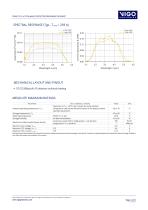
PVMA-1TE-5-1x1-TO39-pSiAR-70 DETECTOR PRELIMINARY DATASHEET SPECTRAL RESPONSE (Typ., Tamb = 293 K) Tchip=293K Tchip=253K MECHANICAL LAYOUT AND PINOUT 1TE-TO39(8p)-pW, PV detector technical drawing ABSOLUTE MAXIMUM RATINGS Parameter Ambient operating temperature, Tamb Storage temperature, Tstg Soldering temperature Storage humidity Maximum incident optical power density Maximum bias voltage, Vb max Maximum TEC voltage, V TEC max Maximum TEC current, ITEC max Test conditions, remarks Operation at Tamb >30°C may increase the active element temperature and reduce the performance of the detector...
Open the catalog to page 2All Vigo Photonics catalogs and technical brochures
 4EM-5
4EM-52 Pages
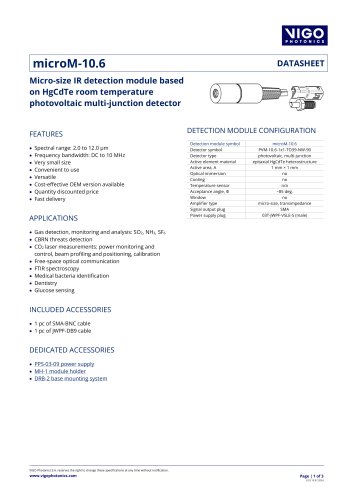 microM-10.6
3 Pages
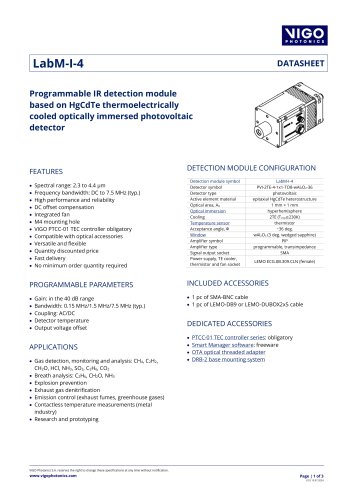 LabM-I-4
3 Pages
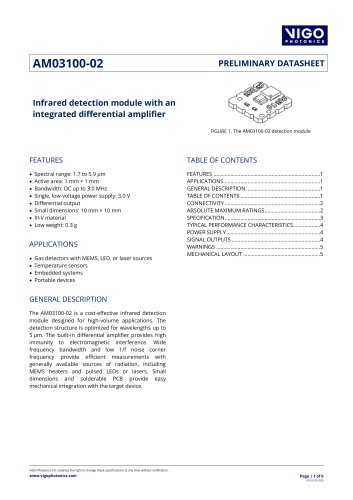 AM03100-02
6 Pages
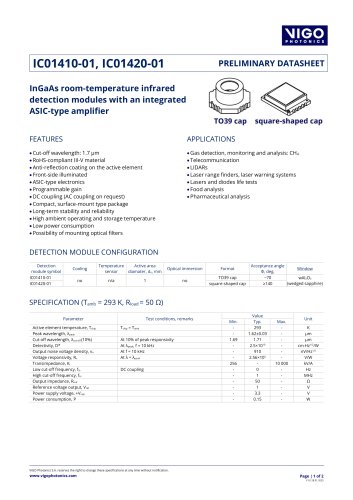 IC01410-01, IC01420-01
2 Pages
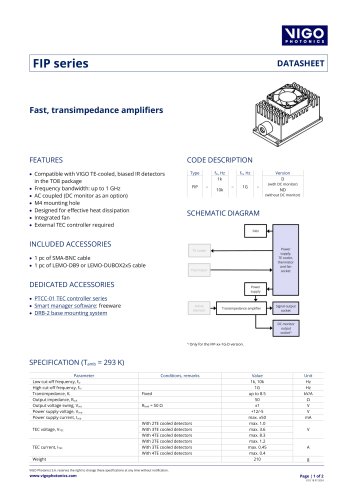 FIP series
2 Pages
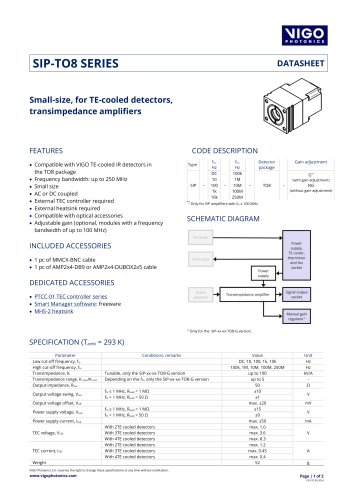 SIP-TO8 SERIES
2 Pages
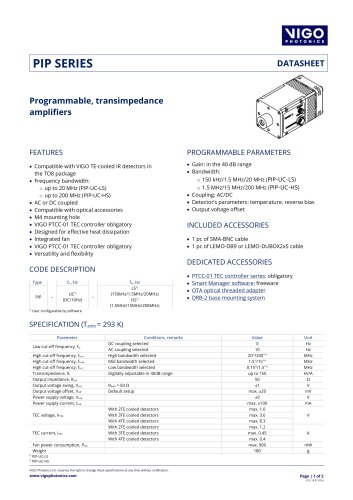 PIP SERIES
2 Pages
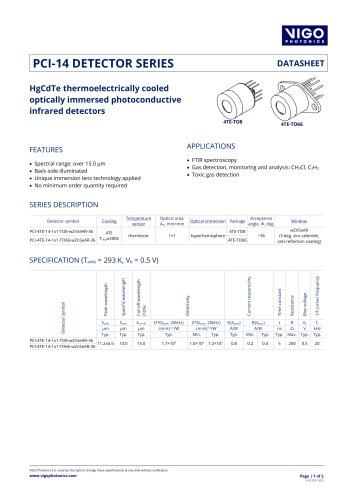 PCI-14 DETECTOR SERIES
2 Pages
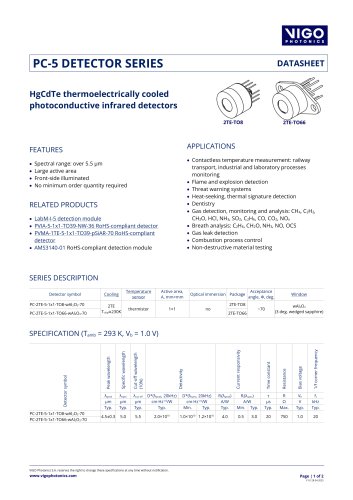 PC-5 DETECTOR SERIES
2 Pages
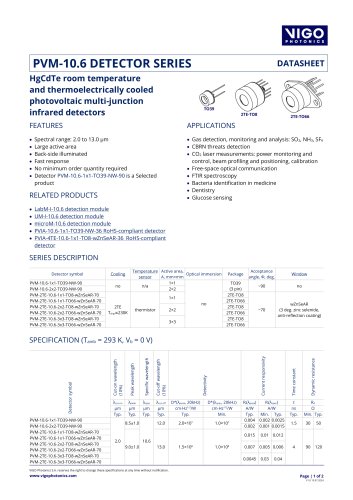 PVM-10.6 DETECTOR SERIES
2 Pages
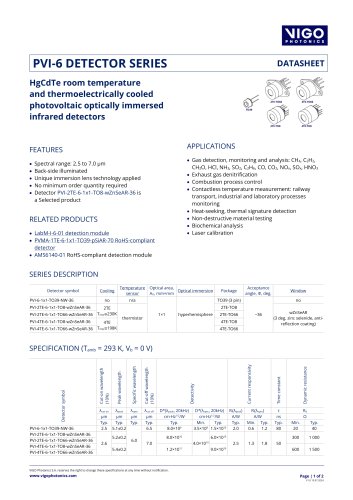 PVI-6 DETECTOR SERIES
2 Pages
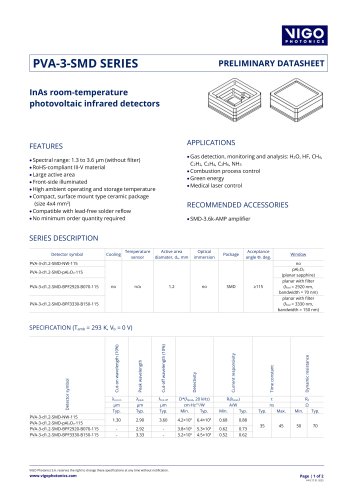 PVA-3-SMD SERIES
2 Pages
 PCI-12 DETECTOR SERIES
2 Pages
 PVA-1.7 SERIES
2 Pages
 PC-LN2-19-1x1-VFP-NW-50
2 Pages
 VIGO Photonics Products 2024
214 Pages
- Power supply unit
- DC power supply
- AC/DC power supply
- Signal amplifying integrated circuit
- Electronic filter
- Low-pass electronic filter
- DC amplifier
- Heatsink
- Single-channel amplifier
- Active electronic filter
- Compact amplifier
- Aluminum heat sink
- Adjustable amplifier
- Programmable amplifier
- Differential amplifier
- USB adapter
- Infrared image sensor
- Infrared detector power supply
- AC amplifier
- Photovoltaic detector